Choose AI Platforms by Clinic Need: Records, Quoting, Marketing, Hiring
Summary: When selecting an AI platform for clinic quoting and records, focus on the specific operational need, such as clinical documentation, patient record access, or marketing visibility. Different AI categories serve distinct purposes, so choose based on the primary bottleneck in your practice. Avoid platforms claiming to solve multiple unrelated issues, as specialized tools typically offer more effective solutions.
Dr. AI says its patient portal already connects with over 140,000 hospitals and clinics across the U.S. That kind of scale makes a small practice wonder if the decision has already passed it by. A patient who types ChatGPT for a clinic near me does not care that your website, records system, reviews, and ads sit in different tools.
A clinic owner looking for an AI platform for clinic quoting and patient records is usually asking a bigger question. Which system will bring in new patients, cut front-desk work, and stop the website from disappearing in Google and AI tools? The answer is not one platform for everything. The best AI platform is the one tied to the bottleneck you can name, like clinical documentation, patient record access, prior authorization, local visibility, recruiting, or weekly marketing output.
The wrong purchase starts when a clinic buys the AI label before it picks the job. A platform that drafts care plans does not belong in the same box as one meant to help your practice show up on ChatGPT. A marketing system should stay away from clinical decisions.
Start with the clinic job before you compare platforms
A clinic should choose the AI category before choosing the vendor. The same word covers very different work. Clinical AI, patient portal AI, payment review AI, marketing AI, and recruiting support do not share the same risk, user, or success measure.
A dentist who sees patients most days needs the first screen to answer one operational question, which part of the practice gets stuck every week. A slow hygiene schedule, a weak Google Maps presence, a buried website, an overloaded office manager, and messy clinical notes are separate problems. If you force them into one AI shortlist, every vendor gets room to sound relevant.
Clinic AI jobs compared
| Clinic job | Platform category that fits | What the platform is judged on | What to avoid |
|---|---|---|---|
| Clinical notes and care-plan drafting | Clinical AI or AI-native EHR | Whether clinicians can find cited answers, draft notes, and keep records inside the care workflow | Buying a marketing tool and asking it to touch patient care |
| Patient record access | Patient portal or records connection platform | Whether patients and clinicians can reach records across systems | Treating portal access as a fix for local search visibility |
| Prior authorization and payment review | Healthcare decision intelligence | Whether clinical records become review-ready for payer or internal workflows | Letting a black-box process create denials nobody can explain |
| Google, ChatGPT, and weekly content | Clinic marketing and AI visibility platform | Whether the clinic is findable, current, and described accurately online | Paying for posts without checking whether AI tools name the clinic |
| Hiring dentists, hygienists, or key staff | Recruiting partner, not an AI content tool | Whether sourcing, screening, and introductions fit the practice | Asking a general admin tool to solve a specialist staffing gap |
A clinic that needs quotes for cash-pay services or treatment options should start inside its practice management and intake workflow. After that, use AI only where it has clear guardrails for drafting patient-friendly language. None of the supplied platforms is described as a dedicated clinic quoting system, so a vendor that claims to handle quoting, records, marketing, and staffing in one purchase deserves a harder demo than a single-purpose tool.
A practical shortlist starts with the job that costs the clinic money this month. A missed new-patient search is a marketing problem. A late note is a clinical workflow problem. A hard-to-fill hygienist role is a recruiting problem. That means the next step is a category choice, not a software tour.
What should handle clinical records and care notes?
Medroid belongs on the shortlist for clinical records when the job is clinician work. Its own description covers search, copilot support, scribing, and an AI-native EHR. Medroid also describes itself as a clinical AI platform for doctors with evidence-based answers, cited sources, care-plan drafting, ambient documentation, and EHR integration. A clinical AI platform should be judged inside the appointment, not in a marketing demo. Ask whether the system can capture the visit, show the source behind a suggested answer, draft documentation in the clinician's workflow, and leave the clinician with final control before anything becomes part of the record.
A records platform needs a different approval path from an ads or blog platform. A dentist, dermatologist, med spa medical director, veterinarian, or physical therapist has to think about clinical risk, record accuracy, staff training, and whether the platform fits the systems already used in the practice. Dr. AI fits a different records-related question because its stated mission is connected patient access, not weekly marketing output. Dr. AI says it connects electronic health records and wearable data through patient portal integrations, so the buyer should ask how patient identity, outside records, device data, and clinic access work before asking whether the platform writes content.
Pelago shows how specialized a healthcare AI platform can become once the use case is narrow. TheNYBeat reported in 2026 that Pelago announced a behavioral health platform at the Behavioral Health Tech conference in Nashville that unifies substance use, mental health, and behavioral addiction care under one contract and one member record through a behavioral health platform launch.
A small clinic should not buy clinical AI because a competitor bought marketing AI, and a med spa should not buy a records system because a dentist needs a scribe. The right clinical demo uses one real visit type, such as a new patient exam, acne consult, crown consult, injury evaluation, or annual wellness visit, and tests whether the note, record, and follow-up work are cleaner after the platform is used.
A practice choosing AI for diagnostic interpretation, prescribing, or payer denials should not use a clinic marketing shortlist as its buying process. Clinical and payment decisions need separate review by the clinician, compliance lead, billing owner, and system administrator before a contract is signed.
Where do prior authorization, payment review, and patient quotes fit?
Hindsait sits firmly in the payment review and prior authorization side of the house. The company says it turns messy patient charts into material ready for decisions, and it describes the system as healthcare decision intelligence for prior authorization, clinical review, and payment integrity. That puts the software beside billing teams and revenue cycle work, not front-desk scheduling or outreach.
No clinic owner should treat prior authorization software like a magic approval button.
Look at whether the program pulls the right charts, builds the review packet, explains why the care fits coverage rules, and records status updates after the paperwork goes out.
The Arizona's Medicare AI rollout is a warning that clinics need answers about supervision before they hand decisions to automated systems. AZFamily reported in 2026 that unsealed documents described serious trouble inside the CMS's WISeR pilot across Arizona and several other states. That project used automated tools with third-party reviewers, and it sold lower overhead and less paperwork along with Medicare pilot program records to protect patient care.
Generating quotes pulls in intake desks, insurance checks, and master fee schedules. When someone asks what they will owe for a dental implant, a dermatology bundle, a med spa membership, or cash-pay physical therapy sessions, the numbers call for active fee sheets, coverage limits, clear disclaimers, and a human eye before anything goes out.
Automating parts of that pricing talk makes sense, as long as the clinic keeps full control over the dollar amounts.
Software can draft everyday summaries from pre-approved rates and clinical plan templates, and that works fine if the billing coordinator checks the text before sending it.
Map the pricing steps on paper before you sign any software contract. The rules need to say who drafts the estimate, which price schedule counts, how staff talk about missing insurance coverage, which clinical notes need a doctor sign-off, and where the signed quote gets archived.
Ask any sales rep selling prior authorization or patient quoting tools to walk through a live case from the first chart entry to the finished bill or payer response. When their presentation skips over that middle handoff, they are selling hopes instead of a working setup.
How should a clinic choose AI for Google, ChatGPT, and local visibility?
If ChatGPT skips over your practice while your spot on Google Maps keeps sliding, paying someone to write new blog outlines won't repair the base. Paragraphs alone miss the point when search engines, language models, and nearby patients still can't tell why your medical team deserves attention.
Search results start with raw data. Humans and crawlers pull signals straight from your site structure, your Google Business Profile profile, patient reviews, detailed service pages, office photos, location references, clinician bios, and routine patient education. Taken together, those pieces tell algorithms whether your practice matches what someone wants in a nearby search.
Public feedback changes how you compare with other facilities down the block. The Springfield Clinic's radiology page, for example, has a 4.7 rating based on 1376 reviews inside its radiology specialty page. Across town, the UTMB Health's pediatric and adult primary care branch shows a 3.8 score gathered from 105 reviews in its League City primary care page. The contrast makes the point plainly, total review volume shapes patient trust just as much as the star count does.
Solo practices can't spend like regional health networks. They can still sharpen the public signals they control. That means writing service descriptions that sound like common local searches, drafting location copy that names actual neighborhoods, collecting patient testimonials that mention specific treatments, and publishing articles that answer routine medical questions.
ClinAds groups clinic visibility work under one roof. It handles website structure, search positioning, articles, social feeds, branding, and advertising in a single workflow. It checks whether tools like ChatGPT, Claude, Gemini, and Perplexity point to your clinic each week, reviews the domain through search crawler logic, and drafts matching material for the technical gaps those models expose.
Owners can test their presence before hiring a marketing firm. Running the ClinAds AI Visibility Checker shows whether popular generative interfaces send users to your office, while the ClinAds AI Crawler Audit reveals what search bots actually read on your pages. Skip vendors who talk only about auto-publishing articles. A useful sales presentation points to live errors on your domain, names the nearby rival winning the referral, identifies the weak listing, and schedules original articles directly onto your server.
Compare monthly software costs with whether the platform fixes your directory presence, since automated filler cannot replace missing local profiles. ClinAds lays out the math in clinic marketing platform fit for administrators comparing standalone software, outside agencies, and managed services.
Multi-location practices and dental groups need the same base with centralized oversight. Growing networks that need office-level AI inclusion, standard doctor credentials, and focused local outreach can turn to marketing for multi-location groups instead of letting separate branches handle marketing with separate tools.
What admin work should stay human or specialized?
Hiring is the easiest place to waste AI effort, because a staffing shortage does not disappear when a tool writes a better job post. A dental practice that needs an associate dentist, hygienist, office manager, specialist, or DSO leader needs sourcing, screening, and introductions, not only faster content.
DDS Recruit dental recruiting is a dentistry-only recruiting firm for U.S. practices and DSOs. DDS Recruit runs the search end to end, sourcing, screening, and introductions, and matches for culture and fit, not just résumés.
A clinic should use AI for recruiting support only after deciding who owns the relationship with candidates. AI can help draft outreach, organize notes, or compare requirements, but the hiring decision still depends on fit, compensation, schedule, clinical expectations, and the owner's tolerance for vacancy risk.
Office administration is broader than hiring, and some platforms solve narrow admin problems at scale. BlueHive says its occupational health platform connects employers with a nationwide network of healthcare providers for drug screenings, physical exams, wellness assessments, and related services through an occupational health provider network, which is a different kind of admin value than clinic marketing or clinical documentation.
A small clinic should keep manual work when the volume is low, the risk is high, or the process changes every week. A spreadsheet owned by a careful office manager can beat a new AI system for one-off vendor quotes, local sponsorships, temporary schedule changes, or a service line that has not proven demand.
Manual work stops being the better choice when the same task repeats and still gets missed. Weekly blog publishing, review response routing, ad creation, missed-call follow-up, provider bio updates, and location-page edits are good candidates for systems because delay makes the clinic less visible before the owner notices.
A clinic owner burned by an agency retainer should ask every admin or marketing platform for proof of work, not a thicker report. The proof should be a fixed workflow, visible output, and a clear owner for what happens next.
A practical selection process for a one-to-three-location clinic
The quickest shortlist starts with one problem stated in clinic language. Write it the way you would say it to your office manager: new patients are not finding us on Google Maps, ChatGPT points people to another med spa, notes arrive late, prior authorizations sit, or the associate dentist slot has stayed open too long.
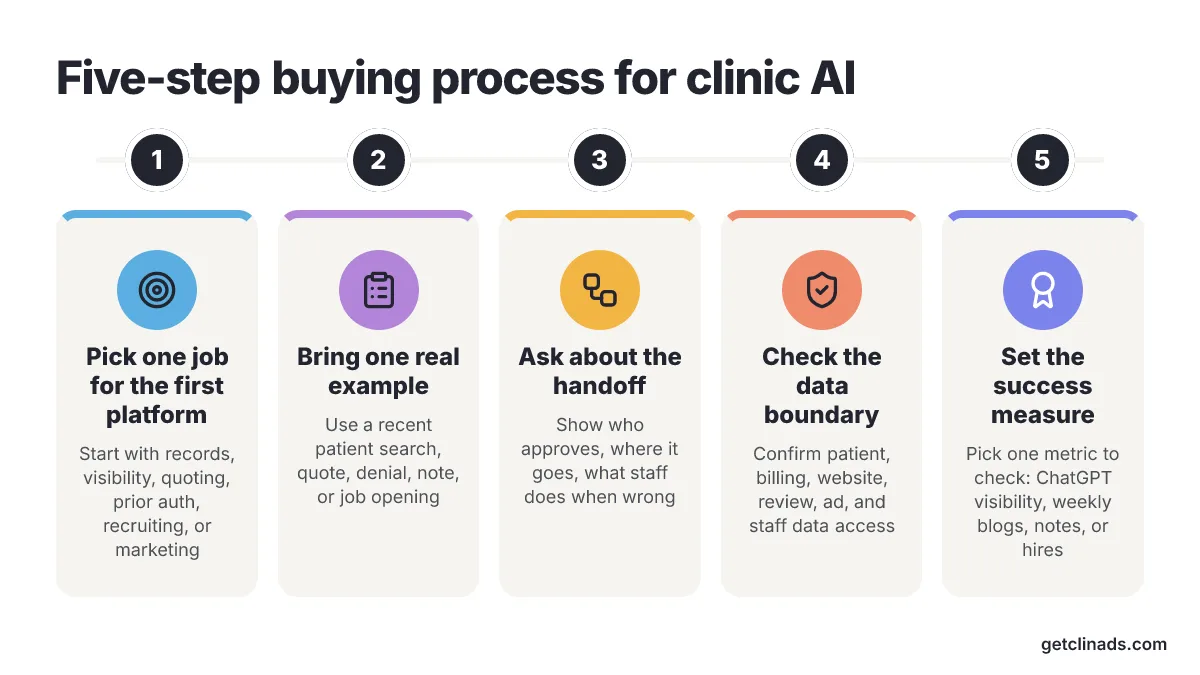
A clean buying process can run in five steps:
- Pick one job for the first platform. Start with records, AI search visibility, patient quoting support, prior authorization, recruiting, or weekly marketing output before you speak with vendors.
- Bring one real example. Use a recent new-patient search, treatment quote, denied authorization, unfinished note, or job opening so every vendor works from the same case.
- Ask about the handoff. Have the vendor show who approves the output, where the final version goes, and what the staff member does when the AI gets it wrong.
- Check the data boundary. Confirm which patient, billing, website, review, ad, and staff data the platform sees, stores, or changes.
- Set the success measure before you sign. Pick one measure the owner will actually check, such as being named by ChatGPT for a service search, publishing weekly blogs, reducing unfinished notes, or moving a candidate to an interview.
A clinic should not judge every AI platform by demo polish. The better test is whether the tool changes the next normal week in the practice, because the owner still has patients on the schedule and cannot spend the week acting as the platform administrator. A practice with website and local-search uncertainty should start by finding the visibility gaps before rewriting the site. The ClinAds article on why a practice is invisible to AI continues that decision for owners who already suspect ChatGPT and Google are picking competitors.
A clinic that depends on online booking should also compare scheduling and local search together. The next layer is whether appointment access and discovery connect, which is covered in the ClinAds comparison of appointment scheduling and local visibility. A platform earns a trial when it exposes the current gap and names the work needed to close it. A platform should wait when the owner cannot name the problem, cannot supply a real example, or cannot assign a staff member to approve the outputs.
Conclusion
Start with one search a patient would actually run this week. Ask ChatGPT, Gemini, Claude, Perplexity, and Google which clinic they would recommend for that service in your area, then record whether your practice appears, how it is described, and which competitor gets named instead.
The first platform worth buying is the one that fixes the gap you can see. Clinical records, payment review, quoting support, hiring, and local visibility each have different buyers and risks, so the next action is to choose one job, test one real case, and make the vendor show the finished handoff. Stop before signing for a bundle that cannot prove what changes in the practice next week.
Frequently Asked Questions
What should I consider when choosing an AI platform for clinic quoting and records?
Focus on the specific operational need, such as clinical documentation, patient record access, or marketing visibility. Choose based on the primary bottleneck in your practice, and avoid platforms claiming to solve multiple unrelated issues, as specialized tools typically offer more effective solutions.
How does Dr. AI help with patient record access?
Dr. AI connects electronic health records and wearable data through patient portal integrations. It focuses on connected patient access, allowing patients and clinicians to reach records across systems, rather than providing weekly marketing output.
What is the role of Medroid in handling clinical records and care notes?
Medroid is a clinical AI platform designed for clinician work. It offers search, copilot support, scribing, and an AI-native EHR. It focuses on capturing visits, showing sources behind suggested answers, drafting documentation within the clinician's workflow, and ensuring clinicians have final control before anything becomes part of the record.
Where do prior authorization and payment review fit in a clinic's AI platform choice?
Hindsait is positioned for payment review and prior authorization, turning messy patient charts into decision-ready material. It is described as healthcare decision intelligence for prior authorization, clinical review, and payment integrity, aligning with billing teams and revenue cycle work.
How can clinics automate patient quotes effectively?
Clinics should map pricing steps on paper before signing any software contract. Software can draft everyday summaries from pre-approved rates and clinical plan templates, but the billing coordinator should check the text before sending it. The clinic must maintain full control over dollar amounts, ensuring accuracy and compliance with fee schedules and coverage limits.
Related reading
- Clinic Marketing Platforms: Pick by Price and Fit
- 8 Healthcare Marketing Platforms That Close the Booking-to-Local-Search Gap in 2026
- Your Practice Is Invisible to AI. Here's the Fix That Actually Works in 2026.
- 5 Platforms That Combine Patient Appointment Scheduling and Local Search Visibility in 2026
- AI Technologies Revolutionizing Dental Imaging by 2026
Sources
- Radiology | Springfield Clinic Medical Specialties (clinic)
- Froedtert West Bend Health Center - Occupational Health - BlueHive (clinic)
- Pediatric and Adult Primary Care, South Shore - UTMB Health (clinic)
- Newly released records detail rocky rollout of Medicare pilot program in Arizona (news, azfamily.com)
- Pelago Unveils New Behavioral Health Platform for Substance Use, Mental Health and Behavioral Addiction Care – TheNYBeat (news, thenybeat.com)
- Medroid AI (healthcare startup)
Where to go next
Want help executing this for your clinic?
Book a 30-minute call and we will map what a real ad engine would look like for your specific service mix.
Book a call