
8 Best Growth Agencies for Direct-to-Consumer Telehealth in 2026
IntroductionYour telehealth brand is one FDA warning letter or a single HIPAA breach away from platform bans and multi-state licensing nightmares. Most performance agencies treat DTC telehealth like standard ecommerce, ignoring the regulatory gravity that kills campaigns and companies alike.
34% of consumers researched information from a healthcare ad, making these channels too visible to treat casually. The FDA's 2025 to 2026 enforcement posture now requires pre-launch claim mapping and LegitScript submission planning, while state attorneys general actively monitor multi-state practice. Picking a generalist costs you more than wasted ad spend. It is an operational liability, and the consequences arrive faster than most founders expect.
The agencies below solve this specific intersection of compliance and acquisition. They build campaigns around HIPAA data governance, state-by-state licensing rules, and platform-level healthcare policies so your growth engine does not outrun your legal footing. A telehealth buyer often researches the provider, the treatment, and the delivery model before booking a single visit. That means your paid search ads, landing pages, and retargeting sequences all need to hold up under regulatory scrutiny while still converting at the margins DTC brands need to scale.
Key Takeaways
The DTC telehealth growth market splits between compliance-first infrastructure builders, paid search specialists, and retention-focused operators. Here is what separates the agencies that deliver real patient volume from the ones that risk your licenses:
- Full-funnel compliance infrastructure: Clinads maps FDA-regulated claims into creative briefs and manages multi-state campaign architecture so compliance accelerates launches instead of blocking them.
- Paid search still dominates 2026 patient acquisition: Accelerated Digital Media drove 70% monthly patient request growth for Nurx through keyword expansion and custom landing pages that pass ad platform compliance checks.
- Creator-led content slashes acquisition costs: inBeat Agency's performance creative model delivers an average 20% CAC reduction using compliant, condition-specific micro-influencer content.
- Retention channels multiply revenue: Sweat Pants Agency generated a 9x email/SMS revenue increase over 30 days for a GLP-1 telehealth brand by building flows that respect FDA generic-language requirements.
- State-specific SEO architecture is a baseline requirement: Direction.com and Clinads have proven that geo-segmented landing pages aligned with licensing permissions prevent the user-experience and legal damage of marketing in unlicensed states.
1. Clinads, Full-Funnel Compliance Infrastructure for Multi-State Telehealth

For telehealth brands operating across multiple state licenses, Clinads solves the central tension of the sector: how to run aggressive patient acquisition without violating FDA advertising rules or state-by-state practice limits. The agency's proprietary system converts regulated claims into production-ready creative briefs, manages LegitScript submissions, and structures campaigns around each state's licensing footprint.
Most telehealth brands discover compliance gaps only after a platform flags an ad or a competitor files a complaint. Clinads inverts that timeline. Pre-launch claim mapping flags every statement against current FDA enforcement postures before a dollar hits paid media.
State-specific campaign architecture, assigning creatives, landing pages, and conversion tracking to licensed markets only, prevents the accidental targeting of unlicensed states that erodes trust and invites legal exposure. The trade-off: this infrastructure takes longer to build than a standard performance setup. For brands entering their fourth state or beyond, that upfront time is a cost of doing business safely.
The output is a growth engine where compliance is not a bottleneck but a moat. As one Clinads playbook notes, building visibility across 12 licensed states requires a systematic architecture, not a hacked-together Google Ads account. For DTC telehealth brands where regulatory risk maps directly to revenue risk, that framing makes Clinads the right first call.
2. Cardinal Digital Marketing, HIPAA Data Governance for Enterprise Behavioral Health
The proof sits in their work with Ginger, where Cardinal delivered a 26% lead volume lift through exactly this infrastructure. That lift came from tracking session-level engagement signals inside a compliant container and feeding those signals back into campaign optimization. For enterprise DTC telehealth brands handling sensitive PHI at scale, a generalist shop that bolts on a Business Associate Agreement after the fact creates more risk than value. Cardinal's model bakes the BAA and data governance into the engine itself.
This operational rigor also future-proofs against platform-level policy churn. Meta recently introduced new policies preventing healthcare brands from optimizing campaigns around lower-funnel conversion actions out of fears they could generate PHI, and the Federal Trade Commission has begun punishing companies that unknowingly shared patient data to platforms like Google Ads and Meta. For a behavioral health platform scaling toward an IPO or enterprise contract, that liability difference alone justifies the engagement.
3. Accelerated Digital Media, Paid Search Specialization in Regulated Health Categories
Paid search remains the highest-intent patient acquisition channel in 2026, but running Google Ads for regulated health categories is a different discipline from standard ecommerce search. Accelerated Digital Media holds the deepest publicly named telehealth roster in the agency shortlist, Keeps, Talkspace, Nurx, LifeMD, Grow Therapy, and NOCD. That list covers platform-level healthcare advertising rules across nearly every major DTC telehealth vertical. Here is how they turn that specialization into performance:
- Expand keyword coverage to bottom-of-funnel symptom and treatment queries that generalist agencies miss, generating 70% monthly patient request growth for Nurx.
- Build custom landing pages pre-vetted against Google's healthcare policy requirements, preventing the ad disapprovals and account suspensions that kill momentum.
- Structure campaigns around state-level licensing permissions, segmenting ad delivery to only those states where the brand holds an active license.
- Maintain a compliant rapid-response playbook for when FDA enforcement shifts or platform policies change mid-campaign, drawing on cross-client experience instead of learning on your budget.
The platform rules cover everything from the claims that healthcare brands can make to the subject matter they can display to the specific advertising tools they can use. A generalist performance agency that learned paid search on DTC apparel has no playbook for a Google policy flag at 3 PM on a Friday. Accelerated Digital Media has seen that flag across nine different telehealth brands and already knows which landing page copy change will get the campaign reinstated by Monday.
4. inBeat Agency, Creator-Led Content and Performance Creative for DTC Telehealth

Ad fatigue hits telehealth brands harder than most DTC categories. Condition-specific audiences see the same stock-photo doctor imagery and generic treatment claims across paid social, and they scroll past. inBeat Agency's answer is a performance creative engine built on creator-led content. They work with micro-influencers who produce authentic, compliant content for specific condition communities.
Most telehealth teams pump their paid social budgets through branded ads that users have learned to ignore. inBeat Agency reports an average 20% CAC reduction for telehealth clients using creator-led content, a margin improvement that compounds across paid social budgets. Creator content looks native in-feed, avoids the banner-blindness that suppresses branded creative performance, and carries the trust transfer of a real person discussing their experience. For DTC telehealth, the purchase is a medical consultation. The trust layer is outsized.
Compliance does not take a back seat to creative performance in this model. inBeat's team manages the legal review workflow so creator scripts pass FDA and platform policy checks before filming, avoiding the expensive reshoot cycle that burns creative budgets. The result is a content library that is both legally defensible and algorithmically favored, since platforms reward the engagement metrics that authentic content captures more consistently than polished brand creative. For an early-stage DTC telehealth brand trying to break through on Meta or TikTok without wasting half their budget on ads that get rejected or ignored, this model is the most direct path to a sub-$100 CAC.
5. Sweat Pants Agency, Email/SMS Retention and GLP-1 Sub-Specialization

GLP-1 telehealth is the highest-churn vertical in DTC health. Patients cycle through brands chasing the lowest monthly price, and platform-level advertising restrictions on semaglutide and tirzepatide make pure acquisition economics unsustainable. Sweat Pants Agency has carved out the retention side of this equation, building email and SMS flows that turn a single approved patient into a multi-month revenue stream, generating a 9x revenue increase over 30 days for TrimRx through these channels alone.
The acquisition math is punishing. Paid social platforms restrict weight-loss claims and drug-specific language, and Google's healthcare policy layers an additional approval gauntlet on top of the standard auction. Most brands lose money on the first fill and need month two, three, and four to reach profitability. Without retention infrastructure, you are paying premium CAC for churning patients.
Sweat Pants Agency's retention architecture addresses a specific FDA requirement: every marketing message must stick to generic drug names (semaglutide, tirzepatide), and the full prescribing and safety information rules apply to promotional sends. Their sequences are built inside those guardrails from the start, so your retention flows stay clear of regulatory scrutiny. The brief accounts for the restrictions.
For subscription telehealth models more broadly only a few retention mechanics carry disproportionate weight. The output is a predictable LTV engine that makes aggressive acquisition spend financially rational.
6. Healthcare Success, Full-Service Patient Journey Optimization and CRM Automation

Most telehealth brands leak patients between the ad click and the booked consultation. The landing page loads, the user hesitates, and no system catches them. Healthcare Success closes that gap.
Their full-service model spans strategy, creative, and CRM automation, mapping the entire patient journey from first ad impression through treatment completion and inserting retention triggers at every conversion drop-off point. The methodology produced a 56% cost-per-lead reduction for SynergenX. The CRM handles the heavy lifting: when it automatically follows up on abandoned scheduling forms with a compliant SMS sequence, paid media CPL drops because you are converting the same traffic instead of buying more.
For DTC telehealth brands scaling past the $5M revenue mark, this full-funnel integration separates profitable growth from the treadmill of rising CAC. Healthcare Success deploys CRM automation designed for healthcare workflows: appointment confirmation cadences, lab result follow-ups, and treatment adherence sequences that capture revenue a standalone performance agency leaves on the table. Most telehealth marketing teams treat acquisition and retention as separate line items with separate agencies, creating attribution gaps and inconsistent patient experiences. Healthcare Success eliminates that handoff.
7. Direction.com, Localized SEO and State-by-State Licensing Compliance
A telehealth brand licensed in 12 states cannot run a single national SEO page and expect the right outcome. Patients searching "online TRT clinic" in Texas need to land on a page that explicitly confirms Texas licensure, Texas prescribing rules, and Texas availability, or they bounce back to search results and pick a competitor whose page answered those questions. Direction.com builds the geo-specific SEO architecture that solves this.
- State-specific landing pages aligned with licensing permissions: Each page confirms the exact service available in that state, preventing the user-experience dead end of advertising services in a state where you cannot prescribe.
- Localized schema markup for multi-state practice visibility: Structured data tags signal to search engines exactly which geographic areas your practice serves, supporting map pack and local pack rankings.
- Keyword architecture that maps symptom and treatment queries to licensed states: Prevents the SEO disconnect where a page ranks for a query in a state whose licensing rules it does not address.
- Duplicate-content safeguards across state pages: Direction.com structures geo-pages so search engines index them as distinct, relevant results rather than penalizing the domain for thin or duplicate content.
8. SagaPixel, Performance SEO and Paid Media with BAA-Aligned Operations
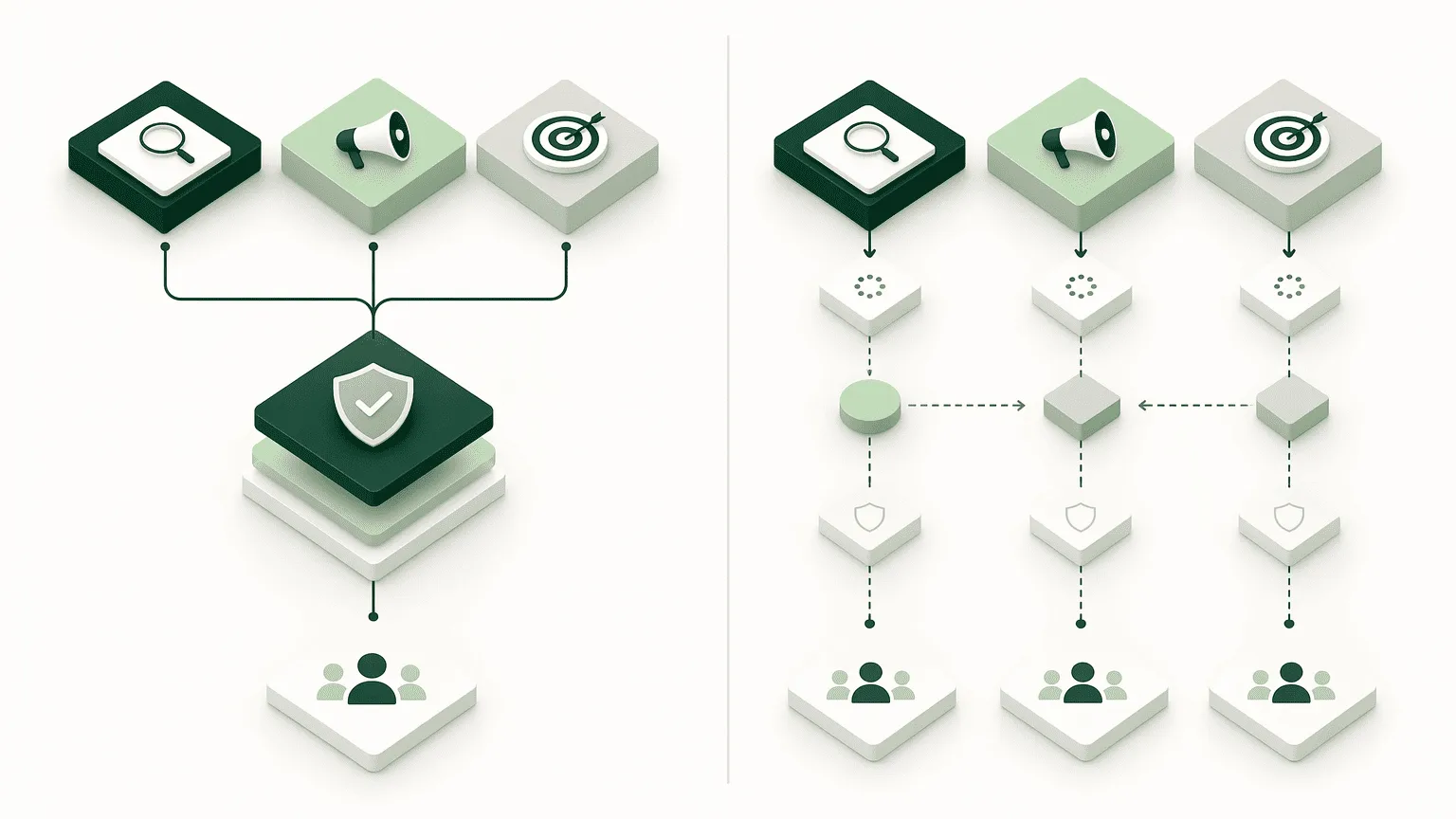
SagaPixel pairs high-volume organic search growth with the legal infrastructure that covered entities require. Most agencies in this space deliver one or the other. Before digging into their pricing and performance, here is how their dual model stacks up against splitting SEO and paid media across separate vendors.
| Decision Dimension | SagaPixel (Integrated) | Separate SEO + Paid Media Vendors |
|---|---|---|
| Organic Traffic Delivery | 34,000 monthly visitors via SEO | Dependent on SEO vendor quality |
| Paid Media Management Fee | 10% to 22% of ad spend | Varies; typically 10% to 20% per vendor |
| Business Associate Agreement | Signs BAA for covered entities | BAA must be negotiated separately with each vendor |
| Channel Attribution | Single dashboard across SEO and paid media | Requires manual stitching of data sets |
| Compliance Accountability | One point of contact for HIPAA and platform policy | Split accountability creates gaps |
The 34,000 monthly organic visitors provide a compounding acquisition base that reduces reliance on paid media over time. For DTC telehealth brands operating as covered entities under HIPAA, which includes any brand that transmits patient data to a provider or pharmacy, the signed BAA makes the vendor a legally compliant business partner instead of a standard marketing contractor. The 10% to 22% ad spend pricing band keeps management fees predictable as media budgets scale.
Conclusion
The right agency depends on your specific regulatory exposure and growth stage. Early-stage DTC brands burning budget on generic paid social should start with the 20% CAC reduction that inBeat Agency's creator-led model delivers. Multi-state telehealth platforms approaching their fifth license need the full-funnel compliance infrastructure that Clinads provides before a state board inquiry forces the issue.
GLP-1 brands whose unit economics hinge on month-three retention cannot afford to skip Sweat Pants Agency's 9x email revenue infrastructure.
Match the partner to your liability profile. The slickest pitch deck is the wrong sorting criterion here; months of regulatory cleanup on the back end costs more than a slower, more careful agency search up front.
Frequently Asked Questions
What makes a growth agency qualified to handle the regulatory complexity of DTC telehealth in the US?
A qualified agency executes three non-negotiables before campaign launch:
- Signs a Business Associate Agreement (BAA) for HIPAA-covered entities
- Maps all creative claims against current FDA enforcement postures and platform healthcare policies
- Structures ad delivery around the brand's specific state-by-state licensing permissions
Which performance marketing channels deliver the highest ROI for telehealth patient acquisition in 2026?
Paid search consistently delivers the strongest patient acquisition ROI because it captures high-intent treatment and symptom queries, Accelerated Digital Media drove 70% monthly request growth for Nurx through keyword expansion alone. Key channel-specific results include:
- Paid search: Captures high-intent queries
- Paid social with creator-led creative: Averages a 20% CAC reduction over branded content
- Email and SMS retention: Generates outsized returns for subscription models, with Sweat Pants Agency reporting a 9x revenue increase over 30 days for a GLP-1 brand
How do top DTC telehealth growth agencies structure their pricing and engagement models?
Pricing structures vary by service type:
- Paid media management: Typically runs 10% to 22% of ad spend (SagaPixel operates in this range)
- Full-service retainers covering strategy, creative, and CRM automation: Use custom quotes based on scope
- Project-based creative production: Also available
The dividing line is proactive compliance infrastructure, not a BAA bolted on after contract signing. Legitimate partners demonstrate this through two specific practices:
- Audit tracking setups for PHI exposure before campaign launch (Accelerated Digital Media)
- Structure ad delivery around state licensing boundaries
What telehealth-specific growth tactics are working right now that differ from standard DTC ecommerce?
State-specific SEO landing pages aligned to licensing permissions replace the single national landing page approach. Creator-led content with legally reviewed scripts replaces stock-photo brand creative to bypass ad fatigue on paid social. Retention flows that respect FDA generic-drug language requirements replace standard ecommerce winback sequences. And campaign architecture segmented by licensed state replaces broad geo-targeting, a structural difference, not a tactical tweak.
How does the FDA's 2025 to 2026 prescription drug advertising enforcement climate affect agency selection?
The current enforcement posture makes pre-launch claim mapping mandatory, not optional. The FDA is actively scrutinizing telehealth advertising claims, and the FTC has begun punishing companies that shared patient data with ad platforms unknowingly. An agency that cannot show a documented process for vetting creative against FDA requirements and platform healthcare policies before campaigns launch is not a viable partner for any DTC telehealth brand handling regulated drug claims or PHI.
Sources
- 7 Best Telehealth Marketing Agencies (2026) | Top Agency Lists - topagencylists.com
- To Lower Risks and Maximize Growth, Health Brands Should Seek a Specialized Healthcare Marketing Agency - Accelerated Digital Media - www.accelerateddigitalmedia.com
Want help executing this for your clinic?
Book a 30-minute call and we will map what a real ad engine would look like for your specific service mix.
Book a call