
Ranking Your Telemedicine Practice in 12 States: The 7-Step Frame That Actually Works
IntroductionYour practice spent months getting licensed in 12 states. Then someone opens Google and sees a competitor you've never heard of in the map pack for "online therapy in Austin." Your clinical skill is not the problem. You're trying to win a game built for physical storefronts.
Google's local algorithm is a proximity engine that rewards businesses physically near the searcher at the exact moment of the query. If you have no physical office in a state, Google's local algorithms prioritize businesses that are physically near the searcher. You will never reliably crack the Local Pack for those 11 other markets by creating fake addresses or hoping Google makes an exception.
This is an instruction to shift your entire indexing strategy away from a map pin and toward an organic authority that Google cannot ignore. The framework below forces you out of the Local Pack addiction and into a ranking model that is licensable, replicable, and genuinely scalable across all 12 states.
Key Takeaways
Multi-state telehealth SEO is a pure organic play for any state where you lack a staffed physical office. The framework corrects three critical errors most practices make: chasing unsupported Google Business Profiles, duplicating thin location pages, and ignoring the trust signals state medical boards hand you for free.
- Proximity is not negotiable: You cannot rank in the Local Pack without a physical address; the organic blue links are your only scalable vehicle across 11 of your 12 states.
- Licenses are your YMYL armor: Displaying active state license numbers on location pages transforms a regulatory requirement into a direct ranking signal for health content.
- Geo-tiering prevents cannibalization: A strict hierarchy of state, city, and interstate compact pages ensures Google understands your service footprint without flagging you for duplicate content.
- "Areas served" footers are a trap: Google treats boilerplate zip-code blocks as doorway-page signals; hyperlocal relevance demands embedded local payer data and state-specific crisis resources.
- Platform profiles play a supporting role: Psychology Today and Zocdoc profiles link equity to your organic pages; they are not a substitute for a properly structured site.
Step 1: Lay the Organic-Only Foundation, Why You Can't Rely on Google Business Profiles for State Rankings

The local algorithm cares about location before anything else. Accepting this constraint stops you from burning $5,000 a month on a Local Pack fantasy. Here is the exact logic to internalize before touching a landing page:
- Accept that one state anchors your map presence. If you have a physical office in one state and serve other states via telehealth, you can only have a Google Business Profile for your physical location. If you happen to have offices in several states, create a separate profile for each address and link it to the corresponding state page. If you are fully virtual in a state, the map pack is functionally closed.
- Do not corrupt your only profile with a fake address. Accurate representation of your practice area is both an SEO best practice and an ethical obligation. Google suspends profiles that misrepresent a virtual office as a staffed clinic. One verified, suspended profile poisons your brand's credibility across the entire domain.
- Treat a service-area business (SAB) profile as a single-state tool. You can set a service-area boundary from your physical headquarters. That radius signals relevance for your home state but carves out zero ranking advantage two thousand miles away. For a fully remote group with no physical office, the SAB option is even narrower.
- Redirect the budget toward organic assets. For many fully virtual dietitians, organic website SEO strategy matters even more than trying to force a local map presence where it does not fit. Every dollar pulled from chasing phantom addresses goes into a geo-tiered page architecture that Google can actually crawl and rank.
Step 2: Build Trust Signals That Satisfy YMYL Standards, Licenses, Schema, and Authority
Google treats health content as YMYL (Your Money or Your Life), which means its quality systems demand demonstrable expertise and trustworthiness. For a licensed practice, the fastest way to prove that is to put your state authorization directly into the page schema and above the fold on every location page.
Embedding your active license number and issuing board creates an immediate arm's-length verification loop. The mission of the Medical Board of California is to protect healthcare consumers through proper licensing and regulation; when you purposely reference that regulatory body on your California page and mark it up with MedicalOrganization schema, you are piggybacking on the board's authority. The Maryland Board of Physicians similarly hosts telehealth FAQs you can reference to signal local regulatory fluency.
This approach also forces an operational discipline that protects rankings. If your licensing footprint changes, say California moves on an administrative shift that impacts usage of a prescription tracking database, your page must update immediately. For instance, effective January 1, 2026, Assembly Bill 82 prohibits healthcare providers from reporting prescriptions for testosterone or mifepristone to California's CURES system, with existing records required to be removed on or before January 1, 2027. A state page that is outdated on this front looks negligent to both a rate and a search engine.
Deploy Physician or Practitioner schema, linking the worksAt property to your MedicalOrganization entity for each licensed state. This creates a connected graph that tells Google your provider is legally authorized in that specific jurisdiction, satisfying the E-E-A-T signals that Google's systems aim to reward.
Step 3: Create Geo-Tiered Landing Pages, State, City, and Compact Hubs

A good multi-state SEO strategy usually starts with one high-quality page per state you actively serve. From that foundation, you branch into a strict three-tier architecture.
- Tier 1: The statewide service page, carrying your license display, primary payer list, and schema.
- Tier 2: City-level pages for the 2 to 5 largest metro areas in each state, each opened with a unique clinical focus that matches that city's mental health profile and internally cross-linked upward to the parent state page.
- Tier 3: A single authoritative hub explaining interstate compacts like PSYPACT, which allows practitioners to provide telehealth services across participating states, linking outward to each eligible state page.
The trade-off: every additional city page you publish must earn its existence with unique, useful content. Slight variations of the same 400-word copy across 12 cities will trip Google's scaled-content abuse filter and tank your entire geo-tier.
Step 4: Inject Hyperlocal Relevance Without Falling Into Doorway-Page Traps
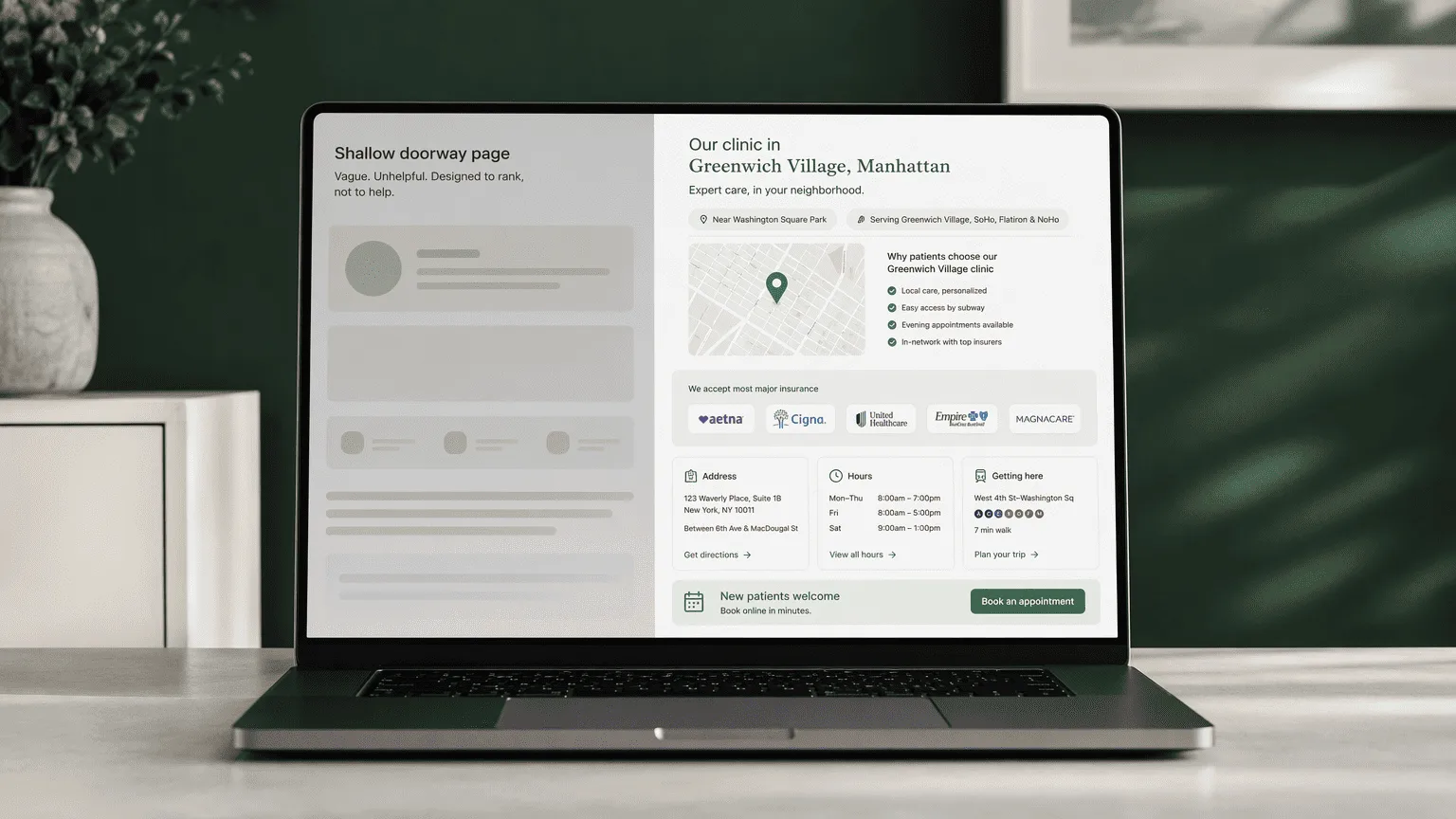
Google's spam policies call out scaled content abuse, meaning lots of pages made primarily for search rankings without real value for users. The test for your city pages is whether a real human in that city would bookmark the resource if they never booked an appointment. If the answer is no, you have built a doorway page.
Substance beats boilerplate every time. List the exact in-network insurance payers accepted in that state, name the specific Medicaid managed-care plans that operate in that city, and link to the nearest crisis stabilization unit with its real phone number. A prose paragraph that embeds a local health department's mental health statistic signals relevance to a search engine far more than any generic "areas we serve" footer.
Practical depth over punting the reader. A Colorado Springs page that says "We offer therapy in Colorado Springs" is invisible. That same page structured to reference the El Paso County public health profile, cite the region's relevant altitude or military population considerations, and explain how your PSYPACT authorization applies is a reference tool. Multi-state telehealth SEO requires a broader approach that targets multiple geographic markets simultaneously, but the mechanism for each market is identical: build the most locally useful health resource you can.
Step 5: Construct a Compliant, Multi-State Backlink and Content Strategy

Healthcare marketing regulations prohibit the kind of reciprocal link swaps or paid placements that a SaaS company would use without a second thought. Your backlink strategy must therefore flow through editorial gatekeepers who trust licensed medical providers. State medical societies and professional associations maintain referral directories. Get listed in the specific state-level chapters, pointing the link to the corresponding state page.
Local health systems often maintain referral pages for outpatient therapy. A profile on a regional hospital's provider finder is a citation from a high-authority local domain that no competing telehealth firm can duplicate overnight.
Guest content on regional health blogs is the third pillar. This is not generic blogging. Write a piece on seasonal affective disorder specific to a northern climate and pitch it to a Midwest health publication, with your author bio linking back to your Minnesota state page.
Then build your own supporting content clusters. Each state page needs 3 to 5 blog posts linked up to it from within your own domain. The posts should address state-specific teletherapy questions: "Does Blue Cross Blue Shield of Texas cover online psychiatry?"
or "How to find a PSYPACT therapist in Ohio." These answer targeted long-tail queries and earn editorial links from local journalists and health reporters who discover them while researching.
The link graph you are constructing is a slow, deliberate web of social proof. An AI-first growth platform like ClinAds automates the heavy lifting of generating and testing this kind of geo-specific creative at scale, so you are not manually writing 72 blog posts for 12 markets.
Step 6: Configure Platform Profiles to Support (Not Drive) Your Organic Map
Your Psychology Today profile is a secondary indexing signal, not a hollow piece of branded real estate. Its job is to reinforce the location pages you already built.
Duplicate your Psychology Today profile for each state where you are licensed, but change the profile copy completely. Do not copy and paste the same practitioner bio across 12 profiles. The headshot and credentials stay the same; the opening paragraph, the named conditions of focus, and the insurance-panel listing must match the market. The profile's website link must point directly to the corresponding state landing page, not your homepage.
Zocdoc and similar booking platforms should list each state's availability independently, with schedule slots that reflect the state's time zone and in-network payer truth. If your provider is out of network for Cigna in Illinois but in network for Cigna in Florida, the Zocdoc profile must not pool the better number across both pages.
NAP consistency is a smaller concern for a virtual practice because you do not publish a street address for 11 of the 12 states. The consistency factor shifts from physical location data to provider-name and practice-name alignment. Every directory listing must use the same legal practice name and practitioner name as your state license pages. Search engines use that alignment to build a clean entity graph they can disambiguate confidently.
Step 7: Set Up Multi-State KPIs, Tools, and Budget Allocation for ROI Tracking
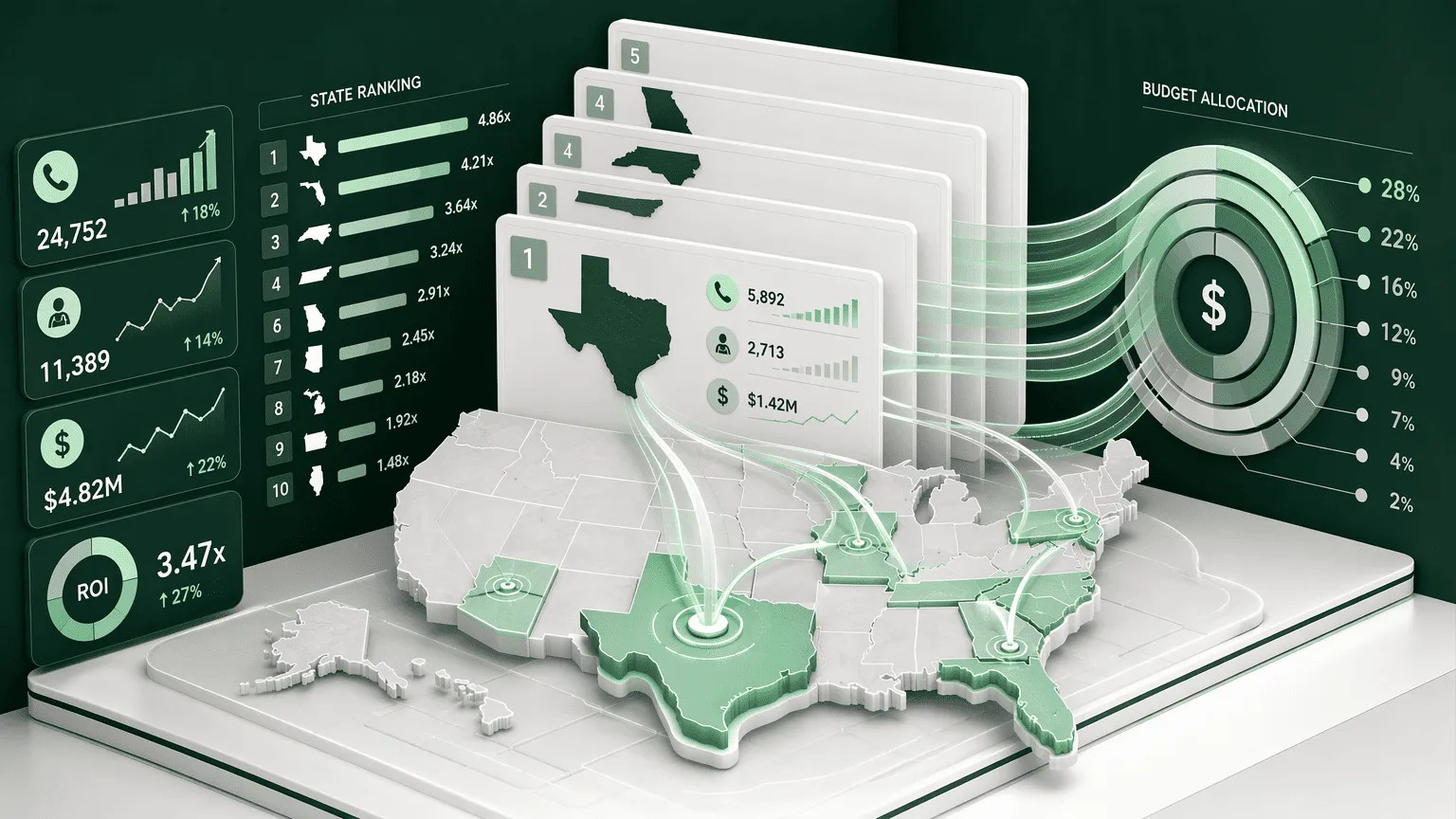
Running 12 distinct organic campaigns without state-level segmentation burns your budget. You cannot optimize what you cannot isolate. The reporting stack below forces you to allocate dollars where the scheduling actions actually happen.
| KPI Dimension | What to Track | Tool and Method |
|---|---|---|
| Visibility per state | Organic keyword rankings for "[specialty] therapy in [state]" and city-level variants | Ahrefs or Semrush position tracking filtered by state geography; track a fixed set of 20 to 30 geo-modified keywords per market |
| Traffic quality | Sessions to each state landing page, engagement rate, and scroll depth by source | Google Search Console performance report segmented by page; use a regex filter to isolate /texas/ or /ohio/ page directories |
| Conversion and booking | Schedule-a-call form completions and unique calls driven by each state page | Dynamic number insertion pools for each state path; attribute completed Typeform or Calendly events back to the landing page entry point via UTM parameters |
| Authority growth | New referring domains to each state page cluster and the number of editorial placements earned per quarter | Ahrefs backlink report filtered by state-page URL prefix; note which guest posts or society listings drove new domains |
Budget allocation follows the conversion data. After a full quarter of tracked performance, pause content investment for any state costing above 160% of the mean patient acquisition cost of the top three performing states. Pour the freed budget into building additional city-level pages and a supporting blog cluster in those top markets. The discipline is brutal because the budget is finite: "Below $2,500/mo, you're invisible" in any single state, so putting $250 a month across 10 states guarantees you rank in none of them.
Conclusion
Ranking a telemedicine practice across a dozen states is a pure organic-information architecture problem. Stop chasing the Local Pack you will never win and shift your budget into three assets: license-backed trust signals, geo-tiered utility content, and editorial links from state-level health authorities.
Audit your existing state pages today against the seven-step frame above. The same 350-word boilerplate swapped across four cities is the leak suppressing your domain authority. Kill that bloat. Inject local health data that a state medical board or department of health has published, and start tracking state-specific conversion rates immediately.
One link from a state telehealth policy page buys more durable ranking power than fifty thin city pages ever will. State conversion rates, broken out by service line, tell you where the real demand lives so you can feed the pages people actually need instead of another hollow directory of zip codes.
Frequently Asked Questions
What are the key local SEO factors that influence telemedicine rankings on a per-state basis?
Organic on-page signals dominate: unique state license display, medical schema, geo-specific insurance payer lists, and locally useful crisis resource links. Since a virtual practice cannot rank in the Local Pack without a physical address, organic click-through and dwell time on your state page become the primary ranking levers.
How do state medical board regulations and licensing visibility affect our local search presence?
Displaying your active license number on each state page directly satisfies Google's YMYL quality standards for health content. It transforms a regulatory obligation into a trust signal. An outdated page referencing a changed regulation, like CURES reporting rules, signals negligence to both a visitor and a search-quality rater.
What is the step-by-step process for setting up and optimizing Google Business Profiles for a multi-state telehealth practice?
Only create a profile for a physical, staffed office address. List telehealth as a service and link to the corresponding state page. For a fully virtual practice, do not create a profile in a state without an office; attempting one with a virtual address will get suspended and eventually penalize your entire domain.
How do we build localized content and backlinks that comply with healthcare advertising rules across 12 different states?
Build genuinely useful state and city pages that embed local crisis resources and specific in-network payer details. Earn editorial backlinks through state medical society directory listings, regional health system referral pages, and guest posts on local health blogs. Avoid paid link placements or reciprocal swaps.
Which KPIs and tools should we track to measure our state-specific local search performance for telehealth?
Track organic keyword rankings per state in Ahrefs or Semrush, state-level landing-page traffic in Google Search Console using page-path regex filters, and conversion events attributed via UTM parameters. The core metric is completed scheduling actions tied to each state page's entry point.
Can a PSYPACT compact page help me rank for multiple states at once?
Yes, as a Tier 3 authority hub. A single PSYPACT page explaining cross-state eligibility should link outward to each participating state's dedicated landing page. This structure prevents you from duplicating compact-explanation content across 12 separate pages while reinforcing the internal link graph.
Sources
- SEO for Telehealth Practices: Ranking Across Multiple States - Mental Health Marketing - mentalhealthmarketing.com
- How Dietitians Can Rank in Multiple States — CV Brands - www.cvbrands.com
- Quarterly Board Meeting Agenda Item #9K - 2/26/2026 - mbc.ca.gov
- Telehealth FAQs | Maryland Board of Physicians - mbp.state.md.us
Want help executing this for your clinic?
Book a 30-minute call and we will map what a real ad engine would look like for your specific service mix.
Book a call