
Your Telemedicine Patients Are Vanishing Into AI Overviews. The Fix Is Not More Blog Posts.
IntroductionA patient types "weird rash on my elbow, is it shingles?" into Google. Six months ago, she would have seen your carefully optimized telemedicine landing page as the second blue link.
Today, she reads a four-paragraph AI-generated answer pulled from WebMD, Mayo Clinic, and a competitor who figured out generative engine optimization six months before you did. She never scrolls.
She never clicks. She never books.
That scene replays millions of times a day across every condition you treat. The organic patient pipeline that funded your practice is getting cut off at the source, and it's not coming back through the old channel. AI-generated answers have replaced the blue link as the patient's first interaction with search results.
If your content is not structured to be the source the AI cites, you're invisible to the patients who need you most.
Key Takeaways
AI overviews and GEO have redrawn what visibility costs. For telemedicine companies, the playbook that worked in 2023 now burns budget and produces silence. These are the rules we enforce on every account in 2026.
- AI citation is the new rank: Healthcare brands cited inside Google AI Overviews earned about 35% more organic clicks and 91% more paid clicks than uncited brands on the same page. Your content needs to seal the citation.
- No BAA means no deployment.
- Multi-state local SEO functions differently for virtual care: Google treats a virtual practice licensed in 12 states like it should rank in none of them without explicit location signals. You build state-license-specific landing pages with localized schema.
- The KPI suite is shifting: Organic traffic as a standalone metric is insufficient. Track AI citation rate, geographic-qualified traffic, and conversion-to-booking rates from long-tail, high-intent terms.
What AI SEO for Telemedicine Is and Why It’s Non-Negotiable in 2026
AI SEO for telemedicine is the discipline of optimizing clinical content to be the cited source inside AI-generated health answers on Google AI Overviews, ChatGPT, Perplexity, and similar platforms, using structured data, entity-rich medical terminology, and verifiable clinician authorship. It is not a replacement for traditional search optimization. It is the layer that makes the optimization visible when the user never sees a search result.
The fuel behind this shift is a user base that has already migrated. The number of monthly generative AI users in the U.S. is expected to reach 161.5 million in 2026. Google’s own AI Overviews now appear in an estimated 30 to 40% of searches and reach more than two billion people a month. A telemedicine practice targeting diabetes management, online dermatology, or urgent care is no longer competing against the five other sponsored telehealth ads on page one. It is competing with a single AI paragraph that calls three sources by name and ignores everyone else.
The key risk is not that traditional clicks will go to zero. It is that the clinical queries that produce your highest conversion rates are the exact queries AI overviews now answer without requiring a website visit. A 35-year-old searching "is my ankle sprain serious enough for a doctor?"
is pre-qualified and ready to book. A generic answer from an AI overview, untethered from your scheduling flow, turns that readiness into a dead end.
The diagnosis is simple. The channel for high-intent patients is being depopulated.
You cannot optimize what you do not control. But you can optimize what you supply. The architecture of an AI-cited answer is a function of explicit structure, entity clarity, and attribution. That is the work product of AI SEO.
How AI-Powered Search Is Rewriting the Patient Acquisition Funnel

The old funnel was a linear path from query to search result page to website to booking. The new funnel inserts a gatekeeper that answers the question and only passes the user through if a follow-up action requires a human. This is the mechanism deflating organic click-through rates for health queries.
- The zero-click detonation: Informational symptoms and casual treatment queries now resolve inside the AI overview. A search for "lower back pain causes" may never produce a click at all, because the AI stitches a complete answer from three authoritative sources before the user reaches the fold. Your page ranks position four and gets nothing.
- High-intent long-tail queries are the new booking floor: Terms like "online psychiatrist accepting new patients Aetna in Texas" are too specific for an AI to resolve without directing the user to a provider. These convert at a rate that makes broad symptom content look like a vanity metric because the patient has already self-qualified the need, the payment method, and the urgency.
- The AI citation becomes the referral source: Traffic that arrives from an AI citation is fundamentally different from a generic organic click. The user has already read your name, your credential, and a sentence of your answer inside the AI overview. They click because they want more of your clinical perspective. This pre-warmed traffic often converts at a rate that dwarfs standard organic visitors.
The Telemedicine AI SEO Toolkit: Platforms, Compliance, and Strategic Choices
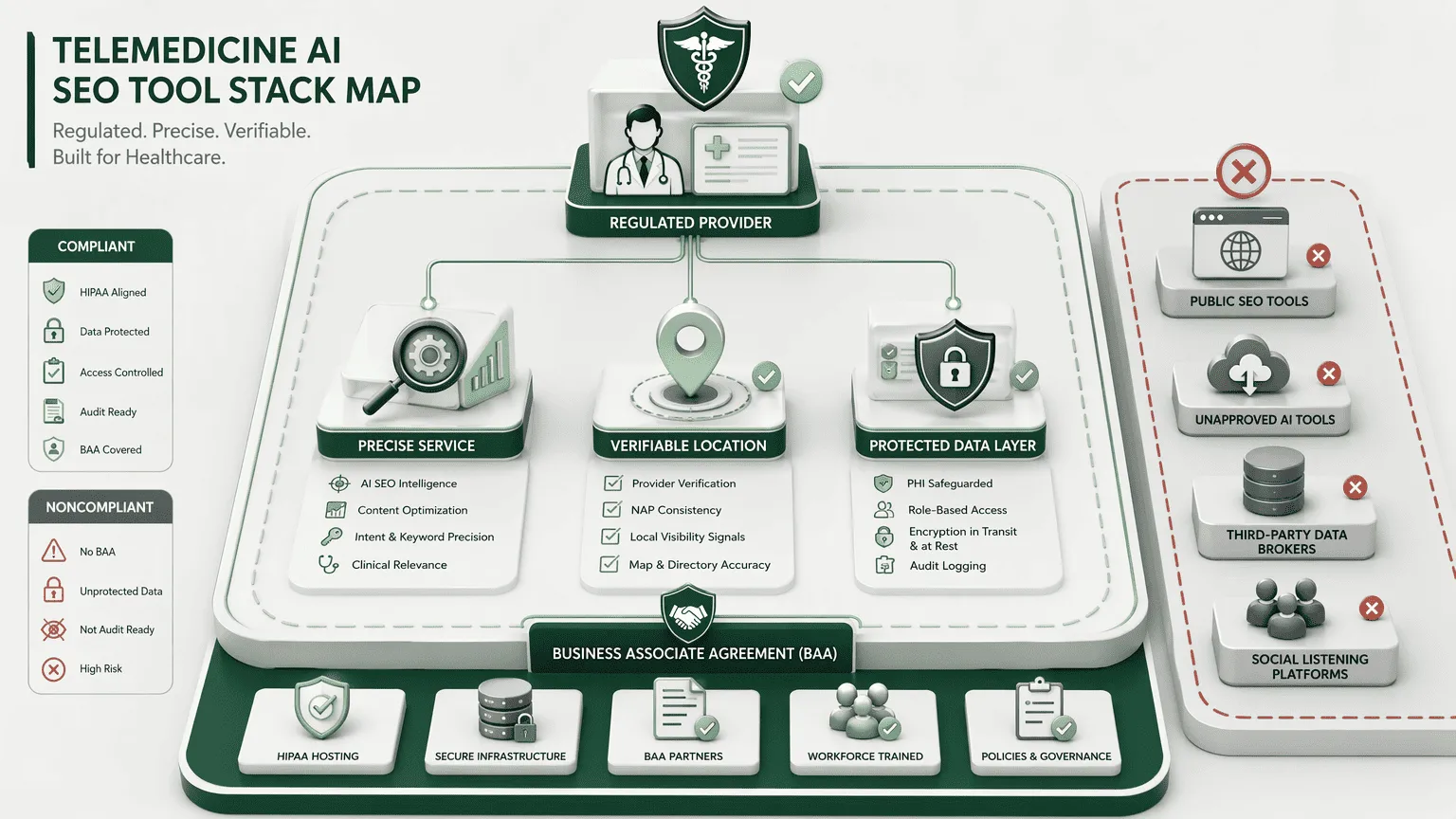
The tool stack divides into platforms that can legally touch healthcare content and platforms that cannot. The division is defined by the Business Associate Agreement.
The AI doing the citation crawl wants to see a regulated provider attached to a precise service, attached to a verifiable location. ClinAds frames it plainly: generate and rank the clinical answers patients search for so that the AI citations point back to your practice. The BAA is what lets those platforms host the content (credentials, conditions, service-area geotags) that makes that possible.
The stack stratification reflects the BAA filter. Reliable platforms fall into tiered categories based on whether they sign one.
| Category | BAA Required? | Representative Platforms | Core Function |
|---|---|---|---|
| AI-Assisted Content & GEO | Yes | ClinAds, Hippocratic AI | PHI-safe entity pages, Gen-AI answer optimization, clinician-to-condition linking |
| Local & Technical SEO | Conditional | Semrush, Ahrefs, Schema App | Entity schema, localbusiness markup, GBP management, Core Web Vitals |
| Non-Compliant & High-Risk | No | Unbounce, standard Google Analytics, Mailchimp, ChatGPT free tier | Standard tracking, pixel-based retargeting, unencrypted LLM ingestion |
Platforms that won't sign a BAA cannot touch any dataset that ties a patient's query to a clinical condition, a doctor's name, or a service location. The risk surfaces at the flash-to-bang moment: the second a lookup table joins a user ID to a procedure code inside a tool without a BAA, the practice faces a HIPAA breach notification requirement. That is the structural reason the High-Risk tier exists, and why wholly eliminating it often requires the telemedicine company to build internal tooling alongside a creative partner that already operates under a BAA.
State-page architecture as a citation condition. Telemedicine practices treat a multistate license footprint as a single market, but AI extractors read geography at the service-area level. A telehealth therapy SEO breakdown from Rank.ai maps the architecture directly: each licensed state requires a unique location page with state-specific licensing clauses, local clinical staff bios where applicable, and schema markup tagging the service area. When an AI model assembles a citation for "online OCD therapy in Texas," it reaches for a page that matches both the condition and the jurisdiction. A single national page gave the model nothing to anchor to. Intrepy Healthcare Marketing confirms that AI search crawlers treat explicit NAP (Name, Address, Phone) consistency across Google Business Profiles and practice location pages as a primary trust signal, not a minor ranking factor.
The compliance-audience double lock. Enterprise AI platforms operating under a BAA create safe infrastructure, but safe infrastructure with empty entity pages still generates zero citations. The exchange requires both the legal container and the content inside it. The platform makes that data HIPAA-safe to host; the bio makes it citeable. Without both, a practice may be compliant but invisible.
Audience targeting that avoids PHI exposure. Restricting display to non-PHI signals (searched condition, visited specialty page, insurance plan type) satisfies both commercial targeting needs and HIPAA's minimum-necessary standard. ClinAds notes that bidding on unbranded diagnostic terms ("OCD treatment covered by Aetna") generates a pre-qualified patient flow without touching PHI at any stage.
Funnel-specific platforms and the entity architecture. The stack organizes naturally around acquisition stages.
| Funnel Stage | Search Intent Type | Content & Technical Requirement |
|---|---|---|
| Top-Funnel: Symptom & Condition Awareness | "OCD symptoms in adults" | Condition pages with diagnostic criteria (DSM-5 reference), peer-reviewed citations, and FAQ schema capturing exact symptom queries. |
| Bottom-Funnel: Booking & Access | "Online OCD therapy covered by Aetna" | Insurance-specific landing pages with real-time eligibility widgets, direct scheduling, and review schema aggregating third-party ratings. |
The funnel dimensions map directly onto the entity types an AI extractor expects: medical condition, credentialed provider, insurance plan, service location. The architecture either provides those entities marked up cleanly, or leaves the AI search surface blank.
FAQ
Does HIPAA require a BAA for SEO tools that only analyze public search data?
No, a BAA is not required if the tool never receives, stores, or processes PHI. The problem arises when the same tool shares infrastructure (a single login, a shared dashboard) with any system that does touch PHI, which is common in lean telemedicine stacks. Isolate the data flows or get a BAA.
Can a telemedicine practice rank in AI overviews with a single national site?
Rarely, and only for unlicensed information queries. AI extractors match citations to jurisdiction-tagged pages. A multistate practice that omits state-specific location pages hands the citation to a local competitor who built them.
Which compliance certification matters most when evaluating a telemedicine SEO platform?
A signed Business Associate Agreement. If the platform will touch any clinical data, the BAA is nonnegotiable.
Standard Google Analytics is not. Google will not sign a BAA for the free or standard paid versions of Analytics. The guidance from HHS is clear: you cannot pass PHI into the tool. Telemedicine sites often do exactly that when a referral URL or page title unwittingly contains a procedure code or condition tied to a user ID.
What is the fastest way to fix AI citation invisibility for a regulated telehealth brand?
Audit whether each licensed state has a dedicated location page with condition-specific content, local clinician bios carrying NPI numbers, and medical entity schema markup. Most practices that are invisible in AI search are missing those pages entirely, not ranking poorly for them.
Building Citable Clinical Authority for Generative Engine Optimization

AI engines cite sources that demonstrate three things: clear attribution to a verifiable author with clinical credentials, entity-rich content that maps to a recognized medical ontology, and a focused topical depth that signals "this is the definitive source for this condition." You cannot trick a language model into citing you out of a shallow content farm. You earn citations by building a knowledge graph that reads like a medical textbook written for the web.
The structural requirement is a topical authority cluster that organizes content around a core condition and radiates outward to related symptoms, treatments, and medications. Each page explicitly links to a clinician-authored bio page with NPI numbers, board certifications, and published research.
Entity-rich content maps the terms you use to a medical ontology like SNOMED CT. When your article about asthma uses the exact concept "reactive airway disease (SNOMED: 195967001)" and links that concept to a treatment protocol backed by GINA guidelines, the AI reading your page can situate your content inside a machine-readable medical framework. You stop being a webpage and become a node in an entity network. Nodes get cited.
The trade-off is velocity. Every piece of content you publish under this architecture requires a clinician's review, an entity map, and a schema markup layer that adds 90 minutes of production time per page. Uncited content has zero patient acquisition value and positive hosting cost. Done right, a single state-level service page with linked clinician credentials and entity markup consistently outperforms a generic national page that lacks both. The audience is smaller but the citation probability is orders of magnitude higher.
Multi-State Local SEO in a Virtual Care World
A telemedicine practice licensed in 12 states who publishes a single "national" services page has effectively decided not to rank locally in any of those states. The workaround is a licensing-based landing page framework that replicates the local signal structure of a physical clinic without the real estate. This is the scalability problem that kills virtual care visibility for practices who bolt on local SEO as an afterthought.
Each state where you hold a license requires a dedicated, unique landing page. Duplicating a page and swapping the state name into the title tag does not count. You need a distinct page that names the specific clinicians licensed in that state, the accepted in-state insurance plans, the telehealth consent process governed by that state's regulatory body, and the service-area business boundaries defined in your Google Business Profile configuration. For the AI overview answering "online psychiatrist Texas," a generic page stays invisible. A state-specific page gets cited.
A location page that is just an address, phone number, and map embed leaves local rankings on the table. The page needs locally relevant condition content, a citation to the specific state telehealth statute that governs your practice, and explicit schema markup using the LocalBusiness and MedicalBusiness types with the service area defined for each license state.
You do not need a physical address in every state to rank for "near me" queries. Service-area business configurations in Google Business Profile allow virtual practices to define the geographic radius where they provide care without listing a patient-facing address. This shifts the old physical-storefront requirement for map-pack visibility into a configuration question. The configuration requires maintenance. Every state license renewal must trigger a page update, and every clinician departure from a state license roster requires immediate content revision.
Measuring What Matters: An AI SEO ROI Framework for Telehealth

The legacy telehealth SEO dashboard that reports organic impressions, average position, and total clicks is measuring the volume of a channel that is shrinking by the month. The north-star KPI for 2026 is the AI citation rate: the percentage of tracked queries where your brand name, clinician name, or clinical content appears as a source inside the AI-generated answer. A citation is a branded impression wrapped inside a third-party clinical endorsement delivered at the exact moment the patient is deciding whom to trust. Your cost-per-acquisition math needs to factor that a citation-elevated visitor arrives with pre-built authority.
The substitution effect against paid search is the primary ROI signal. When you track conversion-to-booking rates specifically from traffic that originates inside an AI overview click versus a standard organic SERP click, the former often converts at a rate that would cost you $75 per booked appointment in paid search. The economic argument for AI SEO is that a sustained citation presence produces the same patient acquisition result as an active Google Ads budget with zero direct media cost, provided you have built the booking-path infrastructure to capture the click when it arrives.
The Full-Funnel Playbook: From AI-Assisted Diagnosis Lookup to Booking

The AI-mediated patient journey threads through three distinct stages. Each stage requires a specific content type, a specific schema markup, and a specific conversion mechanism. Miss one stage, and the AI output skips your practice entirely at that step.
| Funnel Stage | Patient Query Type | Required Content & Markup | The AI Citation Win State |
|---|---|---|---|
| Top-Funnel: AI-Assisted Diagnosis | "Is my chest pain anxiety or a heart issue?" | Condition education content built with FAQ schema, short 45 to 80-word answer blocks, and explicit clinical reviewer attribution. | The AI overview pulls your 60-word differential-diagnosis paragraph as the top answer and lists your clinic name with the citation. The patient reads your name before any competitor link. |
| The AI answer cites a specific clinician bio from your practice as the source for the "best treatment approach" paragraph, surfacing the provider's name, the condition expertise, and the "book appointment" link in the same block. | |||
| Bottom-Funnel: Booking & Urgent Access | "Online urgent care that takes my insurance today" | Emergency and urgent-visit pages with integrated appointment schema, real-time availability widgets, and insurance carrier markup. | The AI Mode response includes a direct "Book your visit" action card populated from your structured appointment data, not from a paid search ad extension. The booking happens inside the AI layer. |
Navigating HIPAA and Regulatory Risk in AI-Driven Content Workflows
The most expensive mistake a telemedicine marketing director makes is plugging a patient's submitted-symptom form data into a standard AI writing tool to generate FAQ content. That is an unrestricted disclosure of protected health information to a non-compliant third-party processor with no legal obligation to the patient. Federal guidelines require a signed Business Associate Agreement with any vendor that creates, receives, maintains, or transmits PHI on your behalf, and that includes the prompt input field of an AI content generator if the data passing through it originated from a patient record.
The secondary regulatory hazard is the clinical claim inside the AI-generated content. If you publish AI-written copy that states "Our online hypothyroidism treatment reduces symptoms in two weeks" and the AI hallucinated that claim from an amalgam of non-clinical web text, you have now published an unsubstantiated health outcome promise. The Federal Trade Commission has issued warning letters to companies making misleading AI-generated health claims, and the FDA's 2025 Final Rule on direct-to-consumer drug advertising tightened the presentation standards for treatment claims in digital media.
The fix is a dual-gate workflow that is non-negotiable. Gate one is the BAA-signed tooling layer: any AI platform inside your content operations that could touch a data flow originating from patient interaction must have a signed BAA executed before a single prompt is written.
Gate two is clinical review before publication. Every piece of content that makes a treatment, diagnosis, or outcome claim must be reviewed and explicitly signed off by a licensed clinician operating under your practice's medical director. The AI writes the draft. The clinician owns the claim. There is no middle ground at audit time.
Conclusion
Telemedicine patient acquisition has migrated from link-building to citation-building. The practices capturing the appointments that used to flow through blue links are the ones whose names already populate the AI-generated answers for their specialty.
This shift is underway right now. The window to establish citation presence before competitor saturation inside a given medical vertical is measured in months, not years.
The first step is an audit of your current content's AI overview visibility. Pick your 15 highest-intent condition queries, run them through Google AI Overviews and ChatGPT, and record whether your practice appears as one of the cited sources. That spreadsheet is your patient acquisition gap analysis. ClinAds audits that gap and builds the citation architecture to close it.
Want to see what your top 15 terms actually show right now? Book a 30-minute intro call.
Frequently Asked Questions
What is AI SEO and how does it apply to telemedicine companies specifically?
AI SEO is the practice of structuring clinical content to be the source that AI platforms cite in their generated answers. For telemedicine companies, it applies to symptom inquiries, treatment comparisons, and provider queries where Google AI Overviews or ChatGPT now deliver the answer and patients never visit a website unless it is cited.
How do AI-powered search engines like Google's SGE or ChatGPT impact patient acquisition for telehealth providers?
They answer high-intent condition questions directly inside the search result, diverting clicks that would have gone to your booking page. Unless your content is cited inside that AI answer, the patient acquisition pipeline from organic search dries up. A citation, however, produces a pre-warmed visitor who already trusts your source.
What are the most effective AI SEO tools and strategies for telemedicine content in 2026?
The core strategy is building topical authority clusters with clinician authorship signals, entity-rich terminology mapped to SNOMED CT, and explicit medical ontology linking to increase citeability.
What regulatory and compliance risks must telemedicine marketers consider when using AI for SEO?
The primary risk is disclosing protected health information to a non-compliant AI tool without a signed Business Associate Agreement. A secondary risk is publishing AI-hallucinated clinical claims that violate Federal Trade Commission standards. Any AI content making a treatment claim must be reviewed and signed off by a licensed clinician.
How does AI-driven local SEO differ for multi-state telemedicine practices versus brick-and-mortar clinics?
Brick-and-mortar clinics rank locally from a physical address. Multi-state telehealth practices require a unique landing page for each state where they hold a license, with state-specific clinician rosters, insurance lists, and service-area business configurations. A single national page will not rank for 'near me' searches in any licensed state.
What key performance metrics should a telemedicine company track to measure the ROI of AI SEO?
Track the AI citation rate, which is the percentage of tracked queries where your brand appears inside the AI-generated answer. Pair that with geographic-qualified traffic, conversion-to-booking rates from AI-referred visitors, and cost-per-acquisition compared to paid search. Traditional impressions and clicks fail to capture the value of an AI citation.
Sources
- Your Practice Is Invisible to AI. Here's the Fix That Actually Works in 2026. - getclinads.com
- How DTC SEO Agency Is Specializing in Telehealth, Telemeds, and SEO & AI Search | Press Releases | indexjournal.com - www.indexjournal.com
- How to Market Telehealth Services: 2026 Guide for Practices - www.webtomed.com
- AI and Local SEO for Medical Practices: What Works in 2026 | Intrepy Healthcare Marketing - intrepy.com
Want help executing this for your clinic?
Book a 30-minute call and we will map what a real ad engine would look like for your specific service mix.
Book a call