
Clinic Marketing Platforms: Pick by Price and Fit
Summary: When comparing marketing platforms for clinics, prioritize those that simplify tasks like local search optimization, website management, and ad creation, rather than those with numerous features. The best platforms help attract new patients by improving online visibility and trust without requiring extensive time investment from clinic staff. Pricing should reflect the value of replaced work rather than just the subscription cost.
Most advice about a clinic marketing platform starts with a feature checklist after the agency report lands in your inbox. The checklist fails when the owner is still seeing patients, the front desk is answering insurance questions, and nobody has time to learn a platform that only produces another report.
The better comparison starts with the job the platform must take off your plate. When you compare marketing platforms for clinics, the first question is not whether the software has more buttons than the agency portal you already ignore. The first question is whether it helps new patients find your clinic on Google Maps, see enough proof to trust you, and book without you chasing a designer, copywriter or ad buyer.
A clinic owner should be skeptical of any platform that sells activity as marketing. Posts, blogs, ads and rankings only matter if they connect to a local patient choosing between you and the clinic down the street.
Start with the job the platform replaces
A good comparison begins with the unpaid work already sitting on the owner, office manager or associate dentist. The strongest clinic marketing platform replaces a messy mix of website fixes, Google Business Profile updates, local content, ad creative, competitor checking and AI recommendation checks, not just social posting.
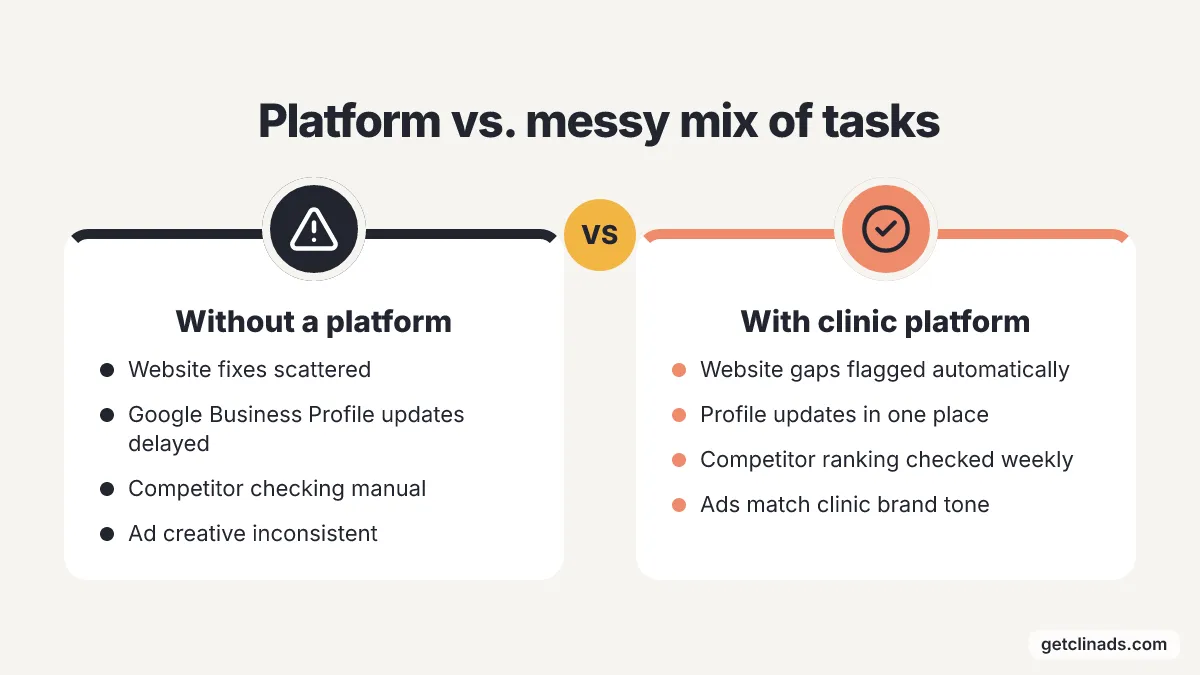
The central point is simple enough to disagree with: a clinic should not buy a marketing platform because it has the most features. A clinic should buy the smallest system that keeps the clinic findable where patients now ask for care, then proves what changed without locking the owner into an agency retainer.
Platform categories blur together because many healthcare tools use marketing language for different jobs. Mirador describes itself as a Health and Human Services platform that helps families find senior living communities, while Beaming Health is a health services platform focused on autism and pediatric therapy providers. MassageBook is marketed as an all-in-one business management solution for massage therapists, which is useful for a massage practice but not the same job as getting a dermatology clinic named by ChatGPT.
Good clinic marketing software sits closer to demand creation and local discovery. A dental practice, med spa, dermatology office, optometrist or veterinary clinic needs its website, reviews, location pages and ads to agree on who it treats, where it is, and why a patient should choose it now.
Directory presence still matters because patients compare proof before they call. The median rated listing carries 36 reviews, so half of those 99 sit below it. A clinic with thin or stale reviews should not treat directory pages and Google Maps as passive assets because weak proof gives a nearby competitor the easier click.
Which features actually matter for a clinic?
Website and location work come first, because every other channel points back to the same proof. A clinic platform should read the website the way Google and AI systems read it, then flag gaps in service pages, city pages, provider details, calls to book, review proof, and basic contact information.
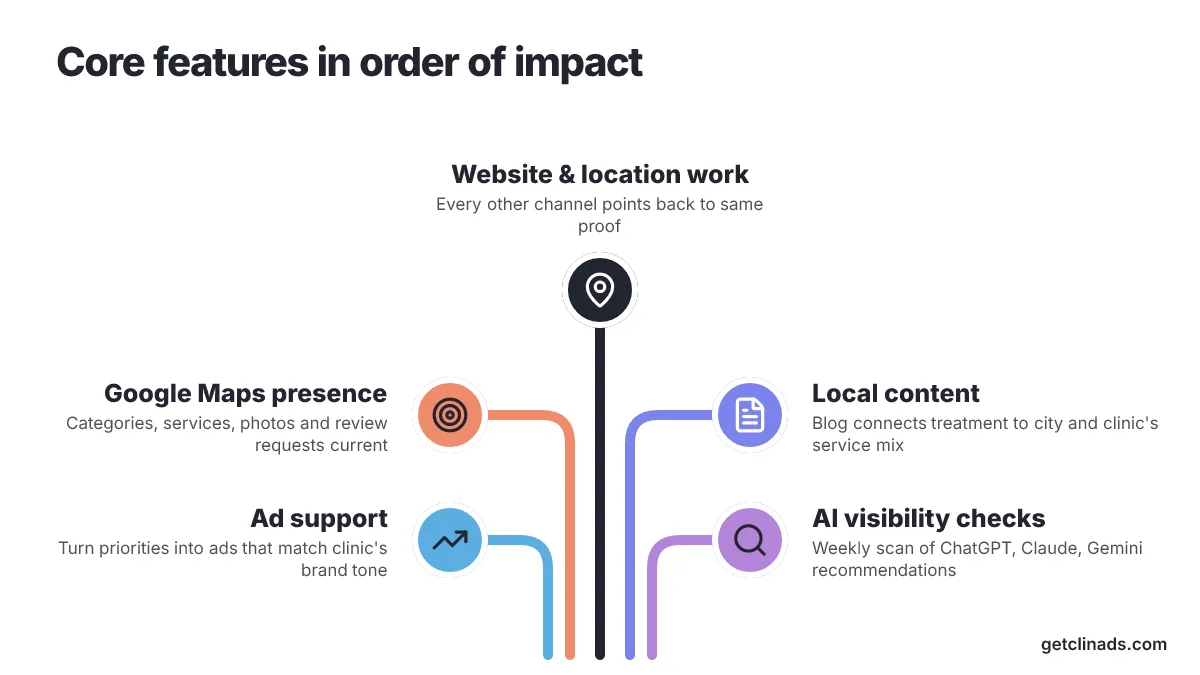
Google Maps work belongs in the core feature set, not in an agency side report. A usable platform should show whether the clinic profile is current, whether categories and services match the treatments patients search, whether photos look alive, and whether review requests are part of a repeatable front desk process.
Content matters when it answers a real local decision. A weekly blog about Invisalign, acne scarring, knee pain, dry eye, or pet dental cleaning should connect the treatment to the city, the clinic's actual service mix, and the next appointment a patient can request. Generic AI content fails because it sounds like every clinic in the state and gives ChatGPT no reason to name yours.
Ad support should cover the practical pieces most owners delay. A platform should turn service priorities into Facebook or Instagram ads, match the landing page to the offer, and keep the tone inside the clinic's brand so a med spa ad does not read like a dental implant promotion.
AI visibility is now a real comparison point, even if it is not the only one. The useful question is whether ChatGPT, Claude, Gemini, and Perplexity name your clinic for searches a patient would actually ask, such as a nearby dentist, a dermatologist for acne scars, or a med spa for laser hair removal. A platform that checks those answers weekly gives the owner a concrete problem list rather than a vague claim about AI search.
Competitor checks turn marketing from guesswork into a repair list. A platform should show why the clinic down the street ranks higher on Google Maps, which pages support that ranking, whether reviews are stronger, and which content gaps are worth closing first.
What should pricing include before it beats an agency retainer?
Pricing should be compared with the work it replaces, not with the cheapest subscription sitting in an app store. A low monthly tool gets expensive fast when the owner still has to brief a writer, chase a designer, review ad copy, update the website, and ask the agency what the report means.
Clinic owners who compare platform costs should sort through four buying paths before they read a sales page.
| Option | What the clinic buys | Price risk | Good fit |
|---|---|---|---|
| Traditional agency | People to plan, create and report on marketing | Retainer continues even when output feels thin | Owner wants delegation and accepts slower feedback loops |
| DIY marketing tool | Software for posting, email, ads or web edits | Staff time becomes the hidden cost | Clinic has a marketer who will use the tool every week |
| Clinic marketing platform | Local search, website, content and ads in one workflow | Poor fit if it only produces tasks the owner must finish | Owner wants less overhead and clearer fixes |
| Operations platform | Intake, engagement, care plans or data workflows | Does not replace patient acquisition work | Clinic has bottlenecks after the patient reaches out |
A referral-only clinic with a full schedule and no plan to grow search demand is the named exception. A spreadsheet, a current Google Business Profile, and a simple review process may beat a paid platform until the clinic wants more new patients from local search or AI recommendations. For a small veterinary or dental practice, the overhead drops when handoffs disappear. The biggest waste is rarely a single software bill. It comes from paying for a scheduler, a social tool, a website vendor, and an agency while the owner still edits every caption at night.
Orthopedic surgeons who want alternatives to expensive agencies should use the same test, only with stricter service pages. The platform has to support high-intent pages for knee pain, hip replacement, sports injuries, and each location, because broad wellness content will not match how surgical patients compare specialists. ClinAds makes clinics discoverable by AI through one solution for a clinic's website, SEO, blogs, social media, brand and ads. ClinAds checks every week whether ChatGPT, Claude, Gemini and Perplexity recommend the clinic, reads the site the way Google and AI do, and is priced per clinic on a call with no retainer or contract.
Multi-location groups need pricing that separates fixed setup from location work. A DSO or clinic group should look for location-level reporting, shared brand rules, and the ability to see which office is missing content, reviews or AI visibility. ClinAds covers this use case on its DSO and multi-location marketing page.
How easy is the platform when you still treat patients?
Ease of use means the clinic can approve, reject, or fix work without turning the owner into the marketing department. A platform that makes someone build workflows, write prompts, connect half a dozen accounts, and decode raw rankings is not easy, even if the interface looks clean.
A practical platform should hand the owner a short weekly decision list. One week it may say the acne scar page is thin, the Google Business Profile lacks a service, a competitor has stronger review proof, and the next blog should answer a patient question already showing up in search. That is the kind of list a busy practice can read before the morning rush.
Access matters because clinic marketing touches sensitive brand and operational details. The practice should know who can edit the website, who can publish blogs, who can change ad copy, and who approves anything mentioning procedures, pricing, financing, or medical claims. If those lines are fuzzy, mistakes spread fast. Reporting should read like a repair ticket, not a lecture. A useful report names the search, the competitor, the page, the missing proof, and the next fix. A bad report shows impressions and clicks, then leaves the owner guessing what should change before next week.
AI content controls matter for clinics because tone is not decoration. A dermatology clinic that writes clinically, a med spa that writes warmly, and a veterinary hospital that writes for anxious pet owners should not sound the same. The platform needs brand rules, service facts, and owner approval before anything goes live for patients.
Where do specialist healthcare platforms fit?
Clincy, a partner of this site, belongs in the operations column for dental practices rather than the broad marketing column. Clincy is an AI-powered patient intake and reactivation coordinator that automates new-patient intake, collects insurance, demographics, health history, and allergies, writes structured data back to the practice management system, and reactivates patients who stopped scheduling. That is a different job from ranking a service page. WellWink fits a different operational need because WellWink describes itself as a care management and patient engagement platform for healthcare providers, including chronic care management, remote patient monitoring, telemedicine, and integrated care plans. A primary care clinic with chronic care programs would compare WellWink against care management needs before it looks at a local SEO platform.
SemantIQ Health sits even farther from front-door marketing because it is an intelligence layer that turns complex claims data into trusted insights in minutes. Spire Group designs, builds, and operates AI platforms across industries with HIPAA-aware data architecture and regulatory awareness, which puts it closer to custom platform development than to a plug-in clinic marketing system.
Directory and marketplace platforms help patients compare providers, but they do not give the clinic full control over its website, Google Maps position, or brand voice. A senior living community on Mirador, a pediatric therapy provider on Beaming Health, and a massage therapist on MassageBook each gains presence in a place patients browse, but the clinic still needs its own local proof outside the marketplace. That extra proof matters when a patient leaves the directory and starts checking the clinic directly.
Operational AI is not a substitute for being recommended. Delco Times reported in 2026 that PrevHealth in Ridley uses AI in a primary care clinic to lower costs and improve care, which shows how broad clinic AI has become. Marketing platforms still need a separate test: whether patients and AI answer engines can find, trust, and name the clinic before anyone fills out an intake form.
How should a clinic choose without buying another unused tool?
A clinic ought to run the decision against next month's real work, not a sales deck. The owner should ask what has to happen next week for Google Maps, the site, content, ads, and AI visibility, then pick the platform that removes the most owner labor from that list. Start with the clinic's actual growth problem, written in plain English. A dental office may need more implant consults from nearby searches. A med spa may need weekly GLP-1 or laser content that does not sound generic. A dermatologist may need ChatGPT to mention the practice when someone asks for acne scar treatment near the clinic's city.
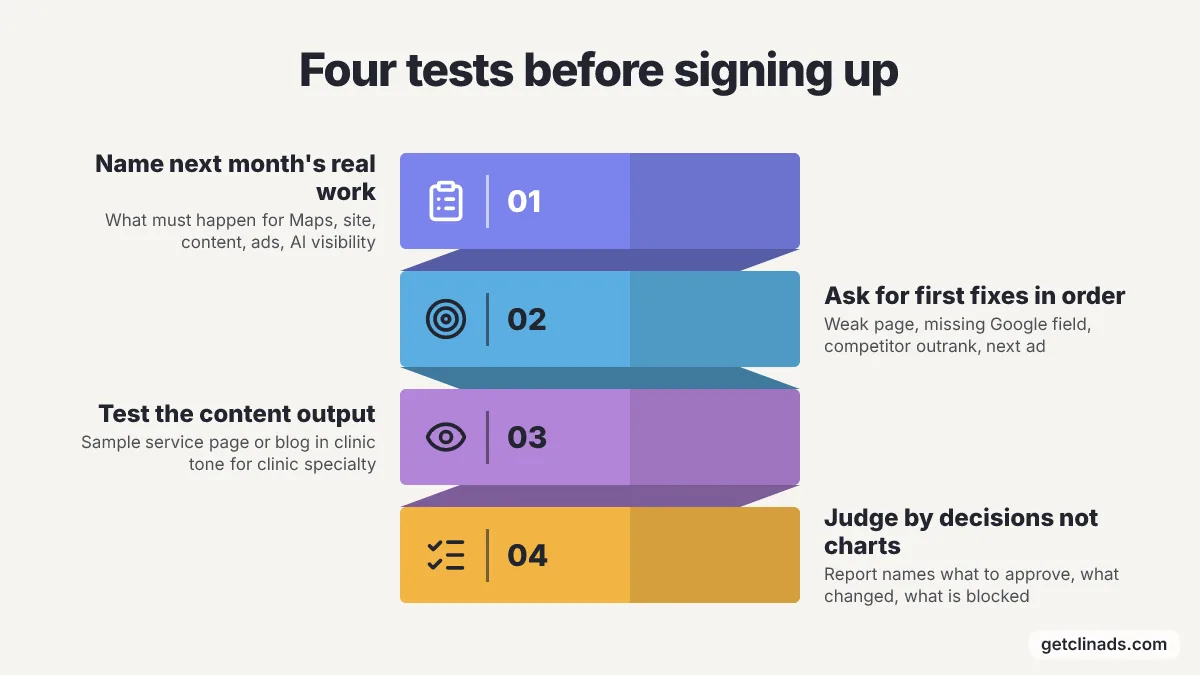
Then ask each platform for the first fixes it would make, in order. A serious platform should name the weak page, the Google Business Profile field that is missing, the competitor that outranks the clinic, and the ad or blog that should go out first. After that, check who actually does the work once the problem is found. A diagnosis helps only if the clinic knows whether the platform publishes the page, drafts the blog, updates the ad, or leaves the owner with yet another task.
Before signing, test the content. Ask for a sample service page or blog topic built around the clinic's specialty, city, tone, and patient objections. If a platform cannot sound like the clinic during evaluation, payment will not fix that later.
Reporting should be judged by decisions, not charts. The best report tells the owner what to approve, what changed, and what is blocked. The weakest report leaves the clinic staring at metrics after a full day of patients.
The last check is simple: do not pay twice for the same job. A dental practice might use Clincy for intake and reactivation and still keep a clinic marketing platform for discoverability. A med spa may keep a booking system and drop only the agency layer. A DSO may need shared control across locations rather than yet another single-location tool.
Conclusion
Begin by auditing the work you already put off, the Google Maps profile, the pages patients land on, the blogs that keep slipping, the ads that never ship, and whether ChatGPT names your clinic at all. The right platform should turn that audit into fixes without forcing you to become a marketer after clinic hours. A serious evaluation needs access to your site, your Google Business Profile, your main services, and the competitors you lose to. Ask each platform what it would fix first, who does the work, and how pricing changes when you add locations. Stop buying when the answer becomes another dashboard, another report, or another retainer without a clear next action.
Related reading
- 7 Best Affordable Marketing Platforms for Small Medical Practices in 2026
- 8 Best Digital Marketing Agencies for Med Spas in Toronto in 2026
- 6 Best Marketing Agencies for Med Spa Weight Loss Programs in 2026
- 8 Healthcare Marketing Platforms That Close the Booking-to-Local-Search Gap in 2026
Sources
- Sterling House | Assisted Living in Bellows Falls, VT - Mirador Living (clinic)
- 10 BEST Speech Therapy Providers in Boys Town - Beaming Health (clinic)
- Lavendura Massage & Bodywork - MassageBook (clinic)
- New Ridley clinic uses AI to improve care while reducing costs (news, delcotimes.com)
- WellWink Health (healthcare startup)
- Spire Group, Inc (healthcare startup)
Want help executing this for your clinic?
Book a 30-minute call and we will map what a real ad engine would look like for your specific service mix.
Book a call