
How Many Ad Creatives Should a Med Spa Test Each Month? The Spend-Anchored Answer.
IntroductionYour CPA is climbing, your once-reliable ad set just hit a cliff, and the creative that booked patients last month is now burning budget for nothing. The problem is that most med spa operators treat creative volume as a matter of intuition rather than a hard, spend-anchored calculation. Running too few concepts accelerates ad fatigue, where lo-fi user-generated content (UGC) burns out in as little as 7 to 10 days on Meta. Running too many without adequate funding per test dilutes your data into noise, guaranteeing that you kill winners before they ever get the budget to prove themselves.
A benchmark drawn from an MHI Media analysis of 80 direct-to-consumer accounts suggests targeting roughly one new creative concept per $2,000 to $3,000 in monthly Meta spend. This ratio is not a suggestion. It is the equilibrium point that prevents your account from cannibalizing itself through creative fatigue while respecting the hard statistical reality that each creative needs a minimum of $100 to $150 in spend to produce a reliable result, according to AdManage's 2025 creative testing framework. The bottom line is clear: your ability to book treatments through paid media is a function of your testing velocity, and guessing the volume is what turns ad accounts into liabilities.
Key Takeaways
Your Meta account lives or dies by a structured testing cadence.
- The Core Rule: Target one new creative concept for every $2,000 to $3,000 in monthly Meta spend, ensuring no concept launches without a testing budget floor of $100 to $150.
- The Winner Rate Warning: Data from hundreds of accounts shows only 2% of creatives tested ever become scalable winners. Volume is non-negotiable, but only when properly funded.
- The Budget Split: Allocate 70% to 80% of your budget to scaling proven winners, reserving 10% to 20% for structured testing of new concepts.
- The Performance Gap: Brands testing fewer than five new concepts per month show nearly half the median ROAS of those testing 15 or more. This is the cost of creative stagnation.
The One-Number Answer: How Many Creatives a Med Spa Should Test Each Month
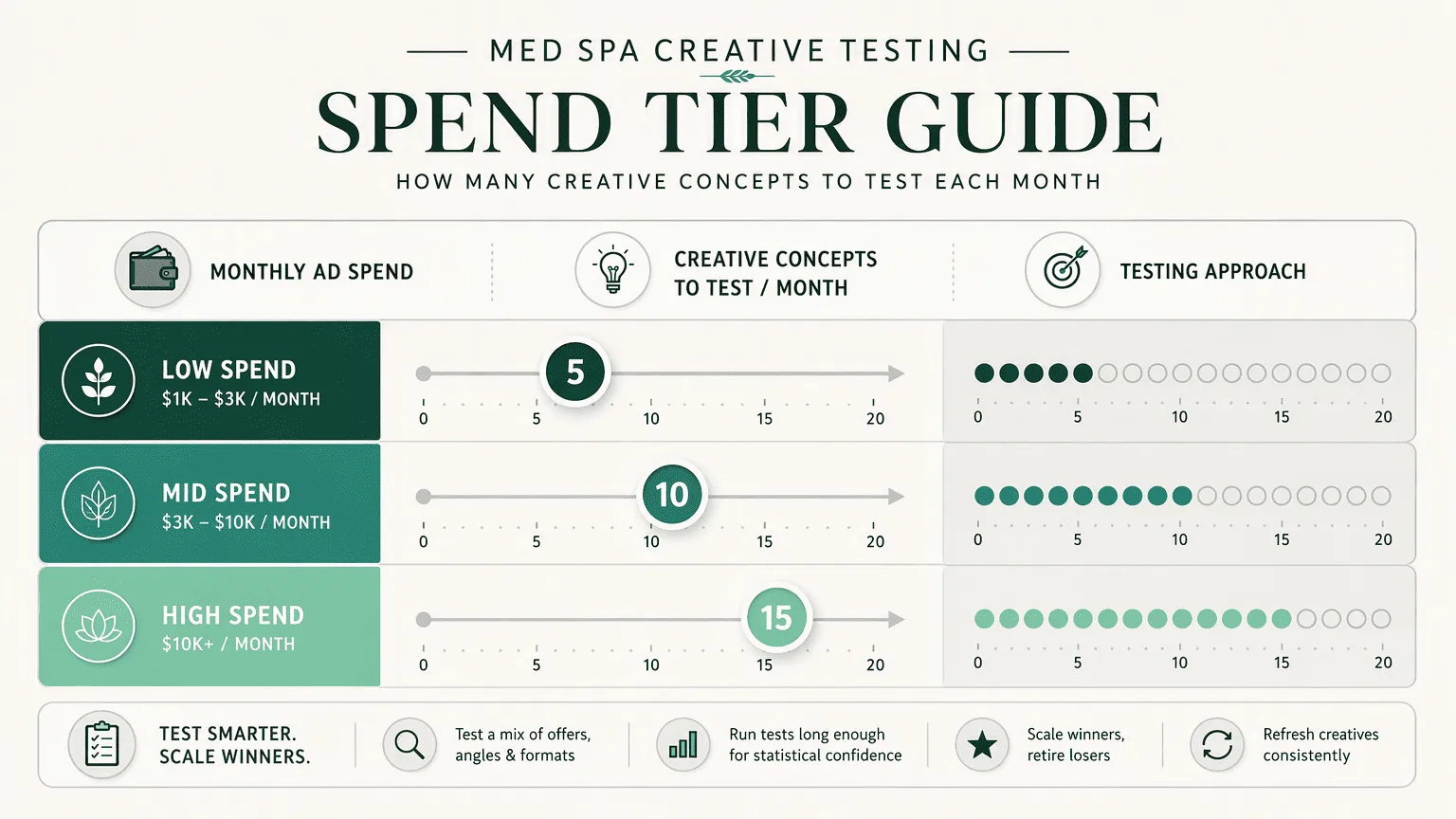
The definitive target is one new creative concept per $2,000 to $3,000 in monthly Meta ad spend, calibrated to ensure statistical reliability and combat platform fatigue. The precise volume range is a function of your burn rate.
| Spend Tier | Target Concepts/Month | Recommended Format Split |
|---|---|---|
| Under $5,000 | 4 to 8 | Primarily low-cost static and UGC video; 70 to 80% video if the procedure requires a transformation showcase |
| $5,000 to $20,000 | 8 to 15 | Mix of batch-filmed video (aiming for 8 to 12 concepts per shoot) and UGC; 70 to 80% video |
| $100,000+ | 25 to 50+ | 70 to 80% video, 20 to 30% static; treat creative production as dedicated infrastructure |
A $6,000/month clinic should ship 3 to 5 new concepts reliably. A $15,000/month clinic should target 6 to 10. The wrong question is how many ads you can make. The right question is how many statistically valid tests your budget can sustain.
What Really Drives the Required Volume: Budget, Fatigue, and Compliance
Generic ecommerce brands can argue about minor edge cases in testing volume. Med spas cannot. The required creative velocity is higher here because three specific accelerants collapse an ad's shelf life faster than the industry average.
- Rapid UGC burnout: A selfie-style video testimonial or a practitioner explaining a treatment on an iPhone burns through its audience in roughly 7 to 10 days. If a med spa is running only two or three concepts, the audience hits ad blindness before the algorithm has even finished optimizing delivery.
- Compliance timelines create mandatory creative turnover: Patient consent windows expire, and before-and-after imagery that was once a powerhouse suddenly becomes a legal risk. You cannot scale an ad that you can no longer legally serve.
- Procedure-specific fatigue: A concept that works beautifully for 'hydrafacial near me' often fails utterly for microneedling or lip filler. A single ad cannot carry five unrelated treatments. This forces a multiplication effect where you need a distinct creative reserve for each core procedure you market, driving the total required volume far above what a single-product brand would need.
The Mechanism: Why Creative Volume Is Meaningless Without Adequate Funding Per Test

A med spa can ship 20 new concepts in a month and still see zero results. The culprit is almost always an underfunded testing phase. Without sufficient spend, the Meta algorithm cannot exit the learning phase, leaving you with statistically insignificant noise instead of actionable data. The trade-off is hard and immovable: a concept that receives less than $100 to $150 in spend has not been given a fair trial.
The 'spray and pray' approach, launching 20 concepts on a total monthly budget of $2,000, violates this floor entirely. In this scenario, each concept gets only $100, leaving zero margin for error, delay, or learning time. You end up with 20 false negatives, killing creatives that could have scaled simply because you starved them of budget.
The 1 concept per $2,000 to $3,000 ratio exists precisely to reconcile these opposing forces. Applying this standard to a $10,000 budget yields 5 concepts. If you reserve 20% of the budget for testing, you have $2,000 for those 5 concepts, or $400 per test. That is enough to satisfy the $150 minimum and give winners room to breathe. The volume and the funding are mathematically aligned, and that alignment is what produces statistically reliable results.
The Real-World Implications of Getting Your Testing Cadence Wrong
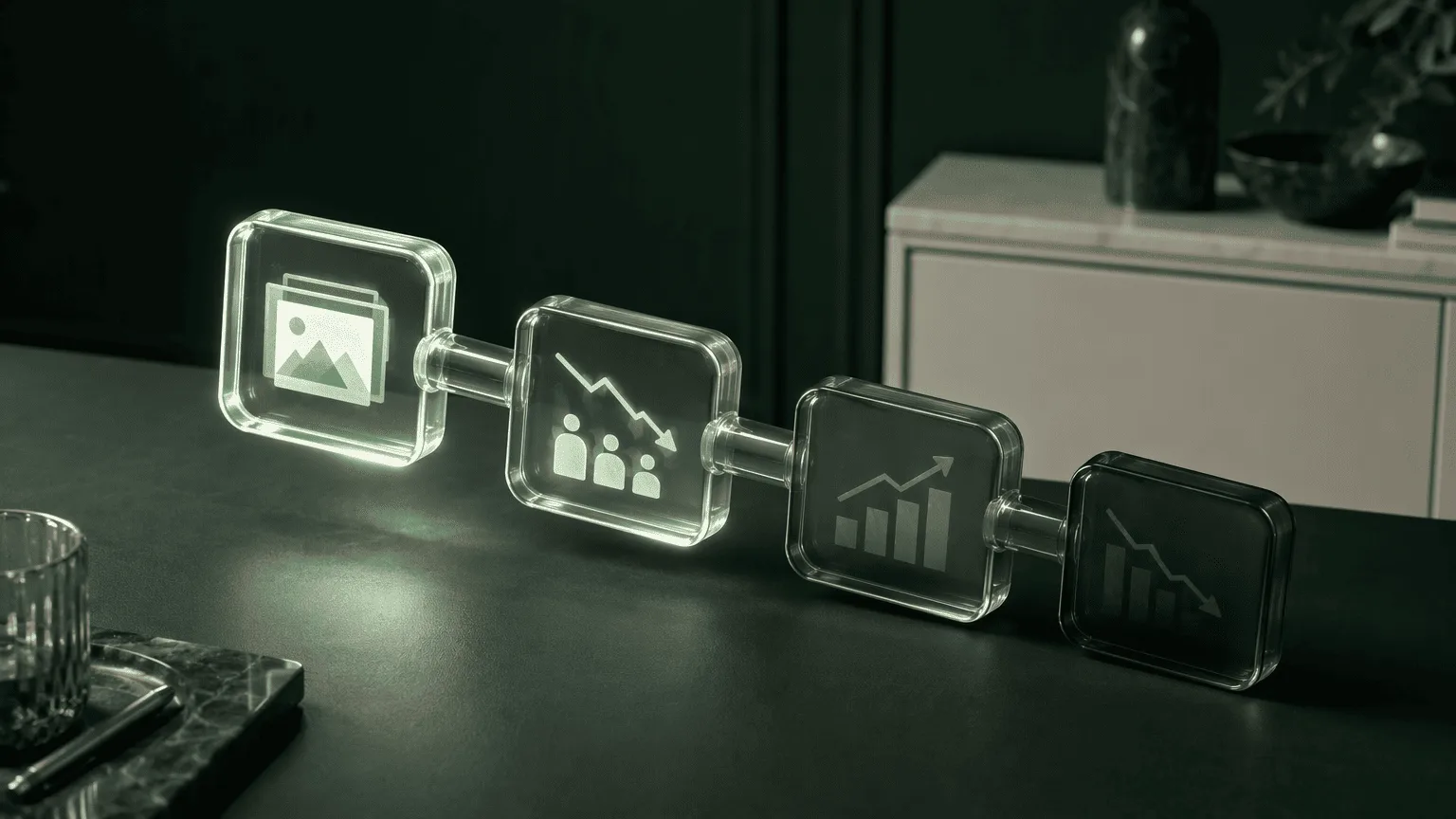
Under-testing is the most common and costly failure state in med spa Meta advertising. A clinic runs the same three creatives for 30 to 45 days, and the performance degradation is both predictable and measurable. Creative fatigue pushes CPMs higher, and cost per acquisition can easily degrade by 30% to 50% until the account tip over into unprofitability.
The financial consequence is a straight line from creative stagnation to account death. In contrast, advertisers running 5 or more creative variants per ad set see 20% to 30% lower CPA than those running only 1 to 2 variants. The gap is not marginal; it is the difference between a $75 booking and a $110 booking that destroys your margins.
The opposite failure is over-testing without funding. Launching 30 concepts on a $3,000 budget creates a fog of false negatives. The operator concludes 'nothing works,' but the real diagnosis is insufficient spend per test. You do not have a creative problem; you have a budget allocation problem.
A Step-by-Step Framework: Calculating Your Ideal Monthly Creative Volume by Spend Tier
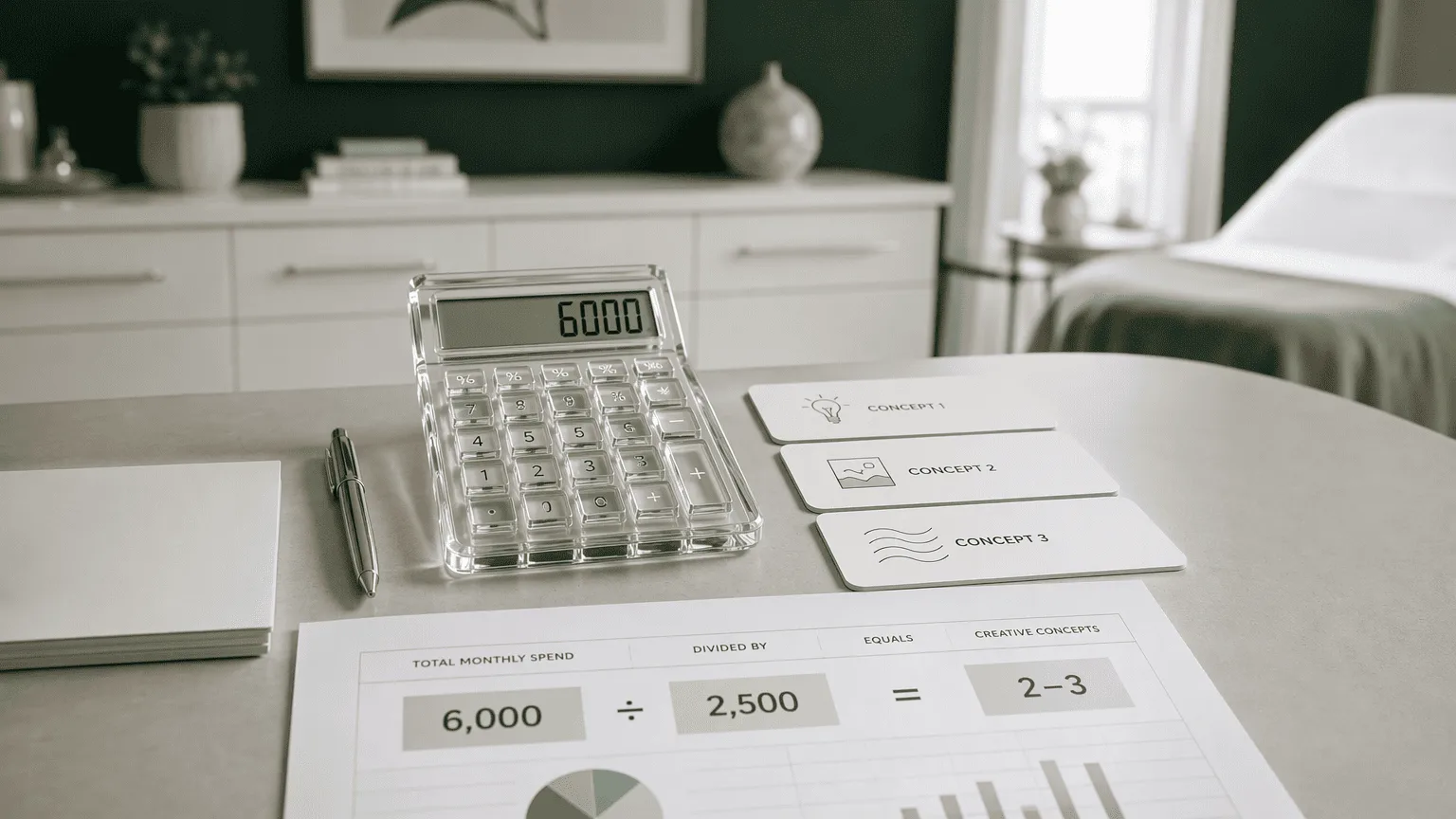
The wrong way to decide your creative volume is to guess based on how busy your content creator is this month. The correct calculation anchors everything to your numbers. Start with your total monthly Meta spend. This is the single, hard constraint.
Next, divide that total by $2,500 to find your target concept count for the month. An example makes this concrete: a med spa spending $6,000/month should plan for roughly 6,000 divided by 2,500, which gives a target of 2 to 3 new concepts, with 3 being the ceiling. Then verify the funding floor: if you allocate 20% of that $6,000 to testing, you have a $1,200 war chest.
Dividing that $1,200 by 3 concepts gives each test a $400 runway, comfortably above the $100 to $150 minimum statistical floor. A $15,000/month clinic follows the same math: 15,000 divided by 2,500 yields 6 new concepts, with a testing budget of $3,000 at 20%, giving each concept a healthy $500 to learn. The calculation is the medicine against waste.
Structuring the Creative Mix: Video, Static, and Procedure-Specific Strategy
Once you have your volume target, the next question is what to build. For med spas, where prospective patients need to see texture, movement, and transformation, video is the primary selling mechanism. A 70% to 80% video to 20% to 30% static split is the baseline recommendation for any clinic whose service complexity demands demonstration.
At lower spend tiers, production cost is the limiting reagent. Founder-filmed iPhone video and lo-fi UGC can carry the full 70 to 80% video load without breaking the bank here. The goal is authentic demonstration, not production value. A practitioner holding a syringe and speaking calmly to camera will almost always outperform a glossy brand video with no human presence.
As spend scales past the $5,000/month mark, the volume requires a more efficient production model. Batch-filmed studio sessions become cost-effective, where a single half-day shoot can generate 8 to 12 video concepts. This allows a $15,000/month clinic to meet the 8 to 15 concept target without requiring a constant, disruptive filming schedule in the practice.
At $100,000/month and above, creative production functions like the front desk or the booking system: a permanent part of the business. The 70 to 80% video, 20 to 30% static split holds, but the infrastructure must be dedicated. The task is to build a creative supply chain that can output 25 to 50 polished concepts monthly without breaking compliance or burning out the marketing lead.
The Med-Spa-Specific Killers: Procedure Fatigue, Disapprovals, and Consent Expiry
Three risks unique to aesthetic medicine demand a higher creative reserve than any non-regulated advertiser would carry. Address these with a pre-stocked library, or accept that your performance will periodically crater.
- Platform Disapproval Loops: Body and face imagery triggers automated and manual policy reviews on Meta frequently. A winning ad that showcases a post-treatment body sculpting result can be mistakenly disapproved and shut down overnight. Without an alternative creative already approved and ready to launch, spend drops to zero while you fight the appeal.
- Patient Consent Expiry: A consent form that expires or a patient who withdraws permission forces the immediate removal of your best-performing ad asset. This is mandatory creative turnover. If you have not already tested a replacement before the expiry date, you walk into a performance slump blind.
- Procedure-Level Creative Fatigue: A concept that wins for 'Botox' does not automatically transfer to 'laser hair removal' or 'RF microneedling.' The audiences, the objections, and the visual language are distinct. Treating one winning format as a universal scaler starves your other procedure campaigns of the fresh, tailored creative they need to survive.
Conclusion
For a med spa on Meta, produce one new creative concept for every $2,000 to $3,000 in monthly ad spend, and give every test at least $100 to $150 so it gets a fair read. Volume without adequate budget behind each test is a vanity metric; it sharpens into a real advantage only when each idea is funded enough to generate meaningful data.
Businesses that treat creative testing as a structured, spend-anchored habit stay ahead because competitors can't keep pace with the fatigue curve. In a channel where every other efficiency gets copied within a quarter, systematic testing is the lever that doesn't commoditize.
Frequently Asked Questions
What is the ideal number of ad creatives a med spa should test each month to optimize performance?
Target one new creative concept per $2,000 to $3,000 in monthly Meta spend. For a clinic spending $6,000/month, that translates to 2 to 3 new concepts. The volume must be funded with at least $100 to $150 per test to generate statistically reliable results.
How does creative fatigue impact med spa ad campaigns, and how often should creatives be refreshed?
Creative fatigue causes CPMs to spike and CPAs to degrade by 30 to 50% as an audience becomes blind to your ads. To combat this, assume UGC-style video creatives burn out in 7 to 10 days and plan to feed the account new concepts weekly.
What budget and resource constraints determine how many ad variations a med spa can realistically test?
The hard constraint is an adequate funding floor per test of $100 to $150. You cannot launch more concepts than your testing budget division allows; reserve 10% to 20% of total spend for testing newer concepts.
How should a med spa structure A:B tests for Facebook or Instagram ad creatives?
Do not test more than one variable at a lower budget. Use Meta's A/B test tool or separate ad sets to isolate the image vs. the headline vs. the angle. Allow each variant enough budget ($100 to $150) to exit the learning phase before calling a winner.
Are there industry benchmarks for med spa advertising creative performance and testing velocity?
Only 2% of creatives tested ever become scalable winners. Advertisers running 5 or more variants per ad set see 20% to 30% lower CPA. Brands testing fewer than 5 concepts monthly show nearly half the median ROAS of those testing 15 or more.
What is the difference in creative testing strategy for static images versus video ads for aesthetic services?
Video demonstrates transformations and builds trust fast, requiring 70% to 80% of production volume for med spas. Static images test quickly and cheaply for remarketing or simple procedural awareness. Always prioritize video for high-ticket or high-anxiety procedures.
Sources
- Turn Your Clinic Website Into Ready-to-Run Ads | ClinAds - getclinads.com
- How Many Ads to Produce Per Month: A Budget Framework - segwise.ai
Want help executing this for your clinic?
Book a 30-minute call and we will map what a real ad engine would look like for your specific service mix.
Book a call