
Your Word of Mouth Has a Ceiling. Here’s How to Break Through It in Ohio.
IntroductionYour clinic runs on trust, and every new patient who walks in from a neighbor's referral proves it. The problem is that word of mouth stalls because it depends on people who already know you; growth slows once that network is saturated. You are invisible to the parent who just moved to town and is Googling 'family doctor near me' tonight.
That search is the front door to a relationship worth thousands in lifetime visits and referrals. 93% of urgent care visits start with a search this specific, and the same intent drives family practice searches across Ohio. The asset you have that no corporate group can buy is genuine community trust. The gap is that trust has no path from your chart notes and waiting room to a screen.
This blueprint translates your off-line reputation into a predictable online acquisition system, without a marketing team and without violating HIPAA. You will build the infrastructure that makes Google, the directories your patients actually check, and your own front desk work together to fill your schedule.
Key Takeaways
A family clinic’s online presence reduces to a few high-impact, non-negotiable moves. Nail these before spending a dollar on ads or content.
- Google Business Profile category: Set the primary category to 'Family practice physician'. It is the single strongest ranking input you control for local map results, which get the majority of clicks for healthcare searches.
- Service-specific pages: Build one dedicated page for each high-value service, well-child visits, annual physicals, school physicals. A 2026 medical marketing guide identifies this single-page-per-procedure approach as the highest-ROI SEO tactic for a practice with no marketing team.
- HIPAA-safe review velocity: Send a text request within an hour of the visit. Two hundred reviews from 2021 lose to thirty from the last ninety days in influencing patient decisions; Google and patients both weight recency heavily.
- Track the only metric that matters: Have the front desk ask every new patient how they found you and record the answer. Actual new-patient visits by source, not clicks or calls, reveals your real cost per acquisition.
Step 1: Fully Claim and Optimize Your Google Business Profile
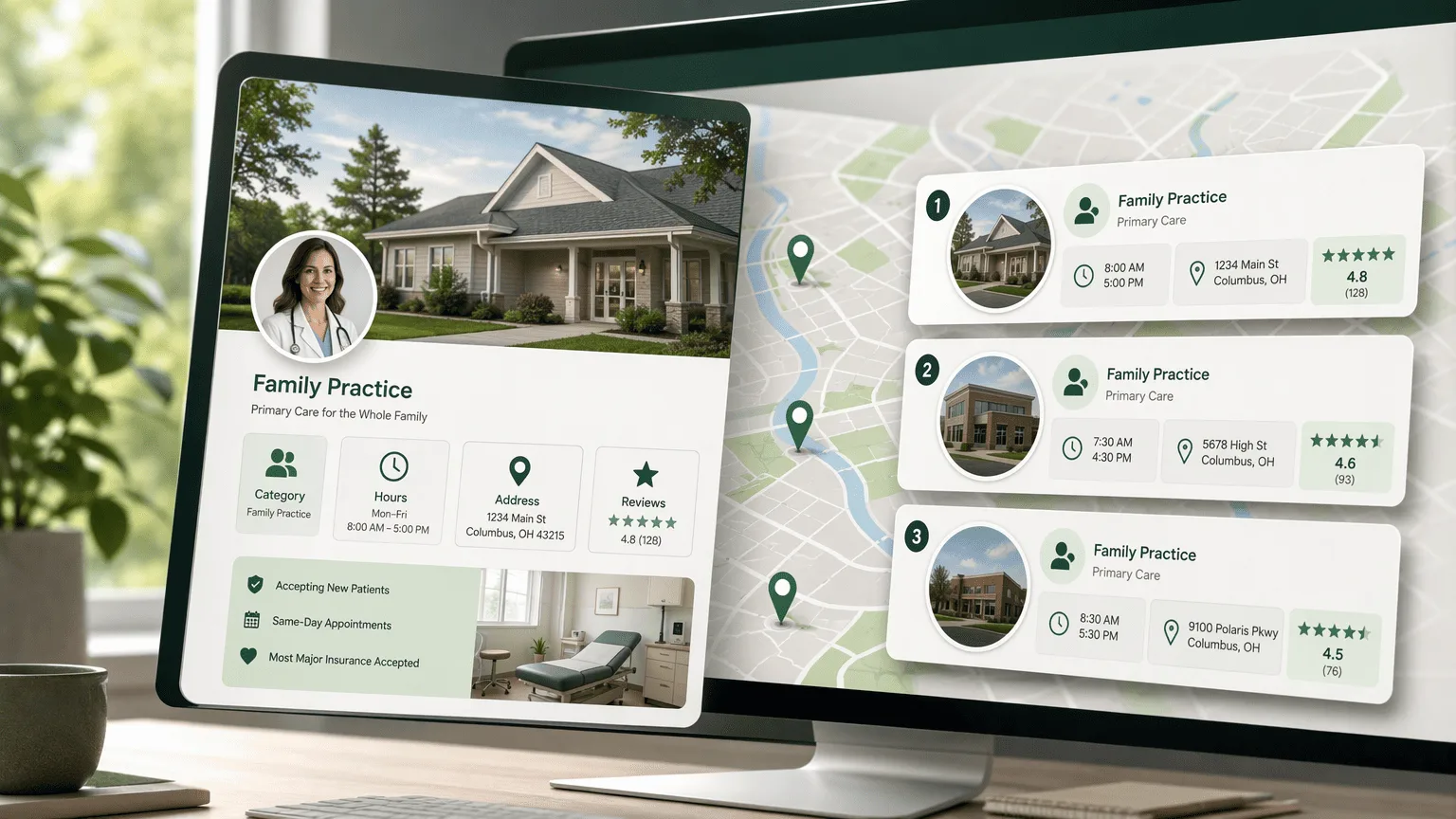
The map pack, those three listings that pin above the regular search results, is where your next patient decides. Local map results above regular listings get the majority of clicks for healthcare searches like 'family doctor near me'. If your profile is incomplete, you have already lost that traffic to a competitor who filled theirs out.
Open your profile now and set the primary category to 'Family practice physician'. Google ranks a practice by its primary category harder than any other on-page signal. Add every service you offer as a separate entry; do not stuff them into the description field where the algorithm ignores them. The Q&A section is free real estate: seed it this afternoon with the top ten questions your front desk answers by phone, then answer them as the business owner.
Profiles with recent photos get measurably more calls and direction requests. The calendar does not care if you feel like being on camera: a monthly cadence of ten fresh interior and team photos signals operational relevance to Google's algorithm. Skip the stock photography. A grainy phone shot of your actual waiting room outperforms a polished asset library shot of a model every time.
A tool like ClinAds manages this cadence, along with the other 200+ local signals, if you want the map pack won without the monthly maintenance sitting on your plate. The standalone profile work still produces results if you do it yourself systematically.
Step 2: Build One Dedicated Page for Each High-Value Service
Your website probably lists your services somewhere, but that list is a ghost at 10 p.m. when a parent types 'how much does a school physical cost near me.' Search engines do not pull answers from a generic 'Our Services' menu. They pull the page whose title asks and answers the exact question.
Build one page per service. The page for 'Annual Physical [Your City]' needs a plain-language cost range, practices that answer price directly convert far better than those that stay silent, a clear list of accepted insurance including Medicare and Medicaid plans like Molina, your provider’s credentials, and a 'Book Now' button at the top and bottom. For a clinic with no marketing team, this single-page-per-procedure approach remains the highest-ROI SEO tactic because it targets the high-intent, long-tail searches patients actually type.
Useful copy beats clever copy every time. A parent deciding between two clinics will pick the one that answered their questions without requiring a phone call. A tool like ClinAds can structure these pages so they contain the schema markup and semantic entities that Google and ChatGPT both read, giving you a shot at appearing in AI-generated search results as well as the traditional blue links.
Step 3: Set Up a Post-Visit Text Review System and Master HIPAA-Safe Responses
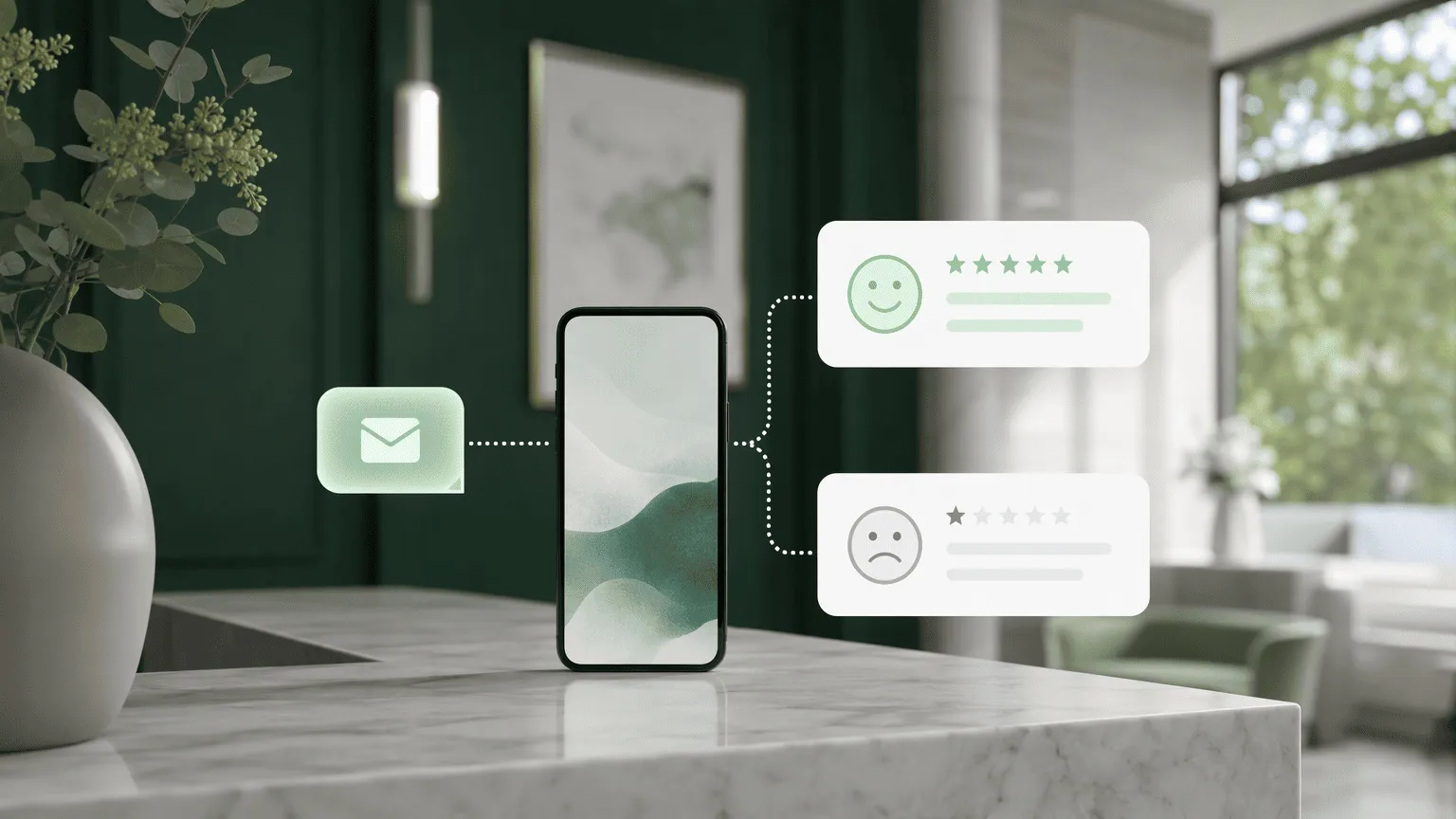
Responding to reviews without confirming a patient relationship is the entire game. The HHS red-line rule: never acknowledge the reviewer is a patient, never reference their visit, their condition, or your provision of care. You can respond to anyone who writes about your practice as a member of the public commenting on a business listing.
For a positive review, the template is simple: 'Thank you for the kind words. Our team works hard to make every visit feel this way.' For a negative review, move the conversation offline immediately: 'We take feedback seriously.
Please call our office manager at [number] so we can listen and correct the issue.' Never mention a date of service in either reply.
On the solicitation side, the workflow is tech-stack-agnostic: send a text with a direct review link within one hour of the patient’s appointment while the experience is fresh, and prioritize recency above all else. Two hundred reviews from 2021 lose to thirty from the last ninety days in influencing patient decisions and local pack rankings; the algorithm reads stale volume as a museum, not an active practice.
Step 4: Choose and Standardize the Healthcare Directories That Matter Most in Ohio
For an independent clinic in Ohio, three non-Google directories drive actual patient searches and profile checks: Healthgrades, Vitals, and Zocdoc. Claim and verify your profile on each at no cost, then standardize your NAP, name, address, and phone number, across every single listing. Inconsistencies confuse search engines and erode patient trust.
| Directory | Primary Function for Ohio Patients | Listing Checklist |
|---|---|---|
| Healthgrades | Checking provider credentials, ratings, and accepted insurance | Match NAP to Google Business Profile exactly; add provider bios and headshots |
| Vitals | Verifying a doctor’s patient satisfaction scores and wait times | Complete every field; a sparse profile makes a practice look abandoned |
| Zocdoc | Finding available appointments and booking online directly | Enable real-time scheduling if your EHR supports it; update insurance panels monthly |
Step 5: Create Content That Directly Answers Your Front Desk’s Daily Questions

Your content strategy already exists inside the front desk log. For one week, have your team write down every question a patient or prospect asks by phone about cost, insurance, or scheduling. The resulting list is your editorial calendar. Questions such as 'How much does a physical cost without insurance?', 'Do you accept Molina Medicaid?', and 'What vaccines does my 4-year-old need?' are not just calls to answer, they are full pages waiting to be built, each one a direct match to a high-intent local search.
These FAQ pages feed directly into Google’s 'People also ask' boxes, where your clinic can capture real estate without competing on a thousand-dollar keyword. The average cost per tracked patient call across clinics performing this systematically sits at $9.26. When you publish, structure the answer first in plain language, then provide the clinical detail. A caregiver with a sick child at 2 a.m. does not need a journal abstract; they need clear cost and next steps.
This method scales without a writer on payroll. Each page is genuinely useful content that proves the clinic understands the community it serves, not generic medical filler.
Step 6: Transform Word of Mouth Into a Trackable Patient Referral Program
Your existing referral engine works; it just operates in the dark.
- Create a non-identifiable referral card or custom link. Print cards with a 'Referred by' blank line and a QR code to a dedicated new-patient booking page; the system tracks the click-through without attaching the sender’s medical identity.
- Train intake on one question. The front desk asks every new patient, 'How did you hear about us?' and logs the exact answer in the practice management system as the intake source. No multiple-choice dropdown, verbatim responses reveal real influence.
- Audit the last 20 new patients monthly. A simple way to measure channel performance is to ask every new customer how they found you and record the answer in your booking system or CRM. This small-sample review tells you exactly which channels drive revenue, not just noise.
Step 7: Optimize Your Website for One-Tap Mobile Appointments
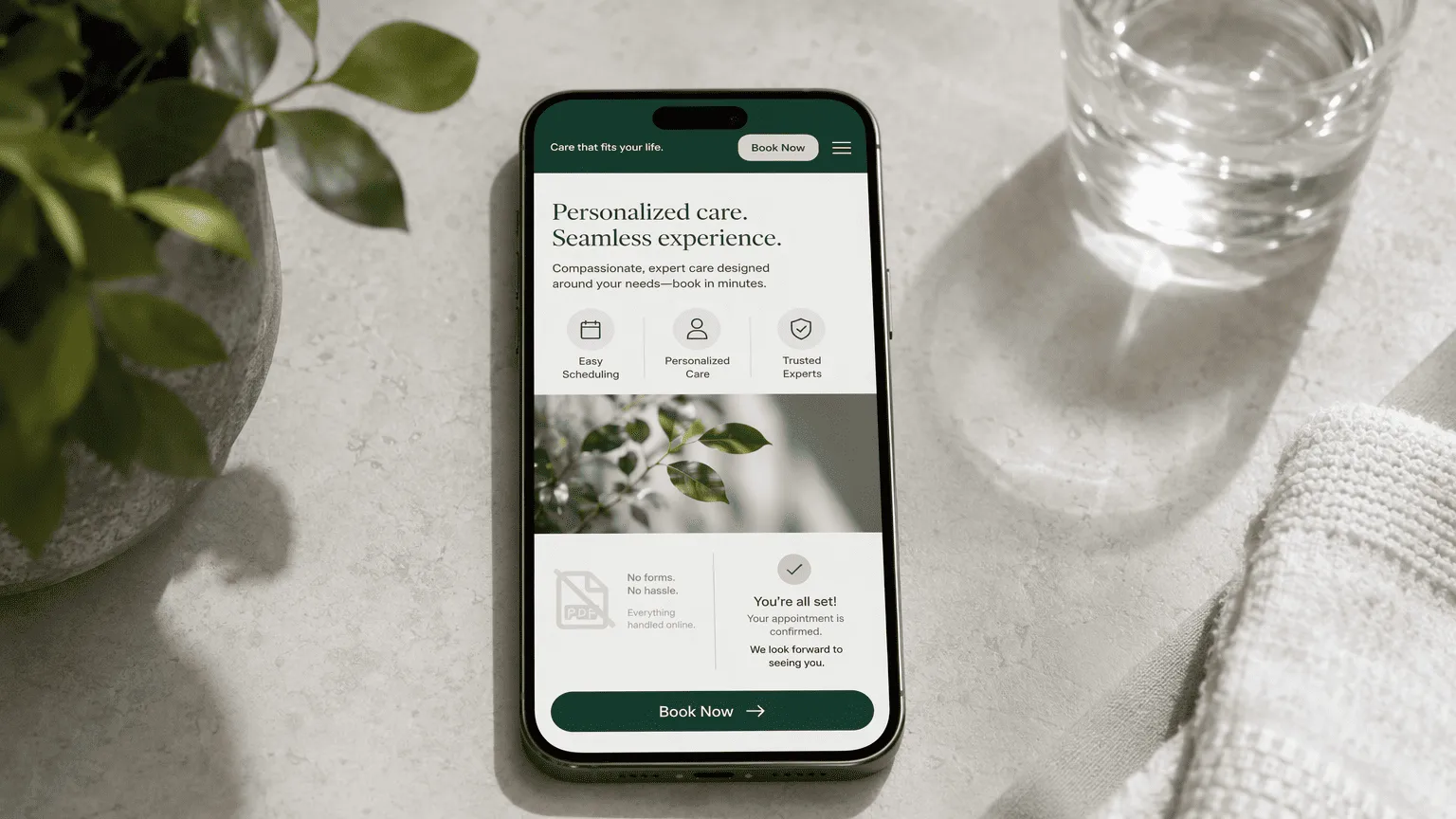
The majority of your new traffic lands on a phone, and most clinic websites still present a PDF intake form as the primary conversion action, that is a near-certain abandonment event. Replace every PDF with a responsive, one-tap 'Book Now' button pinned to the header and footer.
Wire that button directly into your scheduling tool so a patient can secure a slot in under thirty seconds without a phone call. The conversion lift from removing that single point of friction typically covers the cost of a lightweight site rebuild within a quarter.
Step 8: Calculate Patient Lifetime Value and Track Your True New-Patient Source
If you do not know what a new patient is worth over the full relationship, you cannot make a rational decision about marketing spend. A family practice patient who stays five years, returns for annual physicals, acute visits, and labs, and refers a neighbor is worth thousands, run the math and you will see how fast it climbs past a single visit copay. Calculate lifetime value for your clinic: multiply an average annual revenue per patient by the average number of years they stay with your practice.
Then apply the intake log from Step 6. Each month, divide total marketing costs by the number of new patients sourced from each channel to produce a cost per new patient number grounded in real revenue, not platform-reported conversions. Healthcare clicks are among the most expensive in advertising, often tens of dollars for implant, LASIK, and aesthetics keywords, and paying for them blindly without knowing your allowable acquisition cost is the fastest way to lose a marketing budget. Track the number that closes the loop, and every spending decision becomes arithmetic instead of hope.
Step 9: Differentiate With Provider Bios Tied to Ohio Community Roots

A regional health system can outspend you on search ads. It cannot replicate that your attending physician grew up in Toledo, trained at Ohio State, and volunteers at the county fair every August. Rewrite provider bios around that local truth to signal personal authority to patients and geographic relevance to Google’s E-E-A-T quality framework.
- Lead with the specific Ohio community tie. Name the doctor’s hometown, local university, and any board or volunteer service within the county.
- Replace board-certification laundry lists with plain-language credentials. After establishing the local root, list the residency and certification in a single line, not a wall of acronyms.
- Link bios outward to local institutions, the high school, the food bank, a shared employer. The Ohio Independent Collaborative brings together more than 1,200 primary care providers and specialists and offers Affiliate membership: independent physicians can now access group purchasing, direct-to-employer contracting, and best-practice EHR support previously available only to larger groups. Mentioning affiliation where true creates a network-of-trust entity signal that a generic CV cannot.
Conclusion
Your word-of-mouth reputation sets the floor for growth. It is the hardest asset to earn and the easiest to waste by leaving it invisible to a search bar. Moving it online is a systematic, measurable process: claim the profile that controls the map, build pages for the procedures people type at midnight, capture fresh proof with post-visit texts, and log the one intake metric that shows whether any of it worked.
The first move tomorrow morning is opening your Google Business Profile and setting the primary category to 'Family practice physician.' The rest of the system attaches to that single correct input. Once the infrastructure is live, you can run a controlled check with a platform like ClinAds to manage the signals that keep you visible across Google and AI search without turning you into a part-time marketing director.
Frequently Asked Questions
What are the most important first steps for a family clinic to build an online presence from scratch?
Make your first move tomorrow morning with these steps:
- Claim your Google Business Profile and set the primary category to 'Family practice physician', it is the strongest local ranking signal you control.
- Immediately add every service offered, upload ten real photos of the practice, and seed the Q&A section with the top questions your front desk answers daily.
Which local SEO tactics are most effective for medical practices in competitive US markets?
Building one dedicated service page for each high-value procedure (e.g., 'Annual Physical [City]') that includes cost ranges, insurance accepted, and a booking button. This single-page-per-procedure approach targets high-intent long-tail searches and is the highest-ROI SEO for a practice without a marketing team.
How can an independent clinic manage online reviews and patient feedback without violating HIPAA?
Reply to reviews without violating HIPAA rules:
- Never confirm a reviewer is a patient or reference their condition, visit, or your provision of care.
- For positive feedback, reply with a generic 'Thank you for the kind words, our team works hard to make every visit feel this way.'
- For negative reviews, respond with a request to call the office manager and move the discussion offline.
What concrete metrics should we track to know if our local SEO efforts are actually bringing in new patients?
Track only actual new-patient visits by source:
- Have the front desk ask each new patient 'How did you hear about us?' and log the verbatim answer.
- Calculate a cost per new patient by channel each month using real intake numbers against total marketing spend, not platform-reported clicks or calls.
How do we choose which healthcare directories and listings matter most for our clinic’s visibility?
Prioritize Healthgrades, Vitals, and Zocdoc in Ohio, patients actively search and verify credentials on these platforms. Ensure your practice name, address, and phone number (NAP) are a character-for-character match with your Google Business Profile across all three to avoid confusing search engines.
How does a practice with no marketing team create content that ranks for what patients are searching for?
Mine the front desk call log for the top ten recurring questions about cost, insurance (like Molina/Medicaid), and vaccine schedules. Publish each answer as a dedicated FAQ page or short blog post. This turns your most common phone inquiries into ranking content that captures new patients passively.
Sources
- Pricing: Clinic Marketing Software & SEO | ClinAds - getclinads.com
- Ohio Independent Collaborative - www.ohioindependentcollaborative.org
- Urgent Care SEO That Drives Patient Visits | Get A Digital Health Check - patientcaremarketingpros.com
- How to Get Customers Beyond Word of Mouth | Onward - www.alwaysonward.io
- How to Get New Patients: Medical Marketing | O360® - o360.com
Want help executing this for your clinic?
Book a 30-minute call and we will map what a real ad engine would look like for your specific service mix.
Book a call