Your GBP Is a Busy Front Door Your Website Can't Open
IntroductionYour Google Business Profile fills the waiting room while your website collects dust. The profile ranks in the Map Pack for "near me" searches all day long, 92% of patients read online reviews before choosing a dentist, yet the site you pay to host pulls almost no organic traffic. The problem is not that your clinic is invisible online. The problem is that your two most valuable assets act like strangers.
This disconnect has a straightforward cause. When a patient searches for "dermatologist near me" or "child specialist in [area]," Google shows the Map Pack, three local listings, above the organic results, and most local clicks go there. Your GBP answers that high-intent query and earns the click. The website sits lower, often invisible, because it was never optimized to rank for the same terms. What follows is the diagnostic playbook to bridge that gap, turning a strong local listing into a traffic engine that owns both the Map Pack and the organic page.
Key Takeaways
- Google Business Profile and your website answer to two different algorithms, and ignoring one starves the other. Treat them as a single patient-acquisition engine, and the payoff compounds.
- Separate ranking entities. A GBP ranks on relevance, distance, and prominence in the Local Pack. Your website needs its own technical signals and content depth to rank organically. Neither props up the other by default.
- NAP inconsistencies kill momentum faster than any other mistake. When your Name, Address, and Phone data drift across directories, search engines read it as a relevance problem and discount everything your profile has built. This is the repair that pays for itself the fastest.
- Posts convert profile views. Regular Google Posts that link to specific, optimized service pages on your site are the bridge between a busy listing and actual website traffic. Skip the generic contact form. The posts that work point a viewer straight to the exact treatment page they were already looking for.
- The 2026 content standard has shifted. AI-optimized FAQ content, seeded Q&A on your profile, and fresh imagery now separate the clinics that get found from those that get scrolled past. A profile with stale photos and unanswered questions looks abandoned.
- Fifteen minutes a week beats most campaigns. Fifteen minutes a week on this recommended routine outperforms most paid campaigns a small clinic could run. The cost of inaction is far higher than the time investment.
The Google Business Profile vs. Website Traffic Disconnect

Your GBP converts "near me" lookers, but your website needs to earn a completely different kind of attention. Google says local results are based mainly on three things: relevance, distance, and prominence. Filling out your profile, collecting reviews, and picking the right category prove those three signals. That gets you the Maps listing.
Organic rankings, the blue links below, don't care about your profile's review count. They evaluate page structure, internal linking, keyword targeting, and site authority. Organic search drives 51% of all visitors to B2B and B2C websites, while social media contributes only 5% of traffic.
For business services, that number leaps to 73% of all traffic from organic search. Your clinic's GBP traffic is valuable because it is local and immediate, but the organic channel is where sustainable patient acquisition volume lives.
A profile that gets all the clicks while a site gets ignored tells you the local intent is there. What is missing is the site's native authority.
The Technical Website Failures That Kill Clinic Traffic
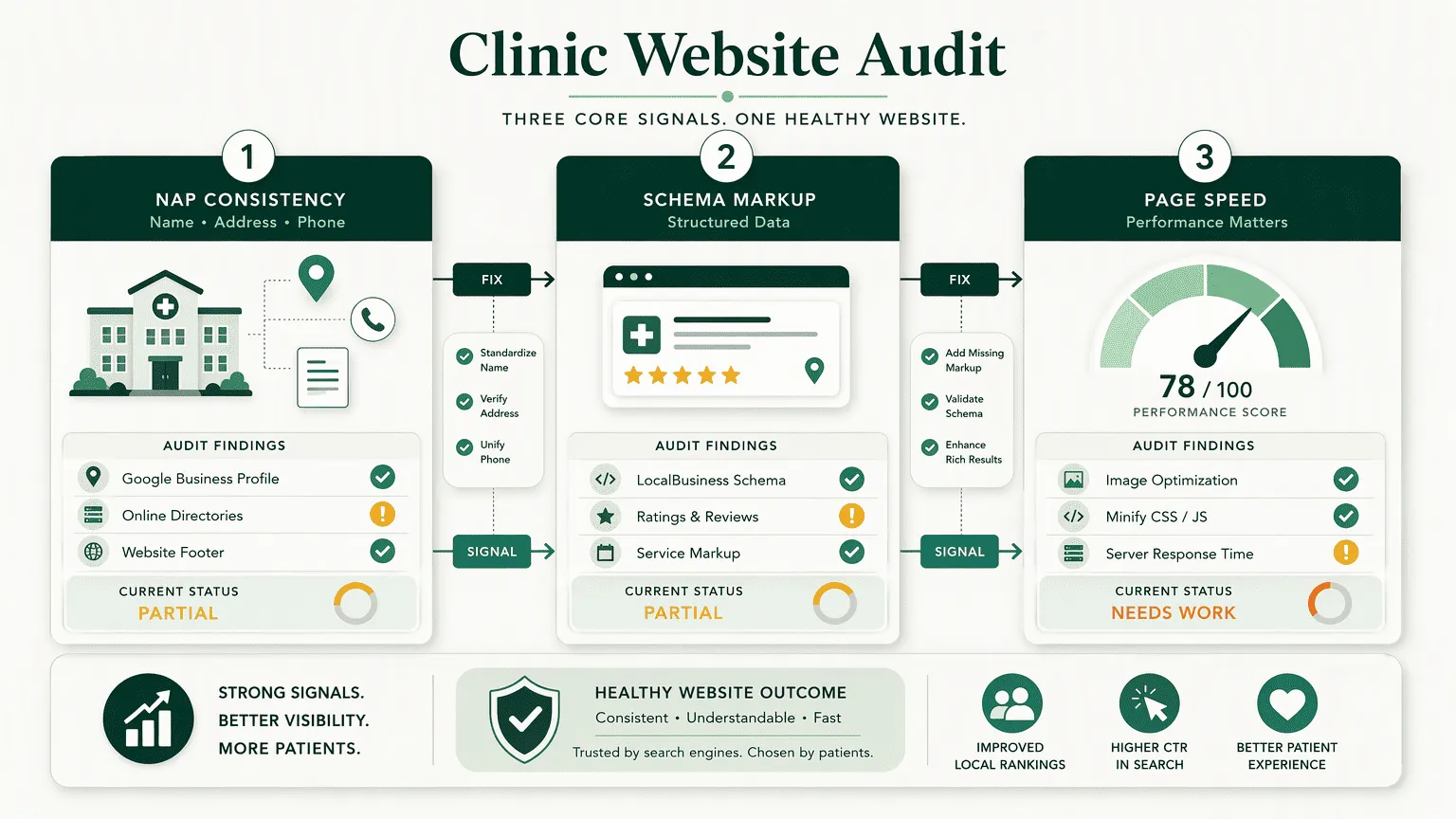
Most clinic websites fail a three-part technical assessment before a single word of content gets judged. The table below maps the most common failures to the specific fix and the authority signal it restores.
| Failure | Symptom | Fix | Signal It Restores |
|---|---|---|---|
| Inconsistent NAP Data | Directory listings show an old address or different phone format | Standardize and distribute exact NAP across all properties | Consistency (trust) |
| Missing Schema Markup | Search engines cannot identify you as a local medical business | Deploy LocalBusiness and Physician schema with specialty detail | Entity understanding (relevance) |
| Unoptimized Service Pages | Every page targets "our services" with no distinct keyword | Build separate pages targeting specific treatments with headers and localized terms | Topical authority (ranking depth) |
Category, NAP, and profile fixes can influence local ranking within a few weeks. The site-side fixes take longer because they are about building persistent equity. Orphaned and duplicate therapist profiles are among the most common problems found during audits, often unknown to the owner. You can use a tool like ClinAds to scan your technical foundation, but the operational fix must be manual: audit every directory listing, add schema to every page template, and rewrite placeholder service copy.
How GBP Activity Directly Powers Your Website's Organic Rankings
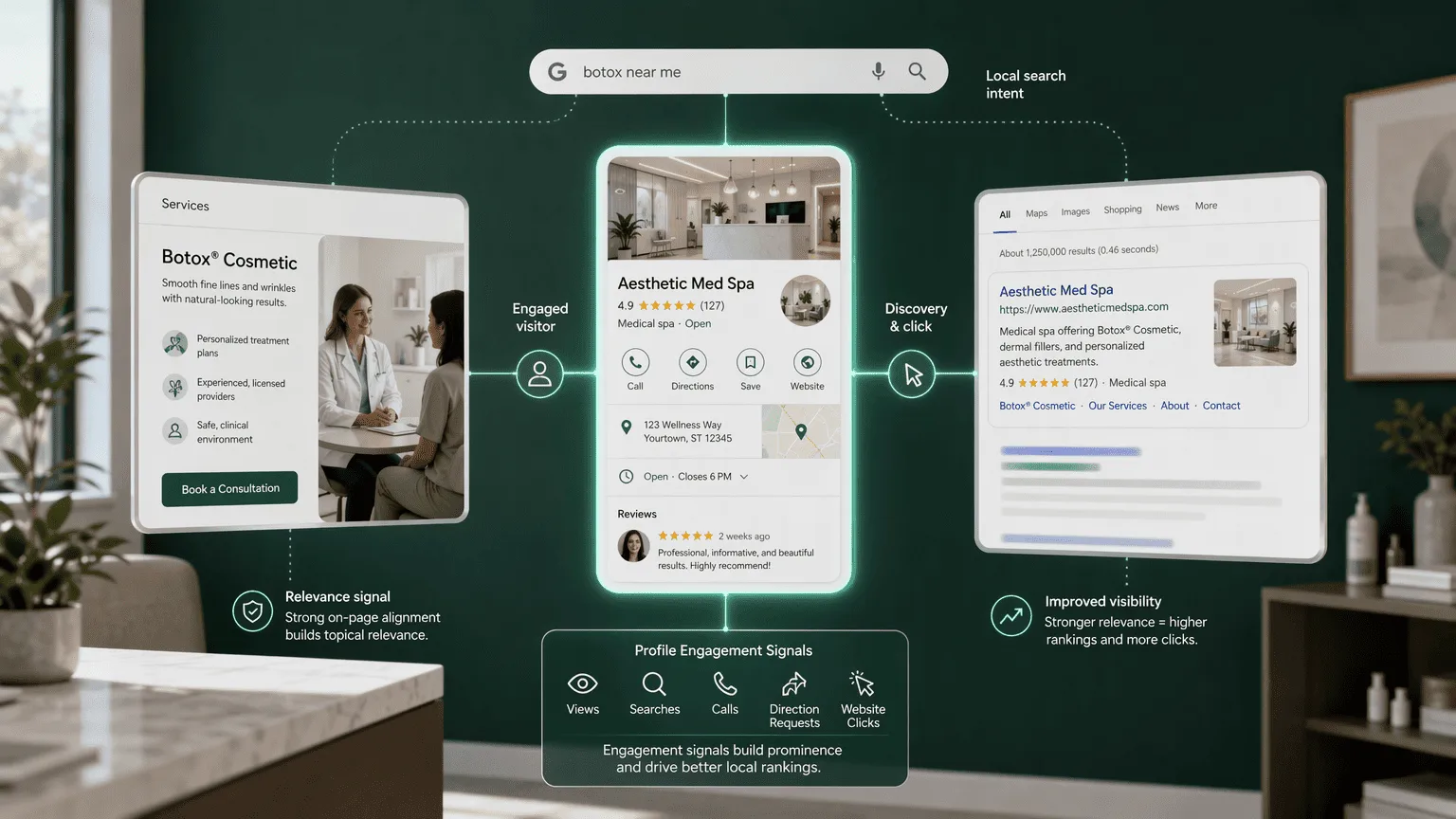
Google's local algorithm uses engagement signals from your GBP to inform organic relevance for location-specific queries. Calling these signals separate systems is technically correct but practically misleading. An active profile catches demand. A dormant one lets it pass by.
Publish regular Google Posts. Each one should link to a specific website service page using anchor text that mirrors the query intent. A post about sports injury recovery links to the sports PT page.
The homepage gets you nothing here; the page built for that exact need wins the click. A consent-based post-visit review request and responding to every review within about 24 hours is the highest-impact ongoing GBP activity a clinic can do. Reviews feed the profile fresh, localized content that Google indexes, and your public response signals active management.
Keep the cadence steady over 60 to 90 days. That consistency compounds into the kind of local prominence that lifts your Map Pack position and your organic service-page rankings together. Business services sites receive less than 20% of their traffic from display, email, and referred sources combined.
Your Google presence is the demand aggregator. Linking it to deep site content is how you capture the traffic those other channels never send a clinic.
Turning Profile Views Into Patient Appointments: The Conversion Bridge
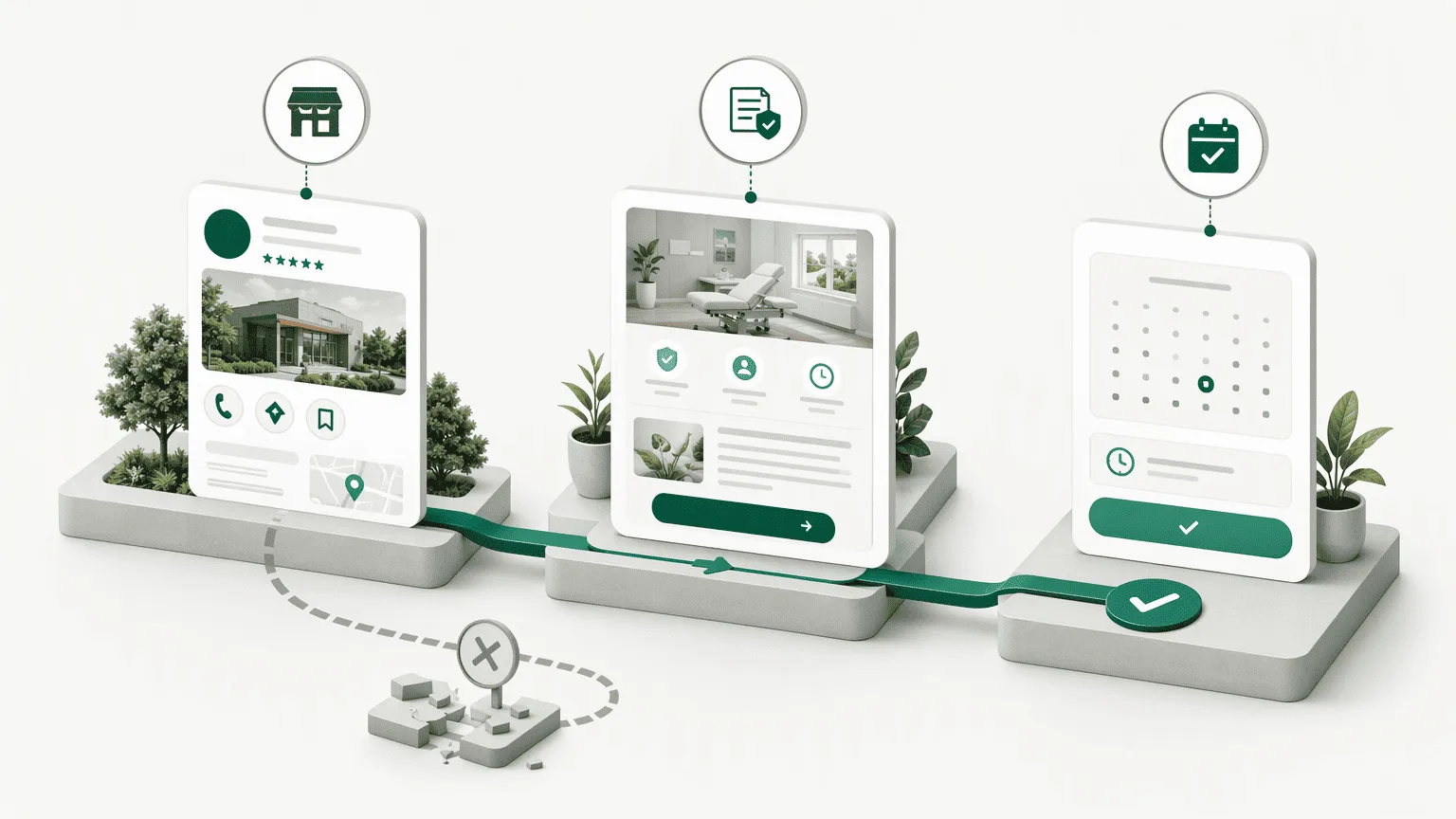
Traffic is vanity. Appointments are the metric. Most clinics lose the handoff between a Google Business Profile impression and a booked patient because they send every click to the same homepage and cross their fingers. The table below contrasts a broken conversion path with a functional one.
| Element | Broken Setup | Conversion Bridge Setup |
|---|---|---|
| GBP Call-to-Action | Call Now button only | Direct booking link, messaging enabled, dedicated appointment URL |
| Landing Page Destination | Homepage or generic contact page | Specific service page matching the Post or query intent |
| Mobile Load Experience | >3 seconds, forms require pinch-and-zoom | Sub-2-second load, thumb-tappable CTA, no scrolling to convert |
| Review-to-Appointment Pivot | No response, no link | Response within 24 hours with a direct scheduling invitation |
61% of mobile dental searches lead to a phone call within an hour. High intent means speed decides the sale. Add direct booking and messaging links to your GBP so patients can act in one tap. The page that receives that tap should be stripped down: one headline matching the query, one compliant CTA, and zero competing offers. If a patient lands on a service page for dental implants and sees a link to teeth whitening and veneers, you leaked the conversion.
whatchangedandwhyyouroldplaybook_failed
The stakes have shifted. In 2026, your website content must satisfy two masters that historically competed: the AI-driven search engine and the medical advertising regulator.
The most effective strategies to remain visible and compliant center on AI-optimized FAQ content. Stop thinking of this as keyword stuffing. It means building pages around the exact question format patients speak into their phones: "how much does physical therapy cost without insurance [city]" or "when should I see a specialist for back pain."
Answer those questions in plain, 40 to 60-word blocks at the top of each page, then expand with clinical detail. Seed your GBP Q&A section with the same questions and provide public, clear answers. The search engines scrape this Q&A text.
AI Overviews and voice assistants pull from it. An FAQ page optimized this way can capture question-based searches that were invisible to your clinic last year.
The compliance boundary is non-negotiable. Your content must never contain superlatives like "best," "top-rated," or any phrase that promises a specific outcome. "Restore mobility within two weeks" is prohibited.
"Our physical therapists design recovery programs that typically show progress within several sessions" is specific, defensible, and safe. Fresh, authentic photos of your actual clinic and staff, updated every quarter, signal recency to Google and build the trust that reviews reinforce.
Local provider queries have remained largely free of AI Overviews, making Google Business Profile the primary local visibility channel for the foreseeable future. The playbook is to win the Map Pack first, then feed the website with the same compliant, question-based authority.
Conclusion
A low-traffic website sitting below a high-performing Google Business Profile tells you the local demand is real and the Google connection is alive. The failure is in the handshake. Fix the technical signals, make every Post a bridge to a dedicated service page, and reorient your content toward answer-first, compliant formats. The two assets stop competing for attention and start compounding. The trade-off: 15 focused minutes a week on the right routine outperforms a year of hoping the profile alone will carry the practice.
Frequently Asked Questions
Why is my Google Business Profile attracting customers but my clinic's website gets almost no organic search traffic?
Your GBP ranks in the Local Pack for high-intent "near me" searches using Google's separate relevance, distance, and prominence signals. Your website ranks through a different algorithm that judges technical structure, content depth, and backlinks. A strong profile does not automatically grant organic ranking power to your site.
What specific SEO issues on a medical clinic website cause it to fail to rank even when the GBP performs well?
The most common failures are three specific gaps that signal irrelevance to the organic algorithm even while your GBP collects reviews and Maps clicks:
- Inconsistent Name-Address-Phone data across directories.
- Missing local business and medical specialty schema markup.
- Generic service pages that target no distinct keywords.
How can a local clinic convert GBP profile views into actual website traffic and appointments?
Add direct booking and messaging links to your profile. Publish weekly Google Posts that link to a specific, stripped-down website service page matching the post's topic, not the homepage. Respond to every review within about 24 hours to boost profile prominence and drive more click-through volume.
Does having a strong Google Business Profile reduce the need for a clinic website, or should both be optimized together?
A strong GBP does not replace the website. Organic search drives 51% to 73% of all traffic for business services sites. The profile captures immediate local intent. The website is the conversion asset that ranks for broader treatment queries and captures the long-tail search volume the GBP cannot reach. Both must be optimized to work in sequence.
What are the most effective strategies a US clinic can use in 2026 to increase organic website traffic without breaking patient privacy rules?
Publish AI-optimized FAQ content structured around voice-search question formats, free of superlatives or outcome guarantees. Seed the GBP Q&A section with the same patient questions. Use authentic, current clinic photos. This approach feeds both AI-generated overviews and traditional organic rankings without crossing compliance boundaries.
How long does it take to see website traffic improvement after fixing technical SEO and GBP integration issues?
Category, NAP, and profile corrections can shift local visibility within a few weeks. The compounding effect of regular posts, review responses, and site content optimization typically materializes into measurable organic traffic gains over a 60 to 90 day window, not overnight.
Sources
- Clincy Case Study: 1.14K Google Impressions in 30 Days | ClinAds - getclinads.com
- Local SEO in 2026 for Physical Therapy Private Practices: How Google Decides Which Clinic Gets the Patient - E-rehab - www.e-rehab.com
- Study: Organic Search Drives 51% Of Traffic, Social Only 5% - searchengineland.com
- Google Business Profile for Clinics: Local SEO Checklist 2026 | PMS - publicmediasolution.com
Want help executing this for your clinic?
Book a 30-minute call and we will map what a real ad engine would look like for your specific service mix.
Book a call