
The Three-Pillar Strategy That Makes Retail Optical Chains Irrelevant in Seattle
IntroductionThe problem is that you're trying to beat LensCrafters and Warby Parker at the one game they've rigged. National optical chains outspend your entire annual marketing budget on a single month of paid search. Online retailers are taking your optical and contact lens revenue while you watch patients walk in, take their prescription, and order elsewhere for $12 less.
The wrong question is: how do I spend more to compete? The right question is: where can they never follow? Chains and big-box opticals often outrank independent practices in local search when they run blanket PPC campaigns, but large retailers almost always lose the local map pack to independent practices with real reviews, complete profiles, and strong local content. They cannot replicate clinical expertise, professional fitting, or relationships that often last for years. One of the biggest ongoing pressures optometry practices face is competition from large retail optical chains and mass merchandisers, but the game flips when you stop competing on ad spend and start competing on factors retail chains are structurally incapable of offering.
Independent optical practices win on three pillars no chain can touch: search dominance driven by local relevance rather than budget, AI-powered convenience that connects directly to in-person care, and a hyper-local brand moat built from authentic community presence. This is the architecture for making your Seattle practice the default choice in a market where patients actively want a real optometrist but keep getting served chain ads.
Key Takeaways
Here is what separates the practices winning against retail optical chains from the ones losing revenue by the week:
- Local SEO supremacy: A fully optimized Google Business Profile and consistent review generation outrank national ad budgets in the map pack every time. Most practices see meaningful movement in the local map pack within three to six months from starting structured SEO.
- Reviews are the trust currency: Independent practices win on reviews, provider reputation, and specialty services, the three signals Google weights heaviest and chains routinely neglect.
- AI matches 24/7 convenience: Chatbots, virtual try-on, and automated recall fill the service gap chains exploit without replacing the doctor-patient relationship that patients actually want.
- Community is the unbreachable moat: Seattle-specific content and local sponsorship build emotional brand attachment that a templated national ad will never copy.
- Price comparison is a losing frame; total value is not: Patients do not choose eyewear based on price alone, they care about fit, comfort, lens quality, professional advice, and what happens when something needs adjusting.
Step 1: Dominate the Seattle Google Map Pack with Hyper-Local SEO
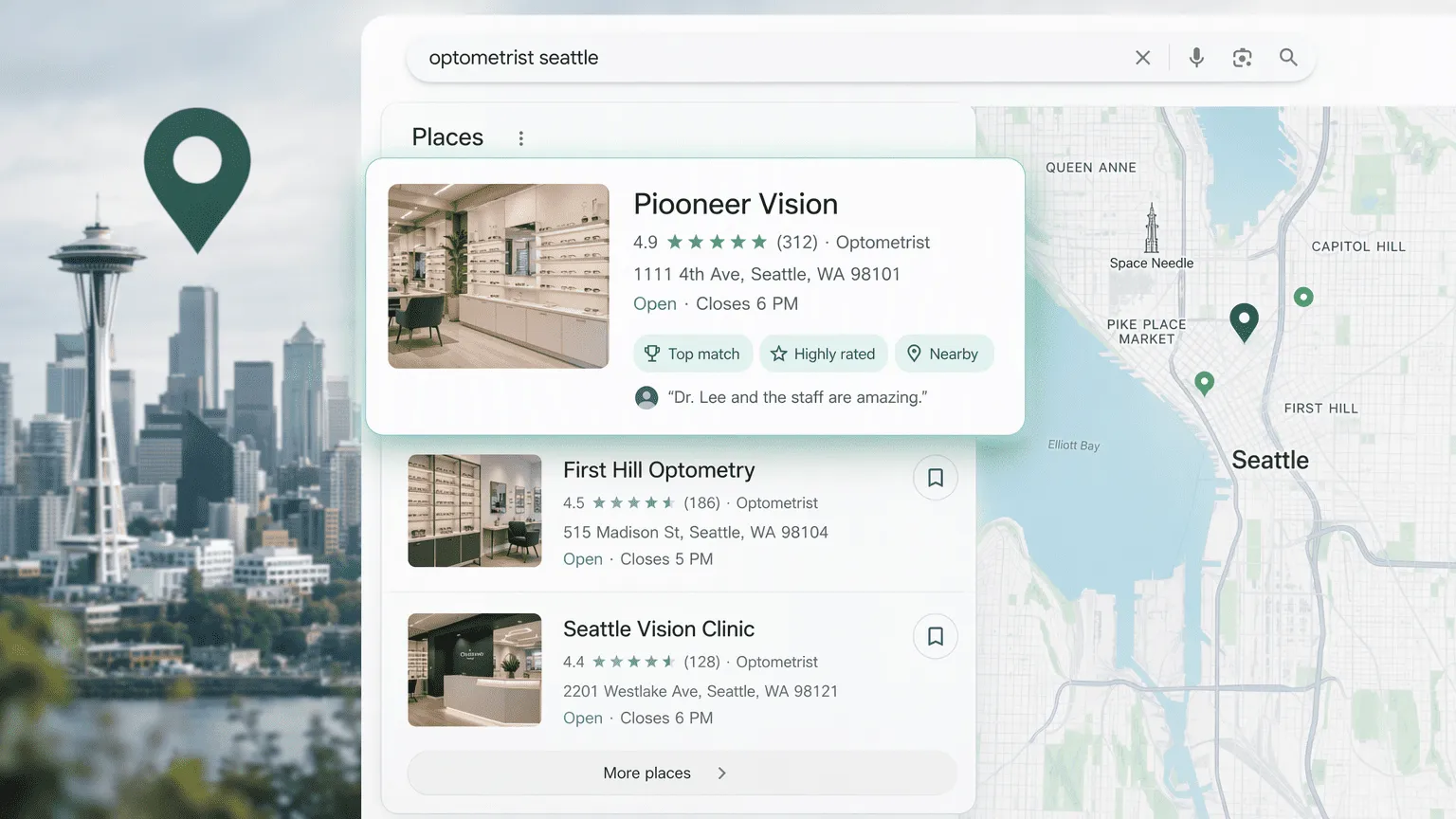
The single highest-ROI tactic for a Seattle practice competing with retail giants is owning the Google Map Pack. A fully optimized Google Business Profile is the map-pack king, and it costs roughly zero media dollars to win. Local visibility usually improves in 60 to 90 days, and appointment growth tends to build over 3 to 6 months. That is the timeline for displacing a LensCrafters listing that sits above yours purely because nobody ever optimized your profile.
The optimization stack is specific. NAP consistency, name, address, phone number, must be identical across your website, your GBP listing, and every directory that scrapes practice data. Audit this first because a single inconsistent suite number fractures the signal.
Next, your business description needs Seattle neighborhood keywords: not "optometrist near me," but "optometrist in Ballard specializing in myopia control" or "eye exams in Capitol Hill with same-day glasses." The chains write generic descriptions for 800 locations. You write one that reads like your neighborhood.
Geo-tagged photos matter more than most practices realize. Upload images of your storefront on a rainy Seattle street, your exam rooms, your frame gallery with local art on the walls. Post weekly Google updates, tie them to Seattle events (a Bumbershoot eye safety reminder) or seasonal eye-health topics (dry eye when the indoor heating kicks on in October). Seed your Q&A section with real patient questions and answer them like a doctor.
The payoff is direct. When a Seattle patient searches "eye exam Seattle" on a phone, the map pack gets the click before any paid ad. A practice with 40 recent reviews and a complete profile takes that click from a chain with a million-dollar national budget, every time.
Step 2: Weaponize Patient Reviews to Outshine Retail Giants
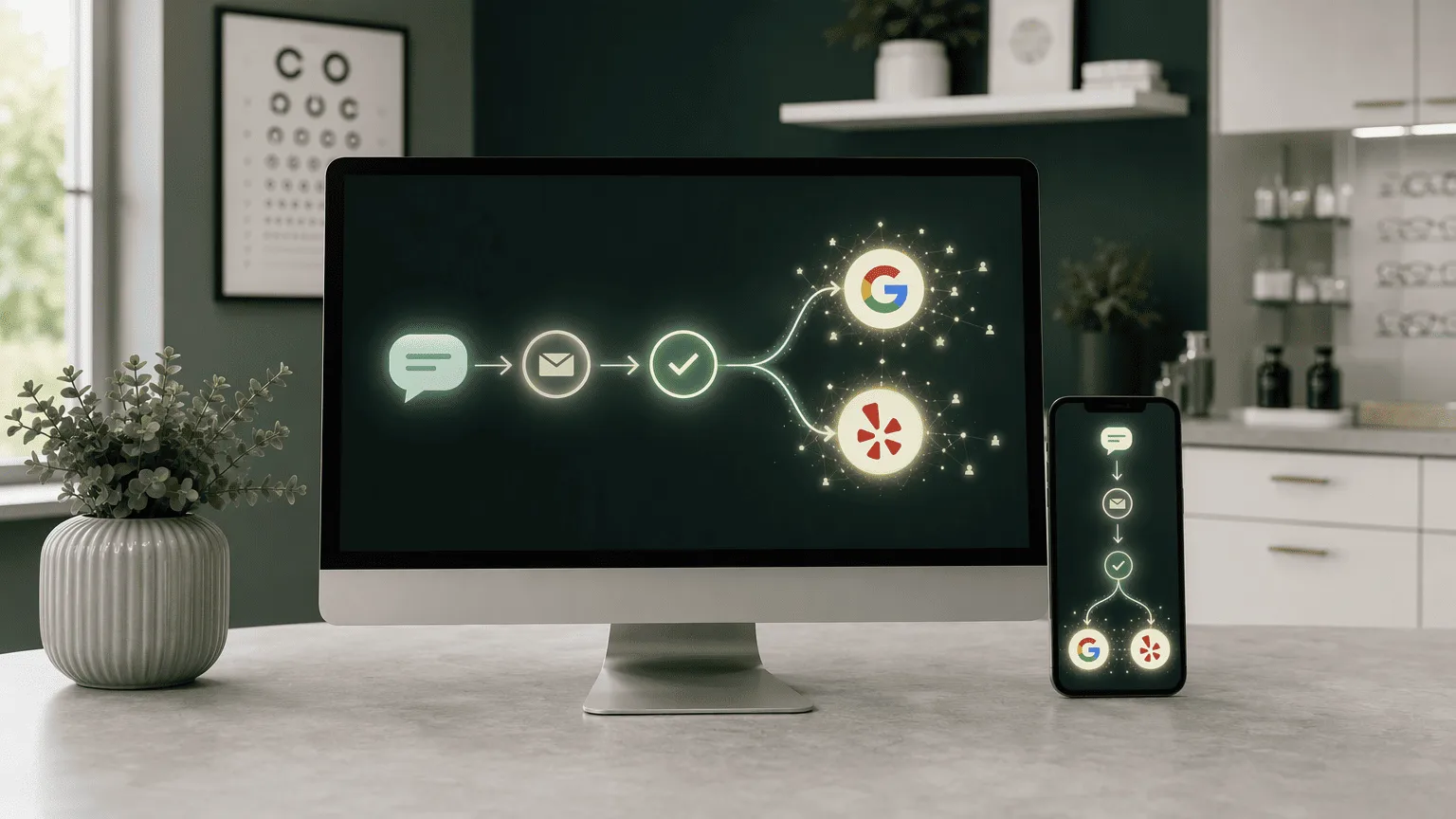
A steady stream of authentic Google and Yelp reviews is the strongest local reputation signal in optometry, period. Chains get reviews organically, but they rarely generate them systematically. Their corporate compliance departments make the process slow and impersonal. You can build a review-generation workflow that produces ten times the velocity of your nearest big-box competitor without anyone from legal reviewing your SMS copy.
The mechanics are straightforward. Send an SMS or email to patients within two hours of their appointment, while the dilated exam is still a vivid memory, with a direct link to your Google review page. Do not send them to a landing page that asks them to choose a platform. Send them straight to Google. For the patients who had an exceptional experience, ask specifically: "Your five-star review helps other Seattle families find us."
Respond to every review, good or bad, within 24 hours. Chains fail here. A LensCrafters employee does not have the emotional investment to write a response that mentions the patient's name or references their specific frame selection. You do. A public response that says "Sarah, glad the new daily lenses are working for your dry eye, we'll see you in Ballard for the six-month check" is a conversion signal for every prospective patient reading reviews before booking.
One practice increased its eyewear capture rate by more than 20% over 4 years through specific reputation-building actions, and another achieved a 100% increase in second-pair sales by implementing strategies that included aggressive review management. The map pack algorithm weights review volume, recency, and response rate far more heavily than ad spend. You compete here with clinical authenticity, and you win.
Step 3: Deploy AI-Powered Convenience Without Losing the Personal Touch
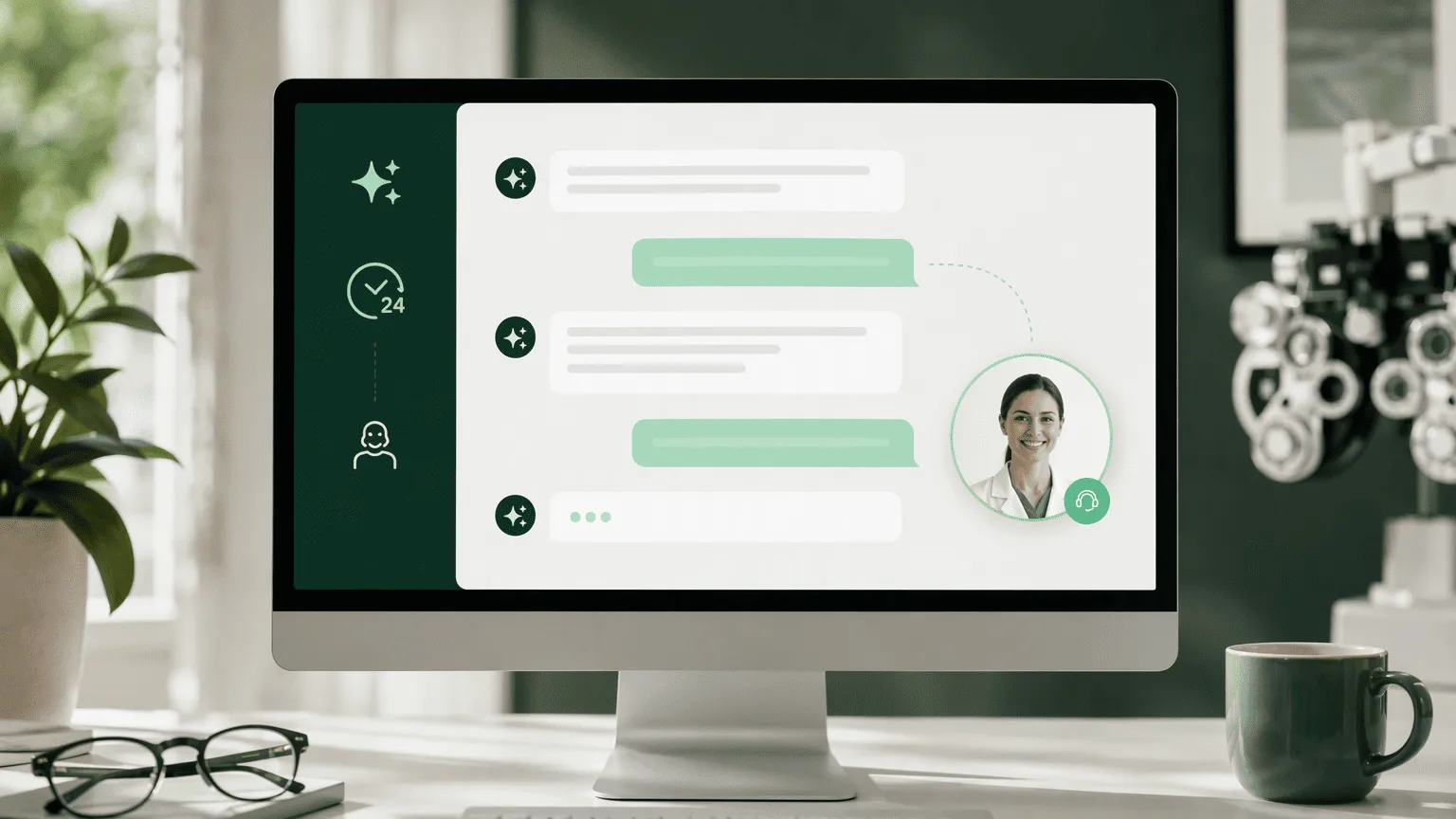
Chains win on hours and automation. An AI assistant can answer routine questions immediately using information approved by the practice, effectively giving your website the same 24/7 responsiveness as a Warby Parker chatbot, but connected to a real clinical destination. It protects your doctors' time for clinical work.
Deploy a website chatbot that handles the high-volume, low-complexity queries: "Do you take VSP?" "Can I reuse my old frames with a new prescription?" "What's the turnaround on progressives?"
Configure it to escalate to a human for anything involving medical symptoms. AI can also spot a cancellation, find suitable patients on the waiting list, and offer the available appointment slot immediately.
The tool follows rules set by your practice for appointment type, duration, and practitioner availability. That is a revenue recovery tool wearing a convenience label.
Add a virtual frame try-on tool on your website. Virtual try-on helps patients explore appearance; it does not confirm physical fit or prescription suitability. A patient pre-selects frames online, walks into your practice, and you verify the bridge fit, the PD, the lens compatibility.
They got the Warby Parker browsing experience. You delivered the professional fitting no online-only retailer can. The AI tools are the bridge to the in-person expertise that chains cannot replicate.
Step 4: Integrate Tele-Optometry and E-Commerce to Match Chain Retail Online
The goal is concierge convenience: the patient buys online easily but receives doctor-verified fit and care. Three integrations close the convenience gap:
- E-commerce for contacts, lenses, and dry-eye supplies: Build or integrate a click-and-collect platform. Patients reorder their prescribed contact lens brand or artificial tears through your website at competitive prices, but the order routes through your practice for professional verification. Implementing a contact lens ordering system increased one practice's sales by 30%, revenue those patients previously took to 1 to 800 Contacts.
- HIPAA-compliant tele-optometry for follow-ups and triage: Offer video visits for contact lens checks, post-operative follow-ups, and red-eye complaints. This keeps revenue in your practice and prevents urgent-care leakage. A patient with a weekend eye issue gets a five-minute tele-visit with you instead of a $300 urgent-care bill and a referral to a chain.
- Frame try-on with in-practice handoff: As covered in Step 3, the online virtual try-on funnels patients directly to a professional fitting appointment. The platform captures their preferences; you capture the optical sale with verified measurements and lens optimization a virtual cart cannot deliver.
Step 5: Build a Hyper-Local Brand Moat with Clinical Expertise and Community Content

The most valuable digital asset a Seattle optometry practice can own is content no national chain will ever publish. Chains maintain templated blogs with generic "how to choose sunglasses" posts syndicated across 600 locations. They will never write about what alder pollen is doing to Capitol Hill patients' eyes in March.
Build a local content calendar. March through May: "Seattle Eye Allergies: Alder and Cottonwood Season Survival Guide." October through February: "Why Your Dry Eye Gets Worse When Seattle Indoor Heating Kicks On: A Winter Care Protocol."
July: "Protecting Your Eyes on Puget Sound: UV, Glare, and Boat Deck Safety." Each article targets local search terms no chain has claimed and positions your practice as the neighborhood clinical authority. Google's 2026 algorithm rewards topical depth tied to a geographic signal far more heavily than domain authority alone, specialty service lines like dry eye or myopia control are often a practice's best source of growth.
Community engagement deepens the moat. Sponsor the Fremont 5K and provide free sunglasses with your practice logo. Run vision screenings at the Ballard Farmers Market one Saturday a month.
Partner with a Greenwood elementary school for pediatric vision days and make sure the PTA Facebook page mentions your practice by name, that mention is a backlink Google values more than a paid directory listing. Feature real Seattle patient success stories on your blog and social channels: "How Marcus, a Kirkland software engineer, finally solved three years of contact lens discomfort."
The patient's neighbor reads that story. It works as marketing because every detail is true.
A chain buys community presence with a campaign budget. You live in yours. The average practice logs between 2,500 and 3,500 patient visits per optometrist per year, each visit is an opportunity to generate another authentic touchpoint a chain employee is never instructed to create.
Step 6: Frame the Value Conversation to Win on Total Cost, Not Sticker Price
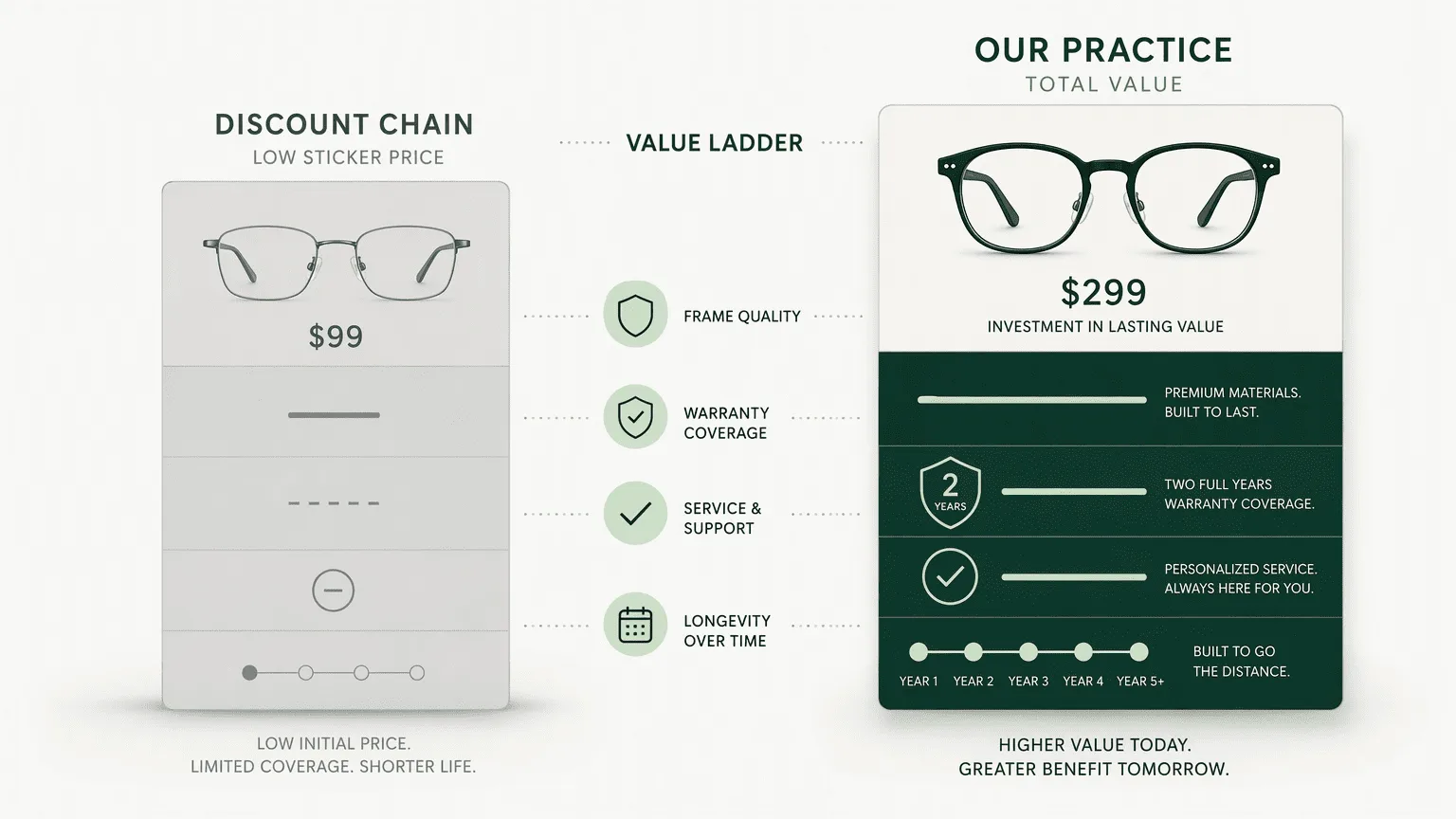
A patient compares your $250 exam-and-glasses package to a chain's $149 offer and chooses the chain. The problem is not your price. The problem is that nobody ever explained what happens eighteen months later. Here is the value-comparison framework that resets the conversation.
| Cost Factor | Discount Chain | Your Practice |
|---|---|---|
| Initial Sticker Price | $149 | $250 |
| Frame Durability and Warranty | Basic acetate frames with a 90-day limited warranty against manufacturer defects. | Premium titanium or hand-finished acetate frames with a 2-year unconditional breakage warranty. |
| Lens Technology Included | Standard uncoated CR-39 plastic lenses with no scratch protection. | Fully multi-coated digital freeform lenses with anti-reflective, scratch-resistant, and UV treatments. |
| 18-Month Replacement Cost | Frames typically show finish wear or temple loosening; out-of-warranty replacement runs another $149. Scratched lenses require an entirely new pair. | Warranty covers frame breakage outright. Lens coatings backed by a 2-year scratch warranty, eliminating out-of-pocket lens replacement within the coverage period. |
| Prescription Accuracy and Remakes | Single-vision measurement with a high remake rate due to adaptation issues or interface blur; each remake visit wastes 45 minutes. | Digital centration measurements and freeform optics cut peripheral distortion; remake rate under 2%. If needed, no-charge courtesy remake within 60 days. |
| Long-Term Vision Health Cost | Skipped retinal imaging or OCT screening can miss early-stage glaucoma or diabetic retinopathy, leading to tens of thousands in delayed-treatment costs. | Annual thorough eye health exam included with optomap retinal imaging and OCT scans; early detection saves a median $6,000 per condition over five years (Prevent Blindness, 2022). |
| True 3-Year Cost | $149 multiplied by at least three purchases as frames and lenses fail, plus the risk cost of undetected pathology. Total: $447+ and uncompensated health risk. | $250 initially, with a replacement pair at a loyalty-program discount of $150 only if lost or dramatically abused. Total: $400, with preserved eye health. |
Conclusion
Retail optical chains can outspend you on paid search and undercut you on frame pricing. They cannot win the local map pack against a Google Business Profile with 60 five-star reviews, weekly Seattle-specific posts, and geo-tagged images of real exam rooms. They cannot replicate a chatbot that books appointments at midnight while preserving the doctor's clinical availability. And no corporate marketing department will ever produce an alder-allergy guide for Capitol Hill or sponsor a Greenwood school vision screening.
The triadic strategy is self-reinforcing: local SEO dominance feeds review volume, reviews build trust that converts e-commerce and tele-optometry browsers into in-person patients, and community content generates the authentic backlinks and social signals that Google's algorithm interprets as authority. Start with the Google Business Profile audit and the first five reviews this week. You can use a platform like ClinAds to ensure your practice surfaces across Google, ChatGPT, Gemini, and Perplexity when Seattle patients search for eye care, the same engine that generates 13.2K Google impressions for its own site without a corporate PPC budget behind it.
Want to see what your first month of content would look like? Book a 30-minute intro call.
The chain down the street cannot out-local you. Do not let them out-market you.
Frequently Asked Questions
What are the most effective local SEO strategies for an independent optometry practice to outrank national retail chains in Seattle?
Optimize your Google Business Profile with exact NAP consistency, Seattle neighborhood keywords in the business description, geo-tagged photos, and weekly Google Posts tied to local events or seasonal eye health. Generate a steady volume of Google reviews and respond to every one within 24 hours. Most practices see meaningful map-pack movement within three to six months.
How can an independent optometrist differentiate their brand experience online compared to large optical retailers?
Differentiate on clinical depth and locality rather than on price or ad volume. Publish Seattle-specific content, allergy guides for cedar season, winter dry-eye protocols, and feature real patient stories. Integrate AI convenience tools like chatbots and virtual try-on that lead patients to a professional in-person fitting, which no online-only retailer can provide.
Which digital channels (Google Business Profile, social media, paid ads) offer the highest ROI for a local eye care practice competing with corporate budgets?
The Google Business Profile offers the highest ROI because it costs media zero dollars and directly influences map-pack placement. Search-optimized local content and systematic patient review generation follow closely. Paid search, without a fully optimized organic and local presence, often burns budget by competing against chain-level spend on generic terms.
What role does patient review generation and reputation management play in competing with big optical chains in 2026?
Reviews are the strongest Google ranking signal and the primary trust currency for new patients. Independent practices can generate reviews systematically via post-visit SMS and email, and can respond personally using clinical detail, which chain employees rarely do. One case study reported a 20 percent-plus eyewear capture rate increase over four years tied to reputation improvements.
How can community involvement and hyper-local content marketing help a Seattle optometry practice build trust that chains cannot replicate?
Sponsoring Seattle 5Ks, running school vision screenings, and publishing neighborhood-specific eye-health content create authentic brand signals. A chain purchases ad impressions; a local practice builds real community ties. These ties generate reviews, backlinks, and social mentions that Google's algorithm values and that templated chain marketing structurally cannot produce.
What specific tele-optometry and e-commerce options should an independent practice offer to match the online convenience of Warby Parker and LensCrafters?
Offer three digital service lines to capture leakage from chains:
- HIPAA-compliant tele-optometry for follow-ups, contact-lens checks, and red-eye triage to capture after-hours and urgent-care leakage.
- Click-and-collect e-commerce platform for contact lenses, solutions, and dry-eye products that routes orders through the practice for professional verification.
- Virtual frame try-on tool paired with an in-person fitting appointment to combine browsing convenience with clinical accuracy.
Sources
- ClinAds Case Study: Our Own Growth Engine | ClinAds - getclinads.com
- SEO for Optometrists: How to Fill Your Exam Chairs - www.optuno.com
- SEO & Digital Marketing For Eye Care Practices - emulent.com
- How Independent Optical Practices Can Use AI to Compete Online - www.ocuco.com
- competing with online retailers Archives - Review of Optometric Business - reviewob.com
Want help executing this for your clinic?
Book a 30-minute call and we will map what a real ad engine would look like for your specific service mix.
Book a call