
Your Clinic Is Invisible for Services. The Problem Is Not Your Website.
IntroductionYou type “orthopedic surgeon near me” into Google, scroll past the map pack, and dig through page two. You do not find your clinic. Then you type your clinic’s name.
There it is, top of page one. The problem is not that Google cannot see you. The problem is that Google sees you only when someone already knows exactly who you are.
That is a local SEO deficit, not a domain penalty, and it is the most common marketing failure in private healthcare today. Stop thinking you have a website problem. You have a structure problem, an authority problem, and a category problem, and every one of them is fixable when you hire the right specialist to audit the gap between what your service pages say and what the algorithm needs to rank a clinic for “knee replacement” instead of just your brand name.
Key Takeaways
A clinic that shows up for its own name but stays invisible for "lip filler near me" or "hernia repair Dallas" doesn't have a penalty. It has a structural gap between how Google reads the practice and how patients search. Close that gap and the rankings shift.
- The problem is a local SEO gap: You lack the GBP signals, category precision, and localized service content that Google requires to associate your clinic with non-branded procedure searches.
- A generalist marketer will burn your budget: Healthcare search runs on regulated trust signals, medical schema markup, and specialist directory ecosystems that a generic agency does not configure correctly.
- Google Business Profile is the ranking engine's fuel tank: An incorrectly categorized GBP with a thin review count guarantees you stay invisible for procedure terms.
- Service pages must match search intent mechanically: Thin pages without internal links, localized HTML tags, and medical structured data look invisible to Google regardless of your credentials.
- Visibility tracks a measurable, 90-day curve: Branded traffic lifts first within weeks. Meaningful movement on competitive procedure terms clusters around month three if the technical sequence is done in order.
Branded vs. Non-Branded Visibility: Diagnosing the Invisible Clinic

Branded search is someone typing your clinic name, your head surgeon’s name, or a recognizable sub-brand. Think “Smithson Orthopedics” or “Dr. Chen cardiology.” Non-branded search is the query that happens before a patient knows you exist, and it is where patient volume lives or dies: “minimally invasive knee replacement Dallas,” “pediatric ENT near me,” “spine surgeon that takes Blue Cross.” Ranking for branded queries confirms Google has indexed your domain and trusts your entity identity enough to match name to page. It is the digital equivalent of a working business license.
Ranking for non-branded queries is the building, the reputation, and the foot traffic. One is permission to operate. The other is revenue.
The trade-off: branded traffic is free but capped at awareness. Non-branded traffic is the scalable asset.
When a clinic dominates branded search and vanishes for service terms, the diagnosis is almost never a penalty. It is an authority gap measured in three specific dimensions: topical relevance, geographic relevance, and prominence. Topical relevance answers whether Google believes your practice is genuinely an authority on a given procedure.
Geographic relevance determines whether your physical location qualifies for the user’s proximity radius. Prominence is the composite score of reviews, citations, and backlinks that signals your clinic is legitimate and established.
A dermatologist listed under “medical clinic” competes with everything; a dermatologist listed under “dermatologist” competes with dermatologists. Fixing this begins with a technical SEO audit that maps every treatment keyword to a specific, indexed service page and tags it with medical schema markup.
Most clinic directors see the blank SERP and react emotionally. They fire the marketing manager or buy more ads. Neither action touches the authority gap.
The real move is to treat visibility as an engineering problem with a defined diagnostic sequence. Map every service you bill for to a URL. Check the index status.
Check the page title tags. Look at the GBP categories. The gap becomes visible within an afternoon of structured audit work, and it almost always comes down to Google not connecting your facility to the procedures because you never told it to, in the structured way it requires.
Why Your Service Pages Are Invisible to Google
Your service page is a 200-word paragraph about "compassionate care" wrapped in a stock photo of a smiling patient. It has no H1 tag matching a procedure term, no schema markup identifying it as a MedicalWebPage, and no internal link from a pillar page that tells Google this URL matters. That page is structurally invisible. Google crawls it, reads zero entity signals, and assigns it to the same relevance bucket as a defunct blog post from 2018. Service pages rank when they speak the machine language of entity association: a clear title tag containing the primary procedure plus the city, an H1 that mirrors commercial intent, and structured data that labels the service, the provider, and the facility.
The second failure pattern is content volume indexed against competitive density. A knee replacement page with 400 words competes against hospital networks publishing 2,500-word condition guides, surgical timelines, and recovery protocols backed by internal links from their surgeon bio pages. Thin content loses because the algorithm cannot build a topical authority graph without enough semantic nodes to connect. You need procedure definitions, eligibility criteria, insurance context, and a clear local call to action, all marked up so Google can extract it as an entity card.
Internal linking is the structure most clinics ignore completely. Google finds a service page through a crawl path. When your homepage links only to "Services" as a generic dropdown and each procedure page lives as an orphan URL accessible only via search, you have built a dead-end street. Link every service page from a condition-specific blog post, from the surgeon's bio, from the location page. A clinic generating 1.14K Google impressions in 30 days did so by fixing exactly this crawl architecture before targeting any new keyword.
If Google cannot see your page, the page does not exist.
The Local Search Engine: How Google Chooses a Clinic
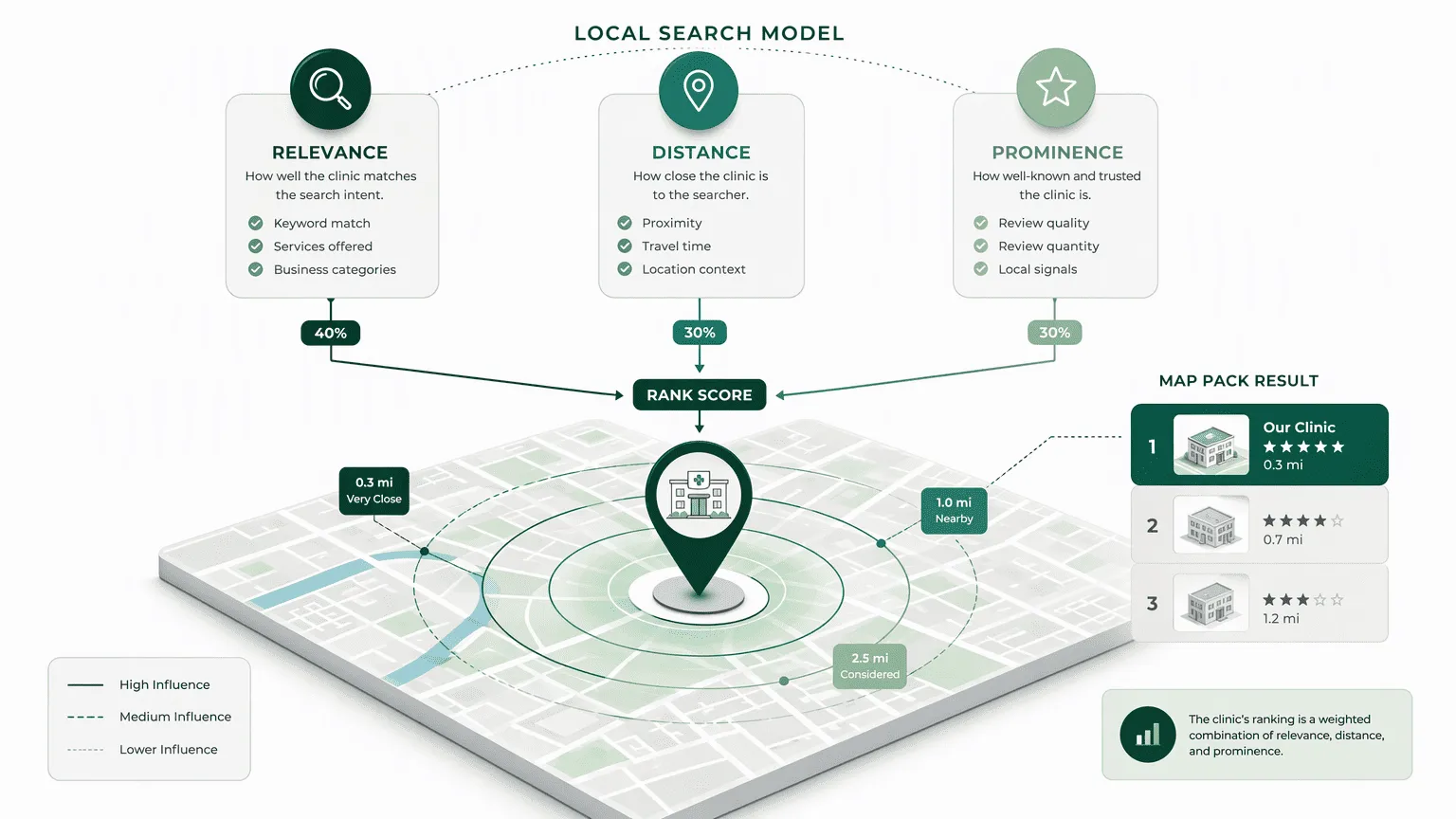
The local pack and map results do not run on the same ranking logic as the blue-link organic SERP below them. The map pack responds mostly to three factors: relevance of your business listing to the query, distance from the person searching, and prominence, which is a mix of reviews, citations and general authority. Distance is non-negotiable but leverageable: you cannot move your physical address closer to every searcher, but you can dominate the radius you occupy by saturating the other two pillars so thoroughly that Google treats you as the default result inside that geography.
| Ranking Pillar | What It Controls | How to Influence It |
|---|---|---|
| Relevance | Whether your listing matches the procedure a patient searches for | Set primary/secondary GBP categories to exact specialties; populate the services menu with procedure names |
| Distance | How close your practice address is to the searcher or the center of the search radius | Cannot change, but tight location-page content and localized service URLs strengthen signals within your radius |
| Prominence | How trusted, reviewed, and cited your practice is online | Generate fresh, keyword-organic reviews at volume; maintain NAP consistency across every directory; build local backlinks from medical publications |
Review signals are not a reputation trophy on the shelf. Review signals increased in importance by 43% from 2015 to 2018, and their weight continues to climb as Google uses review text as a semantic extraction layer. Keywords in reviews rose from ranking #26 in 2017 to #14 in the 2018 survey. When a patient types "Dr. Park fixed my ACL tear in four months" into a review, Google reads "ACL tear" and associates it with your listing. You need volume, and you need keywords. A review generation strategy is a local ranking strategy.
The Specialist vs. The Generalist: Who Can Actually Fix This

A generalist digital marketer will apply a playbook optimized for e-commerce or SaaS: canonical tags, blog cadence, generic link building. None of it accounts for the entity and trust layers Google applies to "Your Money or Your Life" (YMYL) verticals, and healthcare is the most scrutinized YMYL category in the index. The generalist does not know that medical schema requires Physician and MedicalClinic markup correlated with the practitioner's NPI-connected GBP listing. They do not know that individual physicians can have their own presence in local results, separate from the practice, and that failing to claim and optimize those practitioner profiles cannibalizes your own practice visibility.
The regulation layer makes this harder, and a generalist is not prepared for it. HIPAA compliance governs what you can embed in forms and tracking scripts, and buying or rewarding reviews is a regulatory and reputational problem that can cost the whole profile, including the genuine reviews. A healthcare SEO specialist builds around those constraints from day one. They construct compliant review generation loops, target directories like Healthgrades and Vitals, and write title tags that prioritize regulatory-safe language over clickbait.
The role you need is a clinician-fluent SEO operator.
Hire someone who can read a CPT code sheet and translate it into a keyword map. They should audit your GBP categories against your actual revenue mix and know that re-categorizing a "medical clinic" listing to the precise specialty can move rankings inside a week because relevance weight recalculates faster than prominence. The wrong hire builds backlinks. The right hire rebuilds your entity structure on a trust-first framework.
Structuring Your GBP to Capture Procedure Searches

Google Business Profile signals accounted for 25% of the local pack ranking pie in the last major expert survey, and that weighting will only have hardened. If your GBP primary category still reads "Medical clinic" and your services menu is empty, Google has no equation slots to map your profile to a procedure query. Fix the categories first. A spine surgeon listed under "Orthopedic surgeon" plus a secondary "Spine surgeon" trains the algorithm to parse the profile as a specialty entity.
The services section is active inventory. Populate every line item with the exact commercial term patients search: "ACL reconstruction," "rotator cuff repair," "minimally invasive hip replacement." Write the business description to include three procedure-to-city pairings inside a natural sentence structure.
Add a Q&A entry for each top procedure that answers the most common insurance or recovery question, because those answers get extracted directly into the knowledge panel. Then post weekly updates: a surgeon's commentary on a new technique, patient success metrics, seasonal condition alerts. Regularly posting signals engagement to Google; local search experts speculate that active content management on the profile provides ranking benefits.
The Trust Layer: Reviews, Listings, and Authenticity as Ranking Fuel
Review volume and recency are direct ranking inputs in the local algorithm. Medical search is one of the only verticals where a review written with natural clinical language becomes a keyword-rich entity signal that Google can scrape and associate directly with your specialty. A steady cadence of reviews that organically mention procedures and outcomes is an asset class. One review per week per provider is a defensible floor.
- Publish all NAP citation fields with zero variance: Your clinic name, physical address, and phone number must read identically on Google, Healthgrades, Vitals, WebMD, and every insurance directory. Mismatched suite numbers erode the prominence score Google builds across citations.
- Target medical directories with unique authority weight: Healthgrades and Vitals carry ranking gravity for healthcare that general directories like Yelp or Yellow Pages do not. Ensure every provider profile on those platforms mirrors the GBP practitioner listing and links back to the correct service page.
- Generate reviews through a workflow, not a plea: Trigger review requests at the point of clinical outcome. Train front-desk staff to send a link two days after a successful follow-up. Structure the prompt to ask about a specific treatment received so the response text naturally includes procedure language.
- Secure practitioner-level profiles with procedure intent: Individual physician profiles rank alongside practice profiles. Claim them, optimize the description to name conditions treated, and link to the practice’s corresponding service page to consolidate authority into one crawl path.
- Audit and disavow nothing randomly: Do not remove a low-rating review unless it violates platform policy. A four-point-six with two hundred reviews overwhelmingly outperforms a five-point-zero with four. Authenticity with volume wins.
The Timeline and Technical Sequence to Visibility

Phase one moves inside weeks one through four, and the KPI is purely technical: every service page indexed, GBP categories reconfigured, NAP citations cleaned, and the services menu populated with 15 to 20 procedure terms. You should see branded impression lifts and a tick-up in GBP actions before the end of this window because the algorithm finally has a clean signal to work with.
Phase two runs through month two and three. You deploy expanded service page content, medical entity schema, and an internal linking rebuild that connects every procedure URL to a provider profile and a condition blog post. Non-branded queries will begin to register in Search Console as impressions with low click-through rates. That low-CTR impression pattern is exactly the leading indicator you want.
Initial movement on competitive procedure terms tends to cluster around the ninety-day mark. Google recalculates prominence iteratively, and the lag is in the recalculation cycle, not an arbitrary SEO delay. A clinic running the full technical sequence can expect branded visibility within days and mid-tail local terms like "orthopedic clinic near me" within four to six weeks.
Needle-moving traction on surgical-procedure terms lands between ninety and one hundred twenty days, provided the backlink profile and review velocity are aligned. The timeline shortens when a specialist executes against a clear plan rather than experimenting with blog topics. You control the pace by sequencing technique before content and authority before outreach.
Conclusion
Your clinic stays invisible because its digital structure fails to tell Google what you treat, where you treat it, and who trusts you enough to rank you.
Fix the GBP categories. Rebuild the service pages with entity schema and aggressive internal linking.
Hire a healthcare-specific SEO operator who understands that a physician profile on Healthgrades is a ranking asset. The gap is technical, the timeline is measurable, and the fix is entirely within your control.
Frequently Asked Questions
Why does my medical practice website appear only for branded searches but not for the treatments or conditions we treat?
This indicates a relevance and prominence gap, not a penalty. Google has indexed your domain identity for your clinic name but lacks enough localized service content, procedure-specific GBP signals, and external authority citations to associate your practice with non-branded treatment queries.
What specific SEO tactics help a healthcare provider rank for service-based, non-branded keywords?
Build a dedicated service page for each key procedure with a localized title tag, H1 tag, and medical schema markup pointing to the practitioner entity. Link each page internally from related condition content and populate your GBP with matching procedure names in the services menu.
Can a general marketing agency fix this, or do we need a specialist in healthcare SEO or medical website optimization?
A generalist typically cannot. Healthcare search operates under YMYL entity standards requiring specific medical schema, HIPAA-aware review compliance, and specialist directory optimization on platforms like Healthgrades that generic SEO playbooks do not cover.
How do Google's local search and map pack algorithms determine which clinics to show for 'near me' medical service queries?
The local pack ranks businesses based on three primary factors:
- Relevance: How well your listing matches the search query, based on categories and services menu.
- Distance: The physical proximity between the searcher and your business location.
- Prominence: A composite metric of review volume, keyword presence in reviews, and NAP citation consistency across directories.
What role do online reviews, directory listings, and Google Business Profile play in ranking for medical services?
Review volume and re-cency are direct local ranking signals. Keywords naturally embedded in review text function as entity associations for Google. Consistent directory listings build prominence, and an accurate GBP category with a filled services menu connects your profile to condition queries.
How long does it typically take to improve rankings for competitive medical procedure terms in 2026, and what factors influence the timeline?
Branded visibility lifts in days. Mid-tail local terms often improve within four to six weeks. First meaningful traction on competitive surgical-procedure terms typically appears around ninety days when technical structure, content deployment, and review velocity are executed in the correct sequence.
Sources
- Clincy Case Study: 1.14K Google Impressions in 30 Days | ClinAds - getclinads.com
- Local SEO for Medical Practices: The Complete Guide for 2026 - medicalmarketing.digital
- Announcing the 2018 Local Search Ranking Factors Survey - Moz - moz.com
Want help executing this for your clinic?
Book a 30-minute call and we will map what a real ad engine would look like for your specific service mix.
Book a call