7 AI Search Fixes Your Clinic Needs in 2026 (Before You Become Invisible)
IntroductionYour next patient is asking a machine to find you, and even if you're ranking #1 on Google, the machine might name someone else. The problem isn't that AI search is coming. The problem is that 67% of consumers are not rigorously fact-checking AI sources before choosing a local business, according to 2025 GatherUp research. When a generative engine stitches together an answer from outdated directories, a competitor's richer structured data, and a smattering of reviews, your clinic gets flattened into a footnote or omitted entirely.
Healthcare discovery is no longer a blue-link game. A 2025 Medical Economics survey confirmed that patients are already using AI tools to evaluate physician choices, and that behavior is hardening into habit. If your practice's entity profile isn't coherent, quotable, and machine-readable, someone else's is. This article walks through the eight concrete changes that move a clinic from invisible to cited, starting with the asset AI engines actually trust.
Key Takeaways
This is not a signal to pause your Google Ads or fire your SEO agency. It is a signal that AI has added a new layer on top of them: your practice has to be the easiest source for a machine to quote.
- Entity consistency is the new ranking signal: AI crawlers stitch a knowledge graph from dozens of sources. A mismatched address or missing insurance field triggers omission, not demotion.
- Structured data is non-negotiable: Without Physician schema, including acceptedInsurance and hasCredential, your clinic speaks a language AI crawlers ignore.
- Content hubs outrank blog scatter: A condition pillar page linking to service, recovery, and cost pages signals topical authority that AI engines weight heavily.
- Review velocity feeds AI sentiment: Generative answers pull from review summaries. Volume and recency on Google and Healthgrades determine the sentiment layer the AI quotes.
- You can measure AI visibility without breaking HIPAA: Tools like Clinads’ AI Visibility Dashboard track whether your practice appears inside AI Overviews and ChatGPT responses, closing the gap between spend and portrayal.
1. Audit Your Practice’s ‘Entity Profile’ Across Google, Bing, and ChatGPT
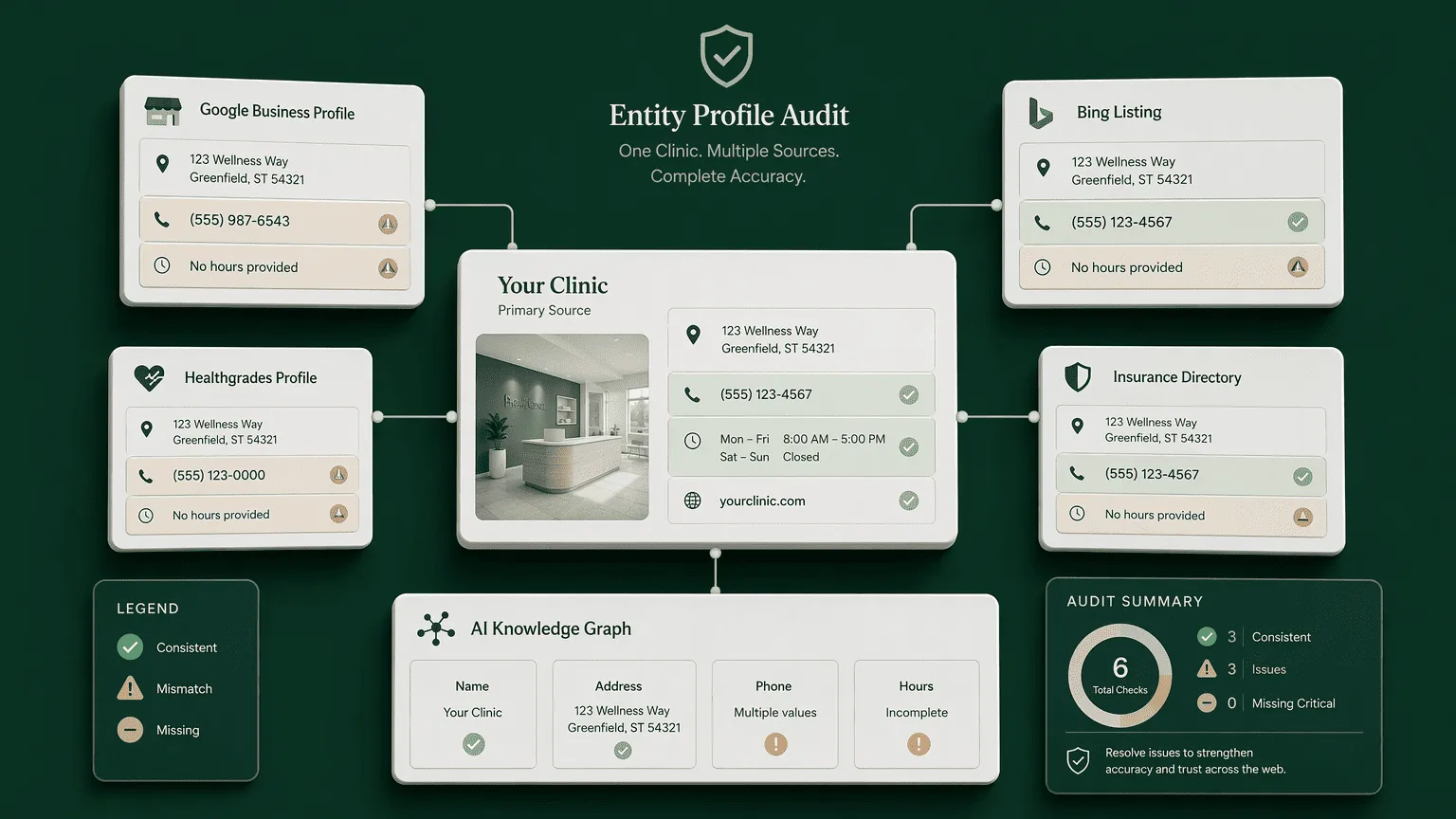
AI search engines don't rank websites. They resolve entities. When a patient asks ChatGPT for a 'cardiologist near me who takes Aetna,' the engine queries the knowledge graph it has assembled about your practice from Google's Business Profile, Bing's index, Healthgrades data, insurance panel directories, and dozens of citation sources. If your National Provider Identifier links to an old phone number on one platform and your hours are blank on another, the AI either defaults to the most confident data point it has, often a larger competitor, or fabricates a plausible composite that gets you sued. AI search optimization is not a trick: it is making the web's record of your practice complete, consistent and quotable.
The audit is manual and unforgiving. Search your practice name plus your city in Google, Bing, and ChatGPT. Look for mismatches in NAPW (name, address, phone, website), accepted insurance plans, and listed specialties. Pay particular attention to insurance panel data: a single outdated Aetna listing on a stale Vitals.com profile can poison an AI answer that filters by payer.
Fix the directories first. Practices that correct Bing indexing, directories, reviews and structured data start appearing in some AI answers within 2 to 3 months. The entity audit is the foundation; skip it and everything else you do will amplify a broken signal.
2. Rewrite Clinician Bios as Context-Rich, ‘Ideal Patient Fit’ Pages
The most-trafficked AI-cited page on your site is probably a clinician bio, and it is probably reading like a CV from 2008. The fix is to structure each bio as an answer to a specific patient problem, using declarative language an AI can lift verbatim. Open with a sentence like 'Dr. Chen performs ultrasound-guided thyroid nodule biopsy for patients with persistently indeterminate FNA results' rather than 'Dr.
So build each bio around an ideal patient fit statement, the procedures tied to it, and the insurance panels accepted, all in quotable sentence fragments. This transforms the bio from a static credential dump into the snippet an AI overview answers with.
3. Implement Advanced ‘Physician Schema’ and Structured Data

AI crawlers consume structured data as machine-readable vocabulary. Without it, your website is just prose. The Physician and MedicalBusiness schema types give Google, ChatGPT, and Perplexity a direct feed of facts they cannot misinterpret. Here is what to implement on every clinician page and the practice-level site.
- Physician schema on each clinician bio: this tags the individual doctor as a schema.org/Physician entity, allowing you to attach machine-readable properties that search engines ingest directly.
- availableService property: list each procedure and service the physician performs, matching the exact terms patients use in conversational queries, such as 'carpal tunnel release' or 'sports physical.'
- hasCredential property: embed board certifications, state license numbers, and fellowship designations so AI engines can verify specialty claims rather than inferring or misattributing them.
- acceptedInsurance on MedicalBusiness: tag the practice entity with every insurance panel you accept; this is the field that determines whether ChatGPT includes you when a patient filters by 'takes Cigna.'
- hospitalAffiliation property: explicitly link your clinicians to the hospitals and surgery centers where they have privileges, preventing the AI from omitting you from procedure-specific queries tied to a facility.
4. Build AI-Authoritative Content Hubs for Specific Conditions and Procedures
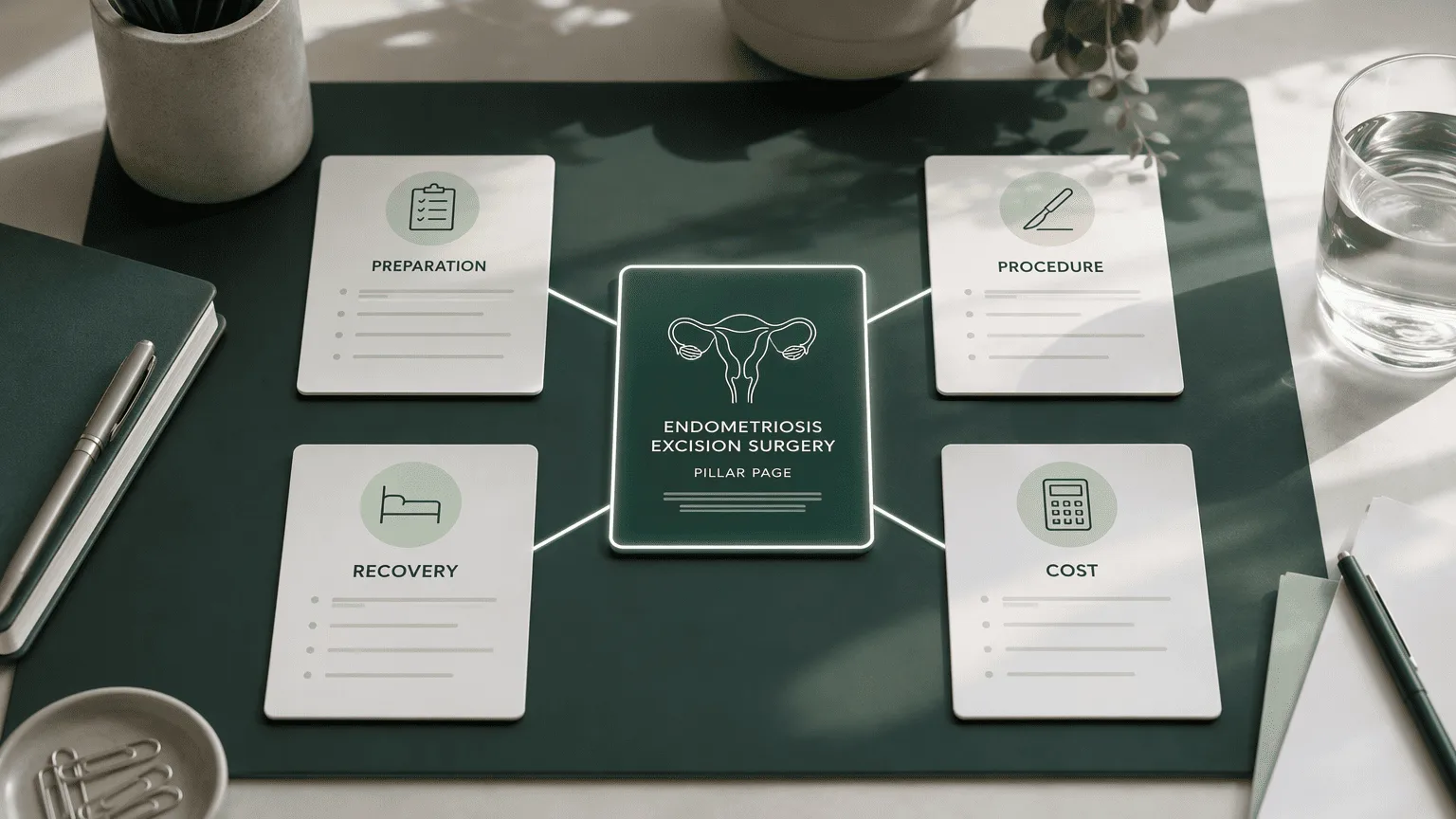
Scattered blog posts on random health topics signal nothing to an AI. It reads them as isolated pages with no semantic relationship. What signals topical authority is a hub-and-spoke model: one thorough pillar page on a condition, say, 'Endometriosis Excision Surgery', linked to detailed spoke pages on preparation, the procedure itself, recovery protocols, and out-of-pocket cost.
Perplexity retrieves live web pages and favors pages that answer the question directly and can be quoted verbatim. When a patient asks 'what does endometriosis excision recovery look like,' the engine scans the hub cluster, sees six interlinked pages with answer-first blocks, and quotes the most relevant spoke paragraph. Google AI Overviews assembles answers from pages Google already trusts, with heavy weight on local signals. A linked content hub covering a procedure end-to-end gives the engine no reason to pull from a generic WebMD summary instead of from your clinic's site. The format matters less than the structure: each spoke page must open with a 40 to 60 word direct answer that stands alone when extracted by an AI citation.
5. Optimize for Voice Search Through Conversational, Long-Tail Question Answers
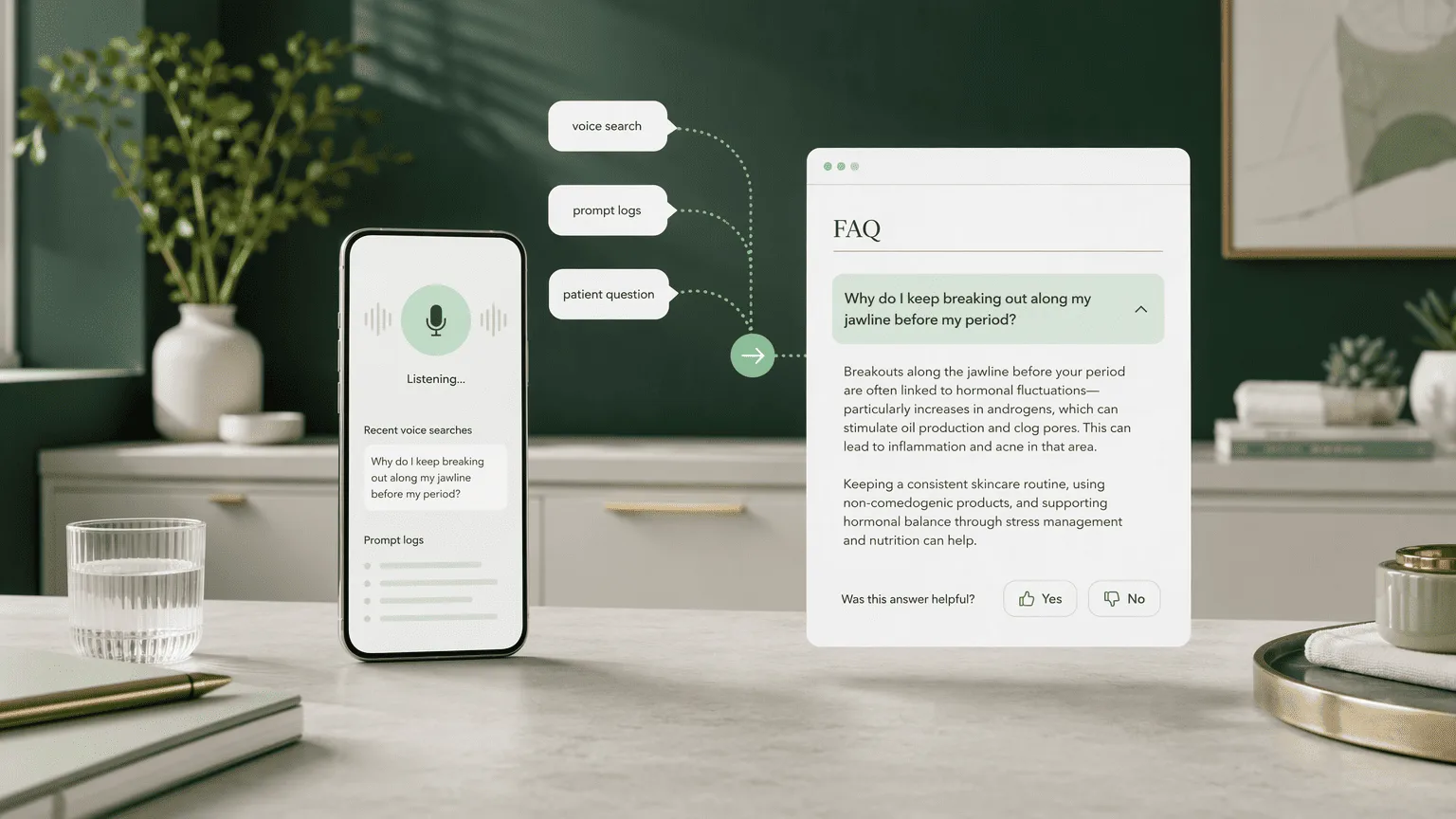
Typed queries are getting shorter while spoken ones keep getting longer. Someone looking for a specialist leans toward the sink and says, "Hey Siri, which dermatologist near me treats hormonal acne and takes Blue Cross," not "dermatologist 90210 Blue Cross." AI chatbots follow the same pattern.
Pull the exact long-tail questions patients are asking. Start with Google's 'People Also Ask' panels. If your practice uses a chatbot on its own site, mine those prompt logs.
Then build one FAQ section directly beneath each procedure or condition heading. Not a buried generic page. A tight block of answers, each one anchored to a single quotable sentence before you elaborate.
The query "should I see a rheumatologist or an orthopedist for joint pain in my hands" deserves an answer that opens with "A rheumatologist is typically the appropriate first specialist for persistent symmetrical joint pain in the hands because..." That first sentence is what an AI overview will cite. Everything after it is context for a human who clicks through.
GrowthPro AI and Pabau research confirms that chatbot interactions follow conversational cadence. Your answer blocks need to match that rhythm. Write them the way you'd explain a condition to a patient in the exam room.
No keyword stuffing. No paragraph-length list of every condition you treat. Pick the two or three questions that actually decide whether a patient books, and answer each one like you're talking.
6. Proactively Manage Your Reputation on AI-Cited Review Platforms
98% of consumers consult reviews before choosing a local business for a transaction, GatherUp found in 2025, and AI engines now digest those reviews into sentiment summaries. A generative answer might state 'patients report long wait times and billing confusion at this practice' because three negative reviews mentioned billing and the AI aggregated the signal. You cannot opt out of this summarization. You can only influence its input by deliberately driving review volume on the platforms the engines cite: Google and Healthgrades.
50% of consumers feel that Google's local platform contains the most trustworthy review content. The platform's AI Overviews and AI Mode prioritize trust signals alongside authority, and review recency functions as a freshness indicator. So the response strategy changes.
A generic 'Thank you for your feedback' reply tells the AI nothing. Instead, respond with keyword-rich, specific language: 'We're glad you had a positive experience with our MRI-guided biopsy process and that our insurance coordinator confirmed your Cigna coverage before the procedure.'
Your response text becomes part of the corpus the AI scans. Each reply is a micro-optimization opportunity that reinforces the entity signal you established in the earlier schema implementation.
7. A/B Test AI-Optimized Content vs. Traditional Landing Pages for Appointment Conversion
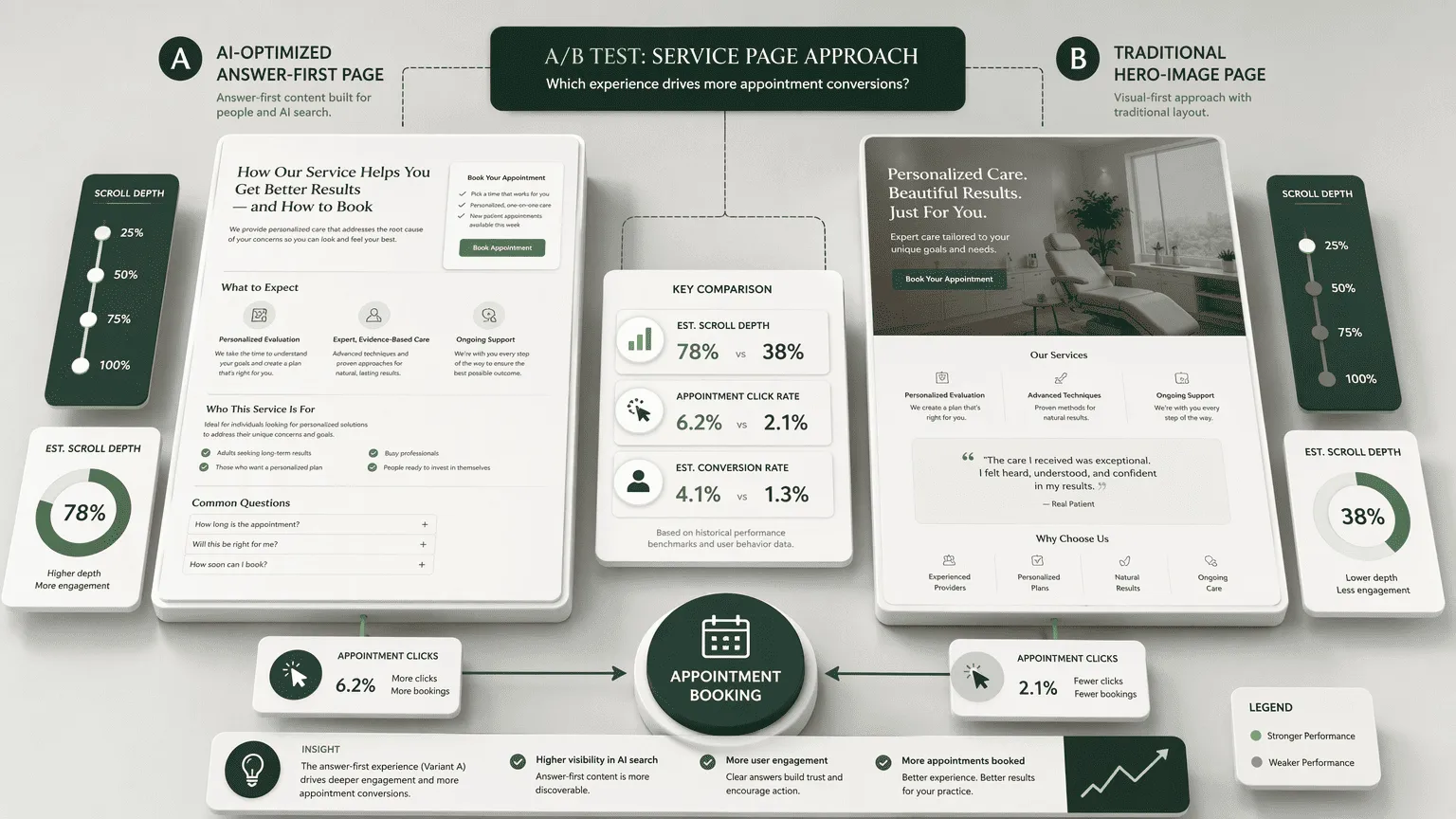
The objection to AI optimization is always the same: 'Will this actually book appointments?' The answer is measurable. Run a structured split test on a single high-volume service page. Here is how the two versions stack against each other on the dimensions that determine conversion.
| Dimension | AI-Optimized 'Answer-First' Page | Traditional Legacy Landing Page |
|---|---|---|
| Opening format | 60-word answer block; quotable summary of procedure, recovery, and insurance | Hero image + headline + body copy, narrative-led |
| CTA placement | Inline, immediately below the answer block | Below the fold, after descriptive paragraphs |
| Structured data | Physician + MedicalBusiness schema with availableService, acceptedInsurance | Basic LocalBusiness markup or none |
| Content structure | Condition hub linked to spoke pages on prep, cost, recovery | Standalone page, few internal links to related topics |
| Quotability for AI engines | High; verbatim extract by Perplexity and Google AI Overviews | Low; narrative prose resists extraction |
| Dependent variable | Appointment form completions per 1,000 sessions | Same |
The methodology, drawn from approaches detailed by Medical Marketing Digital and GE HealthCare's patient acquisition testing frameworks, is straightforward: split traffic 50/50 for 30 days, maintaining all other variables, ad spend, referral sources, seasonality. Track appointment form fills as the sole dependent variable. If the answer-first page converts higher, you roll it out. If it doesn't, you revert. The AI visibility question is resolved with a booking number, not a thought experiment.
Conclusion
AI didn't replace clinic marketing. It added a second front door, and your practice is either visible through it or you're invisible. No middle ground.
The mechanics are concrete, not conceptual. Structured data tells the machine what you do. Consistent directory listings confirm where you are. Condition-focused pages match how patients actually describe their problem. And your review profile shapes the sentiment summaries AI engines surface in recommendations.
Start with the entity profile audit. The practices that treat AI visibility as a compliance task will win the recommendation when a patient asks a model for a doctor. The ones that wait get omitted, and they will never see the gap.
Frequently Asked Questions
How is AI search like ChatGPT and Google AI Overviews changing the way patients find healthcare providers online?
AI search engines synthesize answers from multiple sources and present them as a single summary, pushing down traditional blue links. Patients receive a named practice recommendation, or an omission, based on entity consistency, structured data, and review signals rather than on keyword rank alone.
What concrete steps should my clinic take now to optimize marketing for AI-driven search results?
Start with an entity audit across Google, Bing, and ChatGPT to fix NAPW and insurance discrepancies. Then implement Physician schema, restructure clinician bios as answer-ready pages, build condition content hubs, and drive recent review volume on Google and Healthgrades.
Do AI search engines impact local clinic visibility differently than traditional Google search?
Yes. AI summaries flatten local nuance and can favor larger health systems with more complete structured data. Google local packs still appear for over 90% of simple queries like 'primary care clinic Phoenix,' while AI Overviews appear for 68% of broader local searches but only 15% of simple ones.
What data shows if AI search is actually driving patient appointments or just providing information?
Direct attribution is still developing, but a 2025 Medical Economics survey confirmed patients use AI to choose physicians. The most reliable measurement is A/B testing answer-first landing pages against traditional pages, with appointment form fills as the dependent variable.
What are the risks or downsides of relying on AI search summaries for my clinic's reputation?
AI engines can misattribute or oversimplify your specialty, credentials, or accepted insurance, and 67% of consumers do not fact-check AI results. A negative review cluster can lead an AI to generate an unfavorable sentiment summary you cannot directly correct.
Does optimizing for AI search require abandoning traditional SEO and paid ads?
No. 95% of Americans still use traditional search engines monthly. AI optimization is a layer that complements existing SEO and paid ads by making your practice the quotable source when generative engines synthesize answers, rather than replacing the channels that still drive volume.
Sources
- AI SEO for Healthcare, Medical Clinics & Doctors: The Ultimate Guide - minamedical.ca
- Local SEO Automation Software + AI Visibility | GrowthPro AI - growthproai.com
- How AI is impacting local search & what tools you should use - searchengineland.com
- AI Search Optimization for Doctors · Medical Marketing - medicalmarketing.digital
Want help executing this for your clinic?
Book a 30-minute call and we will map what a real ad engine would look like for your specific service mix.
Book a call