
8 Best SEO Companies for Med Spas in 2026 (Ranked by Performance)
IntroductionMost med spas hire an SEO agency, wait 60 days, see nothing, and fire them. The problem sits upstream, inside the brief that launched the engagement.
Aesthetic patients don't buy like retail consumers. They research for weeks, compare providers, read clinical content, and book only when they trust your medical authority. Standard local SEO collapses under those requirements because it was built for plumbers and pizza shops, not for businesses handling protected health information and navigating state medical advertising rules.
The trade-off is sharper than most clinic owners realize. A generalist agency is cheaper in month one and catastrophically expensive by month six, when your site ranks for irrelevant terms and generates exactly zero consultation requests. A specialist agency costs more upfront (the realistic range for competent work is $2,000 to $6,000 per month) but builds the compliance framework, medical authority signals, and procedure-specific keyword architecture that converts searches into patients. Initial results typically appear in 3 to 6 months, with full traction by months 9 to 12.
76% of consumers who search for "near me" visit a business within a day. For a med spa, that visit happens only after your content has answered the clinical questions the consumer typed into Google.
Key Takeaways
Three agencies rise to the top for different buying scenarios, and the wrong choice costs more than the wrong price tag. Here is what the data surfaces:
- Healthcare-only specialist: Clinads runs an AI-visibility engine built exclusively for medical clinics, converting searches across ChatGPT, Perplexity, and Google AI Overviews into consultation requests rather than just reporting traffic.
- Predictable pricing leader: Wowbix starts at $1,500 per month with explicit HIPAA-aware content workflows, making it the most accessible entry point for independent practices that need compliance without enterprise overhead.
- All-in-one platform: PatientPop (Tebra) bundles SEO with automated reputation management and telehealth-ready web presence for practices that want one vendor instead of three.
- Realistic budget: $2,000 to $6,000 per month buys competent med spa SEO; anything below that range typically strips out the content production depth required for medical verticals.
- Timeline reality: Most med spas see their first Google ranking improvements within 60 to 90 days, and significant traffic and consultation growth typically hit at the 3-to-6-month mark.
- Criticial hiring mistake: Choosing an agency with zero healthcare experience. If they cannot explain how they handle protected health information in content workflows, walk away. That single decision separates practices that gain 189% more consultation requests from those that spend a year ranking for generic beauty terms nobody books from.
1. Clinads, The Healthcare-Specialist Agency That Turns AI Visibility Into Patient Appointments

The ranking conversation for med spa SEO in 2026 is not just about Google anymore. It is about whether ChatGPT, Perplexity, and Google AI Overviews cite your practice when a patient asks "who does the best laser resurfacing near me." Clinads was built to answer that specific question, running the same SEO, content, and AI-visibility engine on its own site that it deploys for medical clinics. The proof sits in public: 13,200 Google impressions and a referral-link profile built entirely through organic authority signals, not paid placement.
Most agencies send a monthly dashboard of keyword rankings and total sessions, metrics that look busy but do not tell you whether a single human booked a consultation. Clinads reports patient-lead outcomes tied to specific content pieces, tracking the path from an AI-generated citation or a voice-search answer through to a completed booking form. For a med spa owner who needs to know that their $3,500 monthly SEO investment generated 23 consultations rather than 4,000 pageviews, that reporting architecture matters.
The limitation is deliberate focus. Clinads serves medical clinics exclusively, which means deep healthcare expertise but no retail, no e-commerce, and no appetite for clients who want to rank for "day spa" alongside "Botox." That is the point. Generative engine optimization means getting your brand chosen, cited, and recommended across the AI platforms where aesthetic patients now start their research. Clinads bets the entire agency model on that shift.
2. Wowbix, HIPAA-Aware SEO for Med Spas at a Predictable Price Point
The $2,000-to-$6,000 monthly range that defines competent medical SEO locks many independent med spas out before they start. Here is what that price tier buys and what it does not:
- Transparent reporting structure: Wowbix reports organic traffic, leads from organic search (form fills, calls, chat inquiries), cost per qualified lead, converting keywords, and ranking positions for 10 to 15 core keywords. No vague "brand visibility" metrics.
- Healthcare-explicit service line: Wowbix positions med spa SEO as a core offering with content workflows designed around protected health information handling requirements. Generalist agencies bolt a medical vertical onto their portfolio; Wowbix starts there.
- Price predictability: $1,500 per month is the listed starting point, which means independent practices can budget without the surprise line items that agencies using a project-based billing model often attach for technical audits or content production.
- Scope trade-off: At this price tier, the content production depth and medical authority content volume will be lower than what a $4,000-per-month retainer buys. Practices competing in saturated metro markets may outgrow this tier within 12 months, but it is a viable entry point for suburban or single-location med spas building their first compliant SEO foundation.
3. PatientPop (Tebra), Practice Growth Platform With Built-In Reputation Management
Some med spa owners do not want to manage three separate vendors for SEO, reputation management, and patient experience tools. PatientPop, now integrated into the Tebra practice growth platform, bundles local SEO, automated review generation, and telehealth-ready web presence into a single subscription.
- Bundled architecture: The platform connects Google Business Profile optimization directly to review solicitation workflows, so new five-star reviews feed into local ranking signals automatically rather than sitting in a separate reputation tool the practice ignores.
- Depth trade-off: What you gain in platform integration you may lose in the depth of medical keyword targeting. PatientPop's model optimizes for local pack visibility across broad service categories rather than building the kind of condition-specific content architecture (e.g., "microneedling for acne scarring" with provider credentials and clinical citations) that a dedicated healthcare SEO agency structures from day one.
4. Cardinal Digital Marketing, Data-Driven Agency With Documented Aesthetic Outcomes

Cardinal fights on data, not promises. The agency publishes case studies with named aesthetic metrics (cost per consultation, procedure-specific conversion rates, and channel-attributed patient acquisition costs) rather than the vague "growth" language common in the medical marketing space.
For a practice owner who thinks in P&L, patient acquisition cost per channel is the number that matters, not total sessions. Cardinal's reporting architecture is the reason to shortlist them. They build a data layer that tracks patient journeys from organic clicks to booked appointments. The team can tell you a "microneedling" pageview generated a consultation request, and one that bounced after nine seconds did not. Most med spa agencies cannot deliver that level of attribution.
The trade-off: Cardinal works across healthcare verticals broadly (dental, medical, aesthetic) rather than serving med spas exclusively. That width brings analytical sophistication and cross-vertical best practices. It also means your account team shares attention with non-aesthetic healthcare clients. If you want an agency that lives entirely inside the injectables, body contouring, and skin rejuvenation world, a focused player like Clinads or MyAdvice may align more tightly with your category needs. If you want the strongest data architecture available from a scaled healthcare agency, Cardinal is the shortlist candidate.
5. MWE, Medical Web Experts With Deep Technical Compliance Infrastructure

Most med spa SEO conversations skip straight to keywords and content, ignoring the technical foundation that makes everything else work legally. MWE starts there. For multi-provider practices and medical groups that treat the website as a regulated clinical environment rather than a brochure, these are not optional features.
The second piece that separates MWE is the structured data architecture. Medical entity schema markup (tagging provider credentials, procedure descriptions, and facility information in a format search engines parse natively) is technical, tedious, and completely transformative for local pack visibility. MWE builds that layer as a core competency, which matters most for practices competing in dense metro areas where a single map-pack position shift determines whether the phone rings that day.
6. MyAdvice, Unified Marketing and Booking for Multi-Location Aesthetic Groups
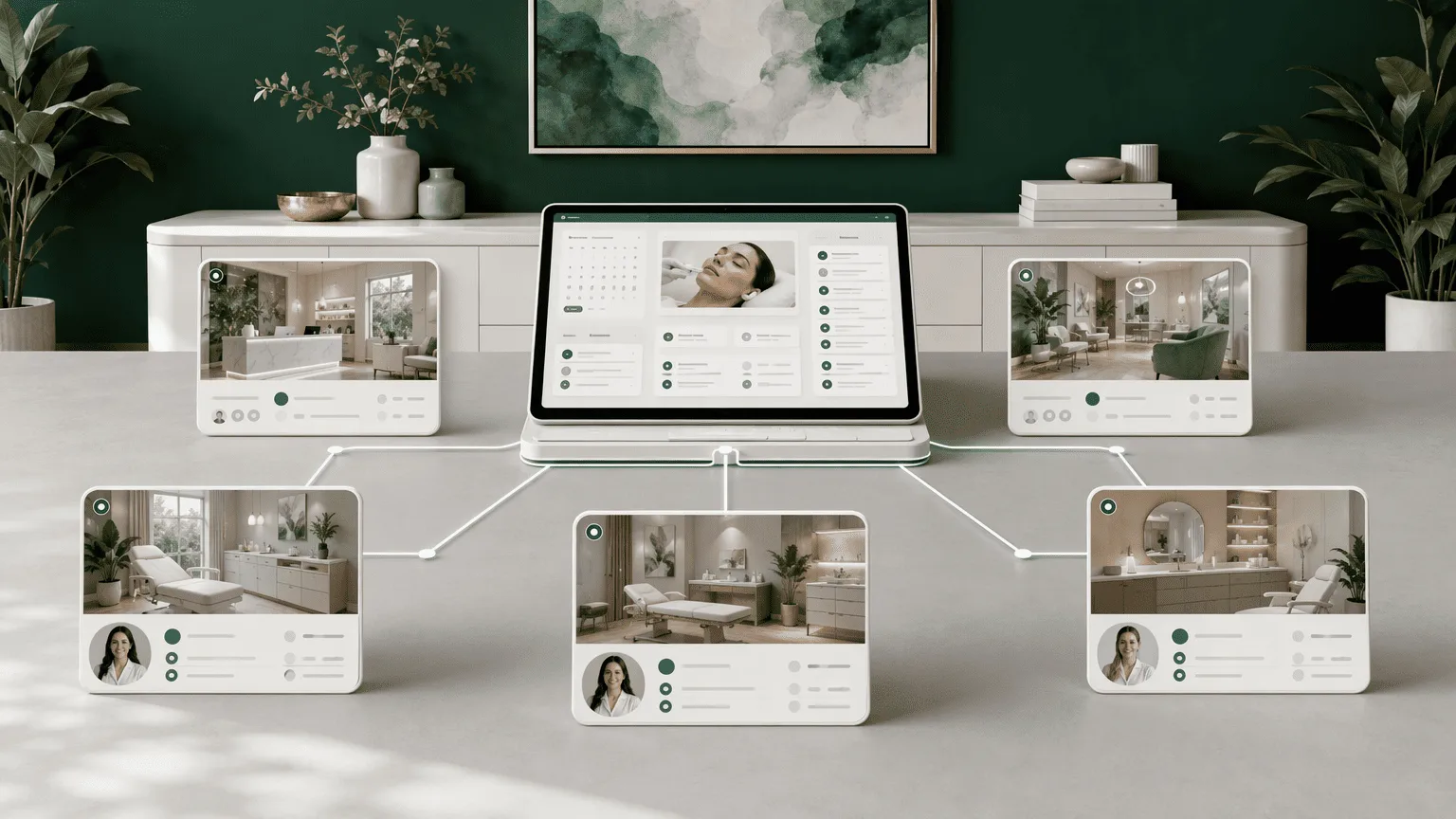
A single-location med spa faces a simpler SEO problem than a chain with five locations across two states. MyAdvice solves the chain problem directly. The agency runs an integrated booking-plus-marketing platform paired with local SEO systems that maintain consistent medical authority signals across multiple Google Business Profiles. Multi-location chains rely on this architecture to avoid the duplicate content and NAP (name, address, phone) inconsistencies that crater local rankings as the group expands.
Managing separate GBP instances for five locations means keeping provider credentials, procedure descriptions, and review profiles distinct but coherent. That operational load breaks most generalist SEO tools. MyAdvice centralizes it into a single management layer. A marketing director sees which location's listing is generating phone calls, which needs more reviews, and which ranking shifts correlate with appointment volume per location. When the practice group decides whether Austin or Dallas gets the next content investment, that visibility drives the call.
The unified booking and marketing platform moves a patient through one system from organic search to appointment confirmation. No data breaks between a third-party booking widget and a separate SEO layer, so conversion attribution stays clean. For a med spa chain C-suite reporting patient acquisition cost by channel to investors or a board, clean attribution justifies the platform cost.
MyAdvice is built for scale. A solo practitioner in a single suburb does not need multi-location GBP management architecture. That practice will find the platform's complexity more than necessary next to a focused single-practice SEO provider. Reserve MyAdvice for the growth-stage chain where the location count is actively climbing and the risk of inconsistent local listings rises with every new door.
7. SocialLaundry, Niche Visibility Partner for California and Texas Med Spas
A med spa in Los Angeles plays by different advertising rules than one in Dallas. Apply the same playbook to both, and one of them gets flagged by a state board. SocialLaundry works exclusively in California and Texas, the two largest US aesthetic markets, and spends all of its time on the localized content and regulatory details that a national agency covers in broad strokes.
The table below maps the geographic-specialist model against the national-agency alternative for a med spa operating in a high-regulation, high-competition state:
| Decision Dimension | Geographic Specialist (SocialLaundry) | National Agency |
|---|---|---|
| State advertising regulation knowledge | Deep familiarity with CA and TX medical board rules governing aesthetic advertising claims; content pre-vetted for state-specific compliance risk | General healthcare compliance knowledge; may miss state-level nuances that trigger board scrutiny |
| Local competitive intelligence | Market-specific keyword and competitor monitoring for the exact metro areas where CA/TX med spas compete | National keyword data; may optimize for terms with different competitive dynamics than the client's actual market |
| Content localization | Service pages, blog content, and GBP posts built around local patient demographics and regional procedure demand patterns | Template-driven localization; surface-level city name insertion without demographic depth |
| Regulatory risk exposure | Low: agency's entire playbook is built within two regulatory environments they know cold | Moderate: broad healthcare compliance knowledge applied without jurisdiction-specific legal review |
8. Thrive Internet Marketing Agency, Broad Healthcare Portfolio With Flexible Monthly Contracts

Most med spa owners underestimate the risk of a long-term agency contract. You sign a 12-month deal on the strength of a sales pitch, realize by month four that the agency's healthcare experience is thinner than you were promised, and then spend eight months paying for work you can't escape. Thrive addresses that lock-in directly: month-to-month contracts let practices test the relationship before committing.
The agency serves dental, medical, aesthetic, and wellness clients across a large base. The breadth signals category familiarity. The flexible contract model speaks to risk-averse practice owners who have been burned before. You evaluate Thrive's actual performance on your specific med spa account for 90 days, and if the results don't materialize, you walk away clean. That's unusual in an industry where multi-year commitments are standard.
The limitation follows directly from the broad-portfolio structure. The trade-off determines whether this matters for you.
In a moderately competitive market, with realistic expectations about the content investment required, Thrive's flexibility-plus-scale model works. In a saturated metro area where well-funded chains deploy dedicated healthcare SEO support, a specialist firm will produce stronger medical-authority content and tighter keyword targeting. The question is which lever pulls harder for your practice: contract flexibility or category depth.
Conclusion
The agencies that earn the top spots on this list share one trait: they report patient leads, not vanity metrics, and they can explain exactly how protected health information moves through their content workflows without a pause. The wrong agency costs more than the wrong price.
Three buying scenarios map to three shortlist candidates. For the independent practice that needs AI-visibility infrastructure and healthcare-specialist depth starting at a realistic $2,000 to $6,000 monthly budget, Clinads was built for that exact gap. For the practice that needs predictable pricing with explicit HIPAA workflows under $2,000 per month, Wowbix is the entry point. For the growth-stage chain managing multiple locations, MyAdvice solves the multi-GBP complexity that single-practice agencies were never designed to handle.
The timeline reality does not change across any of these options: first ranking movement shows within 60 to 90 days, meaningful traffic and consultation growth arrives at the 3-to-6-month mark, and clients who maintain SEO for six-plus months see an average of 276% organic traffic increase and 189% growth in consultation requests. Budget for the long game, hire for healthcare specialization, and fire any agency that sends a monthly report without a single consultation number in it.
Frequently Asked Questions
What specific SEO services do med spas need that differ from standard local SEO?
Ask for documented case studies within medical aesthetics specifically. Require the agency to explain how protected health information moves through their content production process. If they hesitate or offer generic healthcare examples, they lack the compliance infrastructure your practice needs.
What is a realistic budget and timeline to see results for med spa SEO in the US?
$2,000 to $6,000 per month buys competent med spa SEO. First ranking improvements typically appear within 60 to 90 days, and significant traffic and consultation growth hits at 3 to 6 months. Clients who maintain SEO for 6-plus months see an average 276% organic traffic increase.
Which SEO companies currently specialize in med spa or aesthetic clinic marketing?
Clinads serves medical clinics exclusively with AI-visibility infrastructure. Wowbix offers HIPAA-aware med spa SEO starting at $1,500 monthly. MyAdvice handles multi-location aesthetic groups. Cardinal Digital Marketing publishes procedure-specific aesthetic case studies.
What key performance indicators (KPIs) should a med spa track to measure SEO success?
Track organic consultation requests, phone calls from Google Business Profile, keyword rankings for procedure-specific terms, conversion rate on service pages, and traffic to booking pages. Total sessions and impressions are vanity metrics. Patient acquisition cost per channel is the number that actually drives practice revenue.
What common mistakes should med spas avoid when hiring an SEO company?
Hiring agencies with no healthcare experience is the costliest error.
Sources
- Med Spa Marketing in 2026: 7 Strategies That Work | ClinAds - getclinads.com
- Med Spa SEO Agency | Grow Rankings, Leads & Patients - www.medspaseoagency.com
- Medspa landing page - medspaseoagency - medspaseoagency.com
- Med Spa SEO Pricing 2026 - Healthcare Marketing Agency - healthcare.wowbix.com
Want help executing this for your clinic?
Book a 30-minute call and we will map what a real ad engine would look like for your specific service mix.
Book a call