Which Ad Agencies Work With Independent Optometrists Instead of Big Chains in 2026
IntroductionMost independent optometrists are burning ad budgets on agencies that don't understand the difference between a private exam lane and a LensCrafters floor. They hand over the same playbook that works for national retail chains, and they get silence back. Meanwhile, private practices still control approximately 44% of the U.S. eye care market, yet every local Google search is a firefight against massive competitor discount ads.
Most agency strategists have never had to fill a chair with a patient who needs a VSP or EyeMed exam. They plan campaigns around a cheap-pair-of-glasses hook. The tactics that build a chain's national volume often hurt a doctor-owned practice.
This collision is getting sharper in 2026, driven by AI-generated search results and the rise of Generative Engine Optimization that demands local, authoritative content. Specialized optometry agencies have emerged to close this gap. They understand your insurance roster, your average eyewear margin, and your local referral network. This article digs into the three players that get it, so you can stop paying generalists to learn optometry on your dime.
Key Takeaways
Before you re-up the retainer, scan the core findings on the agencies that live in the independent optometry space, and what it costs to play for real.
- Top Full-Service Bet: Clinads dominates for data-driven growth combining programmatic ads with transparent cost-per-patient reporting you can audit.
- Best Local AI Specialist: Vynce Digital leads on Generative Engine Optimization and ChatGPT SEO to surface your practice for 'eye exam near me' voice queries.
- Operational Leverage Play: IOP supplements (or replaces) an agency by rebuilding your brand economics through bulk purchasing power and one-on-one coaching.
- The Spending Reality: Plan on a monthly ad budget between $1,500 and $5,000 to stay competitive, with a cost-per-new-patient in the $30 to $60 range for well-built campaigns.
- The 2026 Rewiring: 4 out of 5 customers use search engines to find local information, and AI Overviews are now composing the shortlist. If your agency has no answer for GEO, you are already invisible.
Verdict
If you need a single agency to build, run, and report on campaigns that convert for a doctor-owned practice, Clinads is the strongest all-around option in 2026. They combine programmatic ad delivery with transparent acquisition-cost data, directly addressing the private clinic's core complaint: the disconnect between agency spending and patient chair time.
For practices whose most urgent headache is local discoverability inside AI-powered search, Vynce Digital is the sharper instrument. Google is rewriting how "eye exam near me" works, and this shop's ChatGPT SEO and GEO framework targets exactly that algorithmic shift. Their play is narrower but solves the trend that is causing localized practices the most anxiety right now.
If your primary challenge is brand muscle and margin pressure from chains, IOP is not an agency. It is a buying group that turns your independent status into collective economic weight. Pair it with one of the digital specialists above, and you cover both the demand and the unit economics sides. The bag-of-words digital agency remains the biggest money trap in optometry. Under $2,500/mo in a competitive market, you are buying invisibility.
Comparison Table: Specialized Agencies for Independent Optometrists vs. Generalist Agencies
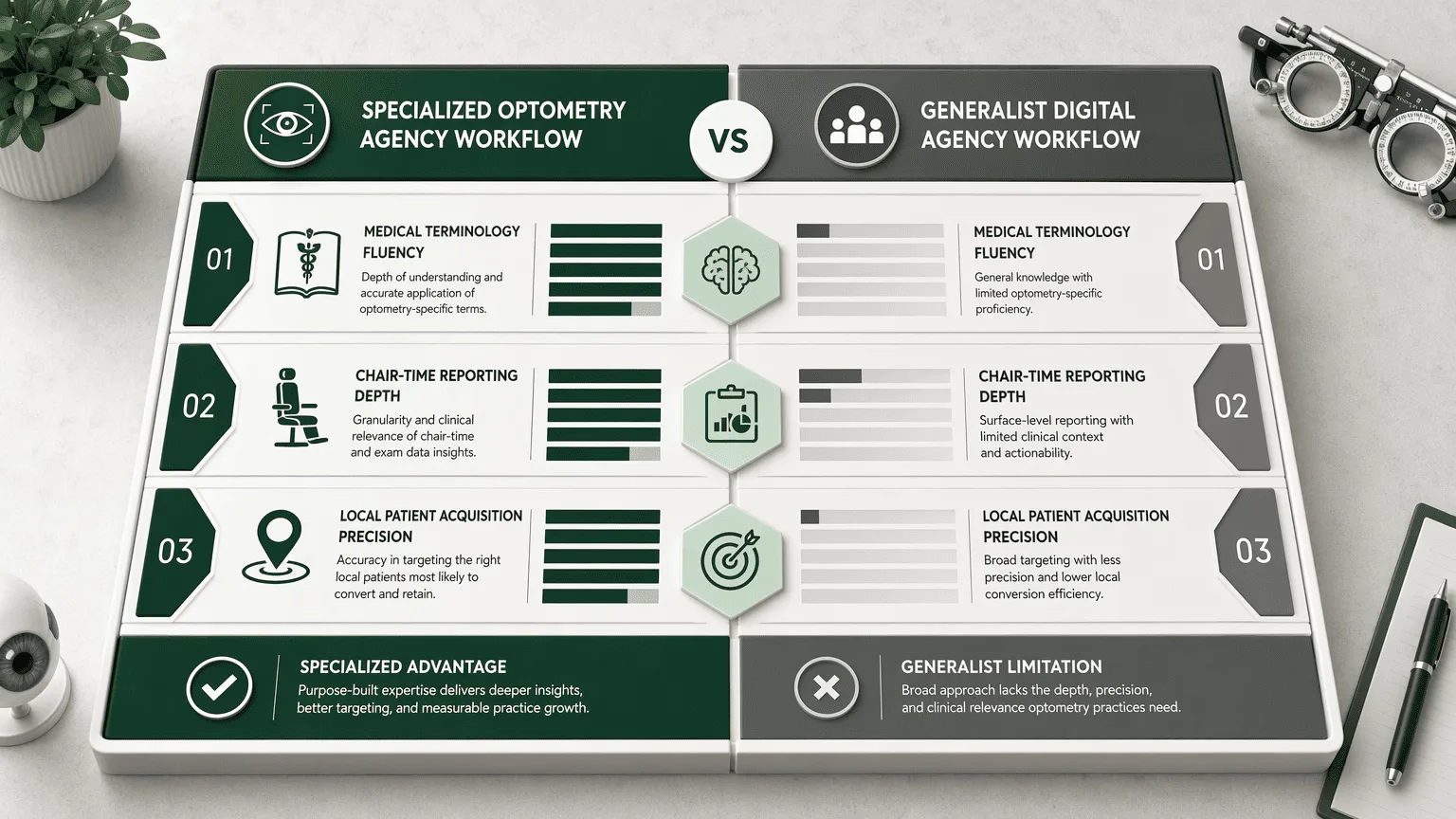
Look at the minimum standards that separate an independent optometrist's floor of reality from the approach generalists default to. Keep your current contract open. Cross-reference it against these rows.
The table flags the abilities that will make or break a single-location or small-group practice in 2026. Generalists avoid medical optometry terminology and rarely report down to the chair.
| Capability | Specialized Agencies (Clinads, Vynce Digital, IOP) | Generalist Digital Agency |
|---|---|---|
| Local Search & GEO | Built playbooks for Google AI Overviews and voice-search optimization targeting specific zip codes. | Typically optimizes for broad keywords; no ChatGPT SEO or structured local-entity schema for medical practices. |
| Vision Plan Marketing | Campaigns are built around in-network status (VSP, EyeMed) as a primary conversion trigger in ad copy. | Treats insurance plans as a bullet point. Creative is often discount-driven or product-based. |
| Optometry-Specific Creative | Ad libraries contain medical practice creative showing exam lanes, specialty equipment, and doctor portraits. | Repurposes retail or e-commerce templates. Stock imagery does not signal clinical trust. |
| Transparent ROI Reporting | Dashboards isolate cost-per-new-patient, exam-to-retail conversion data, and call tracking per search term. | Presents top-level funnel metrics (clicks, impressions) without connecting them to clinical appointments or sold frames. |
| Private-Practice Economics | Understands that gross margins on eyeglass sales average over 75% and builds campaigns to feed optical capture. | Optimizes unsustainably toward the low-margin eye exam because they don't know the optical unit economics behind the office door. |
This is an operational checklist that determines whether your ad spend flows into booked thorough exams or evaporates in the face of LensCrafters' national TV budget. The right column leaves you covering price comparisons alone. The left column arms you with the specifics that actually switch patients.
Clinads: Data-Driven Growth for the Private Practice
Clinads was built for this contradiction: independent doctors need brand-level ad production speed, but they cannot afford to waste a dollar on creative that doesn't fill an exam chair. The platform ingests your website and instantly builds on-brand static and video ads for Google and Meta, tearing out the classic agency bottleneck of waiting two weeks for a single round of creative from an overpriced design team.
The core unit of value is not a marketing tactic. It is a patient acquisition cost you can track from click to appointment. The system ties local search campaigns directly to booked consultations, not mutated last-click attribution, giving you a clear view of whether you are inside or outside that target $30 to $60 per-patient window. Their programmatic layer circulates the creative inventory across display networks in your zip code, meaning the retired couple searching for cataract lens options and the young professional choosing a new optical on their lunch break both see ads tailored to the medical language of your practice, not a generic 15%-off coupon. The trade-off: you are running on a system optimized for speed, so if your practice demands an ornate, multi-month brand narrative built from scratch, this is a sharper, faster tool than a branding agency.
Most importantly, the reporting discipline is designed to make your monthly P&L meeting easier, not denser. You receive line-of-sight to calls answered, forms filled, and new patients push into your scheduling system. Below $2,500/mo in ad spend in a competitive market, you're invisible, but at the entry point Clinads demands for meaningful local reach (starting from $399/mo for the creative engine and scaling with ad spend), you are not buying abstract awareness. You are buying the use to compete medically against the chains on the same map.
Vynce Digital: Local Search and AI Visibility Experts
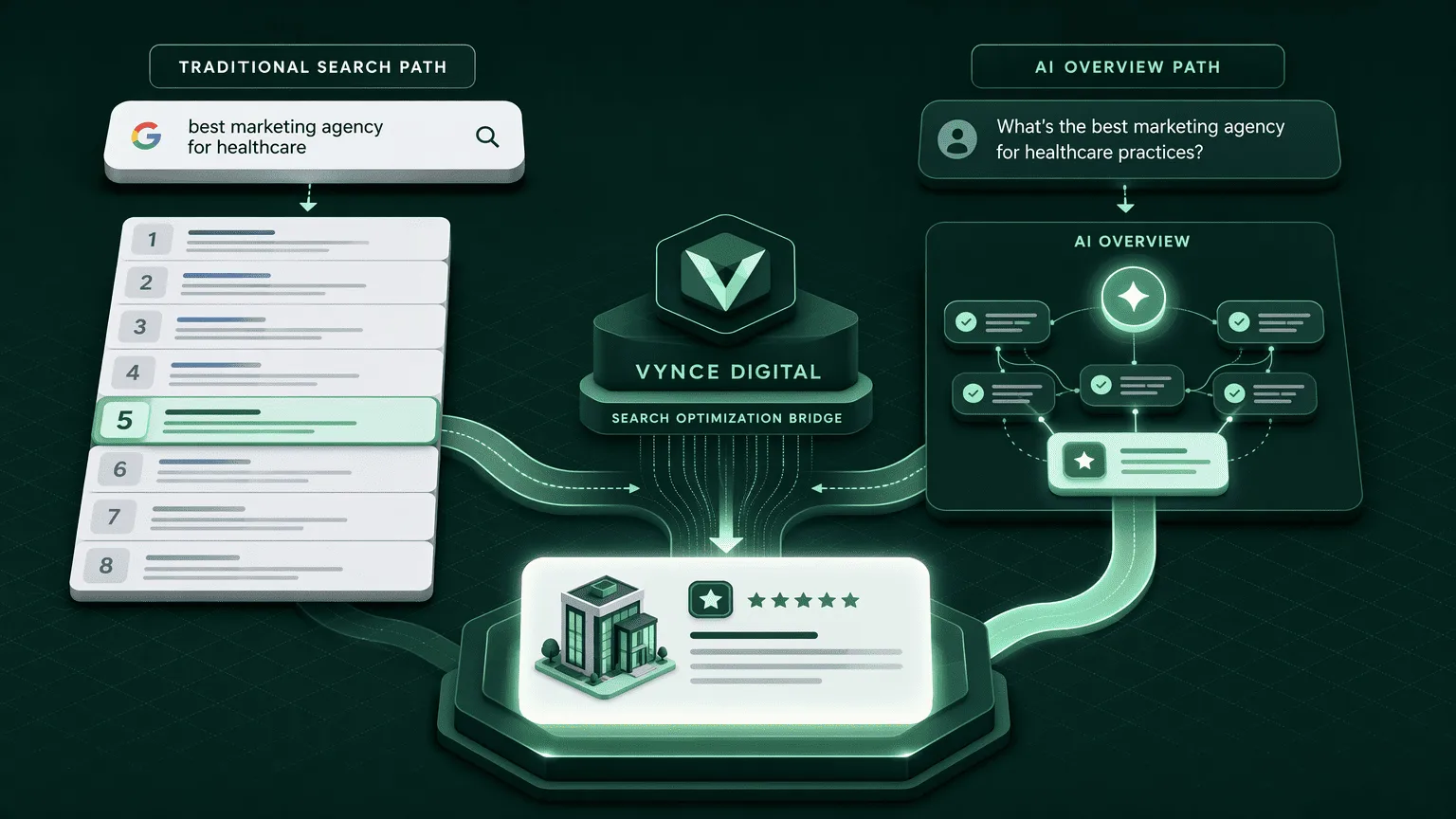
If Clinads is your growth engine, Vynce Digital is your search physician for an algorithm that now reads and ranks you based on natural language. Their practice orbits around one sharp insight: the way patients find a provider in 2026 is fundamentally shifting from a typed Google search to a spoken question inside ChatGPT or an AI Overview. Here is the comparison that frames it.
| SEO Dimension | Generalist Local SEO Approach | Vynce Digital's GEO & AI-First Approach |
|---|---|---|
| AI Overview Optimization | Relies on legacy Google Business Profile listings; no schema tailored for AI-generated summaries. | Structures entity data and author signals so Google and ChatGPT surface the doctor's name and clinic directly in the AI summary for "ophthalmologist accepting VSP near me." |
| Voice Search Targeting | Still targets "optometrist Chicago" typed queries; ignores conversational long-tail phrasing. | Campaigns specifically built around natural speech patterns: "Where can I get a diabetic eye exam tomorrow morning?" fed into Google Ads for Optometrists. |
| Content Strategy | Produces generic blog posts about frame fashion to attract clicks. | Authors clinical-authority content (dry eye therapy explanations, myopia management pathways) that language models expect and rank in your city. |
| Local Lead Verification | Counts ad clicks or phone call duration as a conversion. | Tracks which AI Overview questions led to a direct appointment request, then re-optimizes the answer source for confirmed conversions. |
In a world where 4 out of 5 customers use search engines to find local information, letting an AI Overview answer "eye exam near me" without your practice appearing in the citation is economic suicide. Vynce Digital has moved earlier than most to capture this upstream discovery, giving you a first-mover advantage before competing generalists figure out that the game has already changed.
Independent Optometric Partners (IOP): The Buying-Group Advantage
IOP attacks the chain competition from the supply side. By pooling independent practices into a single negotiating entity, IOP changes your frame and lens costs before you spend a single dollar on marketing.
When your gross margin on eyewear finally reflects real scale, you stop paying the premium that makes chains look cheaper. That difference is the first real marketing budget most indies ever see. It is the economic precondition that makes a specialist agency like Clinads lethal instead of just expensive.
How Marketing Strategy Differs: Private Practice vs. Big-Box Chain
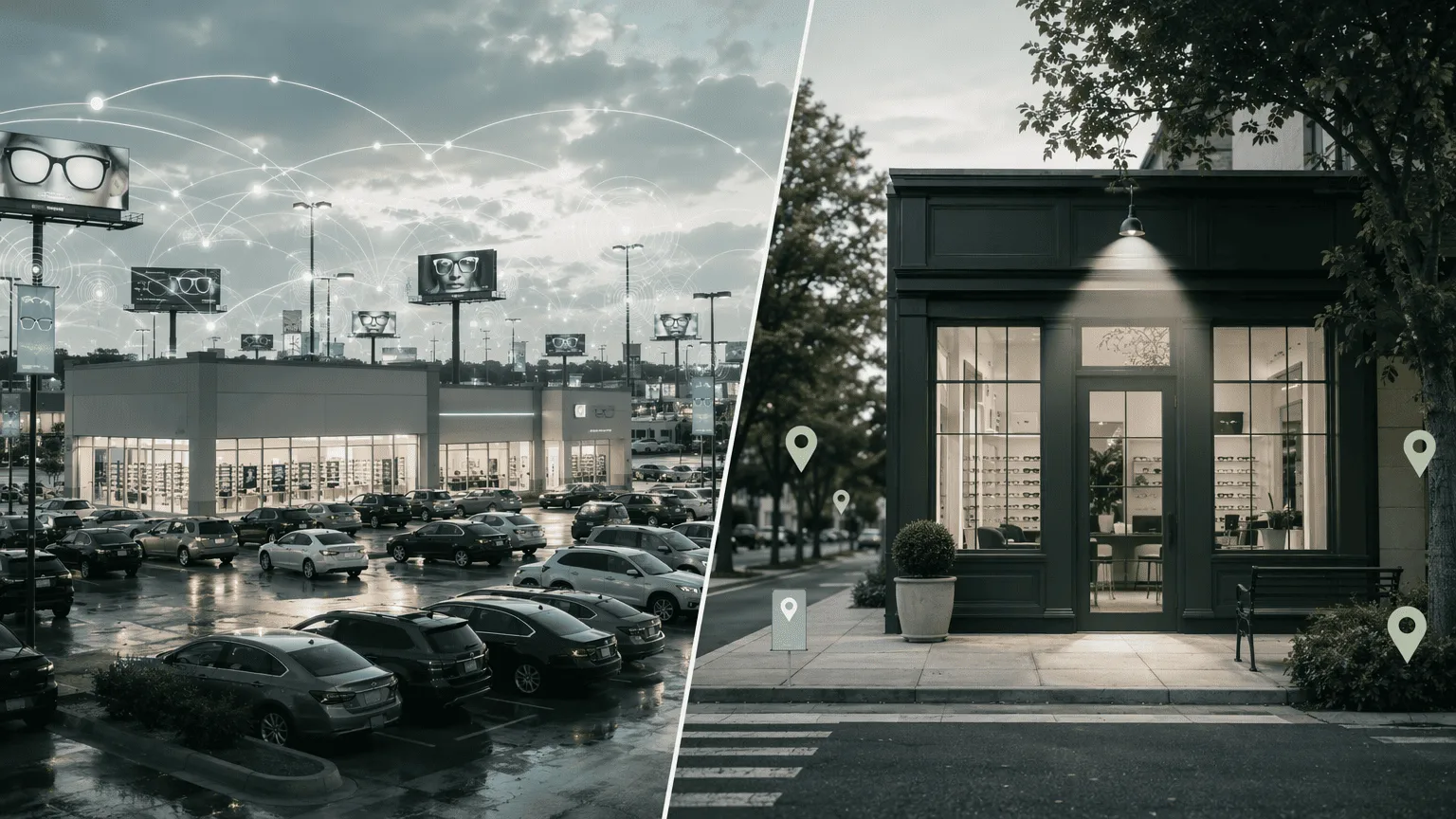
Run an ad like LensCrafters and you will empty your bank account. The chains' economic model is built on saturating a DMA with national TV, capturing the casual shopper with a $49 special, and then directing them to an optical floor engineered to produce a best-in-class conversion rate of an eye exam into a retail sale of over 80%. Their campaign has one job: fill the parking lot. Their conversion engine does the rest, scaling units because their frame inventory and lab access permit it.
Your independent practice runs on a fundamentally inverted P&L logic. Your gross margins on eyeglass sales average over 75%, compared to approximately 25% for the exam itself. Every dollar you spend on advertising therefore needs to nurture a relationship that ends in optical selection, not just a refraction. Promoting a steep exam discount is often a race to the least profitable patient. Instead, the independent's strategic advantage lies in weaving medical authority, specific insurance network acceptance (like publishing your EyeMed Access or Select network details), and genuine appointment availability into your paid creative.
Chains target the lowest common denominator of eyeball cost. You are targeting progressive myopia management, dry eye therapy, and complex contact lens fits. The ad copy must read like a referral, not a liquidation event.
The difference in channel selection follows naturally. Chain media budgets buy banner awareness on national publishers. Your budget buys search intent: the patient already symptomatic, searching for your specific diabetic eye exam CPT code or a doctor who manages their keratoconus.
Voice search and localized AI Overviews reward this specificity. The chain's Omnichannel Marketing playbook emphasizes mass reach. Yours must weaponize clinical precision for the handful of patients in your zip code who need exactly what you offer.
What to Look for When Vetting an Ad Agency
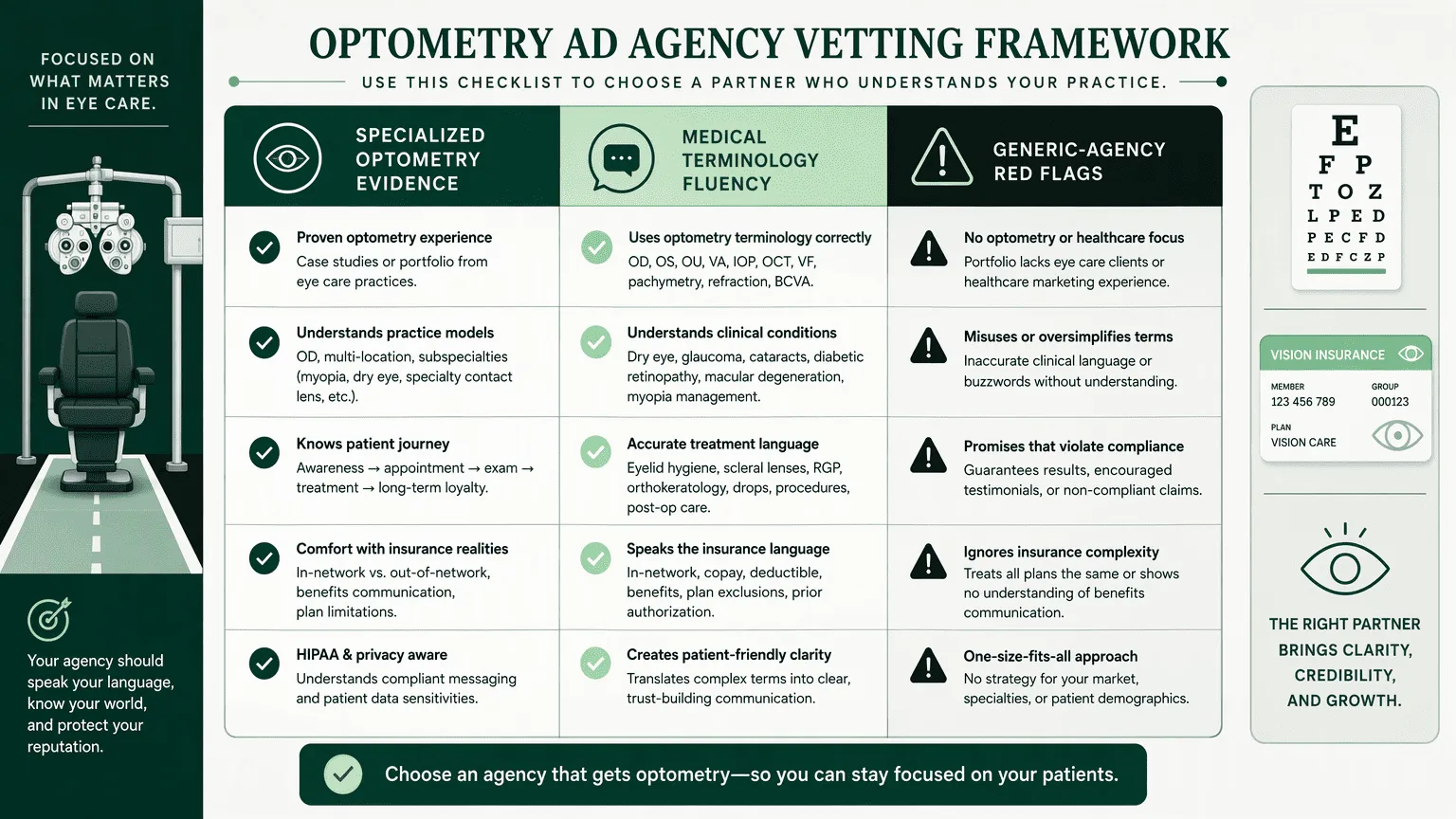
Ask these questions before you hand over your login credentials. A true specialist's answers will open with optometry-specific operations language, not generic digital marketing flattery.
| Evaluation Dimension | What a Specialized Optometry Agency Demonstrates | Red Flag from a Generalist Agency |
|---|---|---|
| Optometry-Specific Portfolio | Shows local campaigns featuring exam-lane photography, insurance network callouts, and medical service-line ads for dry eye or myopia control. | Portfolio is dominated by e-commerce brands or dentistry with stock photos of teeth, repurposed for your optical. They cannot distinguish optometry from opticianry in copy. |
| Local Campaign Framework | Presents a map-centric plan isolating your draw from specific referring zip codes, competitor offices, and your own radius. | Proposes a broad national keyword plan that will drain budget on searches from patients 50 miles outside your chair range. |
| ROI & Attribution Reporting | Dashboard connects ad spend to new-patient calls and booked appointments with dollar-range specificity for patient acquisition cost. | Sends a monthly PDF of clicks, impressions, and bounce rates, avoiding any mention of actual exams or optical revenue tied to the clicks. |
| Vision Plan & Insurance Fluency | Can construct separate ad copy paths for VSP, EyeMed, and medical third-party payer searches, knowing these are distinct keyword funnels. | Asks you to list your plans in a bullet and slot them into a single generic template. Cannot articulate the difference between a routine vision plan and a medical eyecare referral. |
| GEO & AI Search Readiness | Audits your schema markup, confirms your entity is resolving in AI Overviews, and adapts your FAQ content to mirror voice-search phrasing. | Has never heard the term Generative Engine Optimization, or dismissively tells you voice search "isn't a priority yet" while 80% of local searches happen on phones. |
| Transparent Pricing Model | Pricing ties directly to campaign scope, ad spend management, and number of ad variants produced per month, with no opaque "strategy development" line items. | Proposes a flat "digital marketing solution" retainer that masks per-channel cost allocation, creative output volume, and makes cancellation a three-month notice ordeal. |
Budget, Costs, and Realistic ROI Expectations
Here is the bandwidth of money and metrics that separates an underfunded noise campaign from a machine that books new patients repeatably. Position your monthly spend within this frame or accept you are donating to Google's revenue.
- Monthly Ad Spend Bracket: Budget $1,500 to $5,000/month in competitive geographies. Under $2,500/mo, you will not produce enough conversion data to optimize toward a profitable acquisition cost; you will only gather expensive clicks.
- Patient Acquisition Cost Target: Optimize toward a $30 to $60 cost-per-new-patient. This range holds for well-structured search campaigns; programmatic and social top-of-funnel campaigns may run higher but should be judged against downstream optical capture.
- What Moves ROI Most: Market saturation, the specificity of your medical service keywords, and whether your front desk converts the booked call. An agency can deliver the lead at $40; if your staff doesn't answer the phone or cannot describe your dry eye therapy pathway, the lead is dead on arrival.
- Optical Capture is the Lever: With eyeglass gross margins averaging over 75%, refilling your exam schedule at cost-justified clicks only works if you pair ad spend with internal optical conversion discipline. The creative should therefore pre-educate the patient toward premium lens options, not just discount frames.
The 2026 Shift: AI Search and Generative Engine Optimization
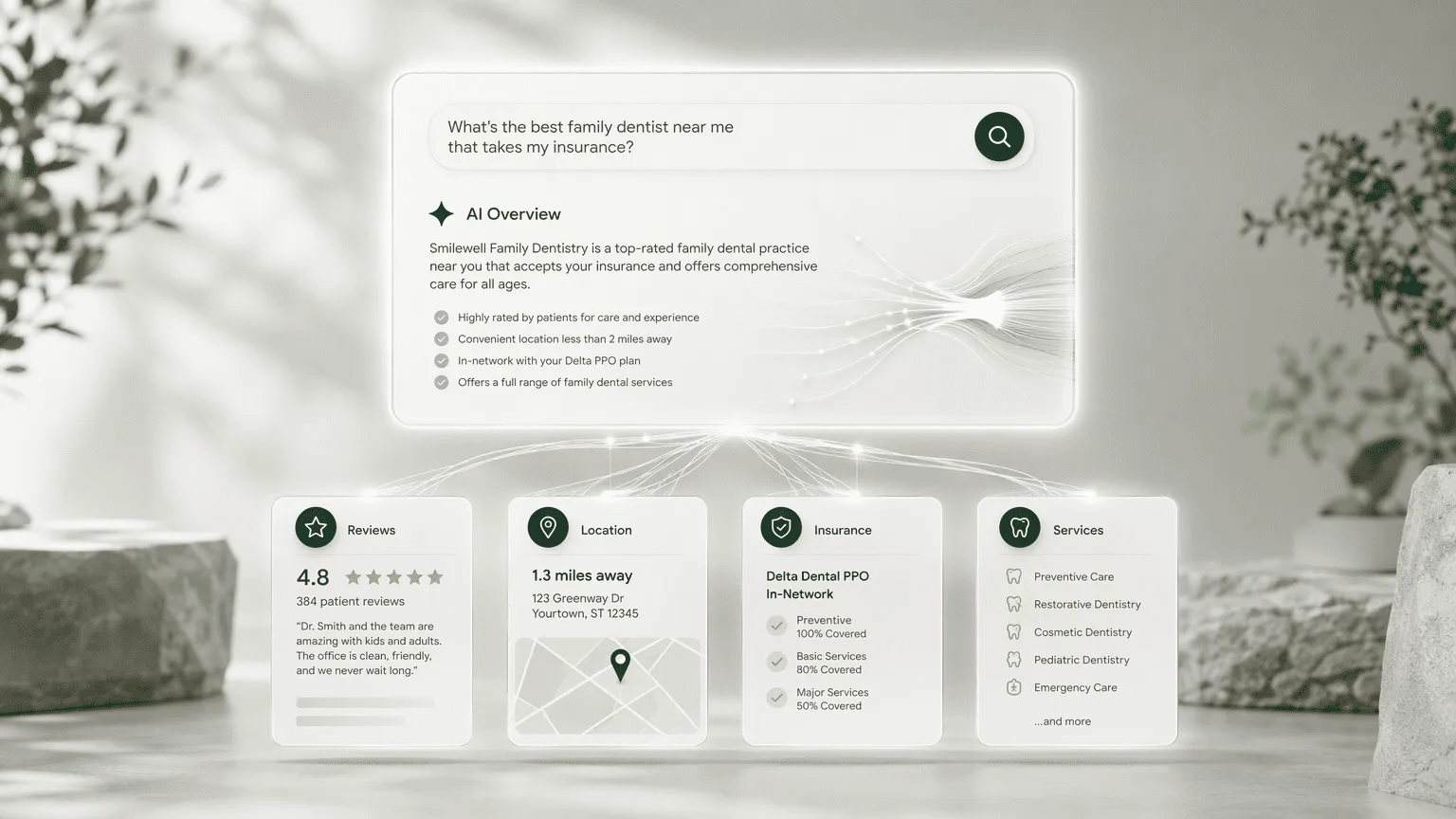
Google no longer just lists ten blue links for 'optometrist near me.' It narrates an answer built from multiple sources, stitching together a practice's reviews, location, accepted plans, and service descriptions into a single AI-generated Overview. If your clinic's entity is not semantically organized for this stitching, you are the blank space underneath the answer box. Specialized agencies are now deploying Generative Engine Optimization to structure your digital footprint exactly how the language model expects: through precise local schema, question-and-answer content mapped to voice search phrasing, and authoritative clinical citations that earn the algorithm's trust in your zip code.
This means your marketing spend in 2026 is split. Paid search still captures immediate intent, but GEO now controls whether you are even in the consideration set for the patient who asks their phone, 'Who is the best eye doctor for dry eyes that takes my vision plan?' The specialist agencies named in this piece have already shifted resources behind this fracture.
Conclusion
Independent optometry still holds approximately 44% of U.S. market share. Grabbing your slice of that pie in 2026 means refusing the generic playbook chains write for their own benefit. Clinads builds the data-driven ad engine, Vynce Digital handles the shift toward AI-powered search, and IOP restructures the economic base that makes your marketing profitable. Pick the partner that fixes your most expensive leak and start running local campaigns in the clinical language your patients actually search for.
Frequently Asked Questions
What types of marketing agencies specialize in independent optometry practices rather than large retail chains?
Three types of agencies serve private practices:
- Full-service digital agencies like Clinads run programmatic and local search campaigns with transparent cost-per-patient reporting.
- GEO and AI-search specialists like Vynce Digital optimize for voice search and AI Overviews.
- Buying groups like IOP reduce supply costs to fund marketing.
All reject mass-discount chain advertising in favor of medical service-line acquisition.
Which specific US agencies have a proven track record with private optometrists?
Clinads, Vynce Digital, and Independent Optometric Partners each have a documented private-practice focus in 2026:
- Clinads connects ad spend to booked appointments with auditable patient acquisition costs.
- Vynce Digital leads on ChatGPT SEO.
- IOP aggregates independent practices into a purchasing collective with one-on-one brand coaching.
How do marketing strategies differ between independent optometry practices and big-box optical chains?
Chains use national TV and heavy exam discounting to fill massive optical floors built for an 80%-plus exam-to-retail conversion rate. Independent practices rely on localized search intent, medical authority, and insurance network acceptance. An independent's ad copy must drive high-margin optical capture, not just low-margin exam volume.
What should an independent optometrist look for when vetting an ad agency?
When vetting an agency, demand the following:
- A portfolio of live local optometry campaigns, not e-commerce case studies.
- Verification that they report cost-per-new-patient on a dashboard, not just clicks.
- Confirmed familiarity with VSP and EyeMed copy requirements.
- An active Generative Engine Optimization framework to handle how Google AI Overviews now rank local practices.
What kind of budget or ROI can a private optometry practice expect when working with a specialized agency?
Key budget and performance benchmarks for 2026:
- A competitive monthly ad budget ranges between $1,500 and $5,000.
- Well-optimized campaigns target a cost-per-new-patient in the $30 to $60 range.
- Working with an agency below $2,500/mo in most markets fails to generate enough conversion data to optimize profitably.
Are there any recent industry shifts or trends in 2026 affecting how independent optometrists advertise?
AI Overviews and voice search have rewritten local discovery. Google now composes its own answer from structured data, meaning your practice must be optimized for Generative Engine Optimization to be cited inside the summary box. Agencies are pivoting from traditional keyword SEO to entity-based schema and conversational search content.
Sources
- Clinic Ad Examples That Convert | ClinAds - getclinads.com
- Pricing: Clinic Marketing Software & SEO | ClinAds - getclinads.com
- MyEyeDr: Bringing Together Eye Care and Eyewear - Technology and Operations Management - aiinstitute.hbs.edu
- Optometry Marketing - Top Rated Practice Marketing & Growth ... - optometrymarketing.com
- About Optometry Marketing Services - optometrymarketingservices.com
- Who is in the EyeMed vision network? – Independent Health Agents - help.ihealthagents.com
- IOP Optometry Group – IOP: Independent Optometric Partners - iopnetwork.net
Want help executing this for your clinic?
Book a 30-minute call and we will map what a real ad engine would look like for your specific service mix.
Book a call