
Most Vancouver Healthcare Marketing Will Waste Your 2026 Budget. Here Is What Actually Works.
IntroductionYour clinic's biggest growth bottleneck isn't your clinical staff, your location, or your waiting room. The problem is that your ideal patient cannot find you where they now spend most of their searching time: on AI-driven search platforms and hyper-specific digital channels.
Most practices are still running Ads Grant campaigns that feel like charity work, boosting social posts to empty rooms, and trusting an agency that has never once explained the regulatory line you cannot legally cross. Vancouver has quietly become a concentrated market for this exact problem because it sits at the intersection of a world-class medical research ecosystem and a tech-savvy marketing talent pool that has grown up alongside firms like Hootsuite, trusted by more than 18 million customers and employees at more than 80% of the Fortune 1000.
The search term 'healthcare marketing agency Vancouver' now signals a specific commercial hunt: you are looking for a team that knows how to acquire patients inside Health Canada's strict advertising guardrails while exploiting digital channels that US-based generalist agencies do not understand. The fix is a specialized stack run like an audit, and that audit starts here.
Key Takeaways
What a Vancouver agency actually owes you, in plain terms:
- Compliance is the real barrier to entry: The ban on direct-to-consumer prescription drug advertising and provincial college rules on testimonials make generic US-sourced strategies legally dangerous. A legitimate agency audits for Health Canada compliance before touching your budget.
- Cost efficiency is not about being cheap: Monthly retainers range from about $1,000 for foundational local SEO to over $25,000 for full-service enterprise campaigns. The advantage over US firms is not sticker price, it is what you keep: lower overhead translates into more hours aimed at your patient acquisition, not at a US downtown lease.
- The 2026 trend is a performance reset: Connected TV advertising for healthcare has moved from novelty to needle-mover, with campaigns now showing a 78% reduction in cost per acquisition in specialized dental campaigns. The old channel mix is visibly burning budget.
- Portfolio substance defeats agency positioning: The Semrush Agency Directory lists 21 healthcare and hospital content marketing agencies in Canada. The gap between them is their pitch deck. The gap is whether their case study shows a 135% traffic increase for a senior care provider in a year or just restates your own website back to you.
The Core Service Suite of a Vancouver Healthcare Marketing Agency

The standard stack a clinic actually pays for resolves into four concrete line items that plug directly into patient acquisition cost. Healthcare SEO sits at the base: technical site architecture built for Google's AI Overviews. Then comes compliant PPC management, where the copywriter knows that Health Canada prohibits unsubstantiated claims and that your Google Ads copy for a physiotherapy clinic cannot promise a cure. Reputation management follows, targeting review velocity and sentiment on platforms where patients now choose a provider before visiting your site. The final layer is provider-focused content marketing: articles and video assets built for search engines, AI agents like ChatGPT, and the referral behaviors of other physicians.
What derails execution fastest is an agency treating a dentist the way it treats a SaaS company. A specialized Vancouver shop knows the dental implant buyer journey includes a three-to-six-month deliberation window, requiring retargeting sequences that a cookie-cutter drip campaign will miss completely. The technical build changes too: web development inside healthcare requires HIPAA-aware form handling, though Canadian clinics operate under PIPEDA, and booking integrations that feed patient data into a CRM without breaking consent rules. The trade-off: you can get a cheaper generalist to run your Meta ads. You just cannot hold them accountable when the bookings do not show up because the creative promised a faster solution than a surgeon can legally state.
Below $2,500 a month, the service stack is mostly invisible to the market. At that tier, an agency may be running your Google Business Profile optimization and a hyper-local set of service pages. One Vancouver agency took a clinic that had been invisible for years and delivered 1.14K Google impressions in its first 30 days active, with ~23% click-through rate. That is the difference between a foundational tier that sets you up for the next budget jump and a retainer that just runs out the clock.
Mastering Canadian Healthcare Advertising Compliance
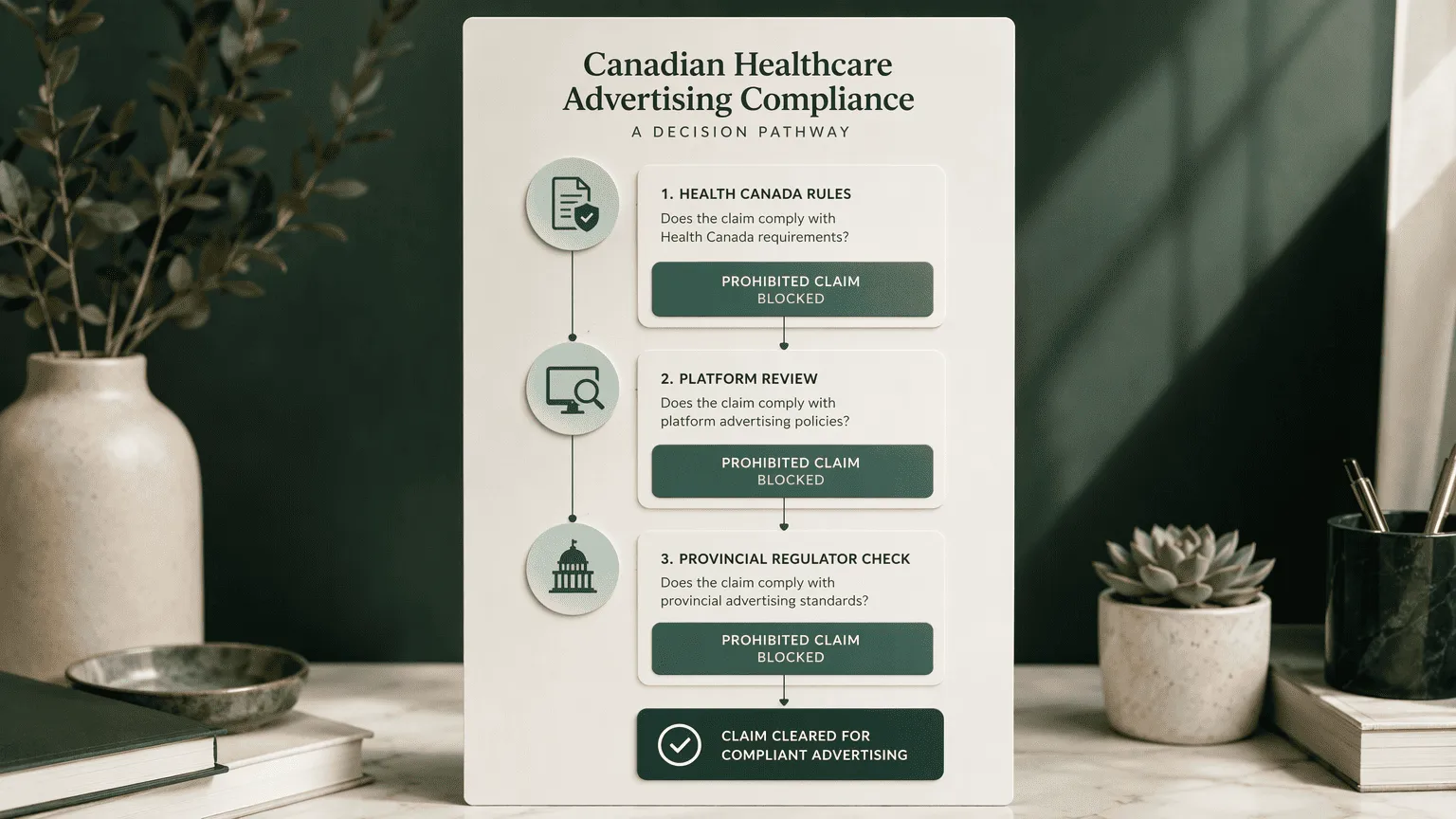
The fastest way to waste your agency retainer is to run creative that gets pulled by an ad platform or flagged by a provincial regulator. Health Canada's framework is binary on the point that matters most: direct-to-consumer advertising of prescription drugs is banned outright.
For clinics, physiotherapists, and dental practices operating in the non-prescription space, the trap is subtler. An agency cannot attribute a specific clinical outcome to a testimonial without running afoul of the provincial college advertising guidelines that govern your practitioners on an individual license level. One complaint from a competitor, and your marketing investment turns into a regulatory review.
The correct approach, as executed by firms like The Health Bureau (Toronto), front-loads a pre-clearance workflow into campaign design. The agency writes creative that leans entirely on educational information, the clinic's formal credentials, and quantified process descriptions. Testimonials become permissible only within a documented framework of patient consent that mirrors the college's guidelines on anonymity and context. Your agency either has a compliance checklist it can show you in the first call, or you are their regulatory experiment.
Why US Healthcare Brands Hire Vancouver Agencies

The calculus is simple for a US telehealth brand or a cross-border pharmacy group. An agency in Vancouver operates in Canadian dollars but builds assets for the highly competitive US patient acquisition market, creating a built-in currency arbitrage on every retainer invoice. The same full-service digital scope that costs you $18,000 out of a New York or Austin agency often lands at $12,000 to $15,000 in Vancouver. The overhead structure and talent market compress the gross margin the agency needs to take on the project. You are buying more hours aimed at what actually touches your patient acquisition cost.
A subtler readiness advantage exists in regulatory fluency. Vancouver agencies have spent years navigating Health Canada's tight restrictions on prescription drug advertising and unsubstantiated health claims. That experience breeds a congenital paranoia around campaign compliance. And that paranoia transfers. For a US client operating across both FDA and Health Canada jurisdictions, a team that treats a medical claim as a legal document is a structural risk reduction that compounds as your campaign scales into new states and provinces.
A third strategic layer operates on market entry. Bilingual capabilities sit natively inside firms like Pulse Digital Health, with French for the Quebec market and broader Canadian patient cohorts built in from day one. A US-based employer looking to recruit Canadian patients for clinical trials, telemedicine, or elective procedures can test both English and French-language patient funnels from a single partner without onboarding a separate Montreal shop. That consolidation cuts the learning curve of campaign launch in half and keeps the patient journey architecturally clean across both languages.
The True Cost of Healthcare Marketing in Vancouver in 2026
The spread between the lowest viable retainer and an enterprise full-service engagement is wide enough that the price you pay reveals the scope you bought before a contract is signed.
| Scope Tier | Monthly Retainer Range | What the Budget Actually Buys |
|---|---|---|
| Foundational Local SEO & Core PPC | $1,000 to $2,500 | Google Business Profile optimization, service page creation, and a tightly managed single-channel PPC campaign (Google Search Ads or Meta) with weekly spend tracking. Expect lead volume, not high-volume branding. |
| Comprehensive Multi-Channel Strategy | $5,000 to $10,000 | Full-site SEO with content calendar, multi-platform PPC (Search, Social, Display), review generation workflow, basic CTV ad testing, and monthly conversion rate optimization on core landing pages. |
| Enterprise Full-Service Digital & Brand | $25,000+ | Custom web development with complex booking integrations, dedicated creative production (video and static), cross-border compliance management, advanced analytics and call tracking, plus ongoing CTV and programmatic ad buying at scale. |
What often goes unspoken is the cost of an unskilled operator. Below $2,500, many agencies are pricing in a junior coordinator running templated reports. Above $10,000, you are paying for the cumulative intelligence from previous campaigns that flamed out on wasted budget months. The Vancouver talent market, built on two decades of tech firms training digital operators, compresses the premium you pay for that experience compared to matching talent sourced in San Francisco or Boston.
Emerging Trends Reshaping Vancouver's Healthcare Marketing Landscape

The story of 2026 in Vancouver healthcare marketing is that old channel mixes are dead. The first thing killing them is Connected TV advertising for dental, physiotherapy, and specialty clinics. Work from outside the region confirms what Vancouver performance shops now replicate: one CTV campaign for a dental provider slashed cost per acquisition from $270 down to $59 per booked appointment, a 78% reduction over five months.
Those numbers, massive rightward shifts in cost efficiency, are definitional. The signal is that streaming-first audiences convert on considered medical decisions at rates that make traditional search-only campaigns look archaic. If your agency is not running CTV creative tests against a Google Ads control group right now, you are paying elevated acquisition costs across your entire book.
The second tectonic shift is AI-driven content personalization engineered for generative search engines, not just Google's ten blue links. Marketing software built specifically for clinics now rebuilds your site structure so ChatGPT, Gemini, and Perplexity cite your pages when a patient asks who the best neurologist in Surrey is. The work moves from blog-churning to entity-rich pages structured as semantic assets, a technical pivot that a generalist agency cannot implement without specialized healthcare schema knowledge.
A quieter but equally profitable trend is hyper-local SEO aimed at senior care and telehealth segments. The same clinic-sepcific expertise that produced a 579% increase in new patient leads for a podiatrist clinic over 12 months now targets senior living occupancy and home-care conversions through geographic micro-targeting. The problem is that this play requires an SEO strategist who understands the 7-day inquiry-to-placement cycle for assisted living, not a keyword planner who optimized a bakery website last quarter.
A Practical Guide to Selecting the Right Agency Partner

You evaluate healthcare agency competence by dissecting their own track record at a granularity that most agency selection calls skip. The following sequence forces an evidence-based decision:
- Audit their healthcare-specific portfolio before a single pitch: Demand case studies from the exact discipline you need. A clinic SEO firm must show metric ranges such as the 135% traffic increase a senior care provider achieved in one year. A portfolio that groups a dentist with a car dealership and a home renovation firm is a deck of reused slides, not evidence that the team knows HIPAA from HTML.
- Interrogate compliance knowledge in the first call: Ask the agency to explain how they handle a negative patient review that mentions a specific adverse outcome. Their answer should reference provincial college advertising standards, not just the Google review policy. A vague response means your regulatory exposure sits on their uncorrected copy.
- Demand verifiable case study metrics, not percentages without context: The industry is full of '300% increase' badges that float off a baseline of two impressions. Require absolute numbers as a check: a podiatrist campaign that produced a 216% increase in conversion rate alongside a 138% organic traffic lift over 12 months is a far more honest signal than a percentage that hides its denominator.
- Audit client retention and review patterns: Short-tenure client rosters and thin review histories for a firm claiming 20 years of operation are a risk signal. A strong agency has clients who stay for multi-year engagements and leave public, named reviews that match the complexity of healthcare work. Anonymous testimonials in a PDF called 'What Our Clients Say' are not evidence.
Conclusion
Vancouver has quietly built a dense cluster of regulatory knowledge, technical search talent, and cross-border capability. The agencies that survive 2026 sell the budget back to you as a structured advantage, with line items that map directly to how your clinic appears on search engines that now answer patient questions before your website ever loads.
Pick the partner who walks in with case-study math you can verify. The one who can recite the Health Canada objection-handling script cold, because they field those calls every week. The one who treats your ad spend like a clinical trial, right down to the measurable endpoints and the refusal to spend past the data.
Frequently Asked Questions
What services does a healthcare marketing agency in Vancouver typically offer?
A specialized Vancouver agency offers healthcare SEO, compliant PPC management, reputation management for provider reviews, HIPAA- and PIPEDA-aware website development, and provider-focused content marketing for AI-driven search platforms. These services are tailored for medical, dental, and hospital clients and exclude tactics that violate Health Canada guidelines.
How do healthcare marketing agencies in Vancouver navigate Canadian healthcare advertising regulations?
They build campaigns on educational content and credentials rather than outcome promises. They follow provincial college rules on patient testimonials, implement explicit consent workflows, and prohibit direct-to-consumer prescription drug advertising. The strongest agencies apply a pre-clearance compliance review to every piece of creative before it launches.
What are the benefits of hiring a Vancouver-based agency for US healthcare brands?
US brands gain a currency arbitrage advantage from the Canadian dollar, bilingual capabilities for English and French patient campaigns, and an agency with ingrained compliance expertise applicable to cross-border FDA and Health Canada situations. The model delivers more billable hours against patient acquisition than comparably priced US agency retainers.
How much does it cost to engage a healthcare marketing agency in Vancouver?
Monthly retainers start around $1,000 for foundational local SEO and PPC, rise to $5,000 to $10,000 for thorough multi-channel strategies including CTV ad testing, and exceed $25,000 for enterprise full-service engagements with custom development and dedicated creative production. Each tier maps to specific scope, not just higher ad spend.
What trends are shaping healthcare marketing in Vancouver in 2026?
AI-driven content optimization for generative search engines like ChatGPT and Perplexity is the new SEO edge, while hyper-local campaigns focused on senior care and telehealth have become the highest-margin plays.
How do you choose the best healthcare marketing agency in Vancouver?
Vet their healthcare-specific portfolio for quantified case studies, interrogate their Health Canada compliance process in the first call, demand absolute case-study numbers not just percentage lifts, and audit their client retention duration and public review patterns. A strong firm can show you the math behind a 135% traffic lift, not just a pitch deck.
Sources
- Clincy Case Study: 1.14K Google Impressions in 30 Days | ClinAds - getclinads.com
- Best Healthcare & Hospital Content Marketing Agencies in Canada 2026 | Semrush - agencies.semrush.com
- British Columbia, Canada Healthcare Marketing - Find Healthcare Marketers in British Columbia, Canada - martech.health
- The Health Bureau: Digital Marketing Services for Healthcare - www.healthbureau.ca
- Vancouver Healthcare Marketing Agency - Pulse Digital Health - pulsedigital.health
Want help executing this for your clinic?
Book a 30-minute call and we will map what a real ad engine would look like for your specific service mix.
Book a call