
Your Google Ads Cost Per Lead Is a Decision About Your Agency, Not Your Budget
IntroductionYour clinic's cost per lead isn't climbing because Google got more expensive. It's climbing because the agency you pay to manage it is running the same generic playbook they'd run for a plumber. The problem isn't your budget. Most generalist agencies and freelancers don't understand the unit economics of a patient, the regulatory handcuffs of HIPAA, or why sending a click to an underbaked landing page turns ad spend into smoke.
A bad agency burns your budget on volume. Clicks spike. Forms fill.
And the front desk sees no new bodies in the exam room. The disconnect is simple but lethal: they optimize for what Google Ads reports, and none of what Google Ads reports tells you whether a human showed up for an appointment. That gap between a 'conversion' and a scheduled patient who actually walks through the door is where clinic profit margins go to die.
Key Takeaways
- Your Google Ads account leaks in three predictable places: expensive clicks that land on a slow homepage, emergency and elective intent crammed into the same campaign, and optimization targets that reward cheap leads over booked appointments. The fix is a specialist who audits against closed revenue, not vanity metrics.
- The single most destructive move a clinic can make is launching Performance Max without six months of clean search data first. That choice funnels your budget into display spam and mobile app placements while you wonder why the phone isn't ringing. Veterinary clinics running Google Ads properly should expect to pay an estimated $3 to $8 per click for core searches, and the broader medical clinic range sits at an estimated $20 to $60 per general-practice lead. If your numbers are worse than that, the channel isn't broken. The campaign structure underneath is.
- A freelancer or boutique agency at $400 to $2,000 per month in management fees typically delivers better unit economics than an in-house hire at comparable spend levels, especially once you factor in HIPAA compliance overhead. The conclusion is blunt: stop optimizing for cost per lead in isolation. The only number that matters is cost per booked patient who shows up.
What a Reasonable Cost Per Lead Looks Like for a US Medical Clinic in 2026

Across all industries in 2026, the average cost per lead is $66.69, down from $70.11 in 2025. Medical clinics operate in a narrower band driven by specialty and urgency. A general practice clinic with a dedicated landing page and proper conversion tracking should land between $20 and $60 per lead. High-urgency services like emergency dental, orthopedics, and dermatology push that range to $40 to $100 per lead, and sometimes well beyond in competitive metros.
The benchmark that catches most clinic owners off guard is the all-in number. Ad spend is only part of the equation. A realistic all-in monthly cost for a veterinary clinic's Google Ads is estimated at $1,500 to $5,000 once ad spend, management, and a landing page are counted.
That is the operational range where campaigns produce measurable patient volume. Below $2,500 per month all-in, you are invisible in most US cities. You are spending enough to feel the pain on your credit card but not enough to generate statistically meaningful conversion data.
Context matters. The average click-through rate across all industries in 2026 is 6.64% and the average conversion rate is 8.18%. If your clinic's numbers sit below those averages, you are facing a campaign architecture problem that a competent operator can diagnose in under an hour.
The Hidden Forces That Inflate Clinic Cost Per Click
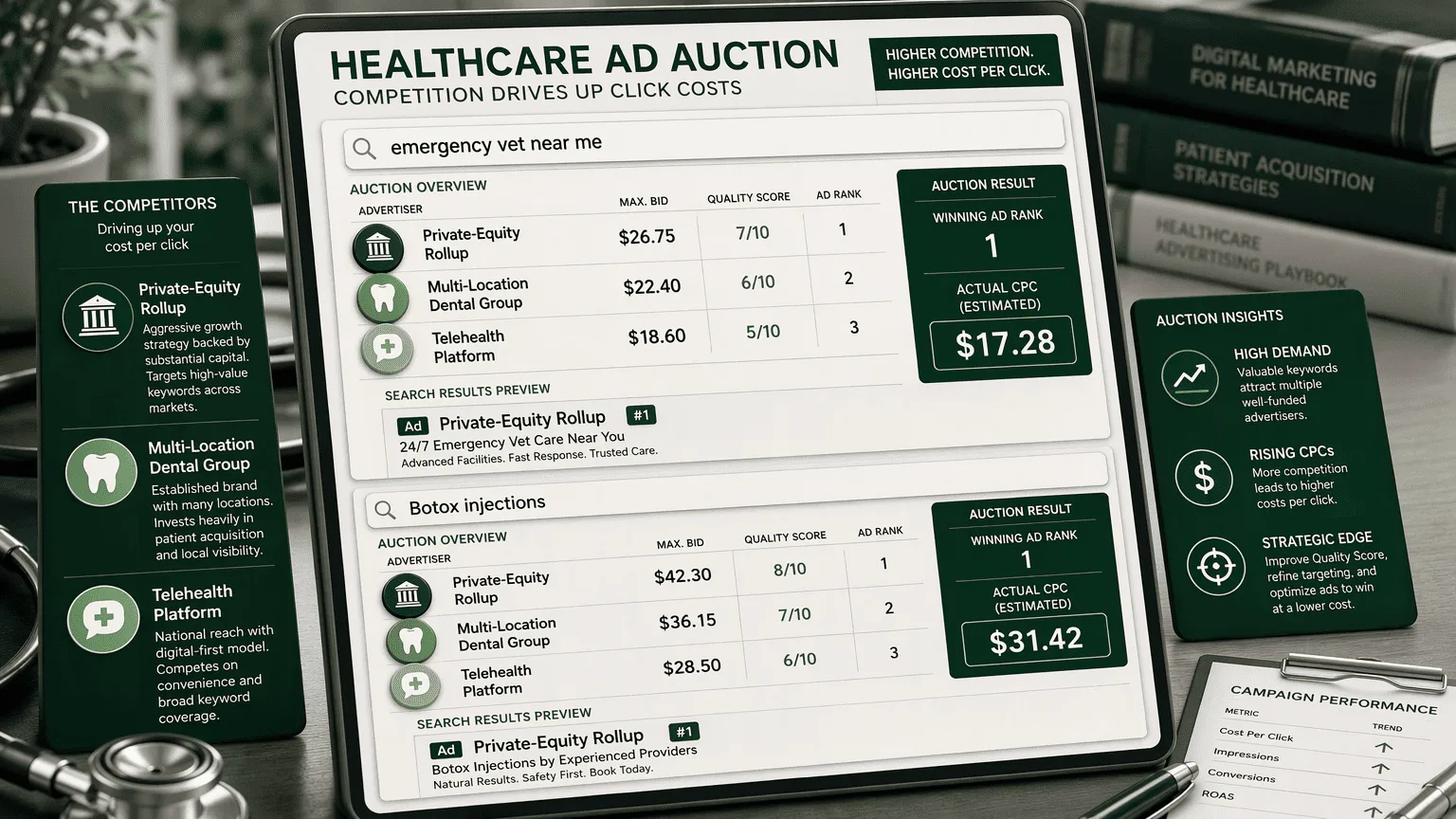
Google Ads is an auction where your competitors set the price you pay, not a rate card Google publishes. In US healthcare markets, those competitors include private-equity-backed rollups, multi-location dental groups, and telehealth platforms with national budgets. They bid up terms like "emergency vet near me" or "Botox injections" because a single booked procedure can justify $50 or more in click cost.
Intent mixing is the second inflator. A campaign that lumps "emergency vet" with "annual vaccinations" forces Google's algorithm to bid against itself. Emergency terms in veterinary medicine run $6 to $15 per click, while wellness terms sit at $2 to $5. When those keywords share a budget pool, the algorithm overpays on low-intent clicks trying to compete on high-intent queries, and your blended cost per lead drifts steadily upward. The same dynamic plays out in human medicine: general checkup terms cost half what "knee pain specialist" commands, but most clinics dump them into one campaign and wonder why costs keep climbing.
The third force is the hidden tax on poor user experience. Sending every click to a slow homepage with no clear booking action pays a penalty on every single click, often a substantial one. Google's Quality Score algorithm evaluates landing page relevance, load speed, and mobile usability. A clinic directing ad traffic to its homepage with a buried contact form pays a premium that a dedicated landing page eliminates, and that premium compounds across hundreds or thousands of clicks each month.
How a Google Ads Specialist Actually Lowers Your Cost Per Lead
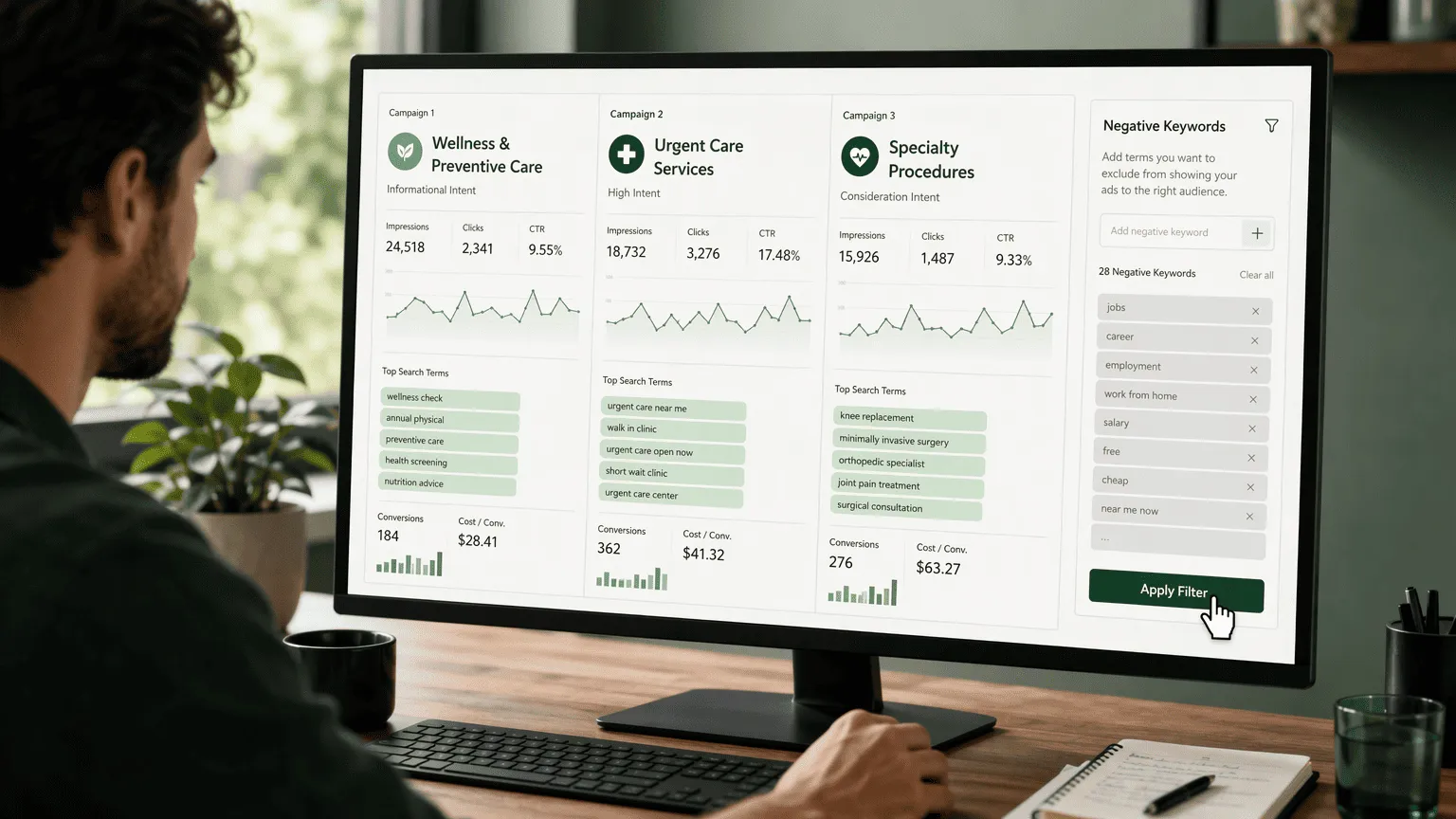
A specialist starts by separating search intent into distinct campaigns. Wellness appointments, urgent care, and specialty procedures each get their own budget, their own bidding strategy, and their own landing page. This structural change fixes the intent-mixing problem that inflates blended cost per lead. It also gives the algorithm clear signals about what a conversion looks like for each service line.
The second lever is negative keyword discipline. Weekly reviews strip out high-cost, zero-conversion search terms before they drain meaningful budget. A dermatology clinic quickly learns that "rash pictures" generates thousands of impressions and zero booked appointments. A specialist catches that within seven days and adds it to the negative keyword list permanently. A generalist marketing manager or a clinic owner running ads on weekends never sees the pattern.
The third lever is where the real money moves. A specialist optimizes against closed sales, not just click activity. Cheap leads that never book are more expensive than expensive leads that convert. In one campaign structure overhaul, a clinic saw lead-to-sale conversion rise 115% while Google spend increased only 22%.
Weekly closed sales rose 156%. The metric that matters is patients in chairs, not the number of forms submitted. A specialist also builds against cost per acquisition (CAC), tracking the journey from click to consultation to treatment. Most clinic owners never see that number.
Your 1-Hour Audit: Diagnosing Exactly Where Your Clinic Budget Is Leaking
Open your Google Ads account and pull three numbers.
- Blended cost per lead: If you cannot separate this figure by campaign or service line, you've already found the first leak. A single blended number masks weak downstream conversion. Emergencies convert at 30% and wellness at 5%, but a blended CPL reports them as the same cost and hides the fact that most of your budget is going to tire-kickers.
- Ad traffic destination: If every ad points to your clinic homepage, you're paying a per-click penalty that compounds daily. A dedicated landing page for each service line with a single, obvious booking action drops that penalty to zero. Landing pages from a specialist provider run as low as $249 each plus $99 per month for hosting, split-testing, and maintenance. That's less than a day's wasted ad spend for many clinics, and it pays for itself inside the first billing cycle.
- Performance Max campaign status: If you launched a Performance Max campaign without first building six months of clean search campaign data, your budget is currently funding display ads on recipe blogs and mobile game placements. Performance Max needs historical conversion data to optimize; without it, Google defaults to the cheapest inventory available, which almost never converts for healthcare. Shut it off, build a structured search campaign with proper conversion tracking, and revisit Performance Max once you have at least 30 tracked conversions in a 30-day window.
Freelancer, Agency, or In-House: Which Hire Actually Fixes Your Unit Economics

For a clinic spending $3,000 to $10,000 per month on ad spend, a freelancer or boutique agency at $400 to $2,000 per month in management fees almost always beats the in-house math. The right choice for your clinic comes down to specific trade-offs in cost, pattern recognition, and regulatory risk.
| Dimension | Freelancer / Boutique Agency | In-House Hire | Large Agency ($3,000+ mgmt fee) |
|---|---|---|---|
| Monthly Cost at $5,000 ad spend | $400 to $2,000 management fee | Salary north of $70,000 plus benefits, tools, and training | $3,000+ management fee, often requiring higher ad spend |
| Pattern Recognition | Brings pattern recognition from auditing dozens of clinic accounts; knows which negative keywords to add in week one | Learns waste patterns on your dime over the first quarter while your cost per lead drifts upward | Delivers broader pattern recognition but often layers on account management overhead that doesn't improve campaigns below $20,000 monthly ad spend |
| Regulatory Risk | Vetting is critical; a generalist PPC freelancer may never have encountered the intersection of medical advertising and privacy regulations | Requires explicit HIPAA compliance training and oversight, adding to the cost and legal exposure | Typically has compliance infrastructure but at a premium; the legal risk of a misplaced claim about treatment outcomes remains real if they treat medical PPC like ecommerce PPC |
| Conversion Path Expertise | Knows that healthcare conversion paths are longer and attribution is messier. Has often seen how 'Botox cost' searchers convert at half the rate of 'Botox injections near me' searchers. | Develops this understanding slowly, without the benefit of cross-account data | Capable of handling complex, multi-channel coordination once ad spend crosses the $20,000 threshold and you need creative production and landing page development |
Why Healthcare Privacy (HIPAA) Rewrites the Rules of Ad Targeting

HIPAA walls off the advertising tactics that most industries run on autopilot. Remarketing audiences built from website behavior become a compliance decision, not just a targeting checkbox, because a visit to a treatment page can itself be protected health information. Google's personalized advertising policies prohibit targeting based on health conditions. A dermatology clinic cannot retarget visitors who viewed a psoriasis treatment page the way an ecommerce store retargets abandoned carts.
Call tracking is key for measuring Google Ads performance in clinics where phone bookings dominate. It also requires a Business Associate Agreement (BAA) with any vendor that handles call recordings or transcripts containing patient information. Google offers a BAA for certain products, but not all features remain available under it.
Dynamic number insertion, the standard method for attributing phone calls to specific campaigns, often requires third-party call tracking platforms, and every one of those platforms must sign a BAA. Skip this step and you're operating outside compliance, with exposure that no amount of lead volume can justify. A clinic's advertising data ends up thinner than a retail brand's.
You cannot build lookalike audiences off your patient list. You cannot upload hashed email lists for customer match without explicit, documented consent. The targeting tactics that make Facebook and Google efficient for other industries are partially walled off for healthcare.
This is precisely why clinic advertising requires a specialist who understands both the compliance boundaries and the workarounds that stay legal. A generalist PPC manager who has never signed a BAA will miss these constraints until an audit surfaces them.
Conclusion
Your Google Ads cost per lead is a function of campaign architecture, not market conditions. The clinics paying $20 to $60 per lead and the clinics paying $100 or more are bidding in the same auctions against the same competitors. The lower-cost clinics have separated intent by service line, built dedicated landing pages, and optimized against booked appointments rather than form fills.
The sequence for lowering your CPL is specific, not complicated. Audit your campaign structure for intent mixing. Replace your homepage destination with a service-specific landing page.
Remove Performance Max if it launched without historical data. Implement negative keyword discipline on a weekly cadence.
And hire someone who understands that healthcare advertising lives inside HIPAA's walls, not outside them. A freelancer or boutique agency at a fraction of an in-house salary will spot the leaks faster and fix them with less wasted budget.
Want to see what your first month of ClinAds creative would look like? ClinAds builds on-brand static and video ads from your existing website in minutes, and pairs them with competitor intelligence from your city and specialty so you know exactly what you're bidding against. Book a 30-minute intro call.
Frequently Asked Questions
What is a reasonable cost per lead for a medical clinic running Google Ads in the United States in 2026?
For a general practice clinic with a dedicated landing page and proper conversion tracking, a reasonable cost per lead ranges from $20 to $60. Specialties and high-urgency services like urgent care or specialist surgeons often see a CPL climbing to $40 to $100. A higher CPL isn't automatically bad if those patients generate more lifetime value.
What specific tactics can a Google Ads specialist use to lower cost per lead for a clinic?
A specialist segments campaigns by search intent, aggressively builds negative keyword lists from weekly search term audits, and designs fast, HIPAA-compliant landing pages to fix Quality Score penalties. The most impactful tactic is shifting your optimization target from a cheap raw lead to the actual cost of acquiring a closed patient.
How do I audit my current clinic Google Ads account to find where money is being wasted?
Immediately check three critical signals to optimize your campaign performance:
- Blended cost-per-lead: Identify your overall cost-per-lead and separate B2C from non-B2C conversions to measure true efficiency.
- Destination URL: Confirm the destination URL; if it is your homepage, you are paying a penalty on every click.
- Ad groups: Look for ad groups mixing high-cost commercial terms with low-cost informational queries, as this dilutes performance and wastes budget.
Should my clinic hire a freelancer, an agency, or an in-house expert to manage Google Ads?
If you spend under $10,000 monthly on ad budget, an experienced freelancer or boutique agency is usually a better financial decision than a full-time salary and benefits. A specialized partner also comes with pre-existing HIPAA-compliant vendor relationships for call tracking, which an in-house hire would take months to build from scratch.
What are the common mistakes clinics make that drive up Google Ads cost per lead?
The single most common fatal error is launching Performance Max campaigns without first accumulating months of clean search conversion data. This hands Google's algorithm a blank check to burn your budget on low-intent display and Search Partner placements long before a real patient ever sees a search ad.
How do healthcare privacy regulations (HIPAA) affect Google Ads targeting and tracking for clinics?
HIPAA forbids you from uploading patient email lists for Customer Match or retargeting users based on their clinical behavior. Any third-party vendor handling patient data, such as a call-tracking provider, must sign a Business Associate Agreement. This forces clinics to rely on first-party data and contextual intent rather than behavioral stalking.
Sources
- Google Ads for Medical Clinics - Ten Thousand Foot View - www.tenthousandfootview.com
- Google Ads Benchmarks 2026: CTR, CPC, Conversion Rate & CPL by Industry - almcorp.com
- A Google Ads Case Study: How to Decrease the Cost Per Lead by 41.6% - goldman-marketing.com
- Google Ads for Veterinarians Cost (2026) | Sprout Sage - sproutsagesolutions.com
Want help executing this for your clinic?
Book a 30-minute call and we will map what a real ad engine would look like for your specific service mix.
Book a call