
Most Clinics Burn 40% of Their Ad Budget Before a Patient Ever Walks Through the Door
IntroductionYour Google Ads dashboard shows clicks, maybe even form fills. Then you cross-reference your EHR and discover half those leads were the wrong insurance, out-of-state, or never booked. The problem is you are running generalist paid ads in a regulatory environment designed to punish exactly that.
US clinics sit at the most dangerous intersection in digital marketing: the convergence of high-intent patient searches, strict HIPAA constraints, and platform algorithms that want to track everything. A general agency will optimize for the conversion pixel, unaware that the pixel itself is a compliance violation waiting to happen.
In 2026, clinic owners are spending more on paid channels than ever, yet most cannot tell the difference between a specialist agency that protects patient privacy and a generalist shop that incurs fines. This article gives you the architecture for compliant patient acquisition: the real platform benchmarks, the tracking blueprint that keeps you legal, and the budget floor you need to compete.
Key Takeaways
A specialized agency structure, a realistic budget floor, and a signed Business Associate Agreement separate clinic growth from regulatory exposure. Before you make another media dollar decision, lock these numbers in.
- Budget floor: You need at least $2,000 to $5,000 per month in ad spend, with a separate 15 to 20 percent management fee or a $500 to $1,500 monthly retainer. Below that, you are invisible in competitive US metro areas.
- Dominant intent channel: Google Search Ads deliver the strongest patient acquisition ROI for clinics, averaging a $5.42 cost per click. Medical searches signal immediate need; demand capture converts higher than demand creation.
- Social conversion reality: Meta Ads convert at a 1.57 percent rate for clinics. The channel is most useful for local awareness and elective procedure demand gen, not emergency or acute-care bookings.
- Non-negotiable baseline: Any partner agency must execute a BAA before campaign launch, must never build audience lists from PHI or unhashed emails, and must not use standard Meta or Google pixels on pages that handle protected health information.
- Speed reality: Paid ads can start generating patient leads within seven to fourteen days of launch. SEO, by comparison, takes two to three months to build momentum.
What a Paid Ads Agency for Clinics Actually Does (and Why HIPAA Changes Everything)
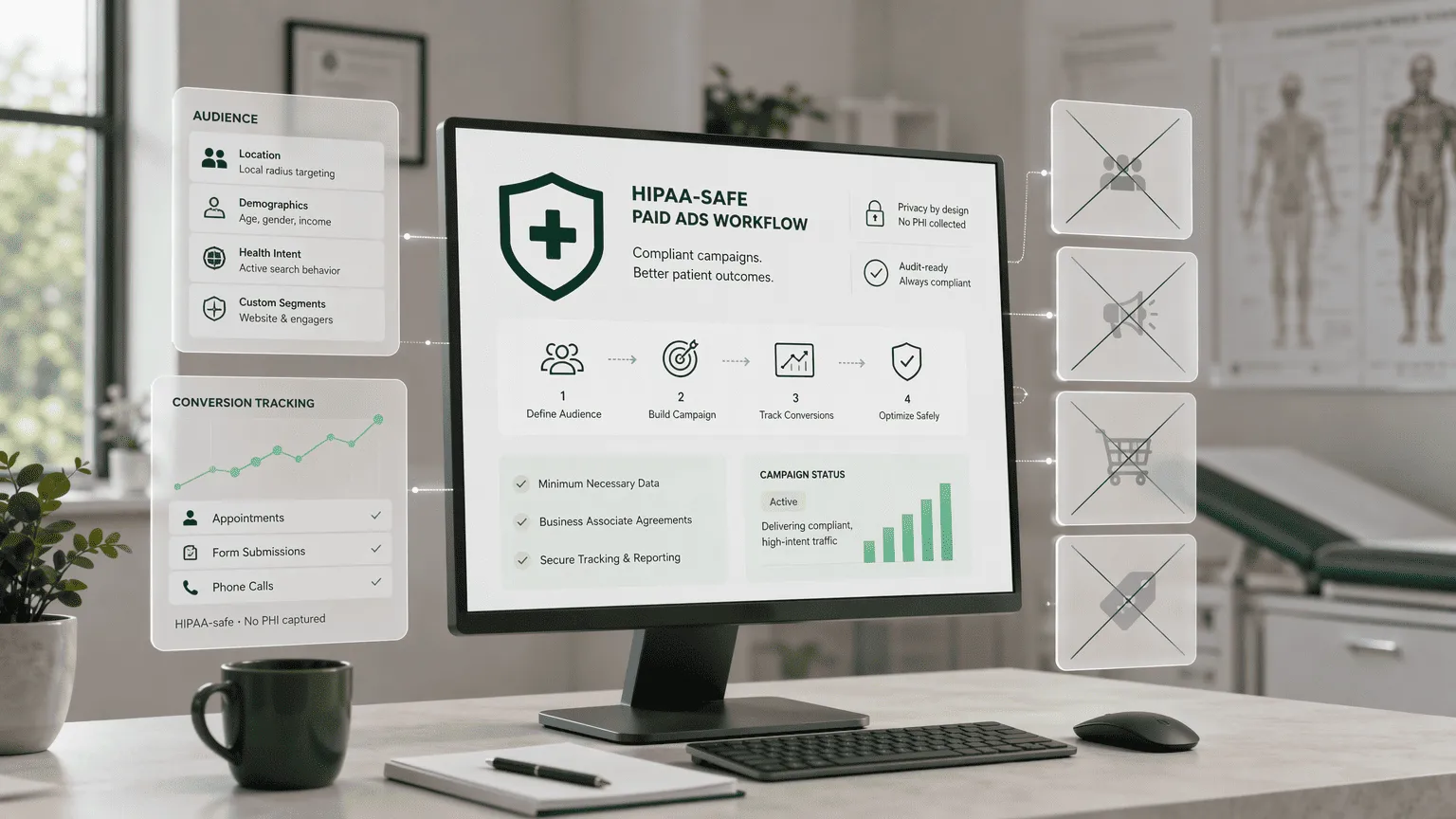
A specialized paid ads agency for US medical clinics builds patient acquisition campaigns where every decision, from the audience target to the conversion tag, is filtered through the HIPAA Privacy Rule. Most generalist shops never perform that filter. They import your patient email list into Meta, build a custom audience, and run a lookalike campaign, and at that moment, your clinic has committed a reportable breach. A specialist agency strips out four standard generalist tactics before a single ad goes live: no unhashed PHI in audience lists, no remarketing on appointment-confirmation pages, no ad copy that implies treatment outcomes or patient conditions, and no standard third-party pixel firing on EHR-connected landing pages.
The core deliverables on a scope-of-work slide remain ad copy, creative builds, landing page design, campaign architecture, bid management, and performance reporting. A clinic-specific agency operates under a signed Business Associate Agreement and reconstitutes every component around server-side tracking, hashed first-party data, and pre-approved compliant language. That workflow is the baseline.
Meta and Google keep rolling out AI tools that make generalist campaign management easier and clinic compliance harder. Google's AI Max for Search exited beta in April 2026, broadening automated assets and match types exactly when clinics need tighter control over which search terms trigger their brand. Meta's price per ad rose twelve percent year-over-year in the first quarter of 2026, squeezing ROAS for every advertiser.
A general agency responds to margin compression by broadening audiences and letting the algorithm optimize toward whatever converts cheapest. For a dental implant practice, the pixel learns to serve ads to the demographic cohort most likely to click, not most likely to qualify, because the standard tag cannot ingest insurance type or procedure need. A specialist agency instead builds the conversion architecture around offline conversion imports, server-side events, and CRM-attributed value scoring, so the platform optimizes toward booked appointments.
This infrastructure takes longer to set up and costs more to maintain, which is why budget-tier agencies do not offer it. When a prospective patient clicks a Google Ad and lands on your page, any standard JavaScript pixel that fires instantly transmits the URL string.
On a condition-specific landing page, that string can contain PHI sent to an ad platform that has not signed a BAA. That single event is a HIPAA violation. Berkeley Health, which has managed over ten years of paid ad campaigns exclusively for healthcare, orchestrates secure CRM handoffs and offline conversion uploads as the default architecture.
The compliant alternative replaces browser-side pixels with a server-side tracking container that hashes identifiable data before transmission and only fires from page templates isolated from electronic health records. Most clinic owners only encounter this distinction during a breach investigation. Waiting until then to audit your agency's pixel infrastructure is a $50,000 mistake.
The right agency builds the patient acquisition funnel around signal, not surveillance. You get Google Search campaigns that bid on provider + procedure + location terms, Meta ad sets built on demographic and interest layers rather than PHI-fueled lookalikes, and reporting dashboards that reject session recordings, heatmaps, and full-URL attribution in favor of aggregated, de-identified conversion counts. If a prospective agency cannot explain how their tracking works in a single sentence, they do not understand it.
The True Cost and Budget Structure for Clinic Paid Ads in 2026
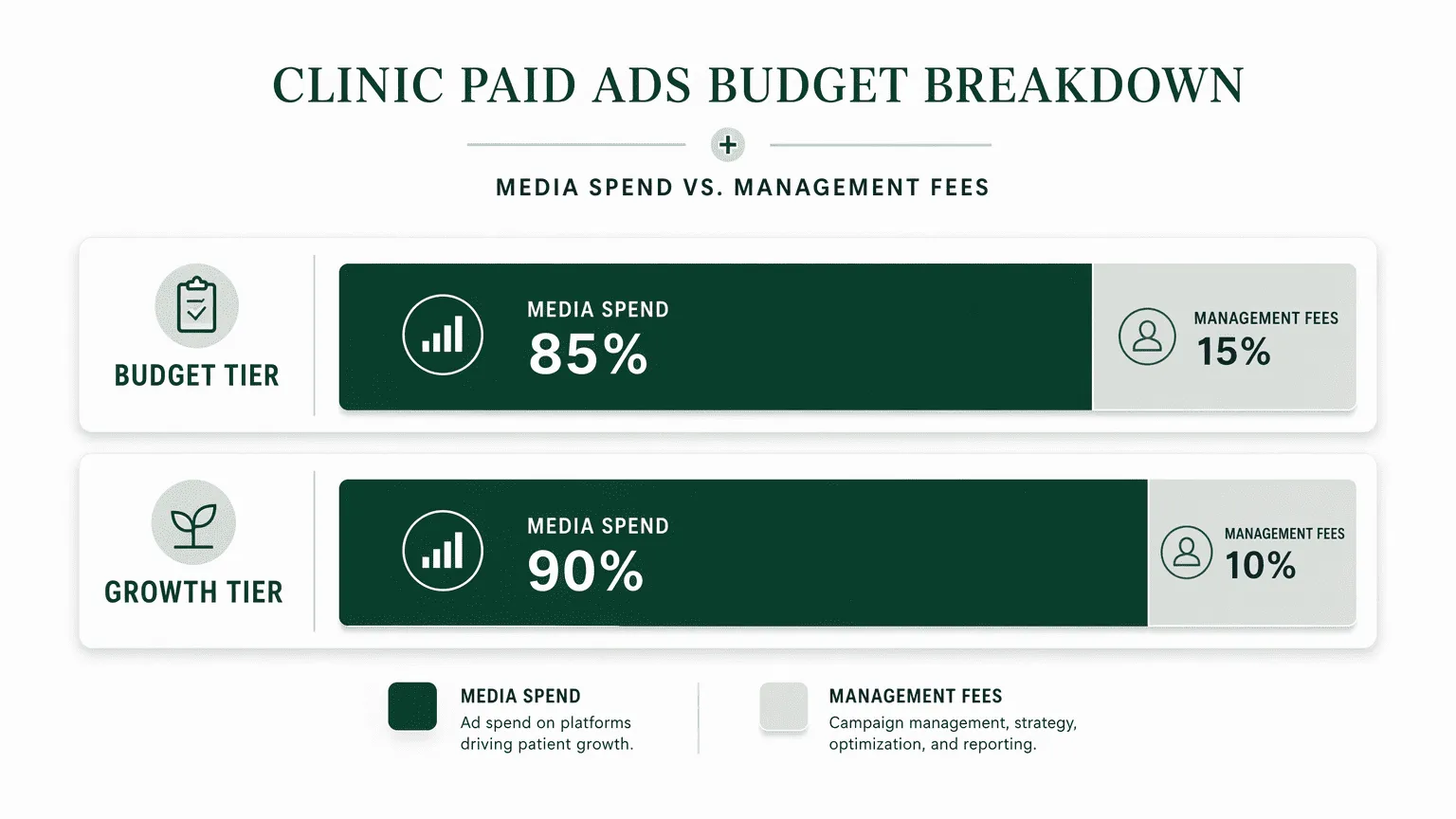
Any agency that quotes you one bundled number with no breakdown of media spend versus management cost is either padding their margin or eating your reach. The industry-standard structure in 2026 separates these two line items, and clinics should refuse to sign anything that does not. The table below anchors you to the real ranges for independent clinics and specialty practices.
| Cost Component | Budget Tier ($2,000 to $3,500/mo ad spend) | Growth Tier ($3,500 to $5,000+/mo ad spend) | What the Tier Unlocks |
|---|---|---|---|
| Ad Spend (Media) | $2,000 to $3,500 paid directly to platforms | $3,500 to $5,000+ paid directly to platforms | Budget-tier covers one focused metro area with Google Search and a lean Meta awareness campaign. Growth-tier expands to multiple service lines, non-brand search, and elective-procedure social creative. |
| Agency Management Fee | 15 to 20 percent of ad spend ($300 to $700/mo) OR flat retainer of $500 to $1,500/mo | 15 to 20 percent of ad spend ($525 to $1,000+/mo) OR flat retainer of $1,000 to $1,500+/mo | Covers campaign architecture, compliant creative builds, landing page optimization, server-side tracking configuration, and monthly performance reporting against booked-patient KPIs. |
| Creative & Infrastructure | Static and limited video ad builds included in retainer; landing page templates | Ongoing static and video ad testing included; dedicated landing page design and offline conversion import configuration | Growth-tier creative is refreshed weekly against ad fatigue data, and each landing page is HIPAA-segmented from the clinic's EHR subdomain. |
| Agency Platform Spend | Not itemized; included in retainer | Not itemized; included in retainer | Covering compliance tools like HIPAA-compatible analytics dashboards, call tracking with dynamic number insertion, and CRM-integrated lead scoring software. |
| Signal Warning | Below $2,000/mo total ad spend across Google and Meta combined means you cannot reach campaign-level statistical significance on conversion lift unless you are in a low-population, low-competition rural market. | Above $5,000/mo in ad spend often makes sense as you scale patient volume, but the marginal return depends entirely on whether your tracking architecture correctly attributes booked appointments back to the channel. Before scaling, confirm your CRM integration is reporting cost per booked patient, not cost per lead. |
Management fees vary by agency structure. Some firms charge a percentage of spend because their incentive aligns with scaling profitable campaigns; others charge a flat retainer because they prioritize creative testing cadence over budget expansion. Both models work when transparent. Neither works when buried inside a single opaque invoice line that reads 'marketing services.' The clinics that win in 2026 are the ones that pay for media directly through their own platform ad accounts, route management fees separately, and retain ownership of every campaign asset, audience dataset, and conversion-tracking container. That way, the agency is replaceable, and the compliance infrastructure stays with the practice.
Platform-by-Platform Patient Acquisition: Google Ads, Meta, and TikTok Benchmarks for US Clinics

Medical clinics get the geometry wrong when they treat Google and Meta as two versions of the same channel. Google Search and Shopping is, at its core, a demand capture channel. Meta, though it retains retargeting capability, is most accurately viewed as a demand creation platform.
The data bears out the performance gap. Google Ads produces far higher conversion rates for clinics because the searcher has already declared a medical need; Meta's lower conversion rate reflects its position higher in the funnel, capturing attention from audiences who had not yet decided to book. The benchmarks in 2026 reflect that structural difference: Google Search Ads for clinics deliver a $5.42 cost per click and an 8.18 percent conversion rate, while Meta Ads for medical advertisers operate at a $14.19 cost per thousand impressions and a 1.57 percent conversion rate.
Both numbers matter, but they belong in different columns of your P&L. Google is your booked-patient engine. Meta is your local-awareness engine.
The wrong application of these platforms is more expensive than most clinic owners calculate. A med spa that funnels its entire budget into Meta Ads for CoolSculpting will generate plenty of impressions among women aged 30 to 55 in the right zip codes, but will convert at a fraction of the rate of a parallel Google campaign targeting 'CoolSculpting cost near me.' With Meta, you are limited to interest targeting, and while that layer works for introducing an elective procedure to a cold audience, it does not capture the person ready to swipe a credit card. The trade-off is that Google captures intent effectively, but its demographic targeting is not as granular or performance-driven as Meta's on a per-impression basis. The most profitable clinic campaign architectures run Google Search as the conversion floor and Meta as the awareness and retargeting layer on top.
TikTok is still experimental for most clinic categories, and its paid ad benchmarks are too sparse to anchor a primary budget allocation. The one exception is elective, appearance-driven medicine targeting a younger demographic: orthodontics, cosmetic dermatology, and med spa injectables aimed at patients under 35. On TikTok, the creative brief matters more than the platform itself.
Most agencies will not touch TikTok for a clinic, because the compliance lift relative to the patient volume is not yet justified in 2026. The correct move is to let Google and Meta fund your experimentation on TikTok.
If you cannot trace a booked appointment back to the ad that generated it, you are flying without instruments. If you trace it by firing standard Meta and Google pixels on pages where patients enter protected health information, you are flying into a mountain. The compliant middle ground is server-side tracking with hashed identifiers, secured under a signed BAA with every platform that processes the data.
Standard browser-side pixels, including the Meta Pixel and Google Tag if installed on a HIPAA-covered page, transmit URL strings and page metadata that can contain procedure types, condition signs, or facility names. PHI can be far broader than most operators assume: a URL path containing '/new-patient/gender-affirming-care' combined with an IP address meets the definition under the HIPAA Privacy Rule. Once that data resides on a Meta or Google server under an account without a BAA, the breach has already occurred.
The compliant architecture replaces those vulnerable front-end events with server-side conversion tracking, where a clinic's own container fires events after stripping and hashing identifiable fields. The Google Ads conversion import process, for example, accepts hashed click IDs and appointment-confirmation counts without ever receiving a patient name. Agencies properly configured for clinics route conversions through offline import files or platform APIs using GA4 server-side setups configured for HIPAA. This is the single piece of infrastructure that separates compliant patient growth from a reportable privacy violation.
Most clinic tracking failures happen at the handoff. Neither the call-tracking tool nor the chat vendor will have signed a BAA unless the agency explicitly demanded one.
Even the best clinic-specific agency cannot fix a breach after the fact. A compliant tracking audit asks five questions: is every software vendor touching patient data under a signed BAA? Are all conversion pixels server-side only?
Does the CRM log contain any attribution fields pulled from standard URL parameters? Are session recordings disabled on all landing pages?
And can the agency produce a report showing exactly which conversion events are sent to each ad platform and with what fields? If any answer is no, the tracking is not compliant.
ClinAds takes the approach of integrating with clinic tools that already operate under HIPAA-grade infrastructure, building image ads and campaign architecture that routes through compliant containers from launch. The signal you need is booked appointments with channel attribution, and nothing else.
How to Evaluate and Choose a Clinic Paid Ads Agency (Including Red Flags)

Most clinics start with the wrong question: 'Can you run Google Ads for us?' The right question is 'Show me your BAA template and your server-side tracking architecture.' The checklist below screens out dangerous generalists before you waste a quarter's budget and inherit their compliance exposure.
- Demand a signed BAA before campaign launch. Any agency that hesitates or claims they do not need one is disqualified. A BAA is legally mandatory for any vendor handling PHI on your behalf. No exceptions, no workarounds.
- Audit exactly where and how conversion tracking fires. Ask the agency to produce a one-page diagram of every tracking event, the pages it fires on, and whether it is server-side or browser-side. If they cannot produce this within one business day, they do not have one.
- Request three live campaigns from similar-specialty clinics with the patient identifiers redacted and look for this.
- Demand case studies with booked-patient cost metrics, not lead form fills. Any agency can generate inexpensive form fills with broad-match search and a generic landing page. Ask for cost per booked appointment and cost per new patient visit, tied to CRM data rather than platform-reported conversions.
- Verify their creative refresh cadence. Clinic ad creative degrades faster than the average e-commerce creative because creative testing pools are smaller and local audiences see the same ad more often. A legitimate agency will specify how many new static and video variants they produce per month and tie that cadence to ad fatigue decay curves.
- Flag any promise of viral healthcare content. 'Viral' medical marketing is almost always noncompliant, either because it leverages patient stories without authorization, makes outcome claims, or pushes creative that platforms will flag under healthcare policy. This is a hard disqualifier.
- Test their HIPAA knowledge with one question. Ask: 'How do you handle remarketing for someone who visited our appointment-confirmation page?' The only correct answer is 'We block it entirely.' If they describe a workaround, end the call.
- Confirm that you will own every asset. Platform ad accounts, audiences, conversion containers, and creative files must remain your property. If the agency builds campaigns inside their own manager account and invoices you a bundled fee, you lose all data and infrastructure if you leave.
Conclusion
Paid advertising for US clinics fractures into two camps: agencies that price in compliance infrastructure and agencies that price it out. A lower-cost option skips the server-side tracking, the BAA, or the creative audit. Those omissions cost more in fines and lost patient trust than any agency retainer ever will.
The immediate action is to demand a BAA from every prospective partner and to refuse any proposal that bundles agency fees inside media spend. That single discipline eliminates most dangerous operators before you ever see their campaign build.
Once you have a compliant architecture under signed agreement, you can focus the budget where the numbers direct: Google Search for demand capture and Meta for local awareness. Add nothing else until those two channels prove they can profitably fund a third.
Frequently Asked Questions
What does a specialized paid ads agency do for medical clinics, and how is it different from a general digital marketing agency?
A specialized agency runs patient acquisition campaigns under a signed BAA, replaces standard pixels with server-side tracking, and strips out PHI from audience lists and ad copy. General agencies typically skip HIPAA audits entirely and use the same pixel-based conversion architecture they deploy for e-commerce, which exposes clinics to privacy violations.
How much should a US clinic budget for paid advertising in 2026, and what is the typical cost structure or management fee?
Budget at least $2,000 to $5,000 per month in platform ad spend. Agency management fees run 15 to 20 percent of that spend or a flat retainer of $500 to $1,500 monthly. Anything below that floor usually signals skipped compliance infrastructure or an inability to reach conversion-level statistical significance.
Which advertising platforms deliver the best patient acquisition cost and ROI for US clinics right now?
Google Search Ads deliver a $5.42 CPC and 8.18 percent conversion rate, making it the strongest patient acquisition channel. Meta converts at 1.57 percent and works best for local awareness and elective procedure demand creation. TikTok remains experimental for clinics except for cosmetic and orthodontic campaigns targeting younger demographics.
What are the current HIPAA rules a paid ads agency must follow when running campaigns for clinics in the US?
- Sign a Business Associate Agreement before any data exchange.
- Never build audience lists from patient emails or phone numbers.
- Block remarketing on appointment confirmation pages.
- Avoid ad copy that implies treatment outcomes or patient conditions.
- Replace browser-side pixels with server-side tracking on any page that could transmit procedure types, condition terms, or facility names.
How do you evaluate which paid ads agency is right for a clinic, and what red flags signal a bad fit?
When vetting a paid ads agency for your clinic, look for three green flags and three red flags:
- Green flag 1: The agency produces a BAA immediately.
- Green flag 2: The agency diagrams its server-side tracking architecture.
- Green flag 3: The agency reports cost per booked appointment from CRM data, not just platform conversions.
- Red flag 1: The agency promises viral medical content.
- Red flag 2: The agency uses standard pixels on HIPAA-covered pages.
- Red flag 3: The agency refuses to separate media spend from management fees on invoices.
Sources
- AI Clinic Ad Generator: Image Ads | ClinAds - getclinads.com
- Paid Ads for Clinics | Berkeley Health - berkeley-health.agency
- Clinic Nudge | Medical Practice Digital Marketing Agency - clinicnudge.com
- Google Ads vs Meta Ads for Clinics: Which One Should You Actually Use? - www.lxp-digital.com
Want help executing this for your clinic?
Book a 30-minute call and we will map what a real ad engine would look like for your specific service mix.
Book a call