
The 70/30 Split: Google Ads vs. Facebook Ads for Eye Exams in 2026
IntroductionYour ad budget is leaking onto the wrong platform. Most independent optometry practices flip a coin between Google and Facebook, run both with no allocation logic, and judge success by whether a dashboard shows numbers going up. The two channels do fundamentally opposite jobs. Treating them as interchangeable rivals guarantees you will overpay for awareness while underinvesting in demand that is already walking through your digital front door.
Google captures the patient who is reaching for their phone to book an exam right now. Facebook builds the reason a different patient does that six weeks from now. The unit economics tell the story. A well-structured Google search campaign for high-intent terms like "optometrist near me" routinely produces cost-per-lead figures in the range of $25 to $65, according to Sprout Sage Solutions' 2026 analysis of optometry advertising costs, while Facebook's lead cost for a similar local radius commonly runs half to two-thirds of that number but with a lead that still needs to be educated before they convert.
The metric that separates a profitable campaign from a budget fire is not a dashboard impression count. Google is the closer; it converts demand that already exists. Facebook is the prospector; it manufactures demand in a cold audience. Your practice needs both, but never in equal measure, and never measured against the same yardstick. What follows is a practical audit of the mechanics, the real cost data, and the compliance guardrails every independent optometrist has to respect, so you can stop debating the channel and start allocating the budget.
Key Takeaways
If your Google versus Meta debate starts with picking one, you have already framed the problem wrong.
- Google catches someone typing "cataract surgeon near me" right now. Meta plants your name in front of someone who will need that surgeon in six months. These channels serve opposite functions, and funding only the one that closes a sale today starves the pipeline that fills your schedule tomorrow.
- Measure a Facebook ad with the same cost-per-acquisition lens you apply to a paid search campaign, and you will kill it before the impression frequency has done its work.
- The 70/30 allocation: For a small practice budget, direct 70% to Google Search and 30% to Meta. This ratio secures the bottom-funnel appointment right now while funding the top-funnel pipeline that keeps the schedule full later.
- Unit economics anchor: A new patient costs $25 to $60 to acquire and typically generates $300 in first-appointment revenue, making properly structured Google-led campaigns a direct margin driver.
- Non-negotiable compliance: Google and Meta both enforce healthcare-specific ad policies with no grey area. You cannot make unsubstantiated treatment claims, you must verify your business identity, and you cannot retarget based on inferred health conditions.
Intent and Targeting: How Each Platform Fills Your Appointment Book

A parent searching "pediatric eye exam near me" at 9 PM on a Tuesday is one click from booking. That same parent, scrolling Instagram twenty minutes later, is not. Treating those two moments as the same thing is why most optometry ad accounts bleed budget.
- Google captures existing demand: Someone typed a phrase into a search bar, explicitly declaring what they want. Google Search campaigns bid on that phrase so your practice appears at the precise second the need turns into action. The platform's logic is keyword-driven and reactive; its entire job is matching a declared intent to a provider who can fulfill it.
- Facebook builds demand from profile signals: You define an audience by location, age, parental status, income bracket, and interests like designer eyewear or specific wellness behaviors, a targeting approach documented by eyecare marketing researchers. This places your practice in front of someone who never asked for you, but whose life circumstances make them a strong candidate to need you soon.
- Each channel fills a different slot in the appointment book: Google delivers the "I need an exam this week" patient who is comparing three local practices right now. Facebook seeds the slower decision: the lens upgrade someone considers over a month, the dry eye consultation they bookmark for after vacation, the back-to-school exam they schedule when the reminder hits. Running one without the other leaves a hole. Google-only starves the pipeline of future patients; Facebook-only starves this month's cash flow.
The Funnel Mechanics: How Facebook Builds Demand That Google Captures for Eye Exams
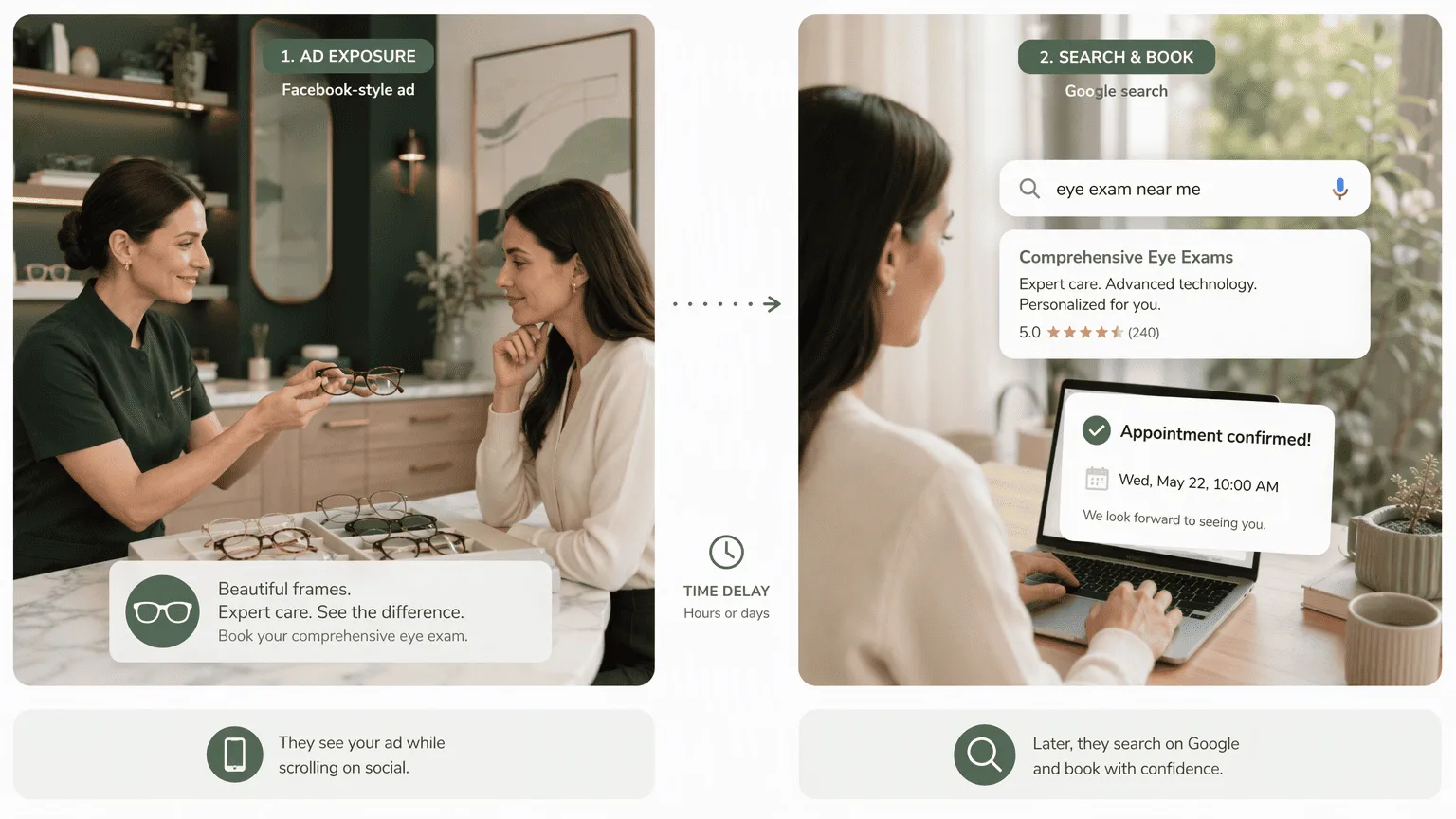
Viewing the channels in sequence turns your advertising spend from a budget into a measurable patient-acquisition engine. Facebook sits at the top of the optometry funnel. An ad showing a relaxed, high-end frame selection process or a 30-second practitioner introduction for a back-to-school campaign does not ask for a booking. It asks for name recognition. When that user subsequently needs an exam and searches your practice brand name or "optometrist [city]" two weeks later, your Google Search ad captures the branded search that the awareness spend triggered.
The trade-off is a timing mismatch that too many operators read as failure. A Facebook campaign with a $0.85 click and zero immediate booked exams is doing its job upstream. The practical fix is retargeting.
A user who watched half your video walkthrough but did not click can be served a lead-generation offer on Meta, or your Google Responsive Search Ad can display a stronger call extension because the prospect already knows the practice name. Without the awareness layer, your Google campaigns are bidding purely on cold search traffic, the fastest way to burn ad budget at breakeven. Run both layers, and your cost per booked exam stops looking like a random line item and starts behaving like a repeatable number.
ROI Benchmarks and Real Cost-Per-Lead Figures for Optometry Ads
The platform cost structures are not theoretical. One Alberta optometry group that ran Google Ads through an agency tracked 13,400 patient calls and bookings from $88,600 in spend over twelve months, a 3.1x return on spend. That ratio reflects a campaign built around verified offline conversion tracking. It is not a universal guarantee.
Across a broader client set, the typical new patient acquisition cost ranges from $25 to $60, varying by local bid competition. The same analysis values a booked appointment at roughly $300. A $40 lead converts at a multiple most practice owners would accept without hesitation.
For a mid-market independent practice with a two-month optimization runway, realistic expectations land around six to eight additional new patient appointments per month. That figure depends on population density, review volume, and how the campaign's geographic radius is tuned.
Nobody should report a Facebook lead that did not book and call it a win. Calls and form submissions are leads, not patients. One specialist firm reconciles every call and form submission against the practice schedule, crediting only those that convert to a booked exam. If your current reporting cannot distinguish an answered phone from a filled chair, you are measuring the wrong thing.
Ad Formats That Work: What Performs on Google vs. Facebook for Eye Exams
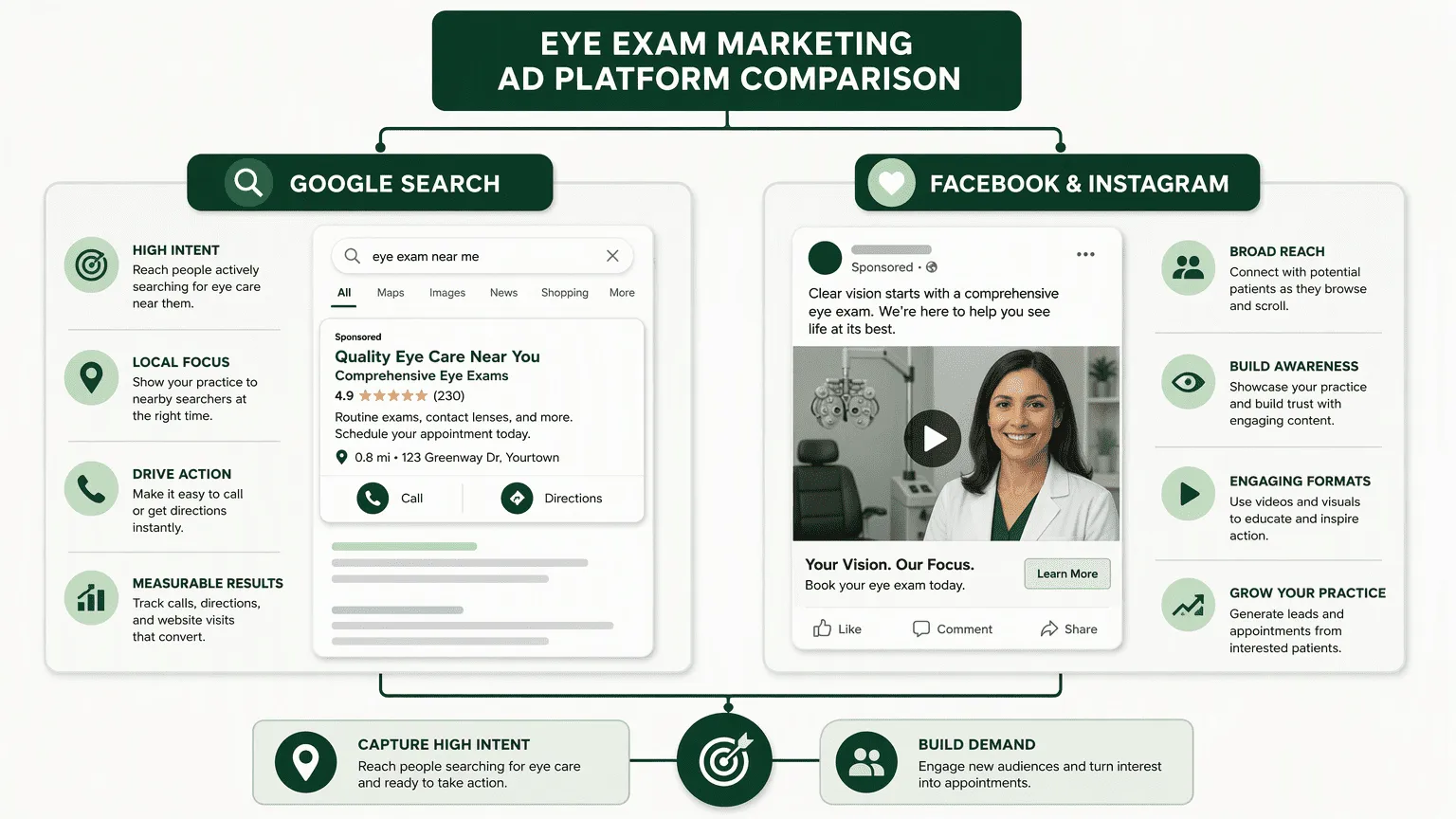
Broad match keywords and generic stock photography cost more and book less. The formats below are the workhorses for optometry offers because each is built to match the platform’s user behavior, not just its placement specs. Brief your designer against this checklist, and kill anything that does not fit.
| Format | Best on Google Search | Best on Facebook and Instagram |
|---|---|---|
| Primary ad type | Responsive Search Ads with location and call extensions; a mobile user can tap to phone the practice without navigating a site | Leader-form ads with an embedded form capturing name, phone, and an exam discount code within the platform |
| Visual format for consideration | Landing pages with a single booking widget; the ad copy promises an availability check, not a brochure | Video walkthroughs of the practice, 15 to 30 seconds, showing patient flow and provider introductions to reduce booking anxiety |
| Offer-driven format | Call-only ads running during practice hours with a compressed headline like "Same-Week Eye Exams" | Carousel ads displaying frame styles and lens options for users who have visited the optical collection page but not booked |
| Local Services platform | Local Services Ads listing the practice’s verified Google Business Profile and a "Request a visit" button within the SERP unit | Not applicable; Facebook does not host a comparable local services verification layer |
Budget Allocation: A Surgical Strategy for Small Practice Budgets in 2026
If you have one marketing dollar and an empty appointment slot, the allocation is not a debate. Put 70% into Google Search to capture the patient searching for an eye exam right now. Put the remaining 30% into Meta to build the branded search volume that makes that Google investment efficient. This is a cash-flow preservation tactic that treats the booking calendar as the primary constraint.
On the money thresholds that matter: below $1,500 to $2,000 of total monthly platform spend, your data set is too thin to optimize against, a point echoed by clinicians-turned-marketers who run dedicated PPC programs for optometry. You can start smaller, but you will be guessing.
Compliance and Pitfalls: Navigating Healthcare Ad Policies Without Getting Banned

The most expensive ad mistake an optometrist can make in 2026 is an account suspension that takes six weeks to overturn while the appointment book dries up.
Google’s updated policy is unambiguous: your business name in the ad must precisely reflect the recognized name displayed on your practice and your domain, a verified direct relationship must exist between you and the domain owner, and your products or services must be directly offered on the destination domain. Third-party resellers and booking intermediaries are prohibited from using your standalone brand name as their own. A generic holding company that runs ads for "Downtown Optometry" without a visible entity relationship is actively violating the terms.
Facebook adds a second layer: it restricts targeting that infers a health condition, confirms advertiser identity, and auto-rejects unsubstantiated treatment claims. A post that says "Our dry eye treatment works better than surgery" triggers an immediate flag. A patient testimonial without a compliant disclaimer is both a legal risk and a platform violation. Filter every ad asset through one test: if your state optometry board would fine you for the claim, Meta will ban you for it.
Budget Leaks and Optimization: Landing Pages, Tracking, and Smart Targeting
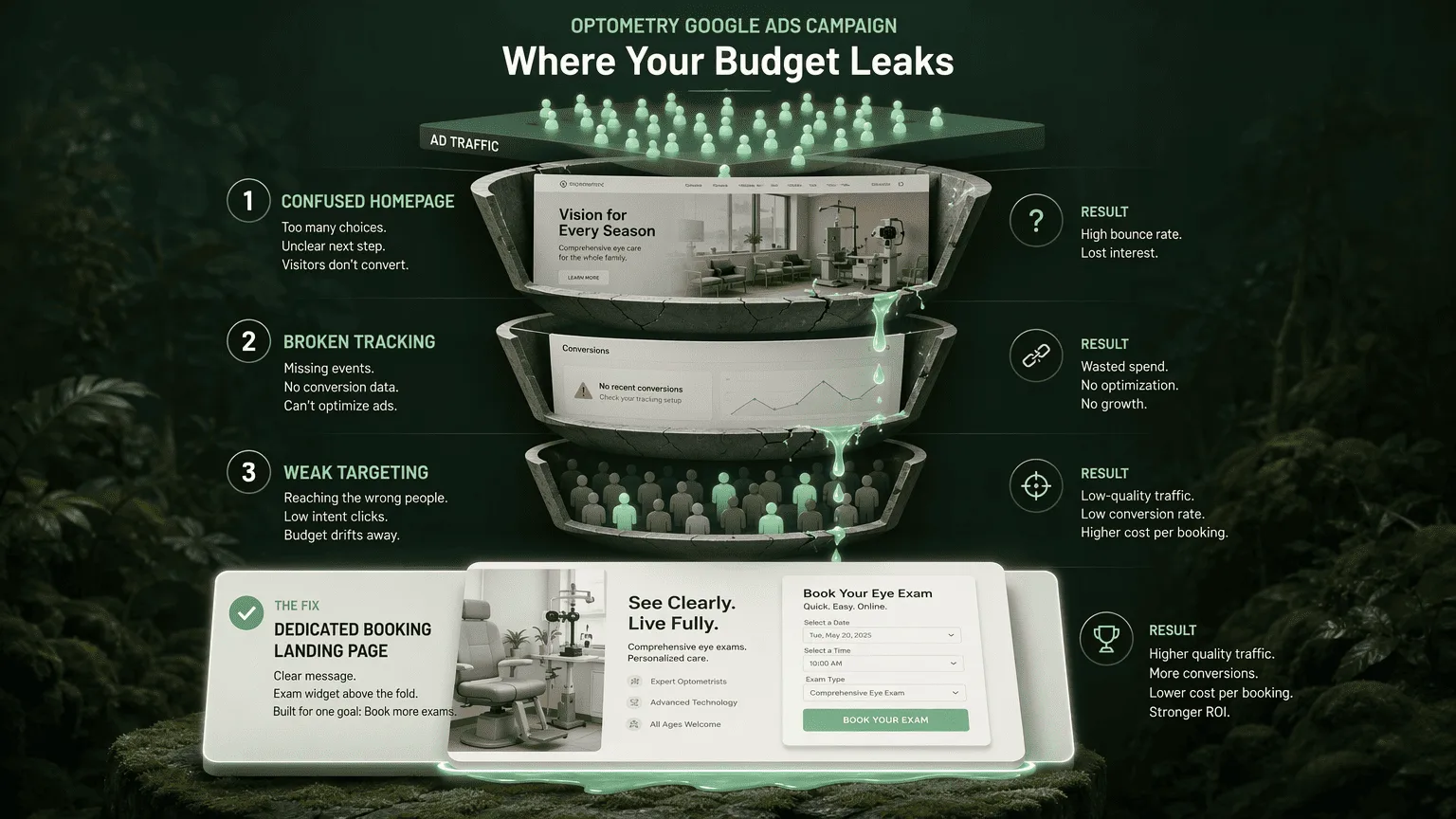
Most Google Ads campaigns that fail for optometry practices do not fail because the bid was wrong. They fail because of three common leaks:
- Poor landing page: Traffic lands on a homepage that gets confused between introducing the team, promoting the optical boutique, and hiding the "Book an Exam" button three scrolls down. The fix is a dedicated landing page with one action and the booking widget above the fold. Sending paid traffic to a focused page built around one conversion action converts more consistently than routing everyone to the homepage, which has to serve too many audiences at once. A slow, generic homepage is a conversion-killer that turns a $4 click into a 7-second bounce.
- No offline conversion tracking: The second leak is invisible to anyone looking only at the Google Ads dashboard. You are spending money and logging form submissions, but you do not know whether those forms turned into booked appointments because nobody connected the gclid click ID to your scheduling software. Advanced optometry-specific setups use gclid-verified offline conversions to join every lead back to the click that produced it, generating cost-per-booked-exam data instead of the "cost-per-lead" number that counts a midnight spam submission the same as a qualifying call. Without this plumbing, you will overfund a weak campaign and starve a strong one because both look identical on the platform-native reporting.
- Overly broad targeting: The third leak is a radius setting that is too wide or a keyword set that catches "free Lasik information" instead of "eye exam cost." Broad match without a disciplined negative keyword list inflates impression volume with zero booking intent, and a 50-mile target radius for a practice whose patients routinely drive 15 miles max wastes impression share on homes that will never convert. Tight geographic fencing and phrase-match modifiers that filter out information-seeking queries separate a $60 patient from a dead click.
Conclusion
Google and Facebook are complementary patient-acquisition layers. During a quarterly budget review, treat them as a single growth engine: allocate roughly 70% of your spend to Google Search to capture the patients searching for you this afternoon, then layer Facebook in at 30% to prime the families who will search your name next month. Before you scale either platform, audit your current landing pages, verify your offline conversion tracking, and confirm that each ad complies with the healthcare-specific policies both Google and Meta enforce. If your dashboard lumps a qualified consultation into the same bucket as a bounced pageview, fix the tracking first and increase the budget second.
Frequently Asked Questions
What are the key differences in targeting and intent between Google Ads and Facebook Ads for attracting new eye exam patients?
Google Ads capture high-intent users actively searching for phrases like 'eye exam near me.' The targeting is keyword-driven and reactive to declared demand. Facebook Ads build awareness by targeting demographic and interest-based audiences who are not yet looking for an eye doctor, such as parents within a local radius or users interested in designer eyewear, creating future demand.
Which platform typically delivers a better return on investment (ROI) for optometry practices in the US?
Google Search ads typically deliver a stronger immediate ROI for eye exams because they reach users ready to book. One case study showed a 3.1x return on ad spend. Facebook excels at lower-cost awareness and pipeline building. A typical new patient costs $25 to $60 to acquire and generates roughly $300 in initial appointment revenue.
What types of eye exam ads perform best on Google versus Facebook?
On Google, Responsive Search Ads with location and call extensions, call-only ads, and Local Services Ads convert best for immediate appointments. On Facebook, lead form ads with an embedded discount offer, short video walkthroughs of the practice, and carousel ads showcasing frame selections perform better for engagement and lead capture.
How should I allocate a small marketing budget between Google Ads and Facebook Ads for my optometry practice in 2026?
Allocate roughly 70% to Google Ads to capture existing high-intent search demand and 30% to Facebook Ads to build future pipeline and brand recognition. To generate statistically significant data for optimization, plan for a minimum total monthly budget between $1,500 and $2,000 across both platforms.
Are there any specific advertising regulations in the US that I must follow when promoting medical services like eye exams on these platforms?
Yes. Facebook requires advertiser verification and restricts targeting based on inferred health conditions. All ads must avoid unsubstantiated treatment promises, and patient testimonials require compliant disclaimers.
Sources
- Advertising for Optometrists | Google & Facebook Ads - optometrymarketing.com
- Eye-Care & Optometry Marketing Agency | Choice OMG - choice.marketing
- Google Ads for Optometrists & Opticians: A Practical Guide - www.ocuco.com
- Pay-Per-Click Optometry Marketing for Eye Doctors with EyeCarePro - www.eyecarepro.com
Want help executing this for your clinic?
Book a 30-minute call and we will map what a real ad engine would look like for your specific service mix.
Book a call