
The Small Clinic SEO Habit Loop That Actually Works Without a Marketing Team
IntroductionMost small clinics are losing 16% of their collectible revenue because their billing office is buried, and here's the parallel nobody's drawing: your practice is invisible in search because the same administrative vacuum ate your marketing. The problem is not that you lack a CMO. The problem is that SEO has been framed as a content-marketing marathon when, for a clinic with no staff, it needs to be a set of rapid, repeatable, local habits.
The worst mistake a solo practitioner can make is treating SEO as a second full-time job. You do not need to build links from medical journals, and you definitely do not need to rank for "best dentist." You need to show up on the map, look trustworthy, and answer the question a patient actually typed in. This article strips paid-for tools out of the equation and gives you a time-boxed framework: a 30-minute weekly rhythm built on your Google Business Profile, HIPAA-compliant reviews, and a handful of free technical checkpoints.
Key Takeaways
Distilled into six hard rules, here is the only clinic SEO checklist that turns zero staff into a local ranking advantage:
- GBP is the entire game: A complete, freshly posted Google Business Profile delivers the highest local ROI you can get from search. Let it sit stale and you are actively losing nearby patients.
- Reviews are your ranking accelerator: A steady flow of reviews lifts both credibility and local search position. Send patients the direct review link and never ask them to describe a specific treatment.
- Free tools first, always: Google Search Console and PageSpeed Insights catch the errors that cost you patients. Paying for a pro suite before you audit your crawl budget is burning cash.
- Broad keywords are a trap: 'Best dentist' is invisible money. Go after patient-intent, neighborhood-tight phrases such as 'emergency root canal [city]'.
- Technical health is quarterly hygiene: Fixing crawl errors and mobile speed takes about 90 minutes and stops Google from silently dropping your pages. Mismatched page titles are the easiest penalty to undo.
- Download the free medical SEO checklist monthly: Run it against every new piece of content to confirm you hit technical, on-page, and local-citation marks each time.
At a Glance
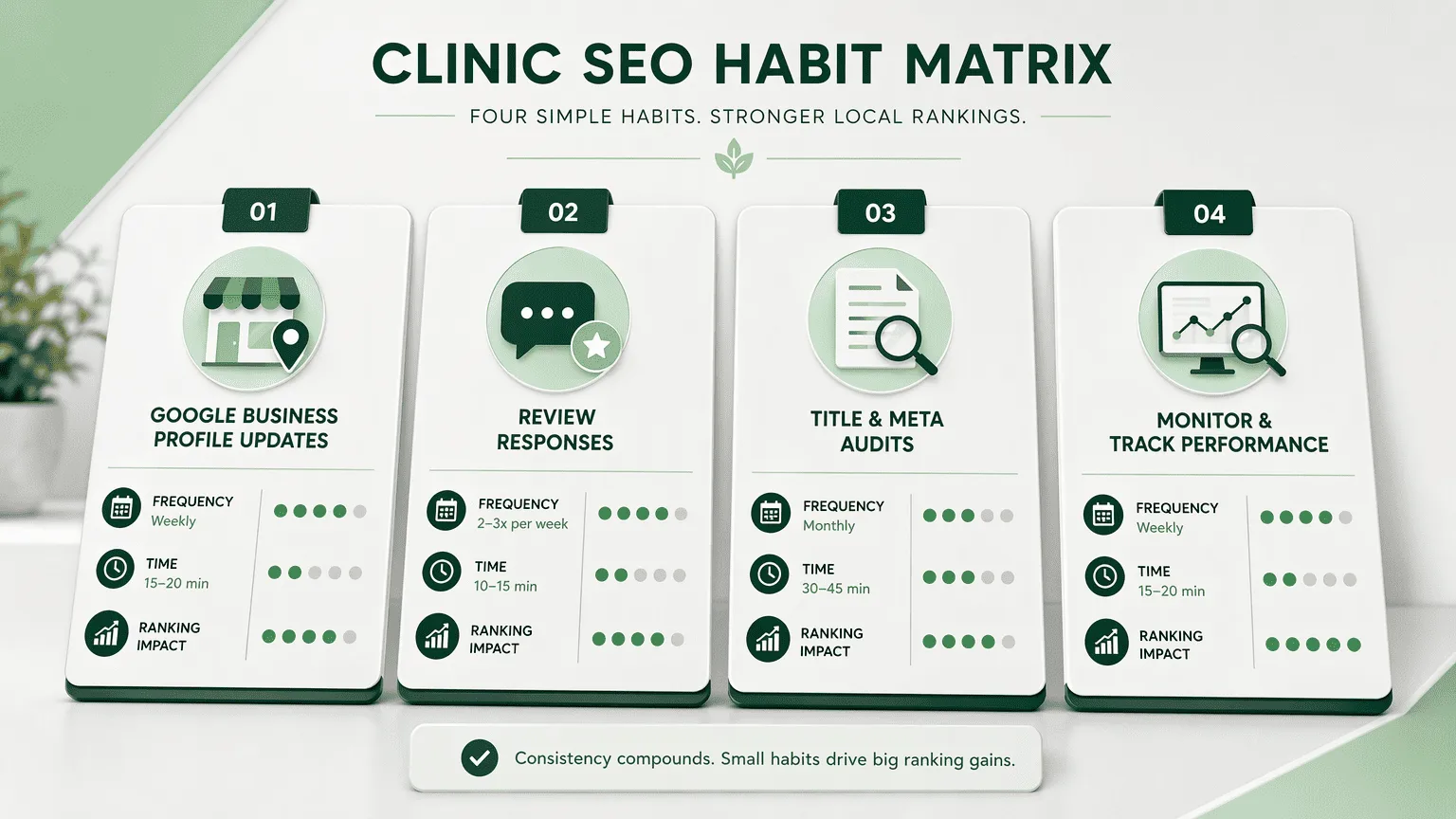
Here is how the options compare across the dimensions that matter most.
| Task | Frequency | Time Required | Free Tool | Impact on Ranking |
|---|---|---|---|---|
| Update Google Business Profile | Weekly | 30 min | GBP dashboard | High (local visibility & freshness) |
| Generate & respond to reviews | Ongoing | 5 min per review | GBP review link | High (local ranking accelerator) |
| Audit page titles & meta descriptions | Quarterly | 30 min | Google Search Console | Medium (prevents silent page drops) |
| Check mobile speed & crawl errors | Quarterly | 60 min | PageSpeed Insights | Medium (technical health) |
| Add or update local citations | Monthly | 15 min | Google / free directories | Low-medium (NAP consistency) |
Step 1: Lock Down Your Google Business Profile for Local Visibility (30 min/month)
The single highest-impact task you'll perform this month, and it will take you less time than one new-patient exam. A complete GBP, updated with fresh posts weekly and listing categories precisely, signals to Google that your practice is actively operating. Follow this exact order monthly:
- Verify NAP consistency first: Open your profile and check that your practice name, address, and phone number read exactly as they appear on your website and every directory you occupy. A stray suite number or old answering-service line will fracture your local authority.
- Optimize primary and secondary categories: Your primary category defines your core service (e.g., 'Dentist'); secondary categories capture your actual mix (e.g., 'Cosmetic Dentist', 'Emergency Dental Service'). Leave no secondary slot empty.
- Post one photo or short update weekly: A waiting room photo, a team shot, or a plain-text update about extended hours. Freshness is a ranking signal, and a profile that looks dormant gets outranked by one that looks managed.
- Respond to every Q&A entry: Fill out the Q&A section yourself with the top 5 questions your front desk answers daily. This preempts patient calls and injects high-value local keywords directly into your profile.
Step 2: Master HIPAA-Compliant Review Generation to Boost Rankings
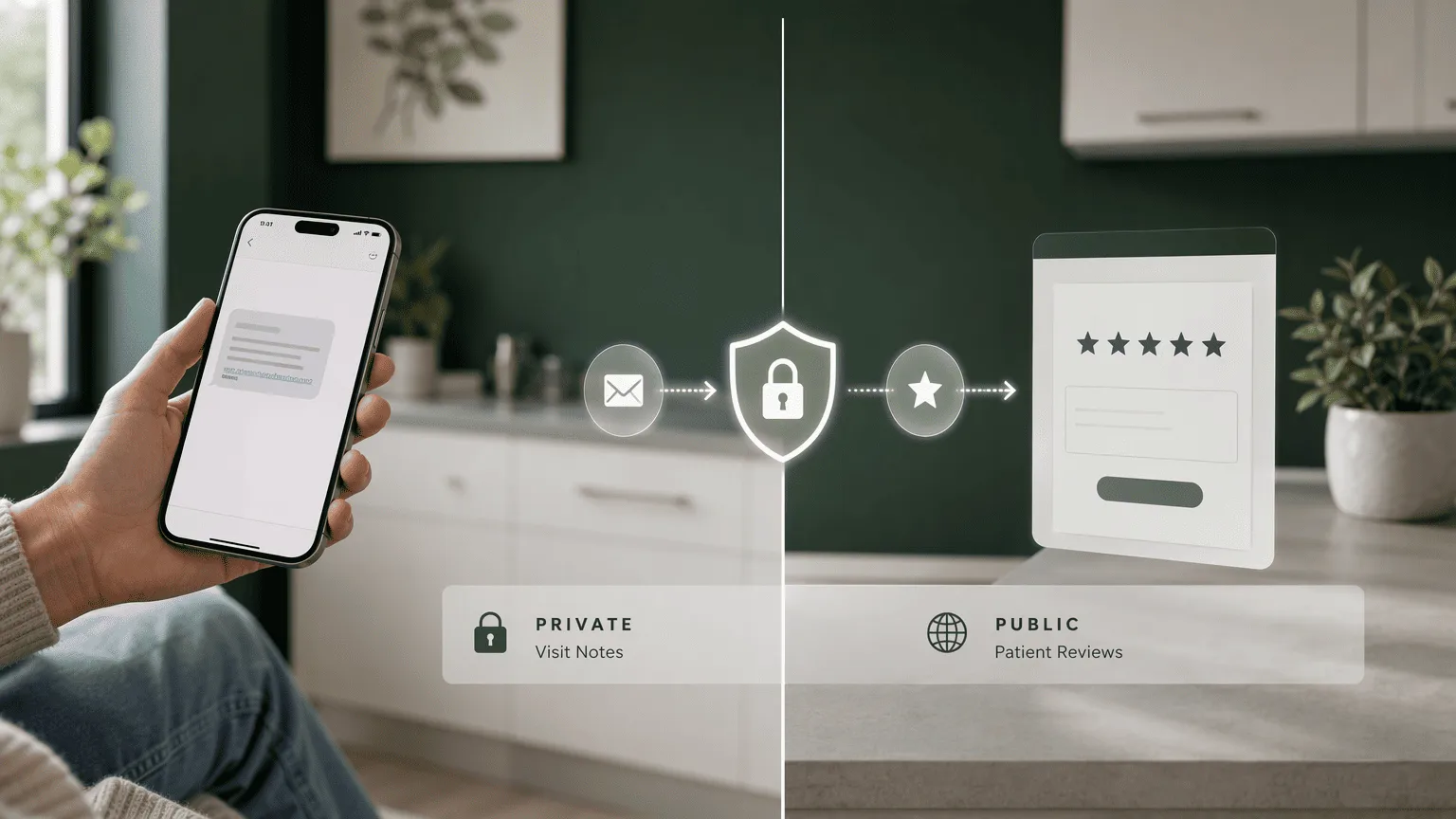
Fresh reviews are the fastest way to climb local search rankings. Google's local algorithm reads a steady stream of positive reviews as proof that your practice is the right result for a searcher's query. The mechanics are straightforward: email or text patients a link that lands them directly on your Google Business Profile review form.
The hard part is what you say around that link. Protected Health Information cannot show up in a public review, and your practice cannot be the one who invites it.
You want volume, but you cannot ask for clinical specifics. Never request that a patient describe their treatment, their diagnosis, or their outcome. A compliant prompt stops at: 'It would mean a lot to our practice if you could share a few words about your experience with our team.' That's it.
Most clinics stall here because they hand this off to a third-party reputation tool they do not fully understand. The fix is simpler than that. Pull your direct GBP review URL from your profile's 'Get More Reviews' section, shorten it with a free link shortener, and embed it directly in your checkout or follow-up email template.
One tap, no login gate. The clinics that collect 98% or more of their production value in revenue are the ones that systematized this prompt. They did not delegate it to a marketing department that doesn't exist.
Step 3: Use Free Tools to Find Patient-Intent Keywords
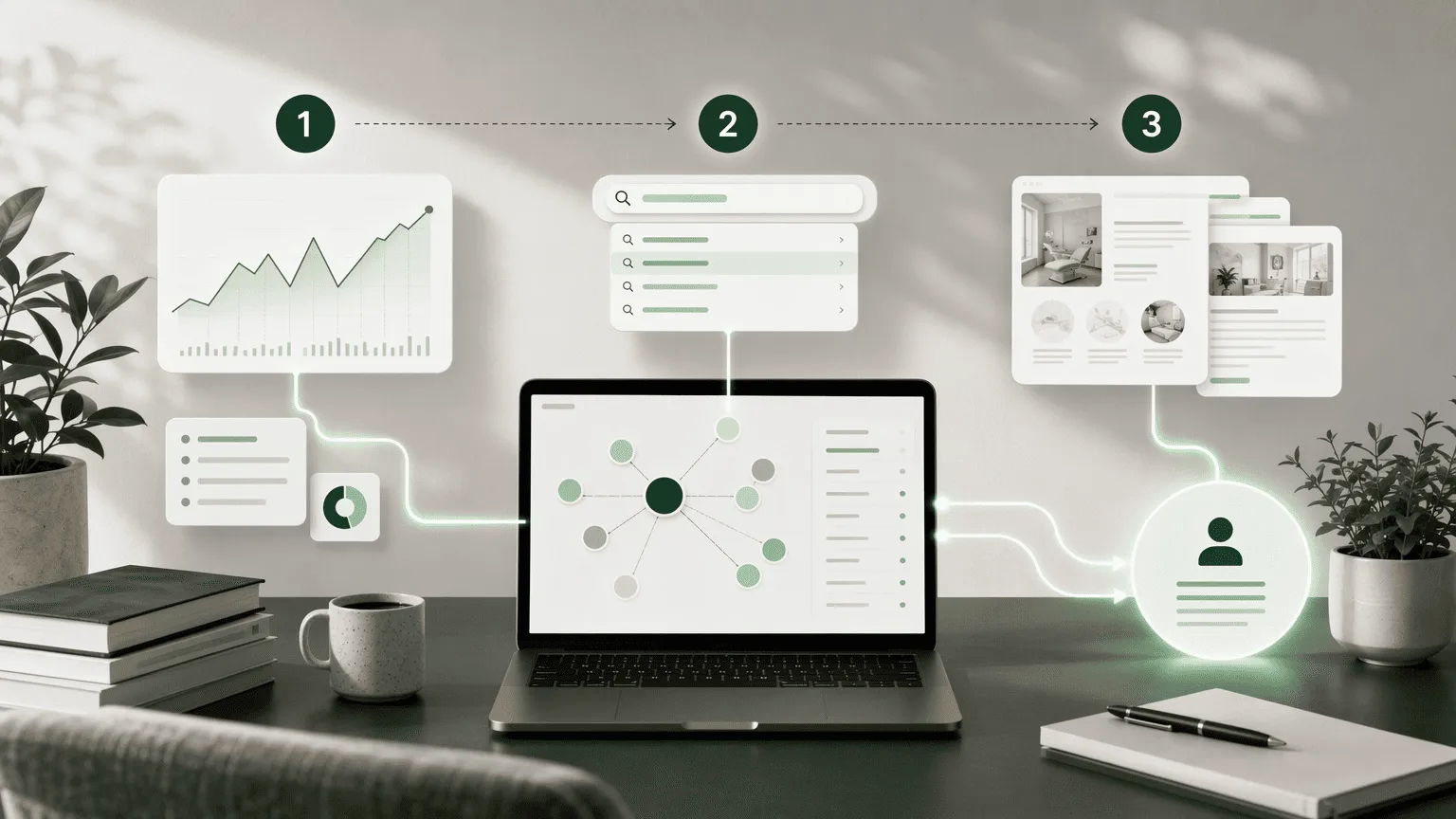
You don't need a paid keyword suite to figure out what your patients are typing. The biggest time-waste in small clinic SEO is targeting broad, high-competition terms that will never convert. Use this three-step stack once a quarter, or whenever you're about to publish a new service page:
- Google Search Console for existing queries: Open the Performance report and filter to your primary market country. Sort by impressions and find the queries where you're sitting on page 2 (positions 11 to 20). These are terms Google already associates with you; rewriting the target page to focus on exactly that patient phrase can double your click-through in under 30 days.
- AnswerThePublic or Ubersuggest for long-tail expansions: Type a core service plus your city (e.g., 'Invisalign Austin') into either tool. Harvest the question-based queries ('How much does Invisalign cost in Austin?') and the neighborhood-plus-insurance combos. These have negligible competition and near-100% conversion intent.
- Google autocomplete for live patient language: Open an incognito window and start a search with 'dentist in [neighborhood] that accepts [insurance]'. Do not execute the search; simply transcribe the 4 to 5 autofill completions Google suggests. These are the exact phrases your future patients are typing right now.
Step 4: Run a Technical Health Check on Your Website (Quarterly Task)
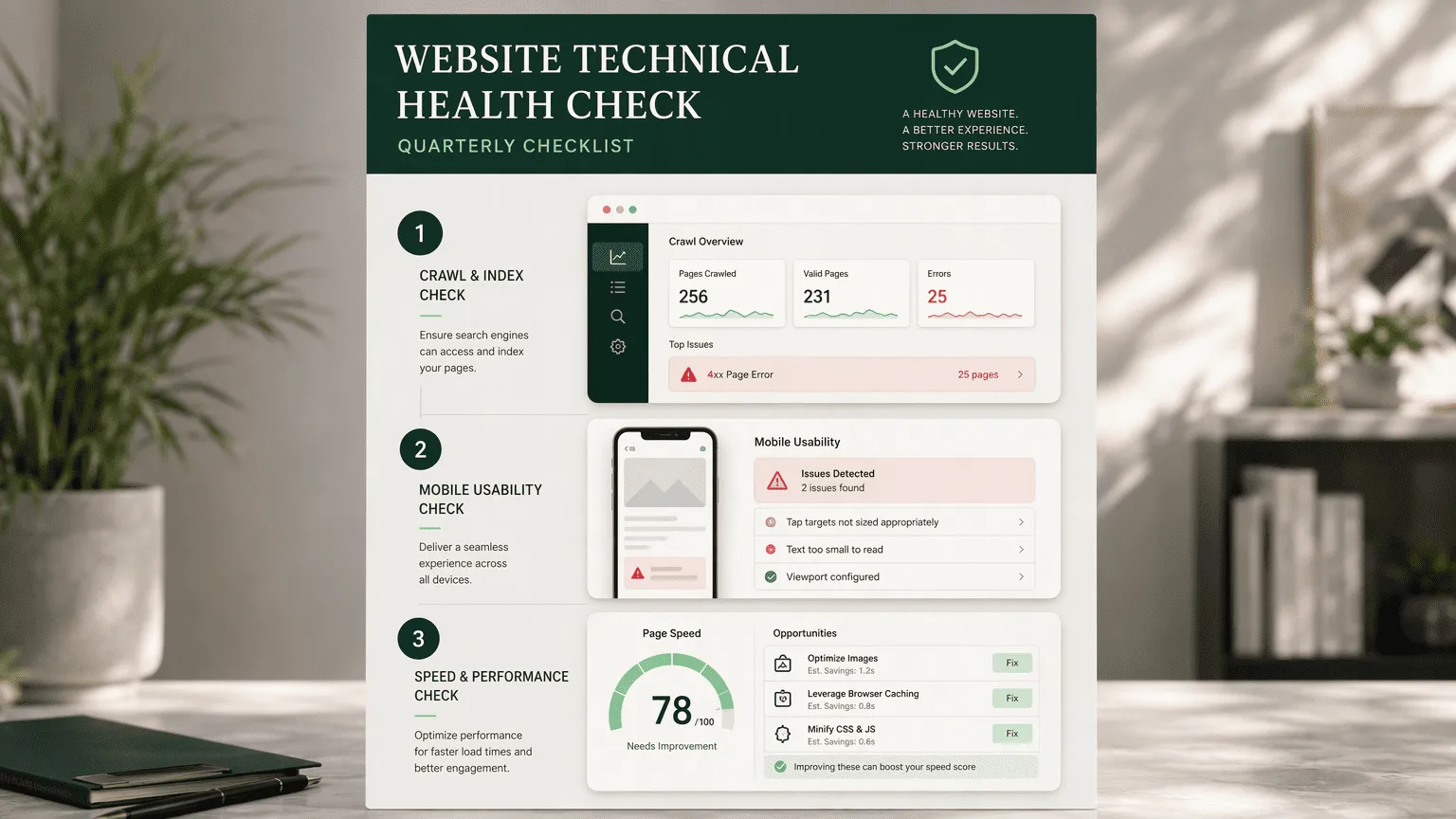
Block 90 minutes every quarter and burn through these three checkpoints to fix technical debt that hurts rankings:
- Fix abandoned pages in Search Console: Open Google Search Console and navigate to the 'Pages' index report. Any URL listed under 'Crawled, currently not indexed' or flagged with a server error is a page Google chose to abandon. Fix the immediate error (often a broken redirect or an old service page you deleted without a 301), then validate the fix in the same tool.
- Optimize mobile speed score: Right after that, run your booking page and your three most-visited service pages through PageSpeed Insights. A mobile score below 60 means you're dropping patients before they reach your front desk; over half of online searches happen on mobile devices, and a three-second delay on mobile pushes a prospective patient straight to a competitor.
- Align title tags and meta descriptions: The final check: open your top ten pages and verify that the browser title tag matches the headline on the page and that the meta description previews exactly what the patient will read. A mismatch isn't just sloppy; it triggers Google to rewrite your snippet, often stripping the exact urgency your copy depends on.
Step 5: Publish Locally Relevant Content That Answers Patient Questions
Generic medical blog posts are a liability. Publishing a 1,200-word explainer on 'What is a dental implant?' against a national DSO with an identical page is a losing bet. Their domain authority is higher. Your page ends up buried, and the hour you spent writing it is gone.
Your front desk holds the better content strategy. They hear the same anxious questions every day. Capture the exact phrasing patients use: 'Can I bring my toddler to my root canal appointment?' or 'Does this office offer sedation for people who are terrified of needles?' Each one is a search query your competitors haven't answered yet.
Pick one question and write a tight, 400-word page that answers only that question. Include the neighborhood or a local landmark in the title, unless it violates HIPAA. An example: 'Sedation Options for Anxious Patients in South Austin.' This is not a creative writing exercise. It is precise content matched to how patients actually search.
Publish on a set afternoon through your CMS, then submit the URL to Google Search Console for immediate indexing. Over eight weeks, with a new page every two weeks, you build a topical cluster. That cluster answers real patient questions in language a competing DSO's generalized 'Services' page never will.
Step 6: Earn Local Backlinks Through Community Partnerships

The fastest local backlink a small clinic can get comes from relationships you already have. You operate inside a local economy right now. The opportunity is turning those everyday connections into authoritative.edu.org, and local business links that strengthen your local pack ranking.
Sponsor a local little league team or a 5K fundraiser. The organization's website lists its sponsors on a dedicated page, and that single contextual link from a recognized local entity often outweighs a directory link from a generic citation site. Accept a pre-dental student for a semester-long shadow.
Their university program needs a preceptor profile page that links back to your practice. Host a free one-hour workshop at a partner pharmacy on a practical topic like insurance navigation, and ask them to list the event on their site. None of these are 'link-building campaigns' that demand cold outreach or a marketing manager.
They are operational decisions you make inside your existing business rhythm. They build a backlink profile that a paid-SEO-only approach cannot replicate.
Conclusion
Consistency density beats volume every time. A GBP updated weekly with a team photo and a review request sent to yesterday's patients will outrank a perfect, untouched site.
The channel isn't broken. The constraint is habit, not budget.
Start now: open your Google Business Profile, verify your NAP string, and schedule a recurring 10-minute calendar block every Friday afternoon to drop in a fresh post. If you sustain that half-hour rhythm for a quarter, you will have done more than 90% of competing practices still waiting to hire a marketing director they don't need.
Frequently Asked Questions
What are the key, low-effort SEO tasks a small clinic can handle without a dedicated marketing team?
Focus exclusively on local signals: optimize and post weekly to your Google Business Profile, send a direct HIPAA-compliant review link to every patient, and run a quarterly technical crawl audit in Google Search Console. Ignore broad national keywords and expensive tool subscriptions until these three habits are automated.
How can a clinic optimize its Google Business Profile (GBP) to attract local patients with minimal ongoing work?
Block 30 minutes monthly for three tasks: ensure your name, address, and phone number perfectly match your website; select every relevant primary and secondary category (e.g., 'Dentist' plus 'Cosmetic Dentist'); and post one photo or text update per week. Weekly freshness is a ranking signal.
Which free or low-cost SEO tools actually move the needle for a small medical practice with no marketing experience?
Google Search Console uncovers your existing page-2 rankings and crawl errors for free. Google PageSpeed Insights quantifies the mobile load time killing your booking rate. Ubersuggest and AnswerThePublic reveal exact, low-competition local questions. Download Clinic Nudge's free monthly medical SEO checklist to run audit hygiene.
How do you get patients to leave HIPAA-compliant reviews that improve local search rankings?
Text or email a direct link to your GBP review form after checkout. The compliant prompt is only: 'It would mean a lot if you shared a few words about your experience with our team.' Never ask the patient to mention their treatment, condition, or any protected health information.
What common SEO mistakes do small clinics make that waste time and hurt rankings?
Targeting broad terms like 'best dentist' instead of neighborhood-plus-service phrases ('emergency crown Denver'). Writing generic blog posts that cannot outrank DSO content. Failing to fix mismatched page titles and mobile speeds above three seconds, and ignoring NAP inconsistencies after a phone number change.
Sources
- Your Practice Is Invisible to AI. Here's the Fix That Actually Works in 2026. - getclinads.com
- Free Medical SEO Checklist for 2025 | Clinic Nudge - clinicnudge.com
Want help executing this for your clinic?
Book a 30-minute call and we will map what a real ad engine would look like for your specific service mix.
Book a call