
Google Ads or Facebook Ads for Eye Exams: The 2026 Budget Decision That Pays
IntroductionMost optometry practices waste their first six months of ad budget on the wrong platform before they figure out the mistake. You have a limited marketing budget and a schedule that needs to be filled this week, not next quarter. The question is not which platform is better in the abstract. The question is whether your next dollar should capture a patient who is actively typing a search for an eye exam, or whether it should build awareness among people who do not yet know they need one.
The answer, grounded in 2026 acquisition costs and conversion data, is not a tie. Google Ads turns active searches into booked appointments. Facebook Ads fills your future pipeline. This article lays out the structural cost differences, the behavioral gap between search intent and social scrolling, and the exact framework for when to run each platform and when to combine them so that every dollar maps to an exam-room outcome.
Key Takeaways
Google Search should be your primary booking engine. Facebook should be your awareness layer. Two platforms, two distinct jobs.
- A Google Ads cost per lead for a booked thorough exam runs $35 to $95. That number lands because the person already wants an eye exam. You bid on intent. You skip the expensive education step Facebook demands before anyone even thinks about booking.
- Social feeds are not a booking counter. Someone scrolling Facebook did not wake up planning to schedule a refraction. The platform is not broken. The creative brief is. Use it for awareness, retargeting, and seasonal promotion, not for counting same-day appointments.
- One seasonal window changes the equation. Back-to-school demand drives a 45 to 70 percent lift in new patient exam bookings, which makes August the highest-ROI month to run Facebook awareness campaigns on top of your Google engine.
- Acquisition cost looks different when you zoom out. A patient who also buys glasses is worth about $363 in the first year. Treat that as your lens for judging spend. A higher upfront cost per lead stops looking expensive when the first-year value covers it with room to spare.
- Do not split the budget on day one. Run Google until your cost per lead hits your ceiling. Then stack Facebook during those high-intent seasonal windows. Dumping $1,500 across both channels at the same time dilutes everything.
- Google is the lower-cost booking channel: A typical Google Ads cost per lead for a booked thorough exam runs $35 to $95, capturing demand that is already searching, which bypasses the costly awareness phase Facebook requires.
- Facebook is not a direct booking channel: Social feeds are for awareness, retargeting, and seasonal offer promotion. The platform is not broken. The creative brief is.
- August demand spikes create a Facebook window: Back-to-school season drives a 45 to 70 percent lift in new patient exam bookings, making August the highest-ROI window to layer Facebook awareness campaigns onto your Google workhorse.
- Patient lifetime value changes the math: A patient who also buys glasses is worth about $363 in the first year. Viewing acquisition cost through a lifetime-value lens justifies both platforms in a mature practice.
- Combined budgets should be sequential, not simultaneous: Start with Google until your cost per lead hits your ceiling, then add Facebook during seasonal high-intent windows. Splitting $1,500 across both channels on day one dilutes both.
How Google Ads and Facebook Ads Differ for Eye Exam Promotion
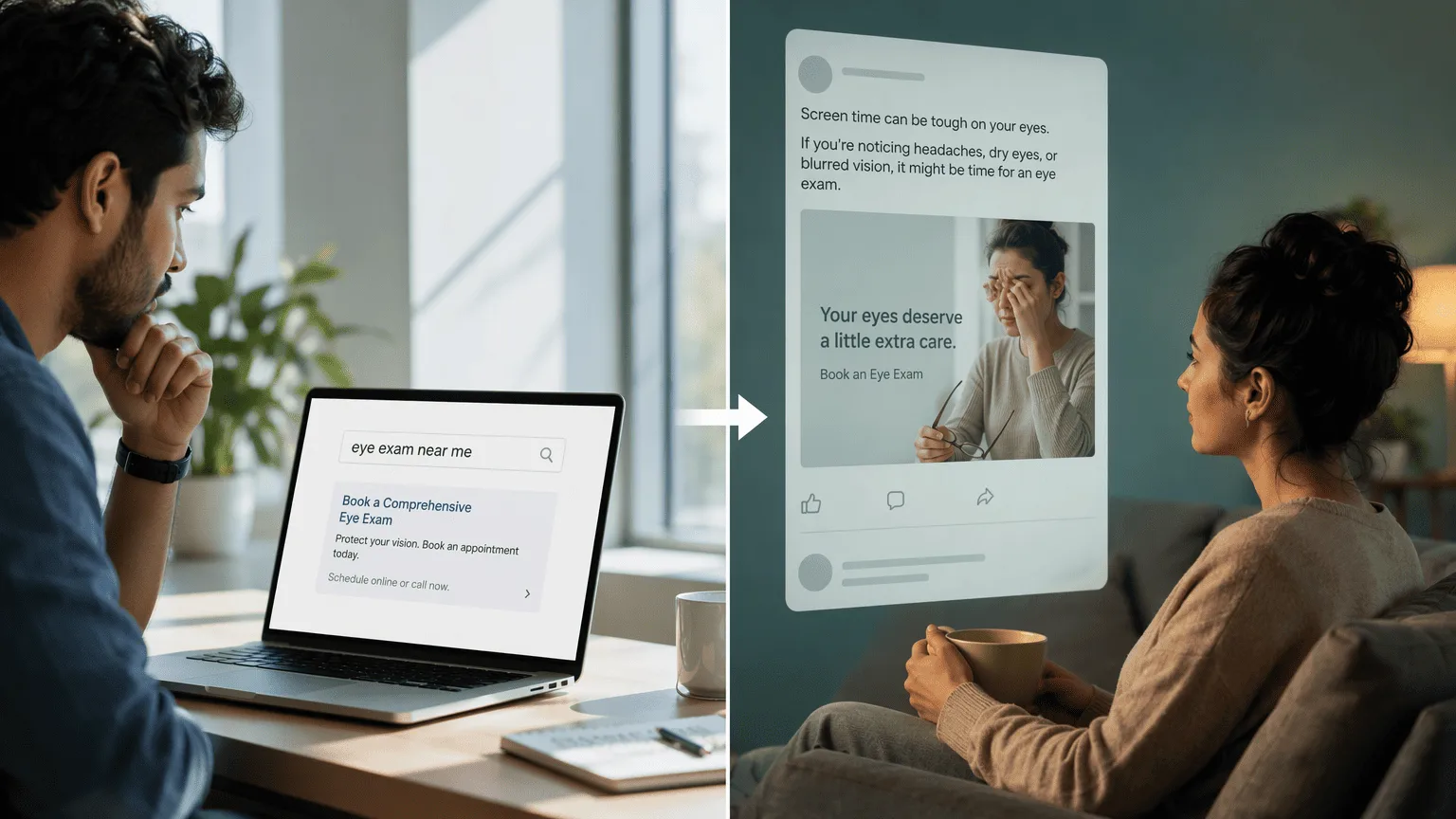
Most clinics start with the wrong platform, and pay for it in wasted budget for six months before they figure out the difference. The problem is not that one platform is broken. The problem is that Google and Facebook serve two completely different moments in a patient's decision to book an eye exam. Clicks Geek frames this precisely: Google Ads is demand capture, Facebook Ads is demand generation. When someone types "eye exam near me" or "optometrist accepting new patients" into a search bar, they have intent right now.
Search ads put you in front of them at that exact moment. For every symptom search someone does, about ten eye care searches are ready to book, which means the person on Google is not browsing, and they are converting. Facebook reaches people before that moment. It interrupts a parent scrolling through a feed with a back-to-school vision ad or reminds a patient that their contact lens prescription expires in two weeks.
The cost structure confirms the split. Google Ads cost-per-lead for a booked thorough eye exam runs $35 to $95, with a well-run practice seeing a blended exam-to-eyewear conversion rate of 45 to 60 percent at a $250 to $450 average eyewear ticket. That math is hard to beat on Facebook, where you are paying to build awareness in an audience that was not looking for you.
The trade-off: Google captures the patient who already wants an exam; Facebook reaches the person who does not know they need one yet. That does not make Facebook useless. It makes it situational.
Back-to-school vision requirements, insurance benefit resets, and the compressed August schedule drive a 45 to 70 percent lift in new patient exam bookings compared to baseline months, and a local awareness campaign in front of parents during that window earns its budget. So do reminder campaigns targeting existing patients about contact lens expiration dates.
Practices that sell annual supply at competitive pricing, offer automatic refill programs, and run Facebook Ads reminding patients about expiration dates hold 55 to 70 percent of contact lens refill revenue in-house. That is real money. But if the phone is not ringing today and you need exams on the schedule this week, Facebook's awareness advantage is the wrong tool. Search is where booked exams come from. The correction most optometry practices need is to run Google as the demand-capture workhorse year-round and layer Facebook during high-intent seasonal windows like Q4 vision benefits deadlines or the August back-to-school rush, not to treat them as equivalent channels with a split budget year-round.
Direct Platform Cost Comparison: Google vs. Meta in 2026
A direct cost comparison answers the question every practice owner asks first: which is cheaper? The unit costs below reflect 2026 benchmarks for US optometry campaigns. The short answer is that Google costs less per booked exam because intent does the heavy lifting that Facebook has to pay for with repeated touchpoints.
| Cost Metric | Google Search Ads | Facebook / Meta Ads |
|---|---|---|
| Cost Per Click (Avg.) | $3.50 to $9.00 | $0.80 to $2.10 |
| Cost Per Lead (Booked Exam) | $35 to $95 | $70 to $160 (full-funnel average) |
| Primary Cost Driver | Competition for high-intent keywords | Audience saturation and creative fatigue |
| Path to Appointment | Click-to-call or booking form; one step | Awareness, retargeting, landing page; multi-step |
| Best Use Case | Capture active exam searches now | Build future pipeline and seasonal awareness |
Google's CPC is higher, but the funnel is short. A search click goes straight to a booking page. Facebook's lower CPC hides the distance from impression to booked exam, and that distance widens the gap at conversion. Measuring platform performance by cost per click alone will steer you wrong.
How to Structure a Google Ads Campaign for Eye Exam Bookings
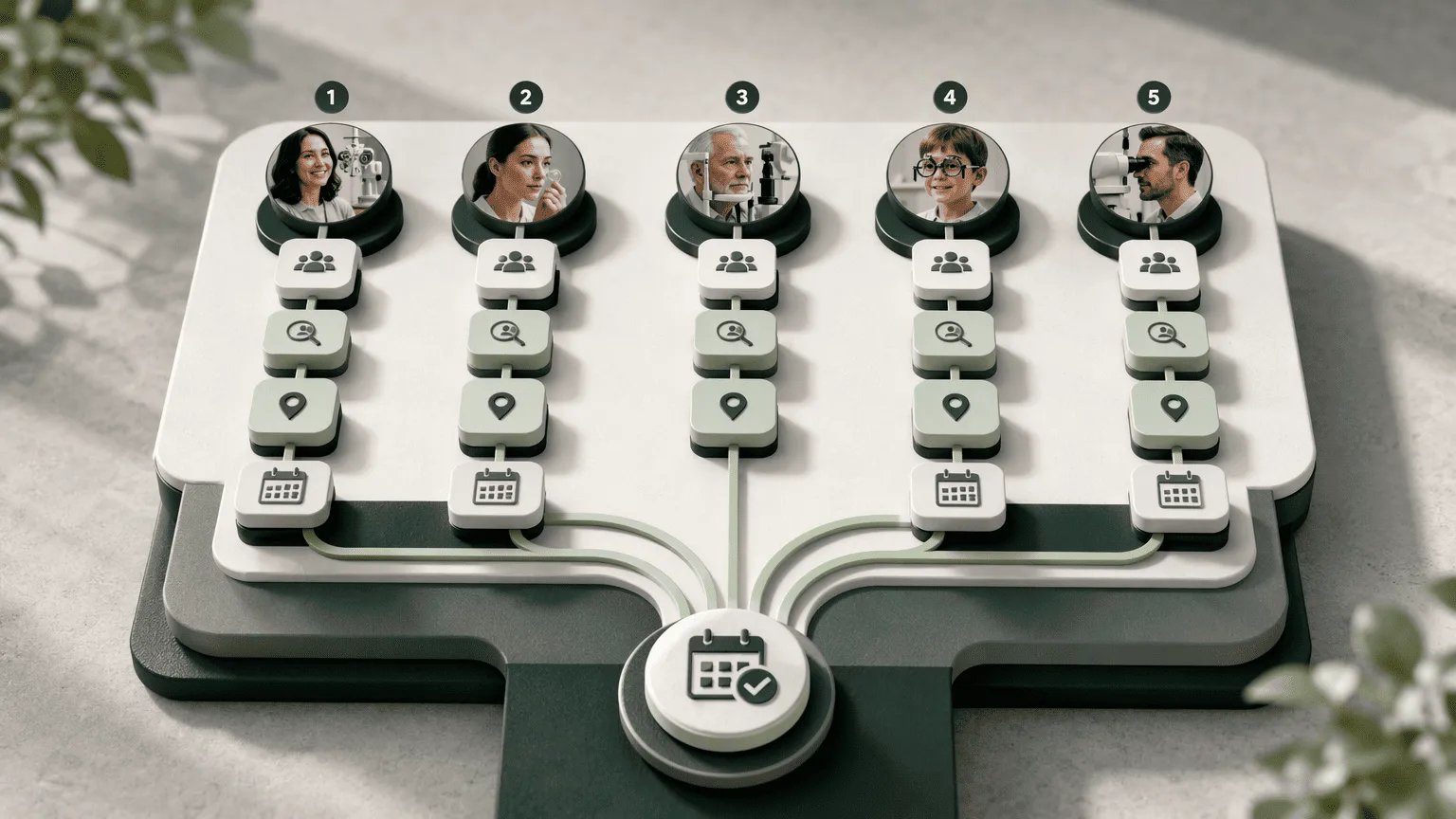
A campaign architecture built around visit type, location, and conversion tracking prevents the common budget leak where clicks do not become patients. The framework below segments your spend so that a contact lens budget does not get cannibalized by a broad routine-exam term.
- Segment campaigns by visit type: Build separate campaigns for routine thorough exams, contact lens fittings, medical eye care (dry eye, blepharitis), pediatric exams, and refractive surgery consults so each service gets its own budget, ad copy, and landing page.
- Set a radius patients actually drive: Target a 5-to-10-mile radius around your practice for urban locations, expanding to 15 miles in suburban markets. Wider radii leak budget into zip codes where conversion rates drop sharply.
- Apply negative keywords aggressively: Exclude "jobs," "salary," "free," "veterinary," and designer-brand names unless you stock that inventory, to prevent your medical eye care campaign from matching irrelevant traffic.
- Schedule ads during office hours with a 30-minute lead: Bid only for the window when your front desk can answer a call. An ad clicked at 11 p.m. Friday that goes to voicemail is a wasted click.
- Count only booked appointments as conversions: Track calls of 30 seconds or more, completed online booking forms, and live-chat appointment requests. Clicks are not patients.
- Build ad copy around availability: Use headlines like "Same-Week Eye Exams, Book Online" and pin a phone number extension. Mention accepted vision plans (VSP, EyeMed) in the description line to filter uninsured clickers out before the click.
Facebook Ad Strategies That Generate Eye Exam Awareness
Facebook's best optometry campaigns do not look like ads. They look like a neighbor's recommendation or a symptom explainer that a patient recognizes in themselves. The creative should lead with the problem (blurry night driving, a child squinting at the board) rather than the solution, then pivot to a soft booking path with same-week availability as the close.
The highest-ROI seasonal window is August, when back-to-school vision requirements, insurance benefit resets, and the compressed schedule drive a 45 to 70 percent lift in new patient exam bookings. Run parent-targeted awareness campaigns in mid-July with a lookalike audience built from your existing pediatric patient list, a 10-mile radius around your practice, and creative that names the school district deadline. Layer a retargeting campaign for anyone who watched 50 percent or more of the video but did not click, then serve them a calendar booking ad in the first week of August.
The second high-intent window is Q4, when vision plan dollars expire. Creative should state the deadline and the phrase "use it or lose it" in the primary text, with a direct call button to schedule. For contact lens revenue defense, practices that run Facebook Ads reminding patients about expiration dates hold 55 to 70 percent of contact lens refill revenue in-house.
Building a Patient Lifetime Value Model for Your Practice

Evaluating platform cost per lead in isolation produces false economies. A $70 CPC-padded Facebook lead looks expensive until you realize that patient will return for annual exams for five years and refer two family members. The correct lens is patient lifetime value.
A conservative patient lifetime value model starts with a first-year exam and optical spend. A patient who also buys glasses is worth about $363 in that first year. Add two subsequent exam years at the same practice, a contact lens annual supply, and one referral conversion, and the three-year value of a single acquired patient crosses $1,100. That number fundamentally changes the acquisition math.
Plug your own practice numbers into a simple worksheet: first exam revenue, annual recare rate (a well-run practice targets 75 to 85 percent), average eyewear ticket, contact lens annual supply revenue, and referral conversion rate. Multiply out three years. The output is the maximum you can justify paying to acquire a patient and still earn a return. When a practice calculates that figure and then sees Google Ads CPL at $35 to $95 against a first-year value of $363, the investment logic flips from cost control to growth allocation. You want more of those leads, not fewer.
A lifetime-value lens also makes Facebook's higher front-end acquisition cost defensible. If the practice is capacity-constrained today, Google alone fills the schedule. If the practice has capacity in three months, Facebook's pipeline building is a requirement, not an option. The problem is not that Facebook is expensive. The problem is that most practices try to measure it with a one-week attribution window.
When to Combine Budgets: Demand Capture and Generation
Don't split your ad budget down the middle. That's the mistake we see most often, and it almost always hurts performance.
Google and Facebook belong in sequence, not side by side. Google runs as the daily workhorse. It captures patients who already know what they need and are searching for it right now.
Facebook enters the picture later, during specific windows when you need to build awareness before the demand shows up in a search bar. The ratio depends on two things: how full your schedule is and how mature your market position is. A new practice with open appointment slots should send 90 percent of a limited budget straight into Google Search.
Use Facebook only for remarketing, showing ads to the people Google already sent your way. An established practice running near capacity can afford a different rhythm. Keep Google at its maximum efficient spend year-round, then layer Facebook at 25 to 35 percent of budget during back-to-school in August, vision benefits deadlines in November and December, and any local event window where attention spikes.
Below $2,500 a month, do not split a dollar. The budget gets too thin to learn anything statistically useful on either platform.
Run Google only until you cross that threshold. Facebook widens your future pipeline, but only after Google fills today's schedule.
Google Ads Captures Intent; Facebook Ads Builds It

The behavioral gap between the two platforms is the single largest driver of cost-per-acquisition difference, and it is not close. Someone typing "eye exam near me" or "optometrist accepting new patients" into a search bar has intent right now. They have a need, a deadline, and often a vision benefits card that expires at year-end.
Google Search is not a persuasion channel. It is a fulfillment channel. You win by being the most relevant, fastest, and most trustworthy result on the page.
Facebook operates at the opposite end of the intent spectrum. The user is not searching for you. They are scrolling through a friend's vacation photos or a local community group thread before your ad interrupts them.
That makes Facebook a demand-generation engine. It creates awareness in a patient who did not know their headaches were a vision problem, or who forgot their contact lens prescription expired three months ago. The trade-off is that you must fund the entire journey from subconscious awareness to scheduled appointment, which adds time and cost compared to Google's demand capture.
This distinction dictates everything downstream: creative strategy, conversion tracking, and what counts as a win. Google rewards a booking-first landing page and a phone number visible in three seconds. Facebook rewards symptom-led creative that looks native to the feed and an offer that feels timely, not urgent. Measuring Facebook by last-click bookings alone misses its pipeline-filling function.
For every symptom search an optometry practice targets, about ten eye care searches are ready to book. That ratio is why Google is the booking engine. That is also why Facebook is not.
Conclusion
If you have one dollar to spend, put it into Google Ads.
The reason is straightforward. Someone typing "eye exam near me" or "optometrist that takes VSP" has already decided to book. They need a practice that shows up when they search. Shivam Bhatia, Founder of ClinAds, points out that the cost-per-booked-exam on Google typically lands in a range that pays for itself with a single visit. No awareness campaign can match that immediate return.
Facebook works differently, and it works best later. It primes people who aren't searching yet. Run it during the weeks a patient would realistically book, the back-to-school rush or end-of-year FSA deadlines, and measure pipeline metrics, not same-day appointments. If your schedule has open slots three months from now, that is the right time to layer in Facebook during the next seasonal window.
Start with Google Search. Structure campaigns by visit type. Track every click to a booked appointment.
Hold the spend to a cost-per-patient your own lifetime value model supports. Start with the booking engine. Build the pipeline second.
Frequently Asked Questions
What are the key differences between Google Ads and Facebook Ads for promoting eye exam bookings?
Google Ads captures active demand from people searching phrases like "eye exam near me," making it a direct booking channel. Facebook Ads interrupt passive social scrolling to generate awareness among people not yet searching, which requires a multi-step journey from ad impression to booked appointment.
Which platform delivers a higher return on ad spend for optometry practices seeking eye exam patients?
Google Search delivers a higher near-term ROAS. A booked thorough exam cost per lead runs $35 to $95 on Google because intent bypasses the expensive awareness phase. Facebook's full-funnel cost per booked exam is typically higher, ranging $70 to $160.
How should an optometrist structure a Google Ads campaign to attract local patients actively searching for an eye exam?
Follow these campaign structure steps:
- Build separate campaigns by visit type: routine, contact lens, medical, and pediatric.
- Target a 5-to-15-mile radius around your practice.
- Schedule ads to run during office hours only.
- Use strong negative keywords to filter irrelevant traffic.
- Count only calls over 30 seconds and completed booking forms as conversions.
What ad creative and targeting strategies work best on Facebook for generating awareness and appointments for eye exams?
Use symptom-led creative (blurry night driving, child squinting) that looks native to the feed. Target lookalike audiences from existing patient lists within a tight radius. The highest-ROI seasonal creative names a deadline, such as back-to-school exam requirements in August or year-end benefit expiration in Q4.
When does it make sense for an optometry practice to split its budget between Google Ads and Facebook Ads instead of choosing just one?
Split when Google has saturated its efficient scale and the practice has capacity for future weeks. Run Google as the primary booking engine at 70 to 80 percent of budget, then layer Facebook during seasonal urgency windows like August back-to-school or Q4 benefits deadlines. Below $2,500 in monthly spend, run Google only.
How do patient acquisition costs for eye exams compare between Google Ads and Facebook Ads in 2026?
Google's cost per booked exam runs approximately $35 to $95 because the short click-to-call funnel converts intent immediately. Facebook's full-funnel cost runs higher, typically $70 to $160 per booked exam, reflecting the multi-step journey required to turn a passive scroller into a scheduled patient.
Sources
- Shivam Bhatia, Founder of ClinAds - getclinads.com
- Optometry Practices Marketing | Clicks Geek - clicksgeek.com
- Advertising for Optometrists | Google & Facebook Ads - optometrymarketing.com
- Google Ads for Optometrists: 16 Chapters for Eye Care - www.brandrocket.net
Want help executing this for your clinic?
Book a 30-minute call and we will map what a real ad engine would look like for your specific service mix.
Book a call