
Most Med Spa Advertising in Canada Is Tiptoeing Over a Regulatory Landmine
IntroductionYour clinic's most recent Instagram ad is technically a violation of federal drug law. The Facebook carousel showing a patient's smoother skin after neuromodulator injections could cost you a six-figure fine and a disciplinary notice from your provincial college. Medical aesthetics advertising in Canada operates under a regulatory stack that most clinic owners only half understand while they spend thousands on creative.
That split awareness is what gets operators in trouble. One director knows Health Canada bans off-label promotion; another knows the CPSO hates patient testimonials. Rarely does the same person hold both rules in their head when approving a campaign. The advertising ends up feeling compliant to the team that produced it while carrying multiple enforcement triggers for the agencies policing it.
The tension is real, and it is expensive. A single promoted post can draw scrutiny under the Food and Drugs Act, the Competition Act, provincial college policies, and ad platform certification requirements simultaneously. This article maps those frameworks, names the specific claims and creative formats that attract enforcement attention, and walks through what a defensible med spa ad actually looks like in Canada.
Key Takeaways
Before you publish another treatment ad, these are the rules with the highest enforcement profile right now:
- Prescription drugs require full naming: Any ad mentioning Botox or a dermal filler must include the proper drug name, the manufacturer's name, and claims that mirror the approved product monograph exactly. Off-label promotion is prohibited.
- Testimonials are banned in key provinces: Ontario, British Columbia, and Quebec all restrict or prohibit patient testimonials and reviews in medical advertising. Paying for reviews triggers the Competition Act.
- Before-and-after photos are a provincial flashpoint: Most provincial medical licensing bodies in Canada prohibit before-and-after images in paid ads. The CPSO and CPSBC ban them entirely.
- "Safe" and "pain-free" are trigger words: Claims that a treatment is safe, pain-free, or produces permanent results are prohibited unless backed by strong, Health Canada-approved evidence.
- Device ads need license numbers: Any laser therapy or IPL advertisement must display the device's Health Canada license number and cannot claim efficacy for unapproved indications.
- Federal penalties reach $10 million: The Competition Bureau can impose penalties up to $10 million for a first offense under the Competition Act's misleading advertising provisions.
- Platforms add their own gate: Running Botox ads on Meta requires LegitScript certification with fees of $975 to apply and $2,150 a year per website, plus Meta's own authorization.
At a Glance

Here is how the options compare across the dimensions that matter most.
| Rule | What It Covers | Key Prohibition | Penalty Risk |
|---|---|---|---|
| Federal Food and Drugs Act | Prescription drug ads (Botox, fillers) | Off-label promotion; claims not in product monograph | Up to $5 million per offense |
| Federal Competition Act | All advertising claims | False or misleading representations | Up to $10 million (first offense) |
| Provincial college policies, CPSO, CPSBC, etc. | Patient testimonials, before/after images | Banned in paid ads in Ontario, BC, Quebec | Disciplinary notice, fines |
| Health Canada device licensing | Laser/IPL ads | Must show license number; no unapproved claims | Seizure of devices, fines |
| Platform certification (Meta/LegitScript) | Botox ads on social media | Requires LegitScript approval per website | Ad rejection, account suspension |
The Two-Layer Regulatory Framework: Federal and Provincial Oversight
Health Canada governs the product claims you make. The provincial college governs how you make them. Every treatment ad sits at the intersection of these two authorities, and a fully compliant ad satisfies both. The confusion starts when a clinic treats one as the whole ruleset.
At the federal level, the Food and Drugs Act prohibits advertising a drug or device with claims the regulator has not authorized. For med spas, that means any mention of Botox, Belotero, Juvederm, or Restylane is legally a prescription drug advertisement. Federal and provincial laws like the Food and Drugs Act and the Competition Act prohibit misleading claims, exaggerated results, and unapproved testimonials in med spa advertising. Separately, the Competition Act catches any representation that is materially false or misleading, whether or not it concerns a drug. A single Instagram caption can trigger both statutes.
Provincial medical colleges, including the CPSO in Ontario and the CPSBC in British Columbia, regulate how physicians market regulated services. Their rules dictate the format of advertising with the same force that Health Canada governs its content. In Ontario, patient testimonials are banned in med spa advertising to prevent undue influence, as per provincial regulatory college rules. The Quebec Code of Ethics forbids advertising that exploits a patient's vulnerability. These are format-level restrictions that exist independent of whether the underlying claim is true.
The practical outcome: you can have an ad that passes a Health Canada claim review and still faces a college disciplinary hearing because of the creative format. Operators who treat the federal layer as the only hurdle build campaigns that are half-compliant, which is functionally the same as non-compliant, and just as expensive when enforcement lands.
How Health Canada Classifies Botox, Fillers, and Laser Therapy in Ads

The regulatory category your treatment falls into dictates exactly what your ad must include. Most clinics collapse Botox, fillers, and lasers into a single bucket called 'treatments we advertise.' Health Canada does not, and getting the classification wrong is the fastest way to get a compliance letter.
- Botox and neuromodulators are prescription drugs: The ad must display the proper drug name, the manufacturer's name, and only authorized therapeutic claims. Medical clinics must avoid advertising treatments with scientific claims that are not backed by Health Canada-approved evidence, under Section 3 of the Food and Drugs Act. Off-label promotion, even in a testimonial context, is prohibited. Meta also classifies Botox as a restricted prescription drug category requiring LegitScript certification and advertiser authorization.
- Dermal fillers are medical devices (Class IV): Fillers like Juvederm and Restylane are regulated as devices, not drugs, but the advertising requirements are similar. Any efficacy claim must mirror the device's approved indications. You cannot imply that a filler restores structural volume for an unapproved anatomical area, even if the injector uses it that way clinically.
- Laser and IPL devices are Class III/IV medical devices: Every ad for laser hair removal, skin resurfacing, or IPL therapy must display the device's Health Canada medical device license number. Claims must stay within the device's approved treatment indications. A common violation is promoting a hair removal laser for skin rejuvenation when that indication is not on the device license.
- HIFU and body contouring devices require careful classification: The equipment typically falls under medical device regulations if it alters tissue structure. Check the specific device license before writing copy. If the indication you want to promote is not listed, the claim is unapproved.
The Red Line: Specific Claims Prohibited in Canadian Med Spa Advertising

Three trigger phrases will reliably attract enforcement attention: 'permanent results,' 'pain-free,' and 'completely safe.' In Canadian regulatory practice, these claims are treated as presumptively misleading unless the advertiser holds Health Canada-approved evidence that substantiates them for the specific product and indication being advertised. Almost no med spa has that evidence on file.
The Competition Act's general prohibition on materially false or misleading representations also catches superlative promises, requiring each element of a claim to be independently substantiated:
- Performance guarantee: a claim that a filler produces 'instant, natural-looking volume', the instant part is a performance claim that must match the product monograph.
- Aesthetic promise: describing results as 'natural-looking' is a subjective claim that needs objective substantiation.
- Duration claim: stating results 'last years' contradicts a monograph that says six to twelve months, creating a Competition Act violation and a college policy problem.
The comparison trap is equally sharp. Canadian standards do not permit the American-style playbook of implying your clinic is the 'premier' or 'top-rated' provider without objective, verifiable, third-party substantiation. An ad that says 'This clinic has treated over 4,000 neuromodulator patients since 2019' is factual and defensible. An ad that says 'We're the best Botox clinic in Vancouver' has just handed a competitor the evidence for an Ad Standards Canada complaint.
Before-and-After Photos and Patient Testimonials: A Provincial Breakdown
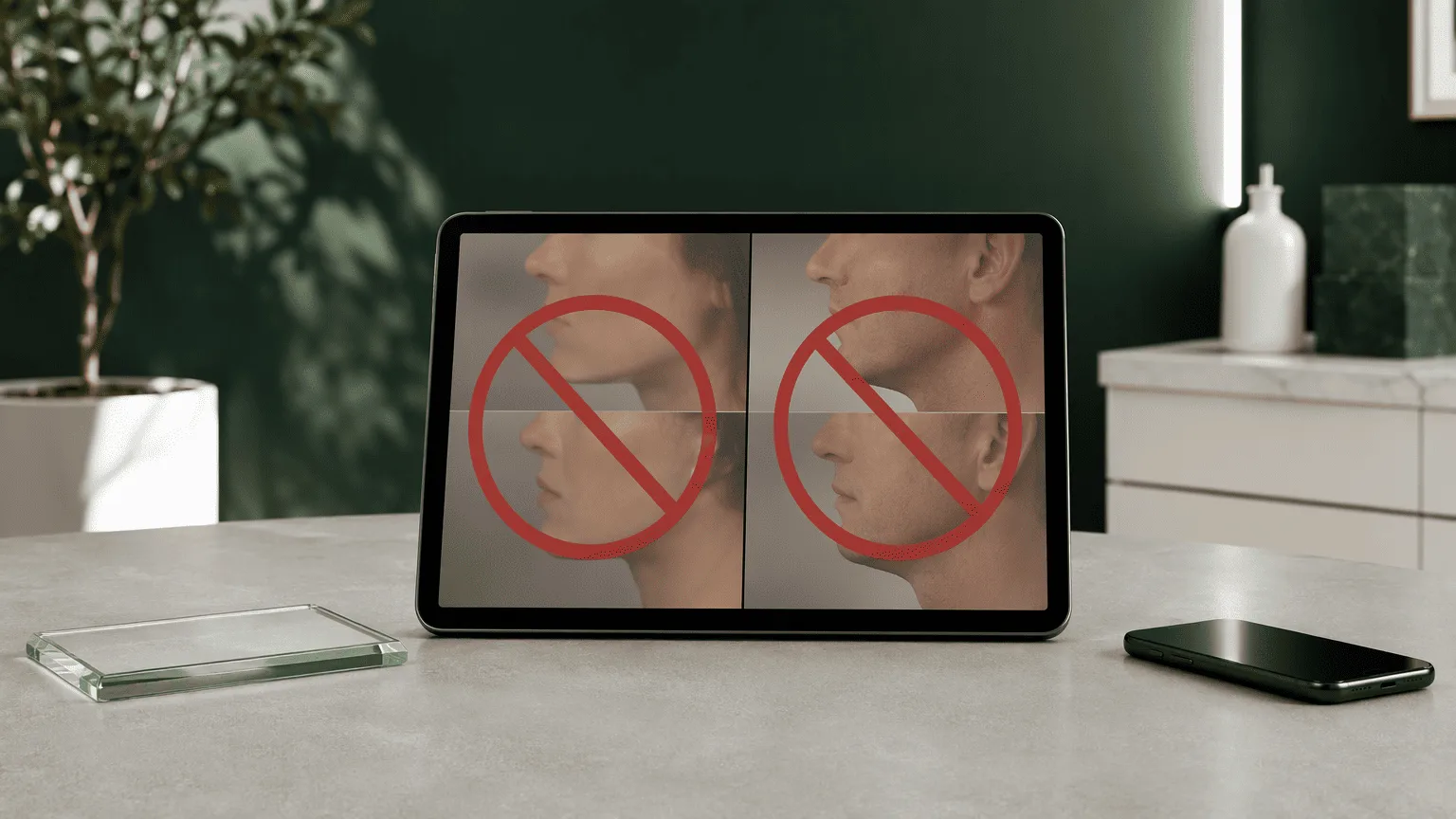
If your med spa runs paid social ads in Ontario or British Columbia, remove every before-and-after composite from your current campaigns right now. Both provinces' medical licensing bodies prohibit these images in promotional contexts, and Facebook's ad library makes your creative permanently visible to anyone who looks.
Many provincial medical licensing bodies, like the College of Physicians and Surgeons of Ontario, prohibit using these images in unsolicited ads or paid social media campaigns. The CPSO's position is that before-and-after photos can create unreasonable expectations of results, which undermines informed consent. The CPSBC takes a similarly strict line. Quebec's regulatory framework prohibits advertising that exploits a patient's vulnerability, creating a broad and subjective standard that covers dramatic visual transformation imagery. The question is whether the format itself, in a paid advertising context, constitutes an improper inducement.
Testimonials are equally restricted. Provincial medical licensing bodies in Canada prohibit using patient testimonials on social media, as they can be misleading or lack scientific credibility. The rationale is that an individual patient's experience does not constitute evidence of treatment efficacy. This blanket prohibition captures video testimonials, star ratings from patients, and written reviews repurposed as ad creative. Offering discounts or incentives in exchange for patient reviews is considered deceptive advertising under the Competition Act and Advertising Standards Canada guidelines, adding a second enforcement layer to review-generation tactics that are common in other industries.
The safer creative direction is educational content that does not hinge on a specific patient's results. Treatment animations that show mechanism of action, provider-to-camera explainer videos that reference approved indications, and branded clinic content focused on the environment and safety protocols all operate within the permitted zone. These formats build trust through transparency without triggering the testimonial and before-and-after prohibitions that govern high-risk creative.
The Compliance Mechanism: How Rules Are Enforced and Penalties Applied
Enforcement in Canada moves through three parallel channels, each capable of flagging a single ad:
- Health Canada: issues compliance letters to advertisers promoting prescription drugs or medical devices outside approved indications, demanding corrective action and creating a formal enforcement record.
- Ad Standards Canada: operates a complaint process under the Canadian Code of Advertising Standards where a competitor or member of the public can file a complaint, and a non-compliance finding requires the advertiser to withdraw or amend the creative; referrals to the Competition Bureau can lead to penalties up to $10 million for first offenses under the Competition Act.
- Provincial colleges (CPSO, CPSBC, etc.): initiate disciplinary proceedings against physicians for advertising that violates college policy, with penalties including mandated remedial education, fines, practice restrictions, and license suspension, a disciplinary record that is public, permanent, and visible to every prospective patient who searches the physician's name.
Navigating Platform Policies: A Practical Compliance Checklist for Med Spas

Federal rules, provincial policies, and platform certification requirements combine into a review process that catches most violations before the ad ever runs, if you know what to check. Here is the pre-publication audit sequence we walk clinics through:
- Confirm product classification before writing copy: Look up the specific Health Canada drug identification number or medical device license number for every treatment mentioned in the creative. If the indication you want to advertise does not appear on the product monograph or device license, the claim is unapproved and the ad is non-compliant.
- Verify that prescription drug mentions include required identifiers: Every ad that names Botox must also include the manufacturer's name and the authorized therapeutic indication as it appears in the product monograph. 'Botox Cosmetic reduces the appearance of moderate to severe frown lines' is compliant copy. 'Botox gives you a fresh, youthful look' is not.
- If a claim cannot be proven with Health Canada-approved evidence, it should not appear in the ad.
- Remove before-and-after imagery from paid ad creative in Ontario, BC, and Quebec: These provinces treat promotional before-and-after photos as prohibited inducements. If you want to use them on your website or organic social pages, confirm your specific college's policy in writing first, and never place a dollar figure or 'Book now' CTA next to a transformation image.
- Audit every testimonial or review for ad placement: If a piece of creative contains a patient quote, a star rating, or an endorsement of treatment results, pull it. Build alternative social proof through clinic accreditation badges, provider certifications, and treatment volume statistics, factual, non-prohibited signals that replace what you cannot say.
- Attach required disclaimers and license numbers to device ads: Every laser or IPL promotion must show the device's Health Canada license number and restrict claims to the device's approved treatment indications. This includes static image ads, video captions, and landing page copy.
- Secure platform certification where the treatment qualifies: If you are advertising Botox on Meta, complete the LegitScript certification process. If you are running on Google, confirm whether your campaign keywords fall into the restricted drug terms category that requires certification to bid.
- Check CASL and PHIPA compliance on campaign flow: If the ad directs to a lead form or email capture, confirm that CASL mandates clear opt-out options, proper sender identification, and explicit consent for promotional emails from med spas, and that PHIPA requires explicit consent before using personal health information in med spa marketing. A compliant ad that feeds into a non-compliant email flow exposes the clinic to both federal privacy enforcement and college scrutiny.
Conclusion
Canadian med spa advertising rules force a discipline that the American market never demands. No testimonials. No aspirational before-and-after galleries. Every claim must trace back to a product monograph. The result is a marketing environment where the clinic that educates builds authority faster than the clinic that sells.
The operators who treat this as an advantage are the ones building durable patient volume. A brand built on transparent, compliant content competes on substance. Provincial regulators reward that. A competitor running prohibited transformational photos is competing on aspiration, and that axis gets narrower every time a college updates its guidance.
Run the pre-publication audit on every ad. Train your marketing team on federal and provincial layers as separate compliance requirements. Build your creative playbook around the formats regulators permit. The channel works. The compliance brief just demands more rigor than most clinics are applying.
Frequently Asked Questions
What are the key federal and provincial advertising regulations that Canadian medical spas must comply with for treatment ads?
The regulatory framework for med spa advertising operates across multiple layers:
- At the federal level, the Food and Drugs Act prohibits advertising drugs or devices with claims Health Canada has not approved.
- The Competition Act bans materially false or misleading representations.
- Provincially, medical licensing bodies like the CPSO and CPSBC impose restrictions on ad format, including testimonial and before-and-after photo bans.
How do Health Canada and advertising standards bodies classify treatments like Botox, dermal fillers, and laser therapy in advertising?
Specific products carry distinct advertising requirements under Health Canada rules:
- Botox is a prescription drug requiring the proper name, manufacturer, and only authorized therapeutic claims.
- Dermal fillers are Class IV medical devices with similar claim restrictions.
- Laser and IPL devices are Class III/IV medical devices requiring the license number and approved indication claims in every ad.
What specific claims are prohibited in Canadian med spa advertising compared to the U.S.?
Claims of permanent results, pain-free treatment, or guaranteed safety are prohibited without strong Health Canada-approved evidence. Superlative comparisons and off-label promotion are banned. Unlike the FDA's more flexible cosmetic language, Health Canada requires that ad claims match exactly what appears in the product monograph.
Can Canadian med spas use before-and-after photos and patient testimonials in their ads?
In Ontario, British Columbia, and Quebec, most provincial licensing bodies prohibit before-and-after photos in paid promotional ads. Patient testimonials are broadly prohibited when they imply treatment efficacy. These restrictions apply to paid social campaigns. Some provinces permit limited use on clinic websites or organic pages.
What are the consequences for non-compliance with med spa advertising rules in Canada?
Consequences include Health Canada compliance letters demanding corrective action, Ad Standards Canada complaints forcing ad removal, and Competition Bureau penalties reaching $10 million for a first offense. Provincial colleges can impose fines, required remedial education, practice restrictions, and license suspension.
How do provincial colleges of physicians and surgeons affect advertising rules for med spas in different provinces?
Provincial colleges regulate the format and professional conduct of physician-supervised advertising. The CPSO in Ontario and CPSBC in British Columbia strictly ban testimonials and before-and-after imagery in promotional contexts. Quebec's Code of Ethics prohibits ads that exploit patient vulnerability. Rules vary, making local college policy review mandatory.
Sources
- Medical Social Media Compliance in Canada: What To Avoid - minamedical.ca
- Med Spa Advertising Rules in Canada — Beauty Pro Supplies Canada - www.beautyprosupplies.com
Want help executing this for your clinic?
Book a 30-minute call and we will map what a real ad engine would look like for your specific service mix.
Book a call