
Texas Medical SEO Company: Why $18.47 Clicks Demand a Better Patient Engine
IntroductionThat $18.47 number is not a typo. It is the average cost-per-click for 'dentist austin' right now, pulled fresh from Semrush data in October 2026. A single, often fruitless, click.
For a practice buying that term, a modest 50-click day torches over $900 before a single phone rings. Most Texas clinics are not burning budget on a bad ad platform. The problem is they are competing in an auction where the house always wins, mistaking the size of a Google Ads bill for a marketing strategy.
Medical SEO flips that math. Instead of renting attention from an algorithm that prices it higher every quarter, you build an asset on real estate you control. Organic patient acquisition through a specialized medical SEO company Texas practice owners hire is a unit-economics decision. When a healthcare SEO Texas strategy compounds, the cost to acquire a new patient drops by 60 to 80 percent compared to those paid search benchmarks, a margin that reshapes a P&L.
A Texas medical marketing playbook in 2026 must dominate Google Maps, answer AI engines like ChatGPT and Gemini, and survive the regulatory scrutiny of HIPAA and the Texas Medical Board. The tactics are more technical, the compliance stakes are higher, and the agencies promising easy wins are louder. We wrote this guide for the practice owner or administrator who needs to cut through that noise, audit what a real medical SEO investment looks like, and pick a provider whose output is a patient engine, not a content blog.
Key Takeaways
Medical SEO for Texas healthcare practices in 2026 is a unit-economics play. These are the six non-negotiables the rest of this article proves out:
- Cost Comparison: Paid search for a competitive Texas healthcare keyword runs $18+ per click today, while a mature organic strategy typically reduces new-patient acquisition cost by 60 to 80% over time.
- Regulatory Constraints: HIPAA governs every byte of patient data your website collects, and Texas Medical Board rules prohibit misleading outcome claims, requiring specific disclaimers on any testimonial or before-and-after content.
- The 2026 Tech Stack: Effective strategies run on three rails: local SEO for Google Business Profile dominance, Generative Engine Optimization (GEO) so AI search engines cite your practice, and patient-intent content clusters that prove authority.
- Pricing Reality: A credible medical SEO program in Texas runs $3,000 to $10,000+ per month. Below $2,500 per month, you are paying for generic reporting without specialized healthcare traction.
- ROI Measured as CPA: The right metric is cost-per-acquisition. A single new patient from a high-value procedure like orthopedic surgery or cosmetic dentistry can justify an entire year of SEO retainer.
- Vetting the Provider: The Semrush Agency Partners directory lists 70 SEO agencies in Texas, but few are genuinely healthcare-exclusive. The evaluation framework is whether they can deliver SEO that is HIPAA-compliant and medical-board-aware.
At a Glance
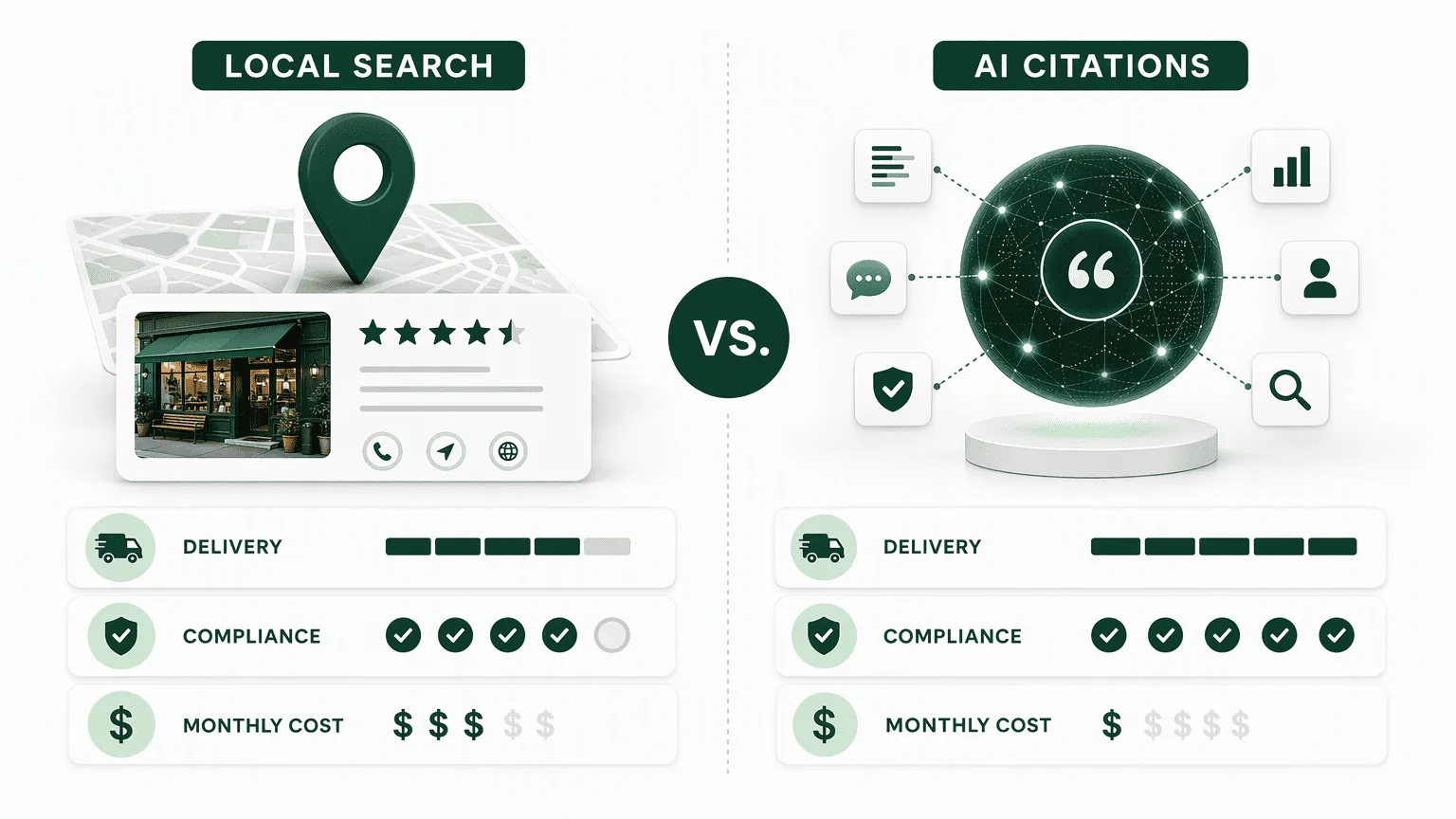
Here is how the options compare across the dimensions that matter most.
| Component | What It Delivers | Compliance Requirement | Typical Monthly Cost |
|---|---|---|---|
| Local SEO (GBP & Maps) | Dominates local 3-pack, drives phone calls | HIPAA for form submissions; Texas Medical Board disclaimers for outcomes | $1,500 to $4,000 |
| Generative Engine Optimization (GEO) | AI citation by ChatGPT/Gemini, entity clarity | No patient data exposure; factual accuracy for medical claims | $1,000 to $3,000 |
| Patient-Intent Content Clusters | Authority on high-value procedure terms | Avoid misleading outcomes; include required disclaimers | $1,000 to $3,000 |
| Technical SEO & Schema | Structured data for local + medical markup | HIPAA-compliant server/forms; no cookie leaks | $500 to $2,000 |
| Monthly Reporting & Adjustments | CPA tracking, keyword rank, GBP insights | Audit trail required for Medical Board compliance | Included in retainer |
What a Medical SEO Company Does for Texas Practices

Medical SEO costs more than the generalist SEO a plumbing company buys. A real medical SEO firm in Texas runs three components simultaneously:
- Local Search Dominance (Google Business Profile & Maps): Optimizing and defending your practice's GBP profile, suppressing spam competitor listings, and building hyperlocal landing pages for each Texas city or neighborhood you serve. This is where most phone calls originate.
- Generative Engine Optimization (GEO): Structuring your site with clear answers, schema markup, and medical trust signals so AI tools select your pages as authoritative sources. ChatGPT and Gemini prize entity clarity and citation-worthy data formats. Your backlink count matters far less here.
- Patient-Intent Content Architecture: Building service and procedure clusters that go well past blog posts: condition pages, cost guides, recovery timelines, and surgeon profiles that satisfy both a search spider and a worried human scanning for credentials. Google's YMYL standards require clear author attribution, cited medical review, and transparent ownership information on every page.
How HIPAA and Texas Medical Board Rules Shape Your SEO

A general SEO agency will install a free contact form plugin and fire analytics tags without a second thought. A healthcare SEO agency Texas practice owners hire cannot. The HIPAA Privacy Rule protects all 'individually identifiable health information' held or transmitted by a covered entity or its business associate, and a contact form that captures a patient's name plus the procedure they are asking about is absolutely a repository of protected health information. Every form submission, every analytics view, every review response that acknowledges someone is a patient creates a compliance obligation that a generalist agency is not insured to manage. The Texas Medical Records Privacy Act goes further, defining a covered entity to include those who for commercial, financial, or professional gain engage in assembling, collecting, analyzing, using, evaluating, storing, or transmitting protected health information.
That covers your SEO agency. If they are handling your Google Business Profile analytics, filtering patient review data, or installing tracking scripts on your site, they are touching PHI in a regulated environment. The enforcement is real. In 2019, Sentara Hospitals was hit with a $2.175 million fine and adoption of corrective action plan that includes 2 years of monitoring after mailing 577 patients' PHI to wrong addresses and initially reporting the breach as affecting only 8 individuals. A medical SEO engagement without a Business Associate Agreement (BAA) in place is a liability ticking in your practice's risk register.
Then comes the Texas Medical Board. Marketing is defined broadly: it is any communication from a provider to a Medicaid or CHIP client that can reasonably be interpreted as intended to influence the client's choice of provider. The board's advertising rules draw hard lines around what your SEO content can claim.
You cannot promise specific treatment outcomes, and you must use clear, conspicuous disclaimers. This directly dictates how you write service pages, procedure descriptions, and even meta descriptions. A marketing-page headline like 'Guaranteed Migraine Relief in One Visit' is a board complaint waiting to file itself.
The content guardrails extend to reading level and accessibility. Providers may offer branded giveaways valued at no more than $15, individually at health awareness events, but unsolicited personal contact such as direct mail, telephone, and door-to-door solicitation is prohibited. Any patient-facing digital content that could be considered marketing must be written at or below a sixth-grade reading level, and if it targets the broader Texas community, it must be available in both English and Spanish. A medical SEO company that does not know these rules will produce content that either gets your practice fined or completely alienates your patients.
The Texas Medical SEO Playbook: What Actually Works in 2026
The SEO playbook of 2023 will not cut it. In 2026, search is fragmented across Google, Perplexity, ChatGPT, and Gemini, each pulling answers from different signals. Your Texas medical SEO strategy must build a citability engine with these four layers:
- Google Business Profile: The most valuable piece of local digital real estate you own. Category selection matters in Texas. A 'Med Spa' selecting 'Beauty Salon' because the volume looks higher is committing a compliance error and an optimization error simultaneously. The correct primary category plus relevant secondary categories, paired with a review-generation cadence that never acknowledges the reviewer as a patient, drives the majority of new-patient direction requests.
- Generative Engine Optimization: Structures your site's content with clear answers, schema markup, and medical trust signals so these AI tools select your pages as authoritative sources. Each procedure or condition page needs a dedicated 'answer block' at the top: 40 to 60 words that clearly state what the service is, who it benefits, and what the core outcome targets are, all written at that sixth-grade reading level. When a prospective patient types 'recovery time for robotic knee surgery Austin' into ChatGPT, a Texas practice using ClinAds's approach to GEO surfaces because the content is structured to answer questions directly. The platform runs an AI-first growth engine that builds these citation-ready assets programmatically, so your surgeon's profile page surfaces in Perplexity as a source.
- Procedure and Condition Service Clusters Mapped to Texas Geography: Your location pages must go beyond 'Dermatologist Houston' with a zip code list. They need real regional data and insurance network acceptance by plan type. Structured before-and-after information is permissible only with the exact disclaimer language the Texas Medical Board requires.
- Defensible Authority in Competitive Metros: A thin blog will not beat the entrenched players in Dallas or Houston. You build authority through cited, physician-reviewed condition libraries that hospitals and medical directories link to, creating a backlink profile rooted in clinical trust rather than guest-post spam.
What Medical SEO Costs in Texas, and the ROI That Justifies It

Credible medical SEO pricing Texas ranges from $3,000 to $10,000+ per month, and the bottom of that bracket does not cover GEO and AI search optimization. You get local profile management and content publishing in a moderately competitive Texas suburb. Below $2,500 per month, you are invisible.
The cost stops being an expense when you recalculate your patient acquisition cost. At an average of $18.47 per click for a high-intent dental term, a practice converting at 5% of clicks to booked consults is paying roughly $370 in ad spend alone for a single new patient, before accounting for the staff time managing the campaign. Medical SEO compounds. A page ranking organically for 'robotic knee replacement Austin' or 'mommy makeover Houston' might take six to nine months to hit position one, but once it does, the incremental cost of the 50th click that month is zero. Over three years, that organic page produces new patients at a CPA of $40 to $80, a 60 to 80 percent reduction against paid channels.
ROI models in healthcare SEO must tie to lifetime value. A single orthopedic surgical procedure generates $15,000 to $40,000 in facility and professional fees. Even at a $5,000 monthly SEO retainer via a platform like ClinAds, on the Growth plan at $399/mo with done-for-you SEO & GEO add-ons, the math is trivial: one additional surgical patient captured from organic search every quarter covers the annualized cost several times over. The KPI to track is how many new-patient appointment requests came from organic channels at a CPA that beats your paid search and billboard spend combined, measured month over month and normalized for seasonality.
How to Choose a Texas Medical SEO Company (and Red Flags to Avoid)
The Semrush Agency Partners directory lists 70 SEO agencies in Texas, but a directory count does not equal an evaluation. The right medical SEO company Texas decision is not a beauty contest between sales decks. It is a binary compliance and capability audit. Here is the evaluation table to use on your next provider call:
The Hardest Parts of Medical SEO in Texas and How to Beat Them

Extreme competition in major Texas metros is the first knockout punch most practices take. Ranking for 'orthopedic surgeon Houston' or 'cardiologist Dallas' pits your practice against academic medical centers, massive private equity-backed groups, and decades-old private practices that started SEO when Yelp was still a startup. The strategic counter is to build a deep bench of long-tail, procedure-specific, and symptom-question content that captures the patient much earlier in their journey: 'why does my knee lock when I walk', 'tingling in left arm after lifting', 'cost of cataract surgery with astigmatism correction Dallas'. These queries are less competitive individually but collectively drive more qualified traffic and are easier to dominate.
The second inescapable challenge is HIPAA constraints on conversion tracking and personalization. An e-commerce site can fire dynamic retargeting pixels with impunity. A healthcare website cannot track a specific user's behavior on a procedure page and then serve them a remarketing ad on Facebook for that procedure. The counter-strategy is server-side analytics, PHI-filtered event tracking, and conversion modeling within platforms like Google Analytics 4 that give you directional attribution without individual privacy violations.
The Texas Medical Board content restrictions mean you cannot use extreme social proof claims or unqualified before-and-after images. The solution is authority-first content: cited clinical studies, transparent surgeon outcome data with proper disclaimers, and patient education resources that earn backlinks from medical journals and hospital systems.
The final hurdle is the shift to AI search. ChatGPT and Gemini surface a short answer from the most citation-worthy source they find; they do not always send the user to your website. Beating this requires optimization for citation clicks.
Structure every service page with an answer-first block: a 40-to-60-word statement in plain English that directly answers the primary procedure question. This is the exact framework ClinAds's AI-first growth engine uses, programmatically generating GEO-optimized content blocks that search agents lift directly into their answers. When the AI cites you, the user may not click through that day.
But they have seen your practice name as the authority. They type it directly next time.
Conclusion
A $900 daily bill for 50 clicks in a Texas market with zero guaranteed consults is a tax on indecision. Paid search has its place as a throttle for immediate volume, but the core patient engine of a Texas healthcare practice in 2026 must be owned, not rented.
CPA math makes the financial case plainly. Over a two-to-three year horizon, an owned organic presence cuts acquisition costs by 60 to 80 percent compared with $18-plus medical clicks.
The compliance case is simpler than most practices realize, and it leaves no room for ambiguity. If your current SEO provider cannot distinguish a Business Associate Agreement from a non-disclosure agreement and does not know which Texas Medical Board disclaimers belong on your service pages, they are an active liability. That is the test. Miss it, and every ranking you pay for sits on a compliance time bomb.
The strategic direction is a healthcare-specialized SEO investment that dominates local map packs, answers AI search engines, and builds a content architecture a medical board would approve. The only remaining question is whether your current provider can meet the evaluation criteria in the table above. If they cannot, that is the gap to close this quarter.
Frequently Asked Questions
What is a medical SEO company and why does a Texas healthcare practice need one?
A medical SEO company is a specialized search optimization firm that helps healthcare practices rank in Google, Maps, and AI search engines under strict HIPAA and regulatory compliance. Texas practices need one because paying $18+ per paid click for terms like 'dentist austin' is unsustainable, and organic visibility is the only scalable patient acquisition channel.
What specific medical SEO strategies work for Texas doctors, hospitals, and clinics in 2026?
The 2026 playbook runs on three rails:
- Google Business Profile optimization for Map Pack dominance
- Generative Engine Optimization so AI tools like ChatGPT cite your content
- Procedure-cluster content built at a sixth-grade reading level that complies with Texas Medical Board disclaimers and is available in English and Spanish
How do medical SEO regulations like HIPAA and Texas medical advertising rules affect online marketing?
HIPAA requires a BAA and PHI-encrypted tracking for any form or analytics tool that touches patient data. Texas Medical Board rules ban promising specific treatment results and require disclaimers on testimonials. Unsolicited contact is prohibited, and all marketing materials must be accessible to a sixth-grade reading level.
How much does medical SEO cost in Texas and what is the typical ROI for a healthcare practice?
Credible medical SEO costs $3,000 to $10,000+ monthly. One high-value surgical patient acquired organically can justify an entire year's SEO retainer.
Which Texas medical SEO companies are the best, and how do you choose the right one?
The best choice is not about a ranked list but a compliance audit. Verify:
- Healthcare-exclusive case studies
- A proactive BAA for HIPAA
- Strategists who know Texas Medical Board content rules
- A reporting model built on procedure-level patient acquisition data, not keyword-count PDFs
What are the biggest challenges of medical SEO in Texas and how can a practice overcome them?
Extreme metro competition, HIPAA's conversion-tracking limitations, board content restrictions, and the shift to AI-synthesized answers are the core challenges. Overcome them by targeting long-tail symptom queries, using server-side PHI-filtered analytics, writing authority-first cited content, and structuring answer-first blocks for AI citation.
Sources
- Pricing: Clinic Marketing Software & SEO | ClinAds - getclinads.com
- AI Marketing Solution for Clinics | ClinAds - getclinads.com
- Best SEO Companies in Texas 2026 | Semrush - agencies.semrush.com
- Medical SEO Services | Healthcare SEO Company - intrepy.com
- Texas Provider Marketing Guidelines — Texas Health and Human Services Commission January 2025 - www.hhs.texas.gov
- HIPAA and Medical Privacy Laws - www.texasattorneygeneral.gov
Want help executing this for your clinic?
Book a 30-minute call and we will map what a real ad engine would look like for your specific service mix.
Book a call