
The 7 Best Online Presence Management Tools for Healthcare
Summary: The best online presence management tools for healthcare in 2026 include Clinads, rater8, and Birdeye, among others. Clinads offers a unified platform for listing sync, review generation, and website personalization. Rater8 excels in physician-level reputation management with EHR integration. Birdeye provides enterprise-grade multi-location management for large health systems, ensuring consistent practice information across directories.
Introduction
Fragmented listings and generic websites are bleeding your practice’s patient pipeline dry. Your Google Business Profile still shows last year’s suite number, and your Healthgrades page routes calls to a disconnected line. A competitor with accurate, active and personalized digital assets will take your place in the search results every time.
Here is why this problem is so expensive. A recent regulatory ruling has classified tracked IP addresses and healthcare-related searches as HIPAA-protected information, which means your cookie-cutter marketing widgets could now be a compliance liability. Meanwhile, 89 percent of patients search for symptoms online before visiting a doctor, and they are making decisions based on what they find.
The trade-off: you can buy a stack of generic tools and spend months stitching them together while exposing yourself to PHI risk, or you can procure a platform that merges HIPAA-native listing sync, review generation, and web personalization into a single operational dashboard. This article audits the seven platforms that solve the fragmented presence problem for medical practices in 2026.
Key Takeaways
Here is the compressed briefing for practice managers who need to fix their digital footprint this quarter:
- Clinads is a healthcare-specific unified platform: It bundles real-time listing sync, review generation, and dynamic website personalization under one signed BAA. You stop paying three separate vendors.
- rater8 owns physician-level reputation: A 4.9/5 G2 rating, transparent ~$89/provider/month pricing, and native EHR integration make it the specialist’s choice for individual MD metrics.
- Birdeye scales for large health systems: A 4.7/5 G2 rating for enterprises that need to control hundreds of locations and 50+ directory listings from a centralized dashboard.
- A signed BAA is the first procurement filter: Before you demo a single feature, demand to see the Business Associate Agreement. If a vendor cannot produce one immediately, they are off the list.
- SMS-first tools convert faster but need PHI guardrails: Platforms like Podium achieve high open rates on same-day feedback, provided you lock down template configuration to avoid patient data exposure.
1. Clinads: The Healthcare-Specific Platform Unifying Reputation, Listings, and Website Personalization
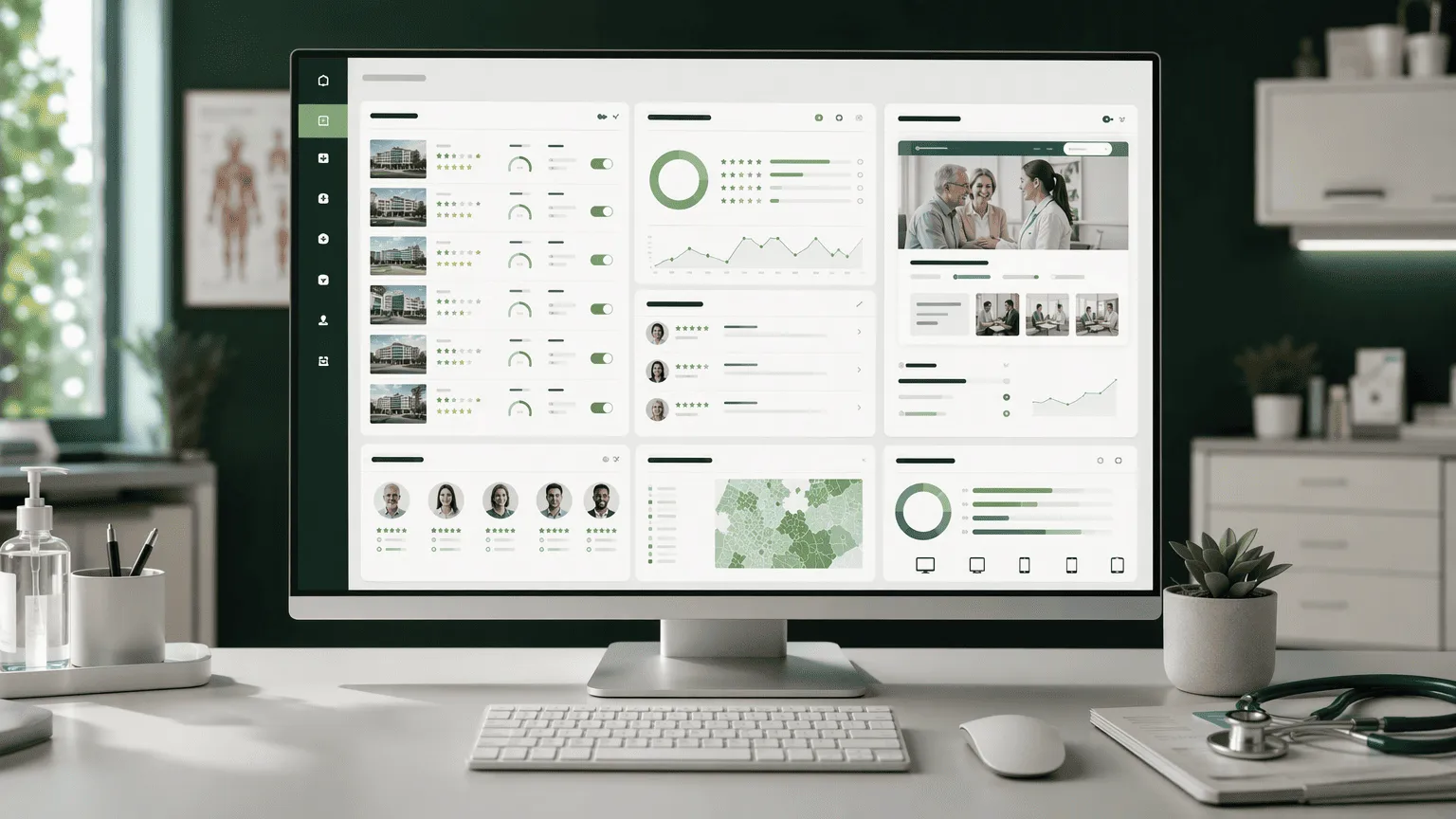
Most practices run their Google listings on one tool, their reputation on a second, and their website personalization on a third. The data stays siloed, and the BAA coverage ends up full of gaps. Clinads collapses that stack. It is a HIPAA-native platform that merges real-time listing synchronization, review generation, and dynamic website content tailored to patient demographics into a single interface.
If you are starting now, open with the unified dashboard. Your front desk can trigger a review request and update the practice’s Google Business Profile with a fresh offer or adjusted hours in the same motion, feeding your local SEO signal directly, with no middle layer. The platform also personalizes the website experience based on referring patient demographics, an approach BCG research credits with improved customer experience by about 10 percent and increased quality metrics by 20 to 25 percent.
Who it is best for: a busy multi-physician practice or a small group with a marketing lead who wants to fire two or three point solutions and consolidate patient acquisition tracking and review management under one vendor. You stop micromanaging the digital presence because the operational bandwidth shifts back to you. The platform suits operators who have already learned that bolting a generic review widget onto an outdated website produces zero incremental patient flow.
2. rater8: Physician-Level Reputation Management with Deep EHR Integration
The wrong way to choose a reputation tool is to ask whether it sends review invites. The right question: does it fire them from your EHR at the exact moment a visit closes? rater8 does. Here is what makes rater8 stand out:
- EHR integration: plugs into Epic and Athenahealth to trigger automated post-visit review requests.
- Provider-level dashboard: feeds a sentiment dashboard that lets you measure every MD’s patient satisfaction score in near-real time.
- Transparent pricing: costs approximately ~$89 per provider per month.
- Top G2 rating: earned a 4.9/5 rating on G2, the highest among the pure-play healthcare reputation set.
For a practice where individual physician brand directly drives patient volume, dermatology, plastics, ortho, rater8 is the default operational hire. You get a clean feed of reviews filtered by provider, which lets you run marketing around a single surgeon’s five-star record or intervene when a specific location’s scores begin to dip. The trade-off: rater8 is not a full-stack listings or web personalization tool. If you need 50+ directory sync and website AB testing alongside reputation, you will pair it with a presence management platform or you will choose a unified competitor. But if the KPI is an accurate, per-MD reputation score that your partners can trust, rater8 owns the lane.
3. Birdeye: Enterprise-Grade Multi-Location Management for Large Health Systems

Running reputation for five locations is messy. Running it for 50 or 200 without a centralized permission hierarchy is impossible. Birdeye solves that with a multi-location dashboard governance layer that enterprise health systems need.
Large groups can set role-based controls so that a regional director views aggregate sentiment across the whole system while an office manager can only respond to their site’s reviews. The platform also syncs practice information across more than 50 directories and adds social listening capabilities that track brand mentions beyond structured review sites. This breadth of signals earns Birdeye a 4.7/5 G2 rating.
The problem is that the pricing model is entirely custom-quote, so a two-doctor private practice will likely overspend for features they never use. For a scaled hospital network or a DSO that standardizes location marketing from one headquarters, Birdeye is the operational backbone. For a solo practitioner, we would look elsewhere. The platform demonstrates that directory sync is now table stakes in 2026: with patient-listing mismatches as granular as a typo or a wrong suite number preventing potential new patients from finding you, the brute-force distribution power of Birdeye directly protects organic search equity across dozens of touchpoints.
4. Podium: SMS-First Patient Communication and Instant Review Capture

Email review requests have a response rate problem. Your patient scrolls past the invite at 9 p.m. and never opens it again. Podium solves that by starting every interaction in a text message. It is an SMS-first platform that captures reviews, converts web chat to text, and processes payment links from the same thread.
Text-based outreach wins on speed. Practices see higher same-day feedback completion because the request lands in a channel that patients actually monitor. Podium holds a 4.6/5 G2 rating and is particularly valuable for appointment-based clinics that want instant service feedback before the visit memory fades.
The trade-off: SMS platforms carry a higher HIPAA risk when template configuration is mishandled. Podium will sign a BAA, but your operations team must confirm that review request messages, payment links, and Webchat-to-text conversion do not inadvertently transmit PHI in the open. The technology works.
The vulnerability is that most practices activate SMS campaigns and never audit the PHI exposure afterward. Do that audit before you broadcast. If your front desk can train on protected template language, Podium will produce the fastest reputation flywheel on this list.
5. Solutionreach: Thorough Patient Relationship Management Beyond Reviews

Your practice might not need a standalone review tool. If you are also trying to fix appointment no-shows, recall campaign drop-off, and fragmented secure messaging, Solutionreach bundles those alongside reputation features in one HIPAA-compliant patient relationship management platform. Here is what it does beyond reviews:
- Automated recall campaigns: Trigger reminders for annual exams, follow-ups, and chronic condition maintenance directly from your patient records.
- Two-way secure messaging: Patients can text your office within a HIPAA-compliant thread for rescheduling or quick clinical questions.
- Integrated scheduling: Patients book directly from outreach messages, reducing the back-and-forth phone tag that bottlenecks front desk staff.
- Review generation as a workflow feature: Feedback requests fire at logical moments (post-appointment, after a secure message resolves) rather than as a bolt-on marketing blast.
Solutionreach is best for the practice that needs patient relationship infrastructure first, with reputation as a component of the platform. The downside is that if your reviews are the single biggest growth lever, you may want a tool like rater8 or Podium that specializes purely in feedback capture instead of a platform that includes it among five other features.
6. Grade.us: The Configurable White-Label Solution Requiring Strict HIPAA Configuration
Grade.us is a white-label review and reputation platform built for marketing agencies that manage multiple clients. It offers deep API flexibility for custom review funnels and dashboarding. But for a healthcare practice, the feature set comes with a hard compliance precondition: you must configure the platform to strip PHI from automated campaigns yourself.
Here is the specific risk breakdown.
| HIPAA Dimension | Native Healthcare Tools (Clinads, rater8) | Grade.us (General Platform) |
|---|---|---|
| BAA Availability | Signed as standard during procurement. | Requires negotiation; verify coverage scope before purchase. |
| PHI in Review Templates | Templates pre-configured to exclude clinical data. | Your team must manually scrub PHI from all outbound prompts. |
| Data Flow Visibility | Unified dashboard built for healthcare compliance traces. | API-rich environment where data paths need custom audit mapping. |
| Implementation Timeline | Days, with health-specific onboarding. | Weeks, with heavier in-house technical configuration load. |
A technically savvy practice or a healthcare marketing agency can use Grade.us safely if they invest the upfront engineering time to build the guardrails. The problem is that most practices skip the PHI audit step entirely. The moment someone pastes a patient’s name into a feedback request, a general platform becomes a compliance liability. Buy this tool only if someone on your team has built HIPAA-native workflows before and can map every data path correctly from day one.
7. Practice Builders: Full-Service Healthcare Marketing Agency with Listings and SEO Focus

Not every practice wants a SaaS login and a dashboard to manage. Some owners want to hand the entire problem to a specialized agency and check a monthly report. Practice Builders occupies that slot. It is a healthcare-specific marketing agency that runs listing cleanups, content marketing, review monitoring, and SEO as a fully managed retainer.
The scope is broad: their myPracticeListing service tackles inconsistencies across a footprint that could span 50 or more online services, from Google and Facebook to niche directories like Citysearch. Their client base reports meaningful movement. One client reported revenue increased by 20% and referrals increased by 25%, while another practice reported a 50% increase in new patient numbers and a 20% rise in gross production within a year. These numbers are self-reported testimonials, not independently verified audits, but they signal the directional impact of an aggressive listings and content cleanup.
The trade-off is control and speed. You lose the ability to push a real-time listing update yourself; an account manager handles it on their timeline. Practice Builders is the right call when the managing partner would rather cut a check than hire an internal marketing coordinator to oversee a tool. If you need instant, in-house command of your digital presence, pick a platform instead.
Conclusion
Match the platform to the bottleneck. If your problem lives at the individual provider level, one physician's ratings dragging down the whole practice, and you already run on Epic or Athenahealth, rater8 solves that specific problem at roughly $89 per provider per month.
If the bottleneck is tool sprawl, you are paying for three mismatched subscriptions to handle listing sync, review generation, and website personalization, Clinads consolidates those jobs inside one HIPAA-native dashboard built for healthcare workflows. That matters when your team is tired of logging into separate systems.
Large health systems with hundreds of locations need centralized governance over every Google Business Profile and review stream. Birdeye was built for that scale of control. Practices that want to hand the whole presence-management problem to someone else, zero internal lift, should send it to Practice Builders.
Before any platform goes live, execute the checklist: confirm the signed BAA, audit every SMS or review template for PHI exposure, and force a clean sweep of every listing inconsistency across every directory you occupy. That pre-work separates a tool you own from a liability you accidentally bought.
Frequently Asked Questions
What core features should an online presence management tool for healthcare practices include?
The tool must coordinate three functions: real-time listings synchronization across directories like Google and Healthgrades, HIPAA-compliant review generation with a signed BAA, and patient communication channels that default to PHI-safe templates. Sentiment dashboards and EHR integration for automated post-visit requests are now standard requirements.
Which platform is best for a solo physician who only needs reputation management?
rater8 is the strongest pure-play reputation tool for solo physicians. Here are its key features:
- Pricing: costs approximately $89 per provider per month.
- EHR integration: integrates with Epic and Athenahealth to trigger review requests automatically.
- Provider-level dashboard: surfaces individual provider sentiment on a clean dashboard.
- G2 rating: highest-rated dedicated healthcare reputation tool on G2 at 4.9 out of 5.
Why do I need a signed BAA before using any online presence tool?
A Business Associate Agreement legally binds the vendor to protect patient health information. A recent regulatory ruling classified tracked IP addresses and healthcare-related search data as HIPAA-protected information, which means even your listing analytics and web personalization scripts could trigger a compliance obligation without a BAA in place.
How do I fix inaccurate practice listings across dozens of directories?
Start with a full audit of your practice name, address, and phone number on Google Business Profile, Facebook, Yelp, Bing, and Healthgrades. Here are your options:
- Use directory-sync platforms: platforms like Clinads and Birdeye can sync corrections across 50 or more directories at once from a single dashboard.
- Hire a full-service agency: a full-service agency like Practice Builders can run the cleanup as a managed project.
Can I use a general review tool like Grade.us instead of a healthcare-specific platform?
Yes, but only with rigorous configuration. General platforms need your team to manually strip PHI from review templates and audit data pathways to avoid exposing patient information. Most practices underestimate this setup burden. Healthcare-specific tools pre-configure these guardrails, which is why they command a premium for the operational safety they provide.
Do online reviews actually influence patient acquisition for medical practices in 2026?
The data is direct: 75 percent of patients use online reviews to choose providers. With 89 percent of patients searching symptoms online before booking, a practice with a weak star rating and unresponsive feedback loop is invisible to the majority of its own prospective patient base. Reviews are now a primary acquisition channel rather than a secondary brand asset.
Sources
- Enhancing Healthcare Web Experiences with Personalization and Compliance - www.acquia.com
- Content Management System for Healthcare | Kentico - www.kentico.com
- Medical Practice Listing Management | Practice Builders - www.practicebuilders.com
- Top 10 healthcare reputation management software (2026) - Birdeye - birdeye.com
Want help executing this for your clinic?
Book a 30-minute call and we will map what a real ad engine would look like for your specific service mix.
Book a call