
Stop Stacking Clinic Tools That Don't Talk to Each Other
Summary: For multi-location healthcare practices, using disparate clinic tools that don't integrate leads to security vulnerabilities and a fragmented patient experience, costing new bookings daily. Unified AI-driven platforms like Birdeye, Podium, and Curogram offer a consolidated solution, enhancing review management and appointment booking while preventing operational inefficiencies and revenue leaks as practices scale.
Introduction
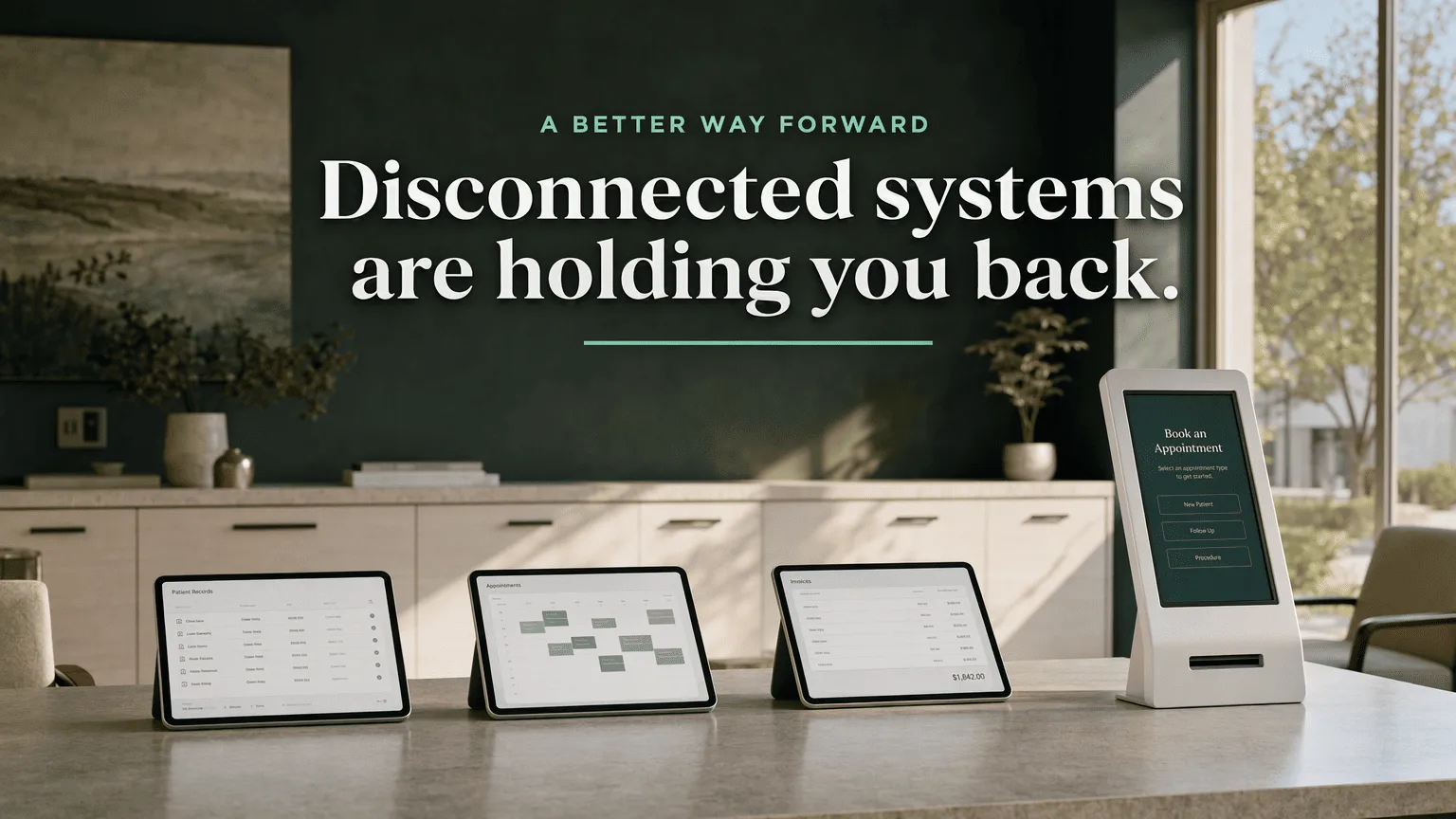
Your largest practice location just got hammered with three one-star reviews over wait times, and your satellite clinic's online booking widget has been routing new patients to a disconnected phone line since last Tuesday. The problem is not that you lack tools. You are running five different systems that share zero data, creating security gaps and a fractured patient experience that costs you new bookings every single day.
For multi-location healthcare groups, this fragmentation is a commercial liability. Five silos mean five surface areas for a breach and five separate experiences your patients have to stitch together themselves. The market has already consolidated around a few AI-driven platforms designed to stop the bleed: Birdeye, Podium, and Curogram. Birdeye just logged a 113% surge in enterprise adoption, and a single multi-location primary care group using Curogram gathered more than 6,000 5-star reviews across its locations in nine months. That kind of volume does not come from sending a few manual email blasts.
This article maps exactly which tools now unify online review management and appointment booking with enough AI depth to matter, and which scenarios still call for a niche point solution. The short answer: for any health group scaling beyond a single waiting room, the unified platform has already won.
Key Takeaways
The shift toward AI-driven, unified platforms sets the current standard for multi-location practices that cannot afford HIPAA gaps or inconsistent patient experiences across sites.
- AI depth now defines the market leader: Birdeye's platform, ranked among top global Agentic AI products alongside Google and Salesforce, uses AI agents to execute local marketing actions, outperforming basic automation tools.
- Enterprise adoption has surged by 113%: This adoption velocity signals that large health groups are abandoning fragmented tech stacks at an accelerating rate.
- Multi-location reporting is non-negotiable: The ability to compare review sentiment, ratings, and booking conversion rates by individual clinic location is the only way to manage performance at scale.
- Point solutions retain a niche edge: For solo practitioners with very low review volume, lightweight standalone tools still have a place. They also work for practices requiring a unique integration not supported by broad platforms.
The Verdict: Are Unified Platforms Worth It for Multi-Location Clinics, and for Whom?
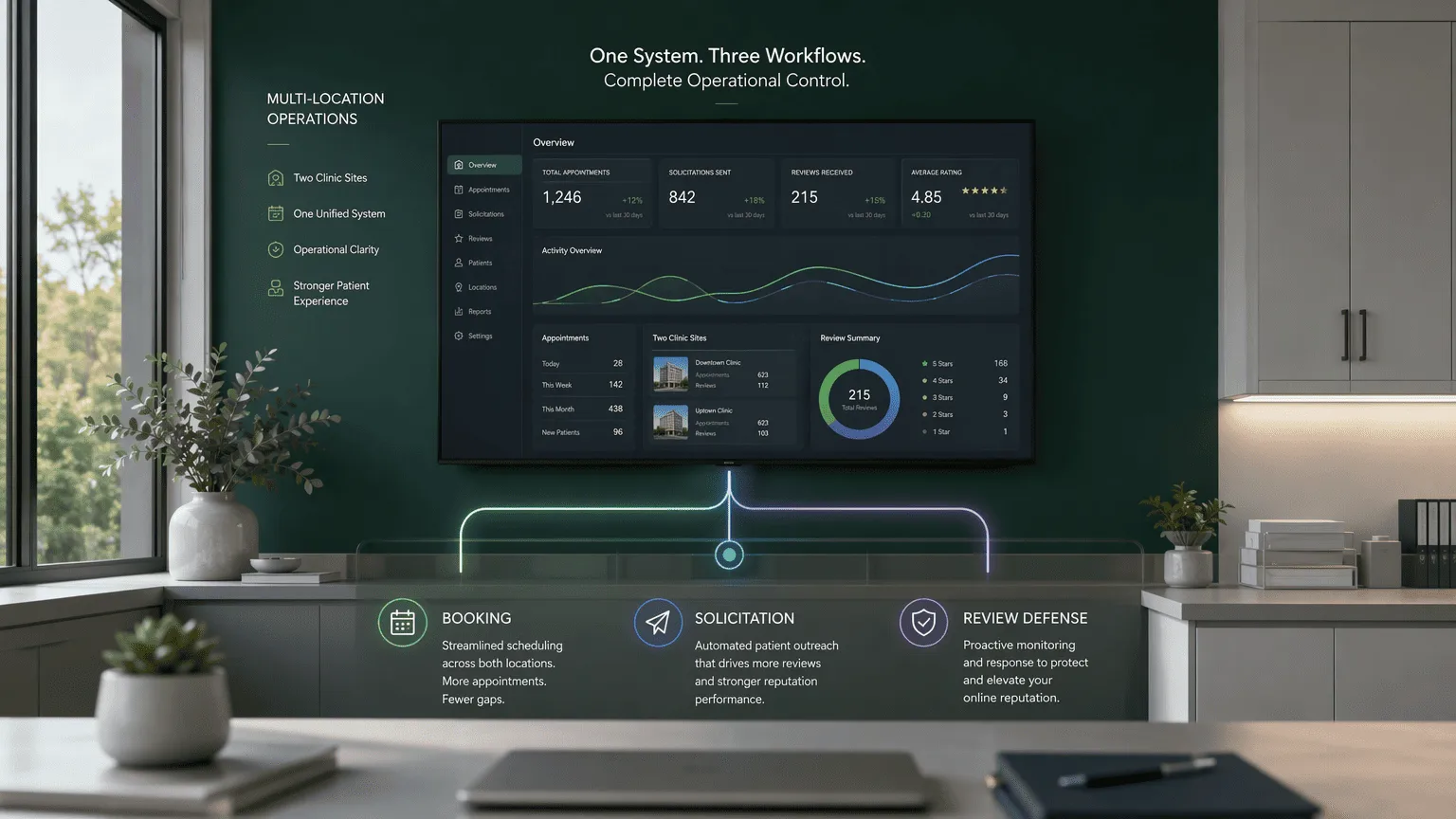
For any health group scaling patient volume across two or more physical sites, a unified platform is not just worth the price. It is the only architecture that prevents your patient experience from degrading as you grow. A 113% surge in enterprise adoption on Birdeye and rapid review accumulation of over 6,000 5-star reviews in nine months through Curogram are not edge cases; they are the output of platforms built to synchronize booking, solicitation, and review defense at scale. The trade-off is cost and implementation complexity, which can be overkill for a very small practice with minimal review volume.
A solo dental practice with one front desk phone and fifteen Google reviews per year does not need a broad AI platform. The moment you add a second location, however, the operational math changes.
Without a unified system, you will miss negative reviews on one site while your other site sends booking confirmations to the wrong email. That is not a software gap. That is a revenue leak.
The Evidence: AI Depth, Adoption Surges, and Real-World Results

Market data from 2026 does not leave much room for debate. Enterprise healthcare buyers are consolidating their tech stacks on platforms that combine deep AI, multi-location control, and native booking sync.
- Enterprise adoption velocity: Birdeye has recorded a 113% surge in enterprise adoption, paired with a 4.7/5 G2 rating across more than 3,900 reviews, the highest volume of user feedback among competitors.
An imaging center on the same platform reported a 30% increase in organic search traffic after consistently generating 5-star reviews.
- Multi-location platform adoption: 81% of Birdeye’s enterprise customers now use four or more products from a single platform, signaling a deliberate move away from siloed point solutions toward a unified operating model.
Strengths of the All-in-One Approach: Security, Synchronization, and Scale

The architectural advantage of a unified platform is security, before anything else. A data breach does not care which vendor caused the exposure; your practice owns the liability.
Beyond security, the operational win is synchronization. That single automation changes your capture rate from a trickle to a stream. In a competitive metro market where more than 80% of your reputation success comes from Google Reviews, the volume of feedback you miss today is the patient acquisition cost you pay tomorrow.
Multi-location scale changes the reporting requirement entirely. With a unified platform, a regional operations lead can log into a single dashboard and compare review volume, star ratings, and booking conversion rates across ten clinic locations side by side. Without that consolidated reporting, what you actually have is ten separate businesses that share a brand name and zero performance accountability. The data showing that 81% of Birdeye enterprise clients now run four or more products confirms that the market has moved past debating whether consolidation works. It is now only a question of which platform you consolidate on.
Limitations: Where Point Solutions Still Have an Edge
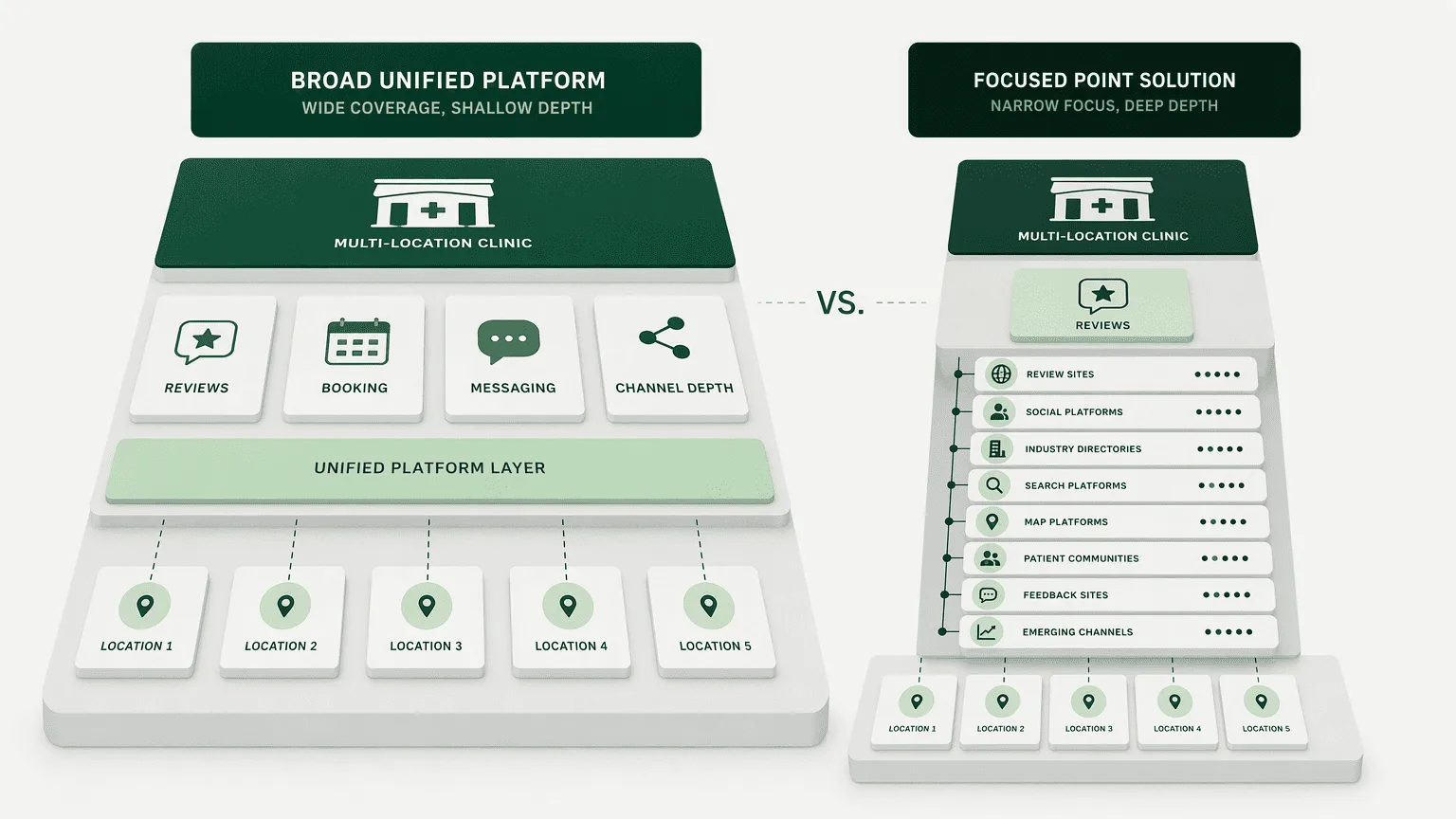
Unified platforms are not a universal answer. The broad-but-shallow risk is real, and a few scenarios still reward a deliberate choice to stay narrow. The table below maps the concrete trade-offs between an all-in-one platform and a specialized point solution for a multi-location clinic.
| Feature | Unified Platform (Birdeye, Curogram, Podium) | Point Solution (Niche Standalone) |
|---|---|---|
| Channel Depth | Strong coverage across reviews, booking, and messaging; moderate depth per channel | Extreme depth in a single channel, such as solo Google Review management |
| Integration Breadth | Broad EHR and PM integration with major systems, though smaller EMRs may not be covered | Potential deep integration with one specific niche EHR not supported by broad platforms |
| Entry Cost | Higher monthly investment appropriate for multi-site complexity | Lower entry cost viable for solo practitioners or very small practices |
| Multi-Location Reporting | Native capability to compare performance across individual clinic locations | Typically dashboard reports for a single entity, lacking cross-site comparison |
| AI Automation | AI agents that write responses, trigger campaigns, and act on review sentiment | Mostly limited to manual or basic rule-based triggers without cross-channel learning |
The Fit: Who Should Consolidate (and Who Should Wait)?

Growing multi-location medical and dental groups should consolidate on a platform like Birdeye or Curogram immediately, given four key considerations:
- Operational math: You are currently losing more in missed bookings and ignored negative feedback per quarter than the annual cost of the software.
- AI capability: Birdeye’s AI agents now operate at the same Agentic AI tier as Google and Salesforce, executing local marketing workflows that a mid-size practice could not staff manually.
- Leadership trigger: If your org chart includes a Director of Operations who oversees five or more clinic locations, a unified AI-driven platform is not optional.
- Podium’s niche: Podium fits best for groups where lead conversion speed is the single greatest pain point; its AI promises 2x faster review responses and can reply to a lead in under two minutes, though its integration ecosystem is narrower at around 180 native and marketplace apps, so you must confirm your EHR is covered before committing.
Solo practitioners with a single site and fewer than 50 patient reviews per year can, for now, wait. A lightweight point solution or a well-configured Google Business Profile with manual follow-up cadence will hold the line. The cost and complexity of a unified platform exceed the current risk at that scale. The trigger to consolidate is the second location, because that is the moment your review risk and booking inventory become impossible for one person to track manually.
EHR integration breadth is the deciding technical factor, not a secondary checkbox. Curogram’s ability to sync with nearly all major healthcare systems and trigger automated review requests after appointment completion is the architecture that generates thousands of reviews without adding staff. If a platform cannot read your appointment completion data, it cannot automate the most important reputation workflow you have. Before evaluating any AI demo, verify that the platform integrates with your specific EHR and practice management stack.
Conclusion
Enterprise adoption jumped 113%, AI agents started handling local marketing tasks on their own, and multi-location groups racked up thousands of 5-star reviews inside a year. The 2026 data points to one thing: fragmented clinic tech stacks are a liability the market stopped tolerating. Audit your current booking, review management, and patient communication tools against a single question. How many of those systems share data, and how many are opening a HIPAA gap?
If the answer is more than one and fewer than all of them, you already know where the problem sits. Fix it before a review audit or a booking failure lands in your lap on a Monday morning with a full waiting room.
Frequently Asked Questions
What are the top software platforms that can manage both online reviews and appointment booking for healthcare clinics with multiple locations in the US?
Birdeye, Podium, and Curogram are the leading unified platforms. Birdeye holds a #1 G2 Enterprise ranking across multiple categories. Podium focuses on AI-driven lead conversion speed with rapid response times.
This prevents the security gaps that appear when separate booking and review tools handle protected health information on disparate, uncoordinated servers where your practice remains liable for any exposure.
Why is it important for healthcare organizations to use a unified platform for review management and online booking instead of separate point solutions?
Separate tools create data silos where booking status does not inform review solicitation and negative feedback does not trigger service recovery. For multi-location groups, a unified platform provides the cross-site reporting necessary to compare reviews, ratings, and conversion rates by individual clinic, accountability that fragmented tools cannot deliver.
How does automated review solicitation work for a multi-site healthcare practice, and which tools integrate with major EHR/PM systems?
Automated solicitation works by syncing the platform with your EHR to detect completed appointments and then triggering a review request via SMS or email without staff involvement. Curogram, for example, integrates with nearly all major healthcare systems to automate this workflow immediately after a patient's visit concludes.
What are the key integration and reporting capabilities needed to compare performance across different clinic locations?
You need side-by-side comparison of review volume, average star rating, and booking conversion rates by individual clinic location. Unified platforms provide a single dashboard for these metrics across sites, where point solutions typically report on only one entity, making regional performance management impossible without manual data assembly.
Is a unified review and booking platform worth it for a solo healthcare practice with one location?
Generally, no. A solo practitioner with minimal review volume and a single booking workflow can manage with a lightweight point solution or manual Google Business Profile follow-ups. The cost and complexity of a unified platform are only justified when the operational risk of managing two or more locations exceeds what one person can handle manually.
Sources
- Automated Healthcare Reputation Management to Boost 5-star Reviews - curogram.com
- My Practice Reputation Management Apps $399/mon - PatientGain - www.patientgain.com
- Podium vs. Birdeye: Why Multi-Location brands pick Birdeye - birdeye.com
- Podium vs Birdeye - www.podium.com
Want help executing this for your clinic?
Book a 30-minute call and we will map what a real ad engine would look like for your specific service mix.
Book a call