
Stop Losing New Patients to Practices With Better Online
Summary: To stop losing new patients to competitors with better online visibility, focus on optimizing your Google Business Profile, generating recent and positive reviews, and tracking the revenue impact of your online presence. Completing your profile, maintaining review velocity, and ensuring HIPAA compliance in review requests are crucial steps to improve search rankings and recover lost revenue opportunities.
Introduction
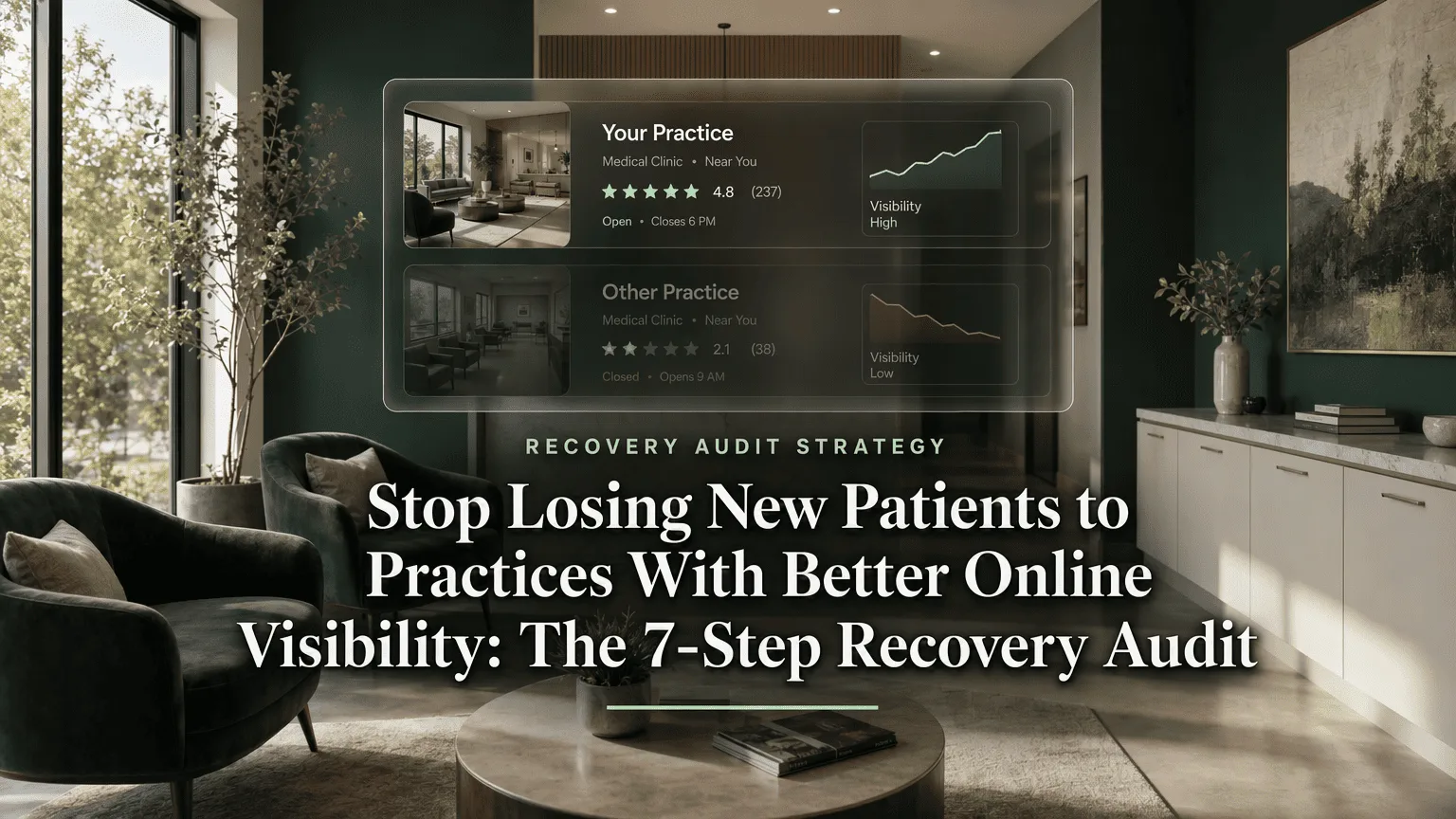
Your practice is invisible at the exact moment a patient decides who to trust. That moment happens when a prospective patient opens Google, types in a symptom or specialty, and stares at a 3-pack of local results that does not include you. The problem is not your clinical care. The problem is that 75% of patients check online reviews first, and if your reputation looks thin or your profile looks incomplete, they click on a competitor. You hemorrhage revenue before your front desk ever hears a phone ring.
For a single-provider practice, that silence translates into a measurable $3,000 to $8,000 per month in missed new-patient revenue. You will quantify that number yourself in the first step. The patient journey has shifted irreversibly from referral pads to local search bars. Nearly half of patients start their doctor search on Google, not with a friend's recommendation. Those first few seconds of visibility determine whether your schedule fills.
You cannot outspend the hospital systems on ads, but you can outmaneuver them in local search. This step-by-step guide gives you a repeatable, high-ROI framework to close the visibility gap, steal back the patients quietly choosing a competitor, and finally tie those new appointment calls to the exact online action that drove them.
Key Takeaways
Stop competing on intuition and close the exact ranking gaps that are costing you new patients. Here is the distilled visibility roadmap:
- Google Business Profile is the highest-use action: Businesses with complete and accurate information are more likely to show up in local search results, making full profile completion the single fastest way to appear in the Local 3-pack where patients click first.
- Review velocity matters more than you think: Review recency, velocity, sentiment, and reply speed all influence your rankings now, and they rose faster than almost any factor group in Whitespark's 2026 data. A stale profile reads like a closed practice.
- You must quantify the revenue you are bleeding: If you cannot attach a dollar figure to the patients you never booked, every marketing decision becomes an opinion. A gap analysis converts lost calls into a tangible cost of inaction.
- HIPAA compliance governs your review system: A workflow that integrates consent-driven review requests into the clinical day solves the reputation problem without creating a compliance liability.
- Attribution closes the loop: If you cannot trace a new patient call back to a specific Google post, service page, or review, you cannot scale what works. A dynamic call tracking number turns visibility spend into a provable revenue line.
Step 1: Calculate Your Revenue Leakage from Online Invisibility

You are losing concrete revenue to quiet online erosion, and you can measure it. Do not start with a subjective complaint that you 'never show up.' Start with a hard number.
Take your city's monthly search volume for your top procedure, say, 'knee replacement specialist Dallas.' Assume a conservatively small portion of those searchers need a provider now. The gap you need to close is the delta between your current click-through rate (often near 0% if you sit below position three) and the standard Local Pack click-through rate of a top-three listing.
The math is uncomfortable but necessary. Multiply those missed monthly clicks by an industry-standard new-patient conversion rate, then multiply that number by a realistic patient lifetime value. A single missed surgical patient can represent $8,000 to $15,000 in lifetime revenue, and a recurring primary-care patient is worth a stable four-figure annuity. For a practice bleeding 10 to 15 new-patient opportunities a month to a more visible competitor, the annualized revenue leakage sits well into six figures. Ignoring your Google Business Profile becomes one of the largest silent costs on your P&L.
This calculation turns 'we need better marketing' from a vague wish into a budgeted recovery plan. Write that number on a sticky note. It justifies every step that follows.
Step 2: Master Your Google Business Profile for Local Pack Dominance
Your Google Business Profile is a free local search advertisement that most practices treat like a neglected billboard. There's no way to request or pay for a better local ranking on Google. You cannot bid your way into the 3-pack. You earn it by signaling to Google that yours is the most relevant, trusted, and active option for the specific procedure a patient just typed into a search bar. To optimize it surgically:
- Select the right primary category: The wrong primary category costs more profiles their ranking than any other single setting. A multi-specialty clinic that selects the generic 'Doctor' category loses the surgical-intent searches that a focused 'Orthopedic Surgeon' profile captures. Go into your GBP dashboard now and verify that your primary category matches the single most billable procedure you want patients to find you for.
- Complete remaining fields with precision: Populate a full services menu with procedure-specific descriptions, not clinical codes. Upload high-resolution geotagged photos of the exam room. Seed your Q&A with five questions a real patient types, like 'Do you accept Aetna PPO for arthroscopic repair?,' and answer them verbatim with location-specific phrasing.
- Post a weekly Google Update: Not a generic health tip. A real practice update, 'Dr. Chen completed his 200th Mako-assisted knee procedure this morning', with a compliant image. One client audit showed that accounts posting weekly generated 34% more calls directly from the profile. This signals Google that your practice is alive, and it feeds the local search algorithm the freshness signal it craves.
Step 3: Build a HIPAA-Compliant Review Generation System Integrated into the Clinical Day
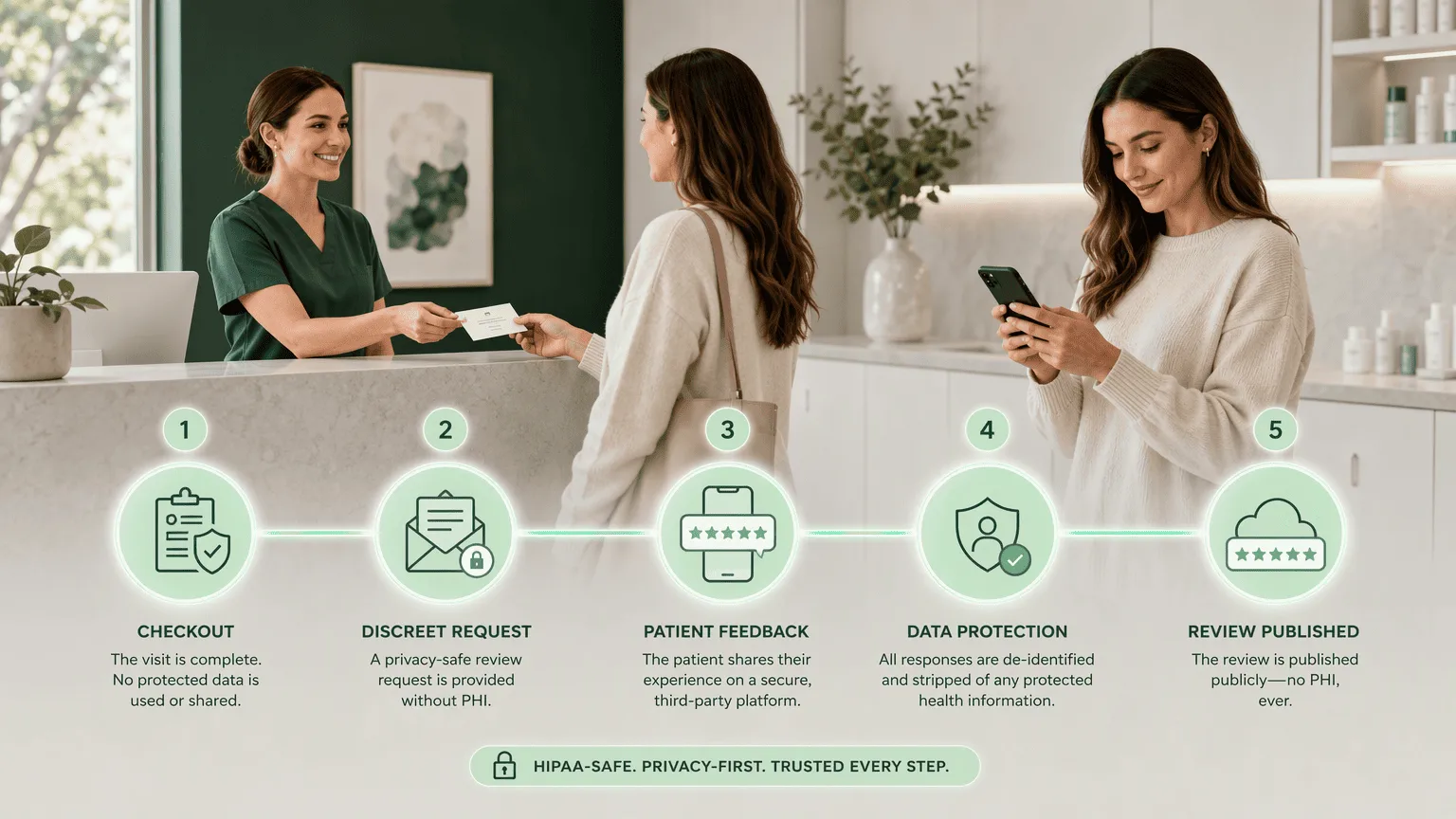
You need a machine that generates a steady stream of recent, text-rich reviews without ever typing a patient's protected health information into a public forum. The system must fit into the clinical day, run on a simple script your staff can execute without fail, and kill the anxiety of a privacy violation. Here is the workflow:
- Identify the review-ready patient moment: At checkout, after a successful outcome or a resolved billing issue, the front desk identifies a patient who expresses verbal satisfaction. This is not a blanket push to every patient; it is a high-trust selection.
- Hand the patient a neutral, non-medical link card: Do not email a link with a protected subject line. Hand the patient a business card printed with a QR code that routes to your Google review prompt. The ask at the desk: 'We are a small independent practice, and if your experience was good today, that review helps us stay open for patients like you.'
- Pre-empt negative feedback in the room, not online: Train providers to close an encounter with a verbal off-ramp: 'Before you leave, was there anything that did not meet your expectations today?' A patient who vents to you privately will not nuke your star rating later. Give them a recovery resolution inside the clinical space, and only then route them to the review card.
- Reply to every review within 48 hours: The reply is not 'Thanks for the 5 stars.' It is a HIPAA-deleted thank you that references a generic detail. 'We appreciate that you mentioned our team made you feel comfortable during a procedure.' Review recency, velocity, sentiment, and reply speed all influence your rankings now, and a replied-to review serves Google both a velocity and an engagement signal.
- Never incentivize with a gift card or discount: Google's review integrity check now asks Maps users whether a practice rewarded them, and a yes can vaporize that review and scrub your profile history. Do not endanger your GBP for a $5 coffee card.
Step 4: Transform Your Website into a Patient-Acquisition Engine
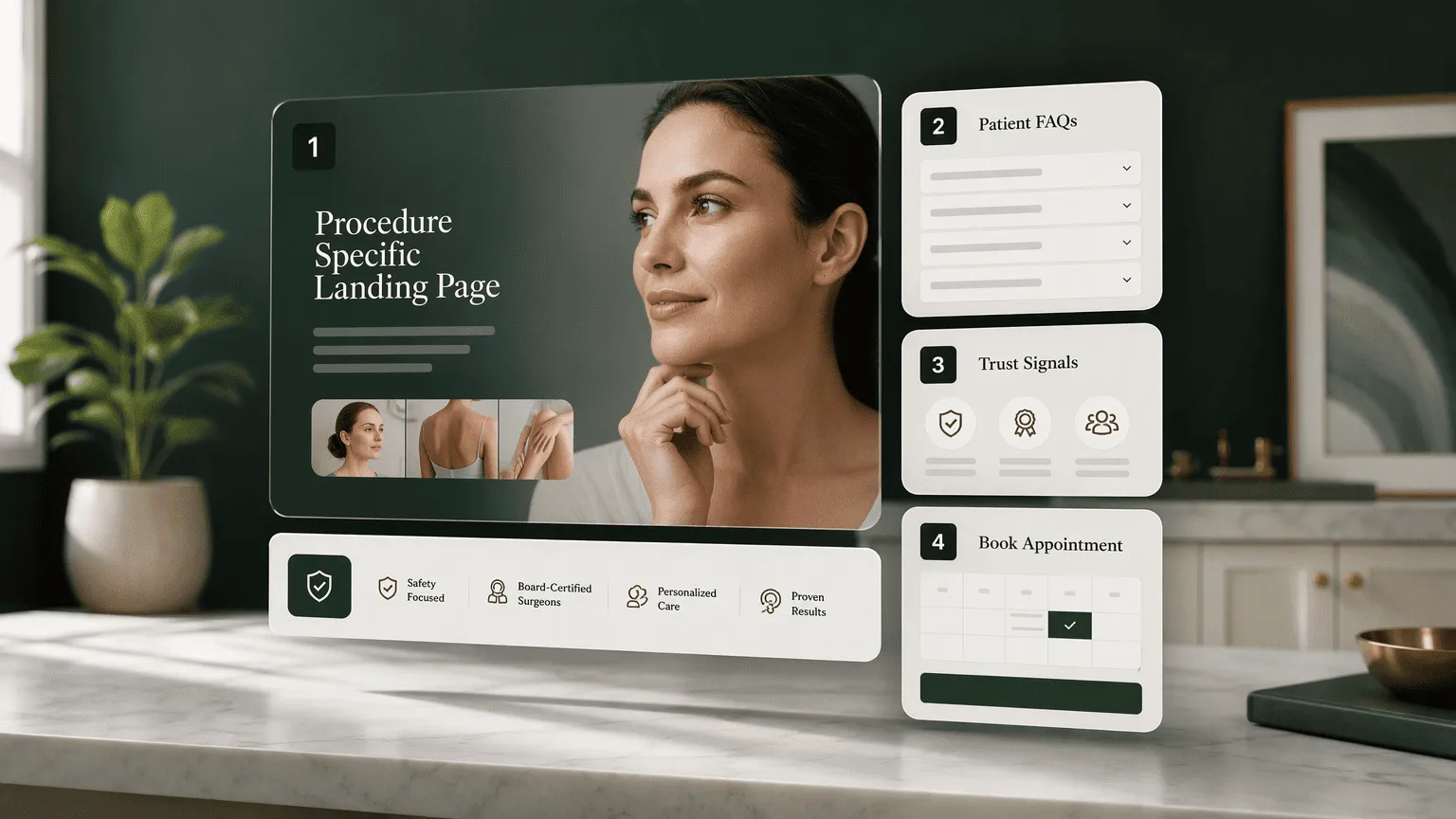
A static brochure website listing your medical school credentials and office hours does not convert. A patient-acquisition engine does. The shift starts with service-specific landing pages built around what the patient typed, not what you studied. To build a conversion-optimized site:
- Create service-specific landing pages: The patient searches 'shoulder replacement recovery time near me.' The page they land on must open with a direct statement about the procedure, a patient-specific FAQ, and a single call-to-action: 'Book a 15-minute consultation with Dr. Park.' Do not force them to click through a generic 'Services' dropdown.
- Add trust signals to every page: Google applies its strictest trust signals to health content under the YMYL standards, and your pages must reflect credible, attributed medical information with visible provider bios. Add embedded, compliant third-party reviews and trust badges on these pages; 94% of prospective patients choose their healthcare provider based on reputation, and a landing page without visible social proof is a conversion leak.
- Optimize for mobile speed: Mobile devices account for approximately 64% of all website traffic, and aim for a load time under two seconds. A three-second delay on a booking page kills your conversion rate by half. Audit your site on a 4G throttle and strip out the auto-play video and the bloated slider. Every extra second of delay is a patient who clicked back to your competitor's fast page and booked with them.
Step 5: Construct a 'Displacement Audit' to Outrank a Specific Competitor in the Local Pack
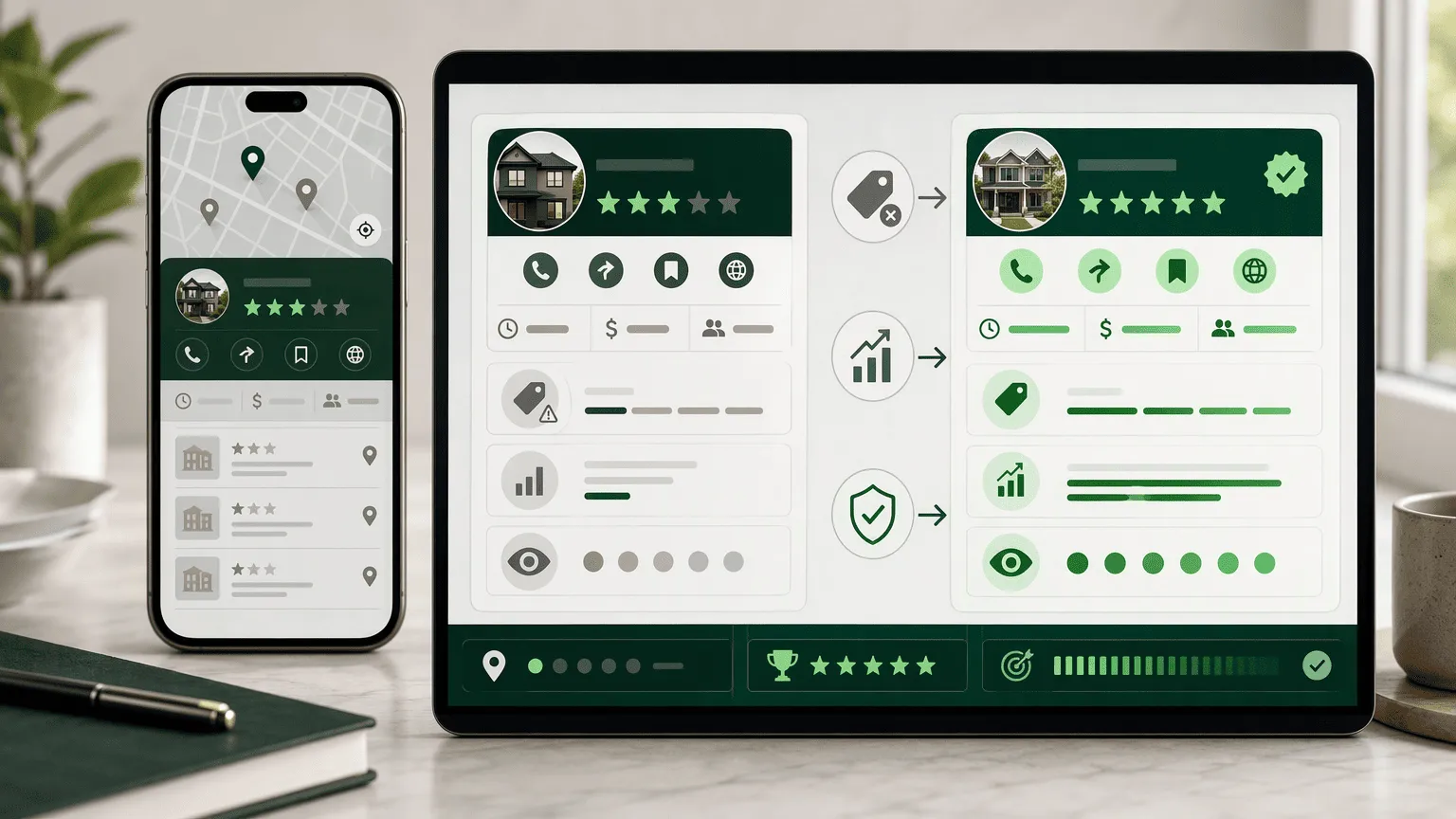
Stop obsessing over 'best dentist in Austin' as a generic ranking goal. Pick the one competitor that sits right above you in the Local Pack and reverse-engineer exactly why Google trusts them more. Conduct a displacement audit:
- Check the primary category mismatch: Open both profiles side by side. If you are a 'Dental Clinic' and they are a 'Cosmetic Dentist,' and the query was 'veneers near me,' Google's relevance engine gave them the edge. You now change your primary category immediately, or you concede that query.
- Quantify the review gap: A competitor with a 4.8-star average and 47 text-rich reviews in the last 90 days will beat a dormant 4.2-star profile every time. Your gap list becomes a monthly scoreboard: set a 30-day sprint to close a 15-review deficit without violating HIPAA, then watch your position in the 3-pack on Maps shift within two to three weeks.
- Audit citation depth: The competitor likely appears on dozens of healthcare directories where you appear on a handful. Your gap-closing list becomes a clean spreadsheet: match their presence on the directories that carry the most domain authority, starting with Healthgrades and Vitals.
- Build backlinks: The competitor's site may have a profile on a local chamber of commerce site or a charitable event recap giving them a domain-authority edge. You close this by replicating it, sponsor a community health fair, speak at a rotary club that gets a.edu or.org recap, and build two new high-trust backlinks this quarter. The goal is surgical: you outrank that one rival and then repeat on the next.
Step 6: Extend Your Visibility Through Strategic Citations, Content, and AI Readiness
Local search is fracturing beyond the Google 3-pack. Patients now find doctors through voice assistants, ChatGPT queries, and AI-generated overviews that scrape your online footprint. A clean citation footprint and content optimized for AI answers has become a visibility multiplier for practices competing against hospital system budgets. The table below contrasts the levers you control in traditional search versus the assets that win in the AI-driven discovery layer.
| Visibility Channel | Traditional Local SEO Asset | AI & Voice Discovery Asset |
|---|---|---|
| Business Identity | Consistent NAP (Name, Address, Phone) on 25+ healthcare directories. | Structured data markup on your site so an LLM can parse your location and operating hours without error. |
| Content Strategy | Procedure-focused landing pages ('Knee Replacement in Plano'). | Condition-focused pages written in question-answer format ('When can I drive after a total hip replacement?') that get pulled into Google AI Overviews. |
| Reputation | Google Review Quantity & Score. | Star rating embedded in JSON-LD Schema so it renders as a rich result in a voice search answer ('The top-rated endodontist is...'). |
| Primary Goal | Appear in the Google Maps 3-pack for local queries. | Become the citable source block in an AI-generated medical provider comparison or voice assistant answer. |
Build these signals now. Submit your structured NAP to the top aggregation partners and claim your profile on every directory that populates. For AI readiness, create a 'question library' page for each core procedure, using the exact language a patient speaks into their phone. The practice that answers 'Is it normal to have swelling five days after a root canal?' on a dedicated Q&A page is the practice an AI overview will cite as the authoritative source.
Step 7: Attribute New Patient Calls to the Exact Online Action That Drove Them
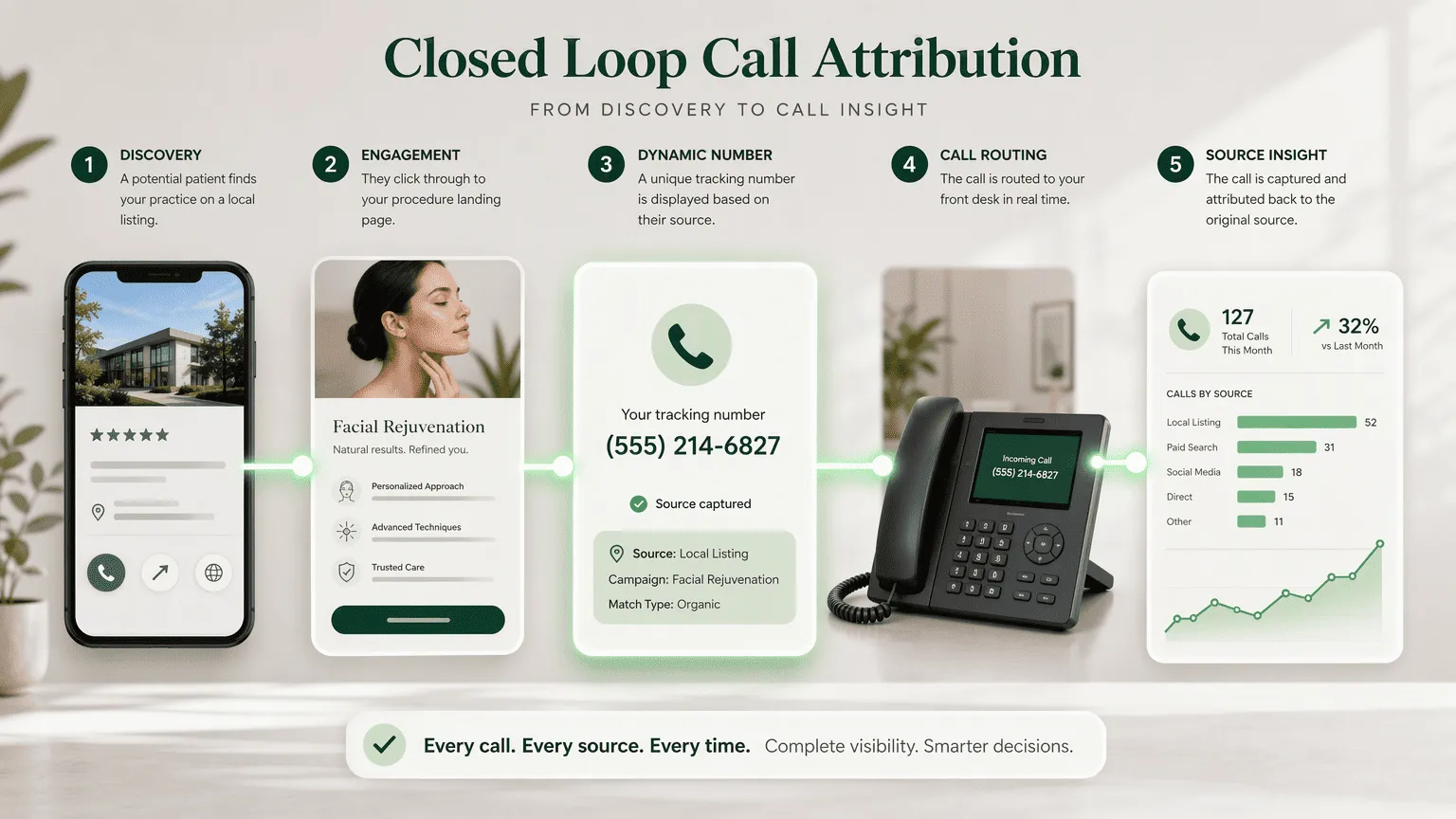
If you cannot prove the phone call came from your Local Pack listing, you cannot prove the visibility investment did anything at all. Build a closed attribution loop:
- Deploy dynamic call tracking: Use a dynamic call tracking number on your Google Business Profile and on every procedure-specific landing page. This swaps your office line for a unique, trackable number that forwards to your front desk and records the call source. In your monthly report, you now see: a seven-call spike on Thursday morning from the profile, directly after you posted a weekly Google Update about a new provider joining.
- Add UTM parameters to every link: Pair the dynamic number with UTM parameters on every digital link, your booking button on GBP carries a
?utm<em>source=gbp&utm</em>medium=organicstring, so Google Analytics or your practice management dashboard shows the exact patient journey from discovery to appointment request. - Script front-desk intake: Script your front desk to close the loop manually on calls that bypass tracking. The moment the intake team takes a new patient call, they ask one scripted question: 'We like to thank the place that sent you, what did you search so that we found you today?' Log that answer in a CRM field and map it back to the campaign that cost you the money. This attribution loop lets you stop paying for visibility that merely feels productive and start doubling down on the GBP post, the 5-star review, or the AI-optimized Q&A page that actually schedules a case.
Conclusion
The practices taking your patients are not better surgeons, better dentists, or better diagnosticians. They are simply easier to find at the moment a patient chooses.
You have the formula to reverse that. Calculate the revenue you are bleeding silently, dominate the 3-pack with a verified, optimized, and posting-active Google Business Profile, build a machine for compliant review generation, and attribute every single new patient call back to its digital source.
This is the new operational baseline for independent practice survival. The patient has already shifted their search behavior; it is your turn to shift your visibility.
Frequently Asked Questions
What are the concrete steps a US dental or medical practice can take to improve its Google Business Profile ranking in 2026?
Verify your location, select the most specific primary category, fill out every service field with plain-English procedure names, and seed your Q&A with patient-intent questions. Post a practice-specific update weekly, not generic health tips. Reply to every review within 48 hours. Profile completeness, category accuracy, and a consistent posting cadence are the highest-use ranking actions available to you in 2026.
How do modern patients actually find and choose a new healthcare provider online today, and what factors matter most to them?
Nearly half of patients start their doctor search on Google, scanning the Local Map Pack or provider directories. They filter by star rating, review recency, and how personally a practice responds to feedback. A verified profile with authentic, detailed patient reviews and clear procedure photos typically wins the click over proximity alone. Reputation transparency has replaced the referral as the top acquisition channel.
What specific components of a practice's website and online reputation make it more visible in local search results than a competitor?
Google's YMYL algorithm weighs visible trust signals heavily: embedded third-party reviews, detailed provider bios, accurate NAP citations, and service-specific landing pages written for patient searches, not clinical jargon. A mobile-speed-optimized site that loads in under two seconds with question-answer content libraries also signals relevance and authority. Consistent directory presence across Healthgrades, Vitals, and WebMD closes the citation gap.
What is the difference in cost and patient conversion rate between paid search ads, SEO, and referral-based online services for US practices?
Paid search ads offer immediate top-of-page placement but carry a variable cost per click; SEO requires four to six months to compound authority but delivers zero per-click cost once ranked. The conversion rate comparison is more nuanced: a top local organic listing often bests a paid ad for patient trust at a 2 to 3x ROI over a 12-month window. You use paid for speed to fill a schedule now, and SEO to own the market long-term.
How can a medical or dental practice measure whether its online visibility is actually translating into fewer lost new patient calls?
Deploy dynamic call tracking numbers on your Google Business Profile and landing pages. This technology swaps your listed number for a trackable line, so you can attribute every inbound call to a specific GBP post, organic result, or review mention. Pair this with a standard intake script asking 'What did you search to find us today?' This closes the attribution loop between your marketing action and your booked appointment.
Sources
- How Dentists Can Rank in Google's Map Pack with Local SEO - getclinads.com
- Tips to improve your local ranking on Google - Google Business Profile Help - support.google.com
- Top Local SEO Ranking Factors For Healthcare Practices In 2026 Revealed - direction.com
- Local SEO for Healthcare: Strategies to Rank – DexCare - dexcare.com
Want help executing this for your clinic?
Book a 30-minute call and we will map what a real ad engine would look like for your specific service mix.
Book a call