
8 Best Tools for Auditing a Medical Practice’s Online
Summary: To effectively audit a medical practice's online presence, utilize tools like Clinads for compliance and patient attribution, Tebra for reputation and listing management, Google Search Console and Google Business Profile for foundational insights, Screaming Frog for technical SEO, WAVE for accessibility compliance, and Birdeye for review aggregation and sentiment analysis. These tools help ensure legal compliance, enhance digital reputation, and improve patient acquisition.

Introduction
Your practice website is quietly leaking Protected Health Information through a misfiring tracking pixel, and your last 12 patient reviews on Google are all from disgruntled pharmacy callers who never actually saw a doctor. The problem is not that you have an online presence. The problem is that no one has audited it through a lens that pairs strict legal exposure with commercial reality.
Running a Screaming Frog crawl without checking if URL parameters expose patient data is a half-measure. The federal government is picking 50 covered entities to review, and patient acquisition is now completely tethered to digital reputation: 77% of patients read online reviews before choosing a doctor. This list bridges the gap, ranking the platforms, scanners, and official protocols that measure both your visibility and your liability.
Key Takeaways
The tool ecosystem splits three ways, and you need coverage from every column. Here is the shape of the audit stack before we break it down:
- Compliance-first auditing: Clinads maps the patient journey for PHI leaks and consent gaps, while the HHS SRA Tool aligns your server config directly against the Security Rule.
- Reputation and listing nerve centers: Platforms like Tebra and Birdeye centralize review velocity monitoring and directory accuracy checks, turning patient sentiment into a trackable metric.
- Standalone technical scanners: Screaming Frog and WAVE catch the YMYL content gaps and accessibility violations that broad platforms skip, but they carry zero compliance weight on their own.
1. Clinads: Audit-Grade Compliance and Patient-Attribution Platform
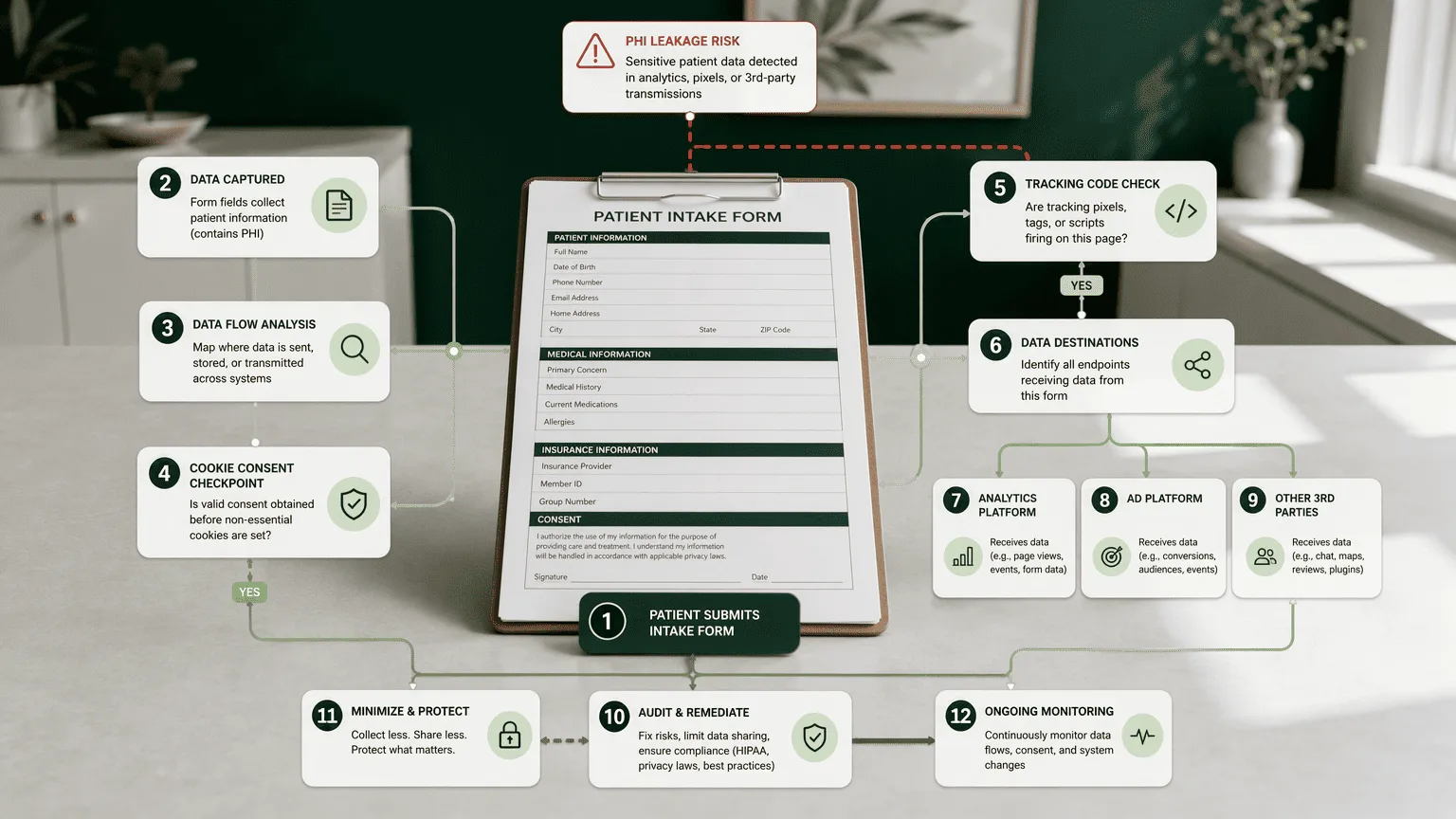
Auditing the online patient journey for both PHI leakage and marketing conversion logic is the gap most tools leave wide open. Clinads is built to close it. Here is where the platform earns its rank:
- HIPAA-specific marketing audits: Rather than scanning for generic privacy policy text, the platform inspects tracking codes, cookie consent configurations, and form-handling paths to flag where patient data might bleed into ad platforms or analytics suites.
- Attribution mapping, not just traffic counting: You see which campaign touchpoints actually produce booked, kept appointments, giving you a commercial truth source alongside the compliance scan.
- Consent gap detection: It identifies where retargeting pixels fire on appointment-confirmation pages or where dynamic number insertion pools are not properly segmented, creating exposure you cannot afford during the 2024 to 2025 OCR audits, where 50 covered entities are under review for Security Rule provisions tied to hacking and ransomware.
2. Tebra: Unified Reputation and Practice Growth Suite
Tebra functions as the operational nerve center for practices whose primary audit gap is patient experience and listing accuracy, not deep crawl optimization.
What makes Tebra dangerous to ignore is the integrated PatientPop listings engine. Name, Address, and Phone (NAP) inconsistencies across Healthgrades, Vitals, and WebMD do not just confuse Google. They redirect your hard-won local visibility directly to a competitor whose listing data is cleaner. The platform flags discrepancies and syncs corrections, which matters when 44% of patients say a practice's website contributes to their choice of provider.
The trade-off: you are buying ease of use at the expense of deep technical SEO control.
Tebra will not show you how Googlebot renders your YMYL resource pages or whether your schema markup passes E-E-A-T thresholds. It is a reputation and listings heavyweight with a lightweight site analyzer bolted on. For practices running fewer than 10 providers, that trade-off is often worth the centralized dashboard. For multi-location groups needing crawl depth, you will need to pair it with a standalone crawler.
3. Google Search Console + Google Business Profile: The Free Foundational Duo

The page is ranking at position 9 with a 1.2% click-through rate, so immediate action is needed in two critical areas.
- Rewrite title tag and meta description: Target them to patient search intent to improve click-through rates.
- Audit your Google Business Profile: Focus on review velocity and check the Q&A section for spam.
With 77% of patients reading reviews before choosing a doctor, a profile showing three stale reviews and an unanswered question from six months ago is actively repelling new patient acquisition.
This duo is your non-negotiable measurement layer. If the data here is dirty, every premium tool you pay for is optimizing against noise instead of signal.
4. Screaming Frog SEO Spider: Deep Technical SEO for the Regulated Niche
A single Screaming Frog crawl can expose critical issues that matter more in healthcare than in e-commerce.
- Staging page leak: Detect forgotten staging pages still housing a Facebook pixel or a PDF lab result accidentally left indexable.
- Redirect and link audit: Map every internal redirect chain and flag broken links on resource pages.
- Trust signal support: Addressing broken resource links supports E-E-A-T signals, as Google's quality rater guidelines treat these as trust indicators for medical content.
This data directly supports E-E-A-T signals that a thorough platform like Tebra cannot touch. A 301 chain from an old service line URL to the current one passes no authority and confuses Google's understanding of your entity. Screaming Frog surfaces that in minutes. If your content audit later reveals that your physician biography pages carry no structured data markup, you already know the next fix without waiting for a monthly platform report.
5. WAVE Web Accessibility Evaluation Tool: Automated WCAG 2.2 Scanning
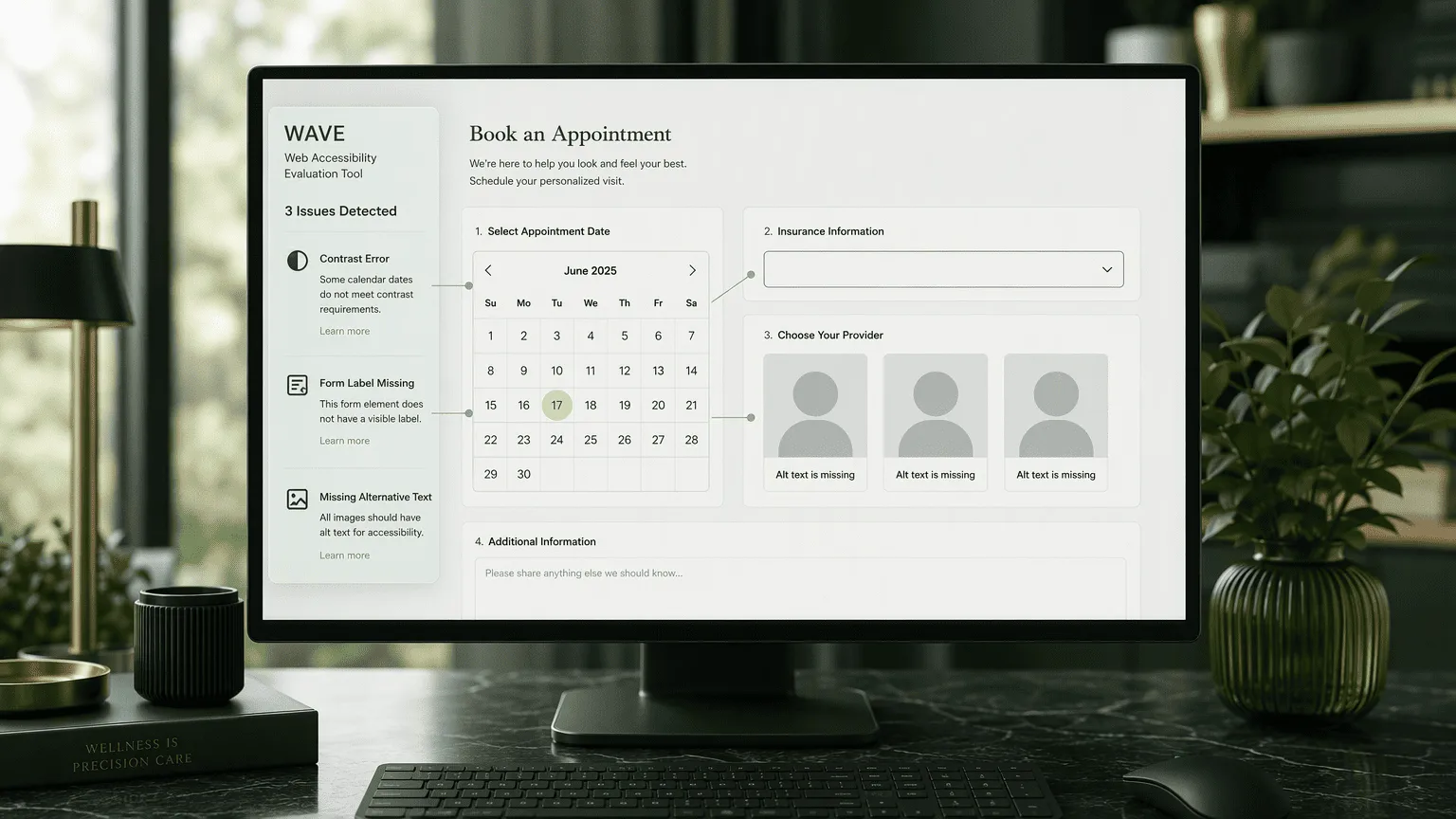
Accessibility is not a design preference in 2026. It is the legal baseline, and WAVE is the fastest automated scanner for catching the structural errors that trigger demand letters and OCR complaints.
The scan is brutal and immediate.
Run your appointment-booking page through WAVE and the tool will surface contrast errors on the calendar picker, missing form labels on the insurance type dropdown, and empty alt attributes on every physician headshot on the 'Our Team' page. Each flagged error is a barrier a screen reader cannot navigate, and each one carries legal weight under WCAG 2.2's expanded rules for focus indicators and accessible authentication. The scanner does not replace a full manual audit conducted by a visually impaired tester, and it will miss nuanced failures in dynamic content panels.
What WAVE does is reveal the lowest-hanging, highest-liability errors in under 30 seconds. Start here, fix the scan output, and document the remediation. That documentation itself becomes an asset if a federal audit ever reaches your practice's digital front door.
6. Birdeye: AI-Powered Review Aggregation and Sentiment Analysis
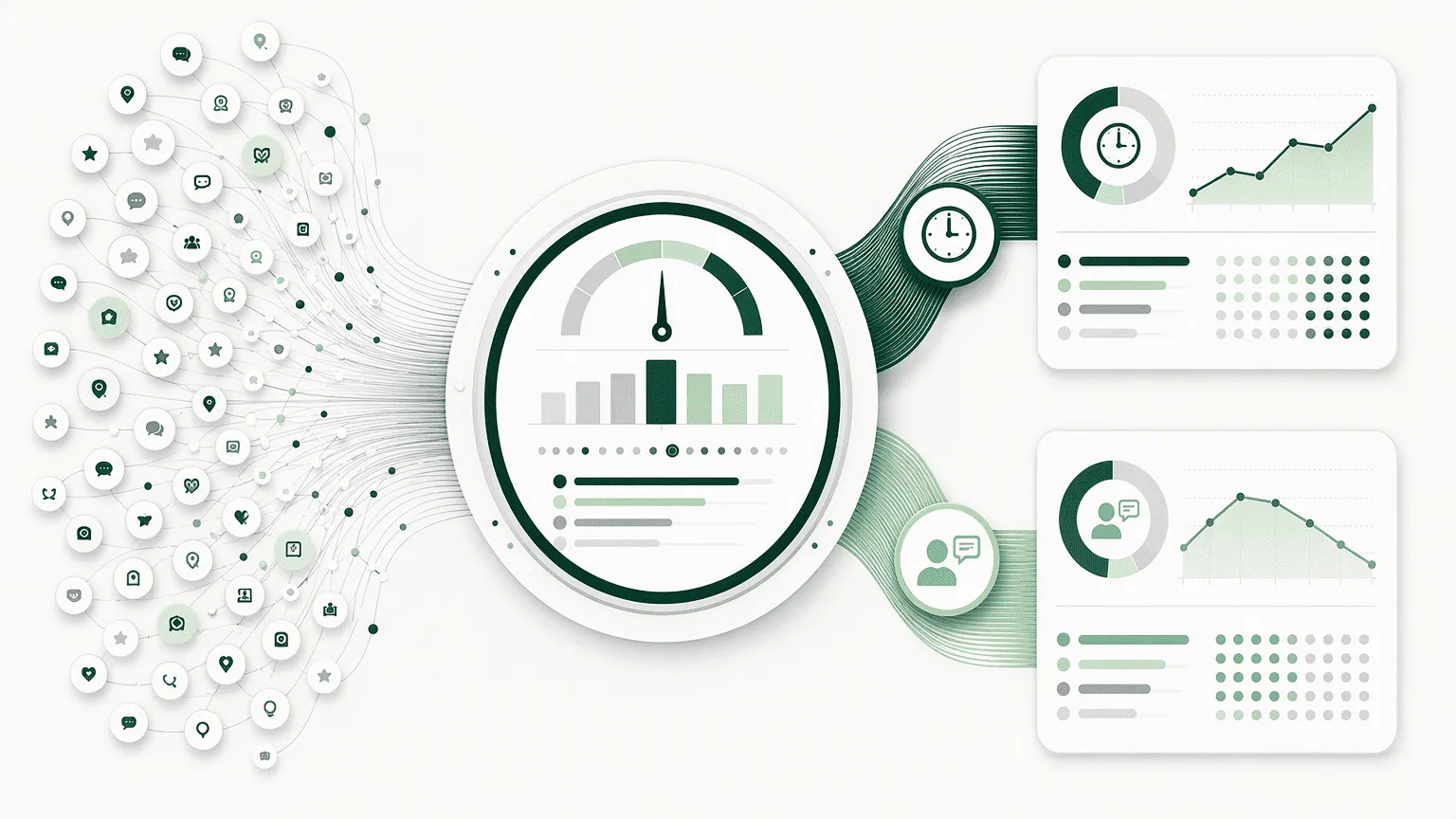
Birdeye moves the audit beyond a simple count of star ratings and into the patterns that actually drive patient decision-making.
The platform's AI benchmarks your practice's sentiment score against local competitors and surfaces the specific friction points patients describe, mainly clinical wait times and front-desk communication breakdowns.
| Audit Dimension | Birdeye | Tebra (with PatientPop) |
|---|---|---|
| Review aggregation breadth | 200+ sites including niche industry directories | Major healthcare directories and general platforms |
| Sentiment analysis depth | AI-driven topic clustering and trend detection | Aggregate rating display and response tracking |
| Review generation workflow | Automated, multi-channel request triggers | Integrated post-appointment requests |
| Competitor benchmarking | Direct sentiment and volume comparison | Listing and NAP consistency comparison |
This is where the audit shifts from 'we have a 4.2-star rating' to 'our wait-time complaint trend is 30% higher than the regional benchmark across the last 90 days.' You cannot fix what you cannot measure, and Birdeye's aggregation engine finds patterns across a review volume that would take a human auditor weeks to manually read and classify.
7. HHS OCR Audit Protocol + Security Risk Assessment Tool (SRA Tool): The Direct Compliance Yardstick
Every commercial platform on this list is an interpretation of regulations. The HHS OCR Audit Protocol is the regulation itself, and the SRA Tool is the government's own calculator for your risk exposure.
Map your website's contact forms, third-party tracking codes, and server configurations directly to the OCR protocol's Security Rule provisions. The current audit cycle is focused on ransomware preparedness and unauthorized access vectors, a targeted review of 50 covered entities. If your intake form data routes through a non-BAA-covered analytics instance, the audit protocol flags it as a technical vulnerability with financial penalty exposure.
The SRA Tool is not a subscription dashboard. It is government-issued spreadsheet logic that evaluates exactly how well your digital infrastructure protects electronic Protected Health Information. Run it, fix the gaps it identifies, and produce documentation that proves you conducted a formal risk assessment.
8. PatientPop by Tebra: Competitor Listings and Directory Accuracy Audit
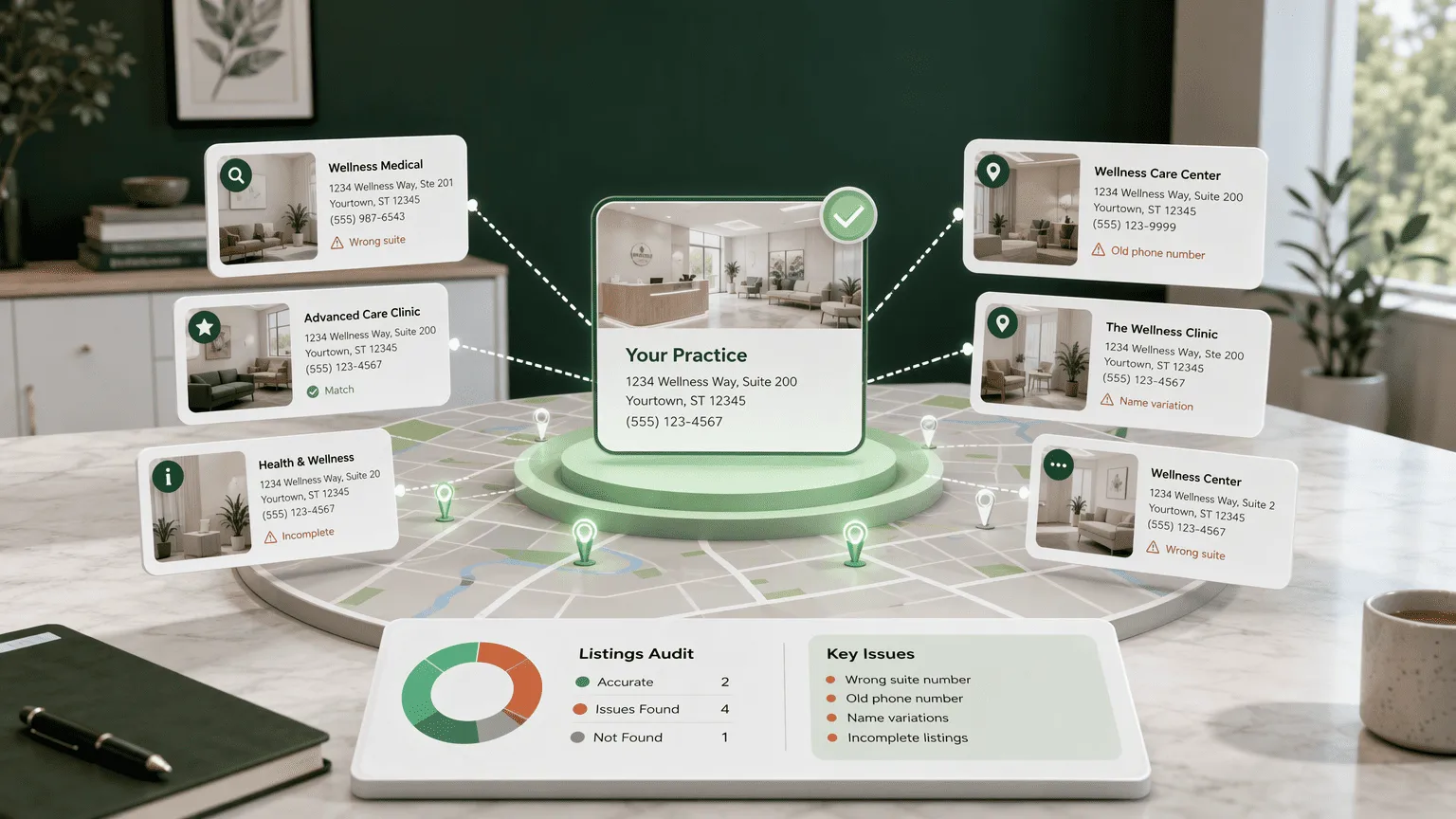
PatientPop's dedicated listing tool is designed to stop competitor practices from intercepting your local traffic through cleaner directory data. Here is the specific audit lens it applies:
- NAP consistency enforcement: Scans every third-party directory for mismatched suite numbers, old phone lines, and practice name variations, flagging the exact listings eroding Google's confidence in your entity.
- Competitor discoverability tracking: Benchmarks how often nearby practices surface in directory search results for your target procedures, quantifying exactly how much local visibility you are losing.
- Review profile parity checks: Identifies whether your competitor holds a 4.5-star average on a specialized directory while your profile sits unclaimed and unreviewed, giving you a prioritized remediation queue.
- Automated correction propagation: Pushes verified listing updates to the network of directories where inaccuracies were detected, closing the audit loop without requiring manual login to 40 separate platforms.
Conclusion
The audit stack that protects your practice in 2026 layers defense and offense without apology. Run the HHS SRA Tool against your server configuration to anchor the compliance layer, deploy Clinads to catch the attribution-level PHI and consent failures that generic scans miss, and pair Tebra or Birdeye to control the reputation signal that feeds 77% of your prospective patients. A Screaming Frog crawl and a WAVE scan complete the technical foundation. The problem is not that you lack data. The problem is that until you run this full diagnostic, you cannot distinguish between a marketing metric and a legal exposure.
Frequently Asked Questions
What are the key components of a medical practice's online presence that require auditing?
Each layer carries both a patient-acquisition risk and a legal liability that commercial platforms or standalone scanners address in isolation.
Which specific tools are best for auditing the technical SEO and website performance of a healthcare practice?
Google Search Console provides the zero-cost query and indexing baseline. Screaming Frog SEO Spider performs deep crawls for broken links, redirect chains, and orphaned medical pages. Together they surface the YMYL content and indexability gaps that broad practice management platforms typically skip.
How can a medical practice audit and manage its online reputation, including reviews and listings, across the web?
Platforms like Tebra centralize review monitoring and fix NAP inconsistencies across healthcare directories. Birdeye adds an AI sentiment analysis layer that benchmarks your practice against competitors across 200+ review sites. Both convert reputation tracking from a reactive task into a measurable, scheduled audit component.
The HHS SRA Tool maps your website configuration directly to the HIPAA Security Rule. Clinads audits marketing-specific PHI leakage, such as misfiring pixels on confirmation pages. WAVE scans for WCAG 2.2 accessibility failures like missing form labels and low-contrast text that trigger ADA complaints.
How do thorough healthcare marketing platforms compare to standalone audit tools for a complete audit?
Thorough platforms like Tebra offer user-friendly dashboards for reputation, listings, and basic site health but lack deep technical crawling or dedicated compliance scanning. Standalone tools like Screaming Frog (technical SEO) and WAVE (accessibility) deliver granular depth. You need both layers for a complete audit.
What is the step-by-step process for conducting a full online presence audit for a US medical practice in 2026?
Start with the HHS SRA Tool to document security risk. Run Clinads to catch PHI exposure in marketing scripts. Audit GBP and Search Console for visibility gaps. Crawl the site with Screaming Frog, scan accessibility with WAVE, and then benchmark reputation consistency and sentiment through Tebra or Birdeye.
Sources
- OCR's HIPAA Audit Program | HHS.gov - www.hhs.gov
- Medical practice growth checklist for 2026 - The Intake - Tebra - www.tebra.com
Want help executing this for your clinic?
Book a 30-minute call and we will map what a real ad engine would look like for your specific service mix.
Book a call