
How To Improve Your Medical Practice's Local Search Rankings
Summary: To improve your medical practice's local search rankings, focus on optimizing your Google Business Profile with accurate information and regular updates, ensure consistent citations across major healthcare directories, and enhance your website's on-page SEO elements. Additionally, create location-specific health content to build topical authority and engage with patient reviews without violating HIPAA regulations.
Introduction
Most independent practices are losing local patients to health systems that outspend them 10:1 on search ads, but paying an agency $3,000 a month to fix your organic visibility is not the only countermove. 88% of healthcare queries now trigger an AI Overview or a local pack, according to BrightEdge 2024 research. The clinic that looks most like the neighborhood expert wins. This guide strips the work down to eight steps you can execute yourself, starting with the one asset that controls the 3-pack: your Google Business Profile.
Key Takeaways
You do not need an agency to own the local map pack. The advantage belongs to the doctor who authenticates their profile, builds location proof, and publishes content an AI snapshot can cite:
- Google Business Profile is the control center: Your verified, category-correct GBP with weekly photo posts and a direct booking link directly feeds the local 3-pack that 88% of healthcare queries show.
- Review velocity cannot violate HIPAA: Use a neutral card handed out at checkout that links to your GBP with no incentive; 31% of consumers will not consider a business under 4.5 stars.
- Citation consistency beats volume: Manually verify your NAP on Vitals, Healthgrades, Zocdoc, and WebMD; a single mismatch confuses Google's local algorithm more than a missing directory.
- Three on-page signals carry the map pack: Your homepage title tag (
[City] [Specialty]), the H1, and a validated LocalBusiness + Physician schema in JSON-LD tell Google exactly where and what you are. - A monthly location-specific health post builds E-E-A-T cheaply: A 400-to-600-word post anchored to a local condition creates the topical depth an AI snapshot needs and no generic blog service can replicate.
Step 1: Master Your Google Business Profile
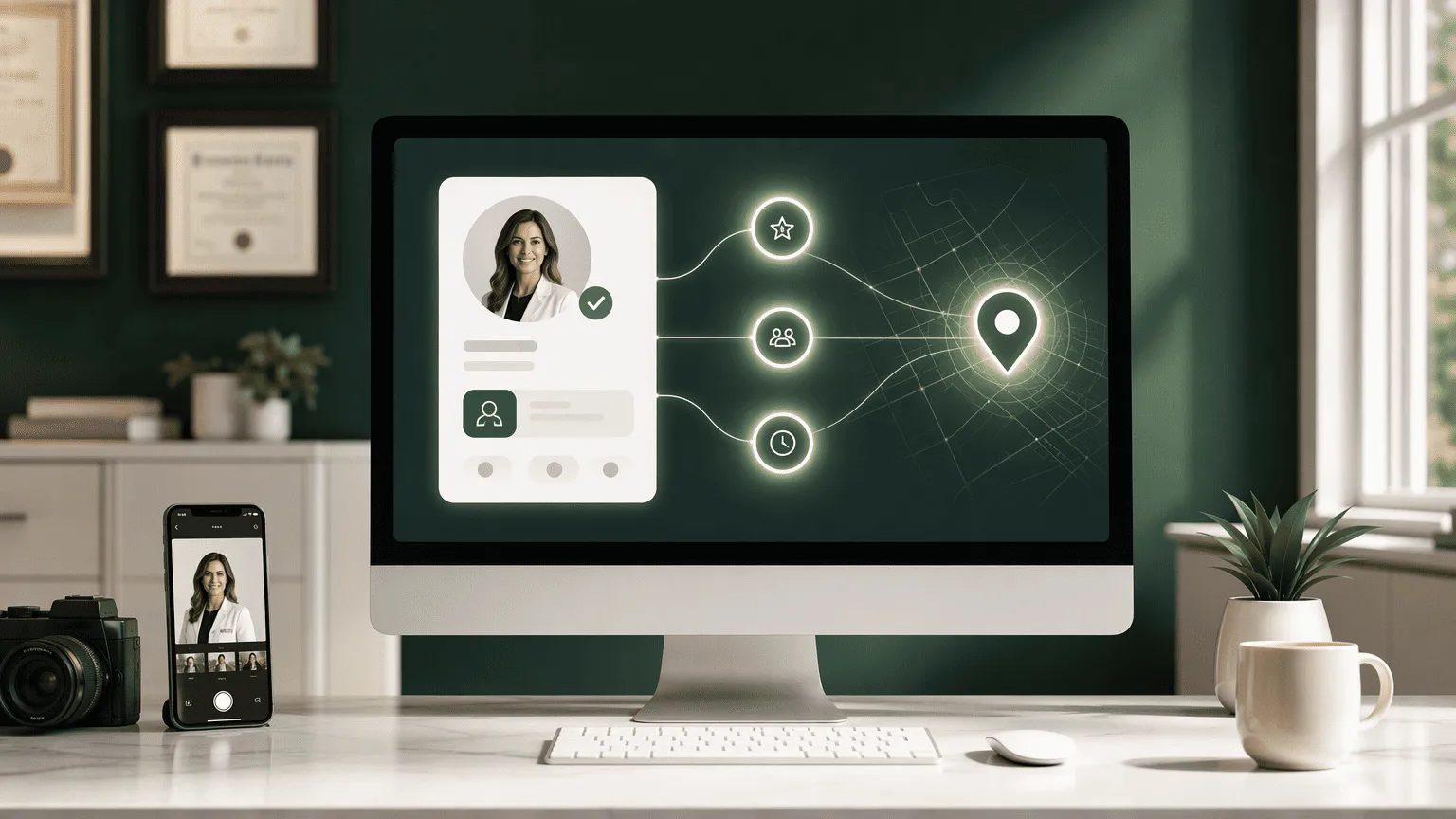
If your GBP is not verified, the category does not match your primary service, and you are not posting photos every week, you are invisible for high-intent near-me searches. Your website's quality does not change this. The local algorithm looks at profile completeness, how often someone engages with the listing, and how recently it was updated. Photos hit all three signals at once.
Pick one primary category, like 'Family physician' or 'Dermatologist,' and stop there. A secondary category will not pull the same weight in the map pack. Fill in the appointment URL field with your direct booking link so someone can schedule straight from the search result. Upload 8 to 10 photos of your actual rooms and staff. Practices with photos receive significantly more direction requests and website clicks than those without.
Google lets you run separate practitioner profiles next to the practice listing. Create one for each clinician. A solo doctor using only a practice page misses the long-tail searches for their name and specialty.
Post something new once a week. A single post with a clean photo of the doctor or a practical health tip sends a recency signal. Dental practices that actively manage their GBP, including posting weekly with images, consistently outperform competitors in the local pack.
The trade-off is simple: about fifteen minutes every Monday morning keeps you in the pack. Zero minutes guarantees a slide within 90 days.
Review volume and reply speed are local ranking and conversion factors that scare off solo practitioners because one HIPAA misstep carries a real liability. The safe method is a neutral review request card, printed on a 4-by-6 card or embedded in the after-visit summary, stating only: 'If you have feedback on your experience with us, tap the link to our Google listing.' You never condition the request on a positive outcome, you never filter who receives the card, and you never confirm that the reviewer is a patient when you reply.
Your reply is boilerplate: 'We appreciate the time you took to share your experience,' with no clinical acknowledgment.
Step 3: Build Consistent Local Citations on Healthcare Directories
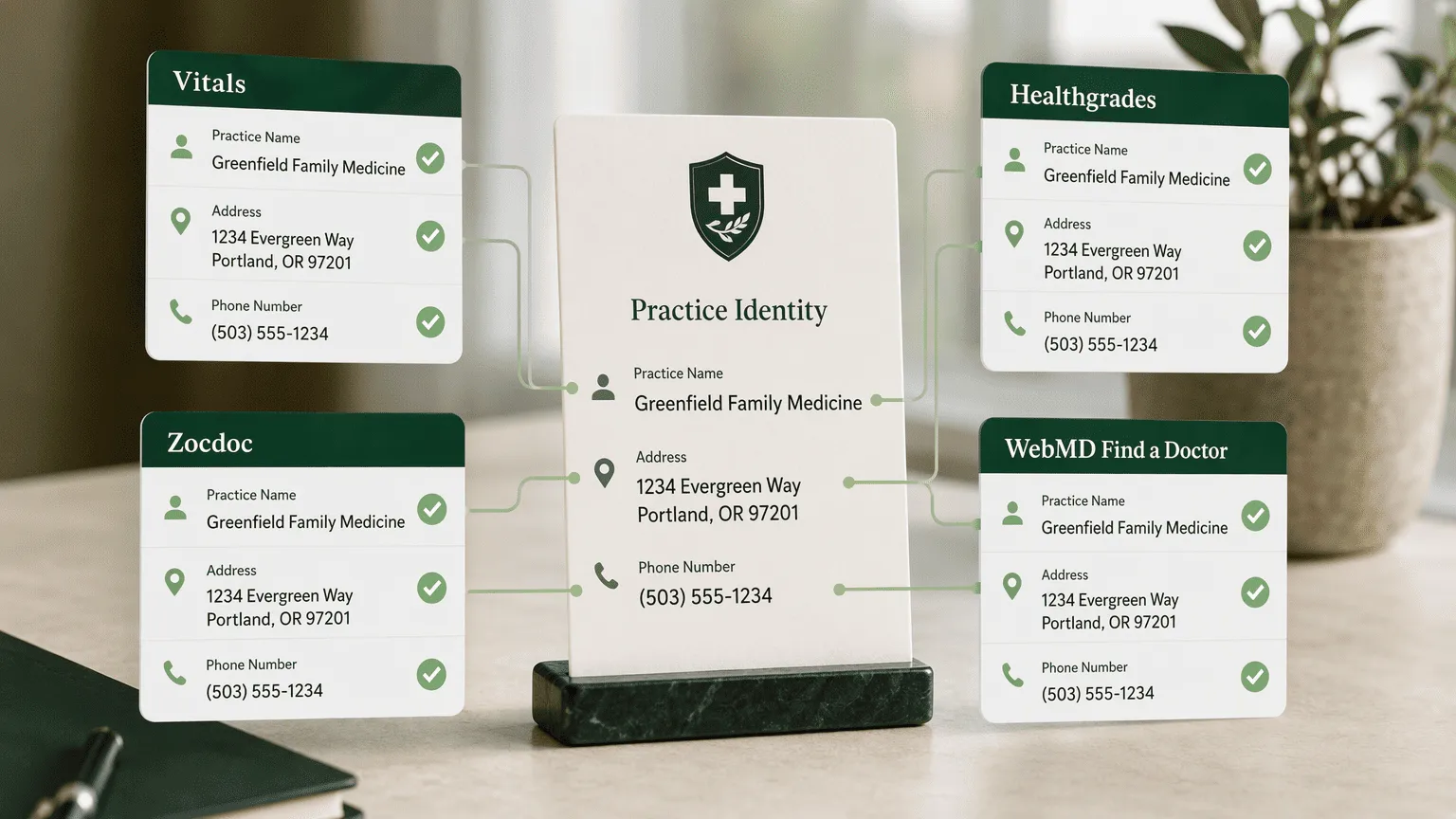
Google's local algorithm cross-references what it finds about your practice on established, industry-specific platforms. For a medical practice in the United States, four directories carry enough domain authority to shift a local pack ranking: Vitals, Healthgrades, Zocdoc, and WebMD's Find a Doctor. You do not need to submit to 50 directories; you need to ensure your practice name, physical address, and phone number are identical on these four. A practice listed as 'Elm Street Family Medicine' on Vitals and 'Elm St Family Med' on WebMD introduces a split identity that suppresses map visibility.
Run a DIY audit by searching each directory for your practice name and your NPI. When you find a variant listing, claim it or contact the directory's provider support to merge it. Use your full street suite number, not a PO Box. Service area businesses that rely on PO boxes violate Google's guidelines for map verification.
Step 4: Optimize Your Website's 'Map Pack' On-Page Elements
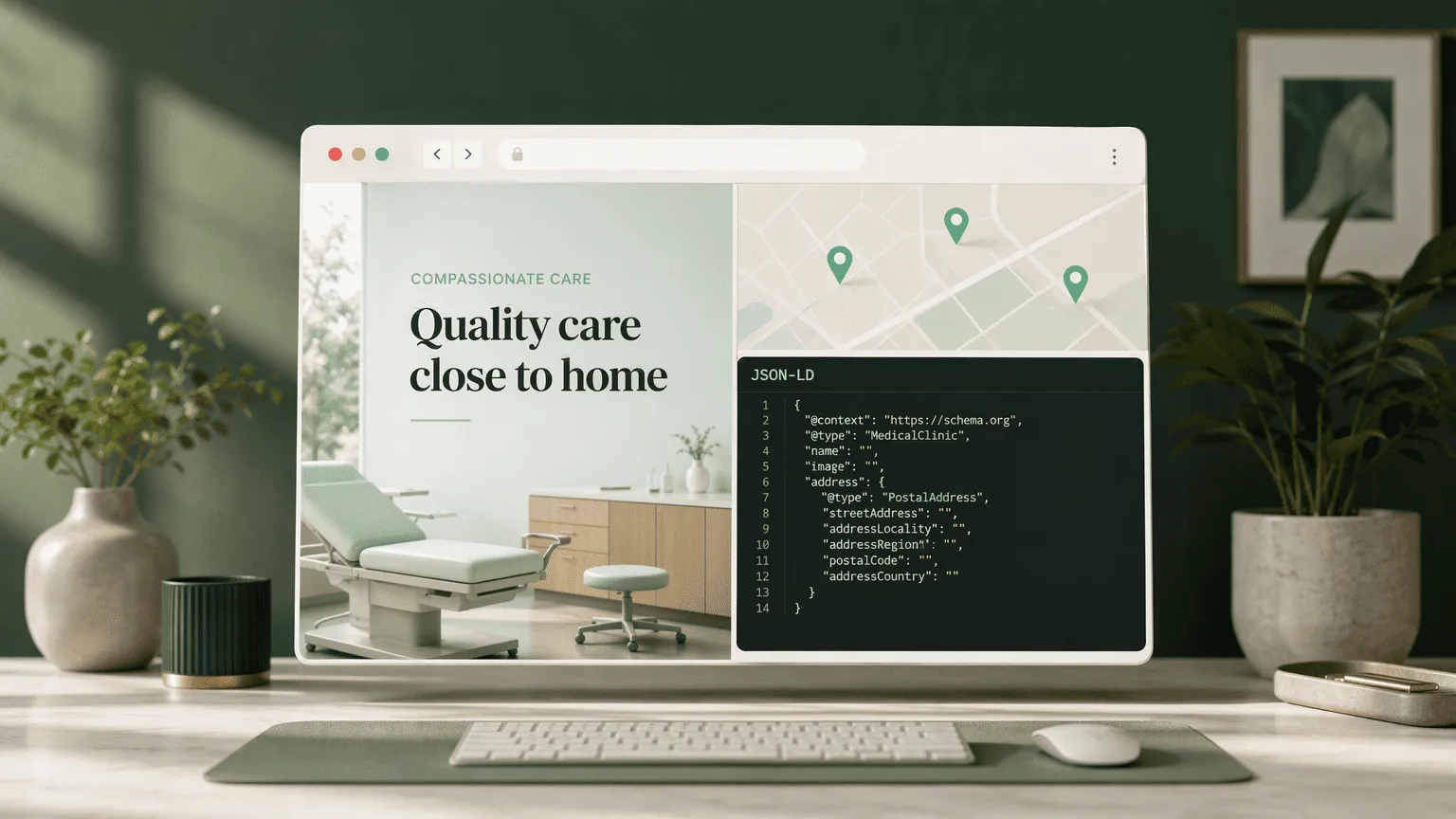
Three lines of code and one title tag change put your practice on the map. Your homepage title tag must read [Specialty] in [City], [State Abbreviation] exactly, such as 'Family Doctor in Portland, OR.' The H1 on that same page should repeat the city and specialty in plain English because Google uses the H1 as the on-page confirmation that the title tag is not lying.
The second signal is structured data. Embed LocalBusiness and Physician schema in JSON-LD format directly into your homepage's <head>. Validate it with Google's Rich Results Test before you publish.
Nearly every local business website should contain a unique page for each practitioner in a multi-practitioner model. Each clinician page gets a unique title tag with their name, the city, and the specialty. Link these pages to your GBP practitioner profiles so that a search for 'Dr. Patel, cardiologist in Austin' hits a chain of confirmed identity signals from the GBP to the website and back. The schema tells a machine what you are; the title tags and H1s tell it where.
Step 5: Create a Local Health Content Strategy That Builds E-E-A-T
Three steps produce content a Google AI Overview can excerpt and cite:
- Identify a condition with a local trigger: 'Lyme disease prevention in [County]' or 'Allergy season starting early in [City]' works because it binds clinical authority to a geography the algorithm already associates with your GBP.
- Write a 400-to-600-word post that opens with your clinical take: State the local incidence, your recommended diagnostic window, and one prevention instruction. Include your office photo and a map embed because mixed media increases dwell time.
- Link the blog post to your GBP post on the same topic: Publish a 100-word summary on your GBP with a call button visible, then hyperlink the blog post to that GBP post. This creates a closed engagement loop, a click on the GBP post signals topic relevance, and a longer page visit confirms authority.
Publish at least once monthly. The practice that posts nothing for six months reads as dormant to the local algorithm.
Step 6: Embed Local SEO into Your Patient Intake Process
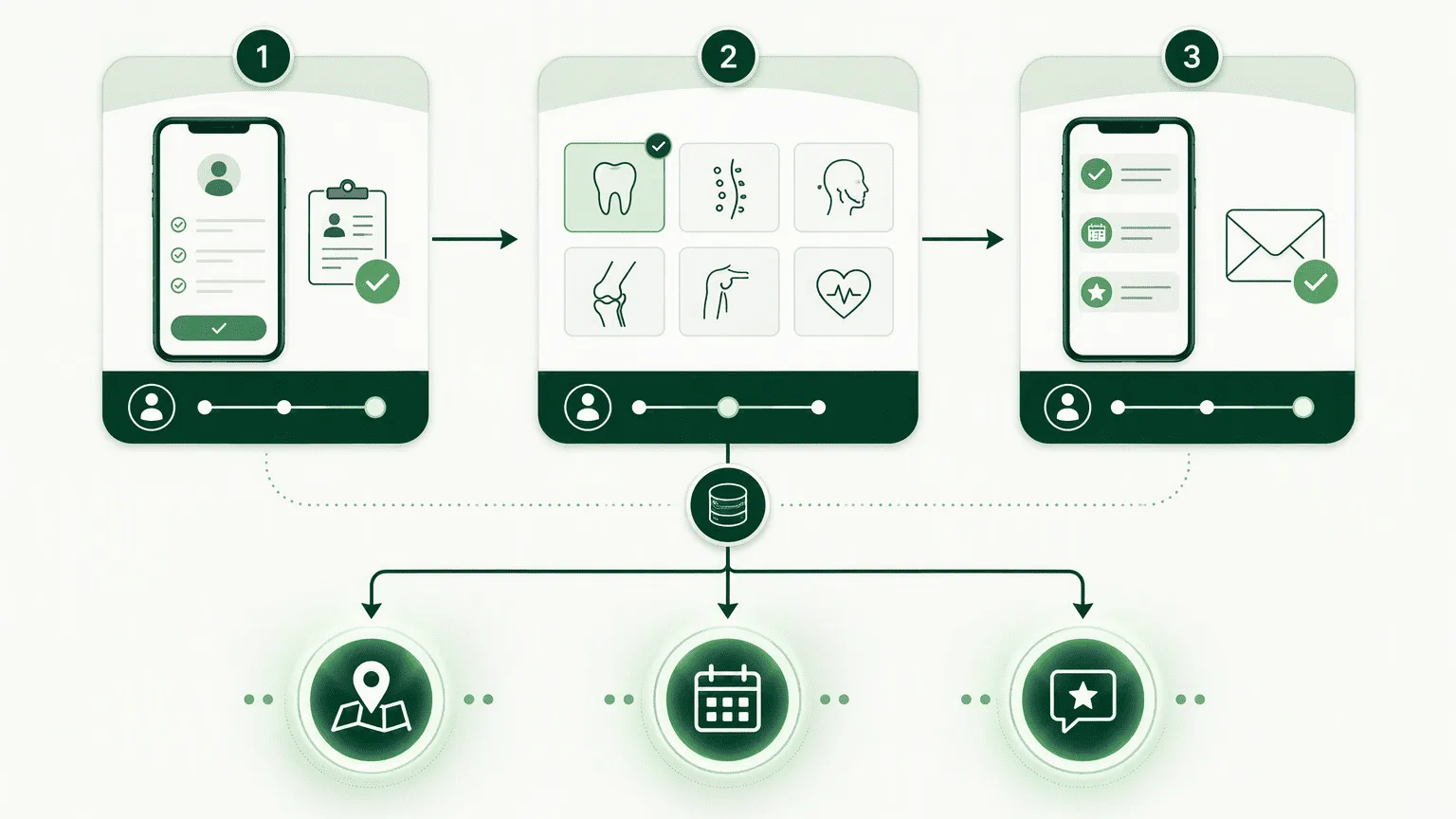
Local SEO work dies when you treat it as a marketing afterthought instead of an intake workflow, so compare the three integration points that capture operational signals feeding your GBP, content calendar, and review pipeline.
| Integration Point | Workflow Action | SEO Signal Captured | Operational Trigger |
|---|---|---|---|
| Pre-Visit Digital Check-In | Patient completes intake forms online and selects their visit reason from a drop-down menu. | Populates your content calendar with the exact service-line terms patients actually use. | Form submission automatically logs appointment type in your EMR and flags it for the marketing team. |
| Point-of-Care Mobile Verification | Front desk staff send a one-click SMS asking the patient to confirm their name and appointment time. | Validates NAP consistency (name, address, phone) for your GBP while the patient is still in the office. | Staff are prompted to send the SMS when the patient's status changes to 'checked in' in your practice management system. |
| Post-Visit Review Routing | A follow-up text thanks the patient and asks if they had a good experience; 'yes' routes them to leave a Google review. | Generates a steady stream of new Google reviews from real patients, which is the strongest local ranking signal. | The satisfaction SMS fires 90 minutes after the appointment end time logged in your scheduling software. |
Step 7: Showcase Authority with Medicare Part B Awareness
A page that answers 'Medicare doctor near me' earns organic traffic in 2026 because it matches a frequent local-intent query. List the enrollment periods, explain what Part B covers without jargon, and link to the official CMS.gov publication. Keep the sales pitch out of it. Google's quality raters flag medical content that skips factual sourcing, so a page that cites CMS documentation and plainly states whether the clinic accepts Medicare reads as credible, not as promotional filler.
Accuracy itself works as a trust cue. In Bowen v. Michigan Academy of Family Physicians, the Supreme Court held that Medicare Part B benefit determinations can be challenged in federal court. Naming the case correctly, including its year, adds editorial weight that most competitor pages ignore. When a 68-year-old searches 'does [your specialty] accept Medicare Part B near me,' your clinic becomes the one in the local pack with an answer page built on primary law.
Include one FAQ at the bottom: 'Do I need a referral with Medicare Part B?' and answer it plainly. Update the page once a year. It turns a compliance task into a local-ranking asset.
Step 8: Earn Ethical Local Backlinks

Backlinks from local publications act as trust signals, not inventory you can purchase. Google's Link Spam policy targets paid links and irrelevant link swaps. Three straightforward tactics produce real, locally relevant backlinks in a single afternoon:
- Sponsor the registration table at a local 5K or health fair: The event page will publish its sponsors, and you will ask for a hyperlink to your homepage. Keep the sponsor logo the same as your GBP photo for identity consistency.
- Join your local Chamber of Commerce: Membership includes a directory listing with a followed link. The link domain is local, aged, and editorially maintained; it is one of the few zero-risk trust signals a new practice can acquire in a month.
- Pitch a 500-word health column to a community newspaper's online section: Offer a piece tied to a seasonal local condition. A newspaper editor will place the link naturally under your byline when you are not pushing a clinic ad. That backlink reports to Google as a local editor citing a local expert on a local topic.
Conclusion
The eight steps form a closed loop. A verified, active GBP feeds review velocity. Review velocity makes directory citations more trustworthy.
Those citations lift the on-page signals and content you publish. Genuine community backlinks reinforce it all. In 2026, the clinic that wins the map pack is the one that proves it is real, locally embedded, and consistently helpful.
No agency can replicate a doctor who publishes a seasonal allergy update, responds to every review, and shows up as a sponsor on the Chamber website. Begin by claiming and verifying your GBP today. Every subsequent step depends on it.
Frequently Asked Questions
What are the most critical Google Business Profile optimizations for a medical practice in the United States?
Verify the listing with your exact practice address, lock the single correct primary healthcare category, add a direct booking URL, upload 8 to 10 real office photos, and post weekly with an image. Google's algorithm weighs completeness, recency, and engagement signals; these five actions cover all three.
Hand every patient a neutral card at checkout with a direct link to your GBP and no incentive. Never acknowledge the reviewer's patient status in your reply. A boilerplate response thanking them for the time is safe; clinical details are not.
What role do local citations and healthcare directories play in local SEO for US medical practices, and how do I build them myself?
Citations on Vitals, Healthgrades, Zocdoc, and WebMD's Find a Doctor serve as cross-referenced identity checks. Google trusts a practice more when its NAP is identical across those four platforms. A single mismatch confuses the algorithm more than a missing directory. Claim each listing manually and match your website's suite number exactly.
Which on-page elements on my practice's website most directly impact local map pack and organic rankings?
Three critical elements tell Google what you are and where:
- Homepage title tag: Uses the
[City] [Specialty]format to clearly identify location and service. - H1 heading: Reinforces the title tag's message for both users and search engines.
- Schema markup: Includes validated LocalBusiness and Physician schema in JSON-LD, which should be tested with Google's Rich Results Test before publishing.
How can I create a local content strategy that attracts patients and builds topical authority without professional help?
Publish a 400-to-600-word post monthly on a condition tied to your city or county, such as allergy spikes or tick-borne disease prevention. Include a photo, a map embed, and a link to your corresponding GBP post. The dual engagement signals (click-through and dwell time) build E-E-A-T.
What local link-building tactics are ethical and achievable for a solo medical practice owner to execute?
Sponsor the registration table at a local 5K or health fair, join your Chamber of Commerce for a directory link, and pitch a seasonal health column to a community newspaper's online section. Each yields a genuine, editorially given backlink that Google reads as a local trust vote, and none violate the Link Spam policy.
Sources
- Bowen v. Mich. Academy of Family Physicians, 476 U.S. 667 (1986) - USREPORTS-476-667 | Content Details | GovInfo - www.govinfo.gov
- Google Business Profile for Doctors: Optimize for Patients - Zocdoc - www.zocdoc.com
- Google Business Profile For Medical Practices: Photos & Optimization Guide - direction.com
- Essential Local SEO: The Importance of On-Page SEO and Local Business Listings - Moz - moz.com
Want help executing this for your clinic?
Book a 30-minute call and we will map what a real ad engine would look like for your specific service mix.
Book a call