
7 Best Marketing Software for Solo Practitioners
Summary: Solo practitioners seeking effective marketing software under $500 per month should consider integrated platforms that automate essential tasks like appointment reminders, email campaigns, and lead management. Clinads, Pabau, and Zoho One are top choices, offering comprehensive solutions without hidden costs or complex integrations, ensuring compliance and efficiency for small practices.

Introduction
Most solo practitioners pick their marketing software wrong the first time. They buy a cheap email tool here, bolt on a separate booking widget there, and six months later they are paying more in integration duct tape and per-contact fees than an all-in-one platform would have cost from day one. A 45.9% of those surveyed who don't rely on marketing automation say the biggest obstacle they face is that they can't find platforms with the capabilities they need. The reality is those capabilities exist inside integrated suites that replace five separate subscriptions with a single monthly line item well under $500.
The problem is not that the software isn't out there. The problem is most comparison lists are written for small teams, not for the solo owner who also functions as the marketing director, copywriter, and compliance officer. That person needs a platform that automates appointment reminders, sends CAN-SPAM compliant email campaigns, manages leads without a sales team, and handles consent intake, all without requiring an integration engineer or a separate HIPAA consultant. The wrong choice wastes money. The right one builds an acquisition engine that runs while you're treating patients.
This list evaluates seven platforms against the real constraints of a one-person practice: a hard $500 monthly ceiling, immediate time-to-value, and compliance handling baked into the core product. No enterprise bloat. No per-contact billing surprises. The order reflects which tool does the most of what a solo practitioner actually needs, with the fewest trade-offs.
Key Takeaways
The platforms below rank by how completely they serve a solo practitioner's marketing workflow, with compliance handling as a non-negotiable gate. You don't need a patchwork of point solutions when one suite can do the job and keep you clear of FTC penalties.
- The compliance-first alternative is Pabau, starting at $59 per month: Built specifically for healthcare, its digital consent and intake automation reduces legal exposure without requiring third-party connectors.
- The best dollar-for-dollar value for non-clinical solo owners is Zoho One at $37 per month for a single employee: It grants full access to 45+ integrated apps, covering CRM, campaigns, social, bookings, and finance for a single low fee.
- Integrated suites prevent the budget death by a thousand cuts: Stitching together separate CRM, email, and booking tools incurs hidden integration costs and fragmented per-contact pricing that pushes most point-solution stacks over the $500 ceiling.
1. Clinads: The Solo Practitioner's All-in-One Growth Command Center

It replaces the booking widget, the email platform, the CRM, and the intake form tool with one subscription that a solo owner can configure without outside help.
For a practitioner moving off a free EHR that lacks any real marketing muscle, Clinads plugs the gap between a clinical tool and a patient acquisition engine. The platform sends pre-care and post-care messages on a schedule that matches what a manual process would demand. Every appointment becomes a repeat visit driver instead of a one-off transaction. You can see how this plays out in real healthcare campaigns on the brand's clinic ad examples page.
What separates Clinads from platforms built for small teams is its refusal to charge per-contact or per-user fees that punish a growing solo practice. Every feature, from consent capture to SMS sequences, lives under one pricing model. For a practitioner staring at a $500 budget, that predictability matters more than a feature matrix that only a marketing operations hire could activate.
2. Pabau: The Healthcare-Specific Powerhouse with Built-in Compliance
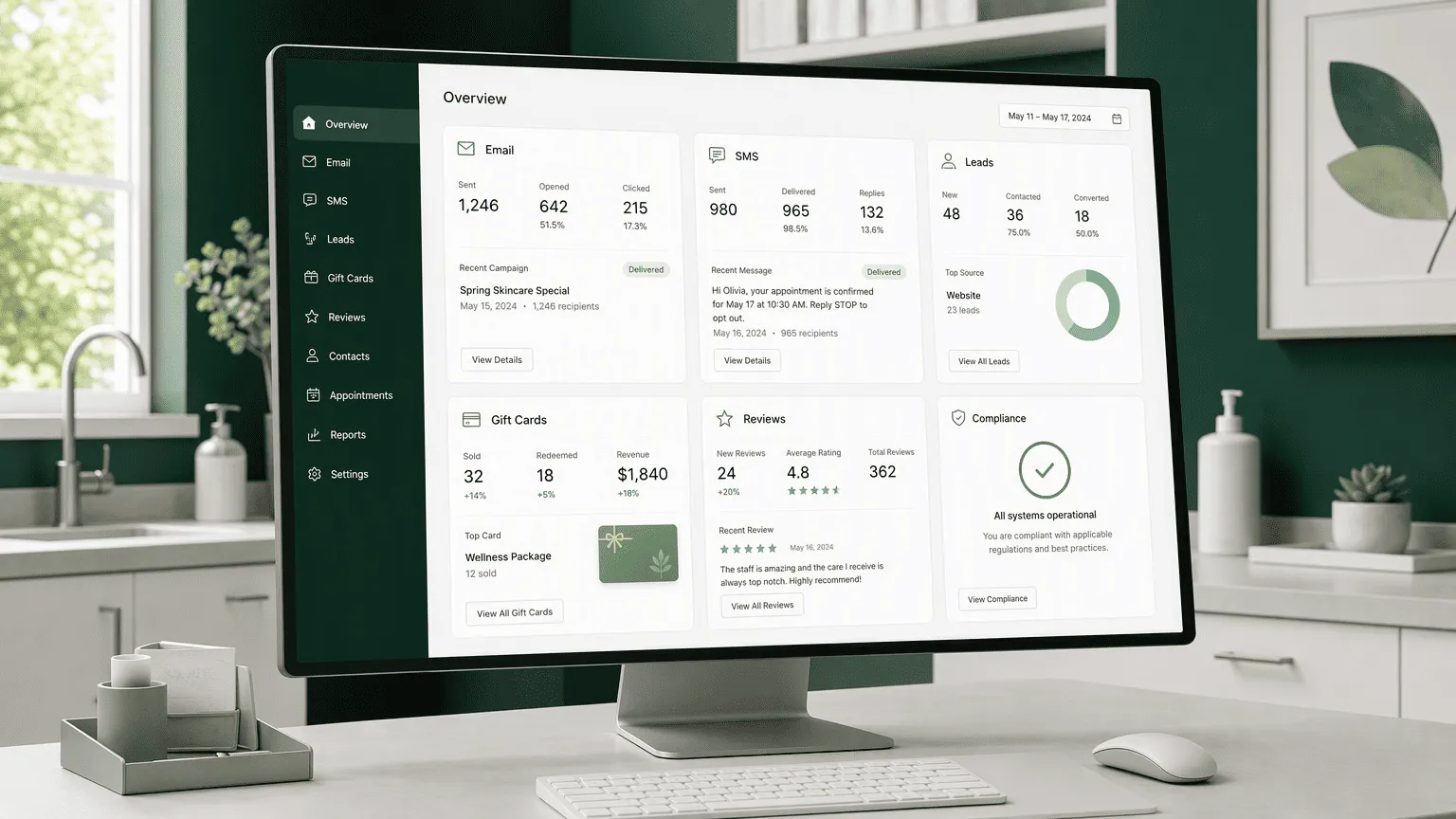
Pabau is a practice management platform with a native marketing suite that automates email, SMS, lead tracking, gift cards, and review management inside a compliance-ready clinical environment. Its pricing starts from $59 per month and scales with functionality, keeping a solo clinic well under the $500 ceiling.
A practitioner adopting Pabau removes the most common CAN-SPAM exposure: sending commercial email through platforms that don't enforce valid physical postal address insertion or timely opt-out processing. Each separate email in violation of the CAN-SPAM Act is subject to penalties of up to $53,088, and you cannot contract away that responsibility by hiring a third-party mailer. Pabau bakes the compliance guardrails into the campaign builder itself.
The platform's automated digital consent and intake forms qualify clients before they arrive, which reduces no-show rates and protects against treating a patient without proper documentation. Adding a Book Online button to a Google Business profile generates instant bookings without requiring a website, a meaningful detail for a solo practice that hasn't built a full digital storefront yet. When a single platform handles booking, consent, and marketing automation, the compliance audit trail exists in one place instead of across four logins, a point that matters when a regulator asks for documentation.
Trusted by more than 3,500 practices worldwide, Pabau includes smart email and SMS campaigns, lead management, and a review collection suite that turns post-treatment satisfaction into public social proof. The trade-off is that Pabau is a healthcare-specific system. A business coach or consultant outside a regulated clinical field will find features like digital consent forms irrelevant to their workflow and would overpay for functionality they cannot use.
3. GoHighLevel: The Ultimate Funnel and Automation Builder on a Budget
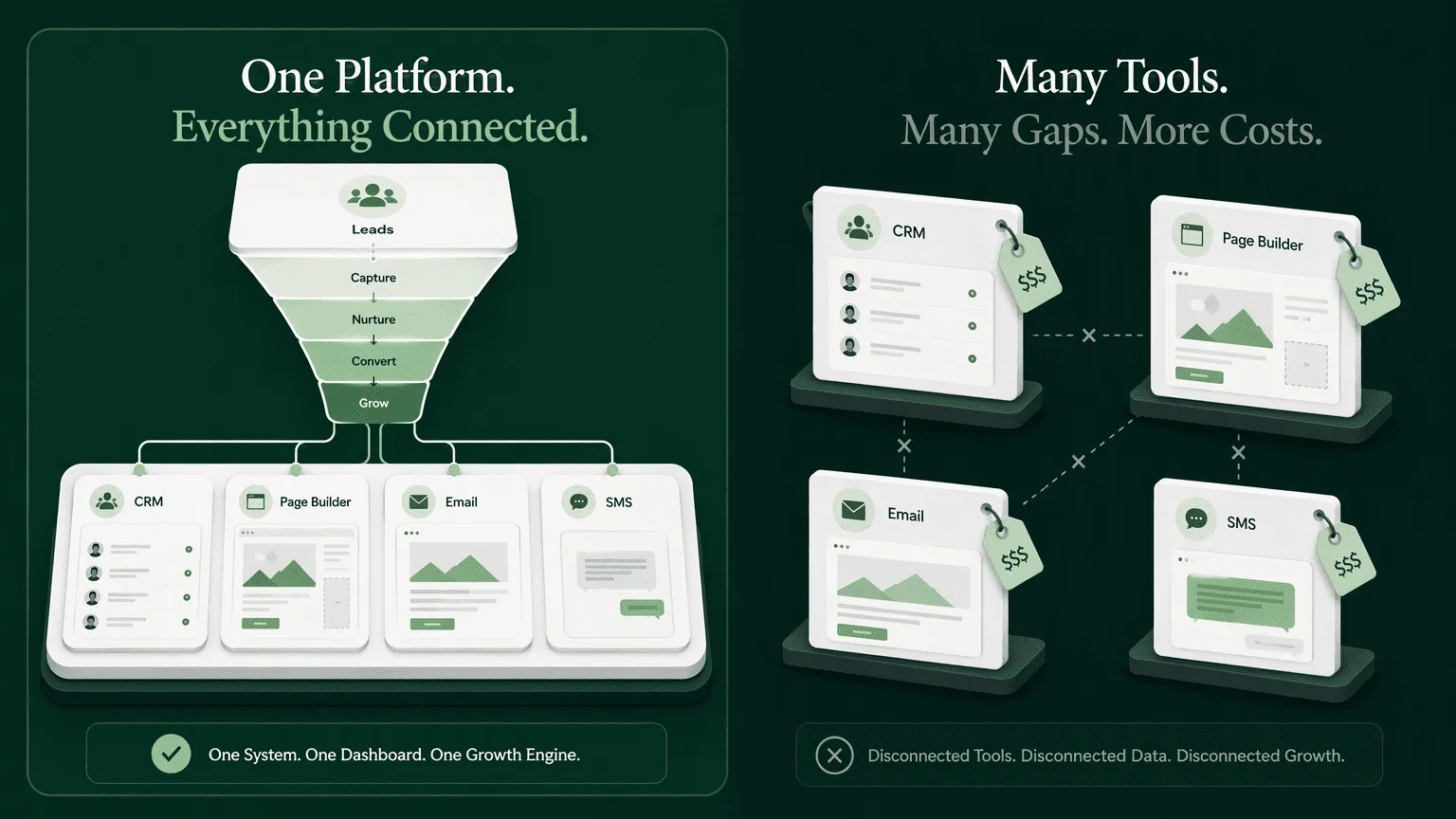
The decision between GoHighLevel and a stack of separate tools is a choice between a single funnel-centric platform and recurring fees for a CRM, page builder, email system, and SMS provider. Here is how the core dimensions compare:
| Dimension | GoHighLevel | Disparate Point-Solution Stack |
|---|---|---|
| Pricing structure | Single monthly subscription with all-in price; no per-contact billing surprise, keeps spend predictive. | Multiple monthly subs from separate vendors, each with its own per-contact or per-send pricing tier. |
| Funnel building | Native visual funnel builder eliminates need for ClickFunnels or Leadpages. | Requires separate funnel software plus domain and hosting configuration. |
| CRM and pipeline | Integrated CRM tracks leads through a pipeline you control. | Standalone CRM that must be connected to each marketing channel through APIs or middleware. |
| Communication channels | Email and SMS automation built in, with triggers based on pipeline stage. | Separate email platform and SMS provider, each billed on contact volume or message count. |
| Onboarding complexity | Deep feature set is intimidating for non-tech-savvy users; setup time is longer than a simpler tool. | Each individual tool may be simpler, but the cross-platform connections introduce their own technical debt. |
| Best fit for solo practice | Practitioner willing to invest several days in configuration and templating to gain agency-level automation capability. | Practitioner who wants to pay a premium for pre-built simplicity and never touch a workflow builder. |
The caution with GoHighLevel is that 59% of B2B professionals say they don't feel they're utilizing their marketing automation tools to their fullest potential, and 31% cite lack of training as the most significant barrier after resources. A solo practitioner without the time or inclination to learn the platform's logic will pay for capability they never activate.
4. HubSpot Marketing Hub Starter: The Freemium Pathway to Professional CRM
HubSpot brings a solo practitioner into a CRM ecosystem the rest of the business world already speaks fluently. Its free tier includes contact management, live chat, and basic email marketing, while the Starter edition opens form-based lead capture and more sophisticated automation at roughly $20 per month. For the owner who plans to grow into a small team within two years, starting with HubSpot is a bet on a platform that won't be outgrown and thrown away.
The constraint every solo practitioner needs to measure is that the free tools cap marketing email volume and remove automation on the free tier. You will build a contact list on free HubSpot and quickly hit the point where the most valuable follow-up sequences, automated re-engagement emails, triggered SMS, sit locked behind the paid plan. 69% of marketers surveyed use automation in their marketing role, which means competing clinics are already running sequences while a free-tier HubSpot user is still manually sending one-off blasts. 58% of B2B professionals say the number one tactic that most amplifies the success of their marketing automation tool is quality data, and the Starter tier's real power is cleaning and segmenting that data before campaigns launch.
The problem is that HubSpot was not designed for a solo healthcare practice. A practitioner who needs those features will be right back to integrating separate tools and paying the associated middleware tax, which erodes the freemium advantage.
For a non-regulated solo consultant who needs contact management and simple email sequences, HubSpot's freemium entry point is unmatched. For a clinic owner, it is a partial solution that requires vigilance about what data enters it.
5. Keap (formerly Infusionsoft): The Seasoned CRM with Robust Campaign Automation

Keap is the platform you buy when the follow-up sequence matters more than the website or the booking page. Its campaign builder handles the multi-step logic other tools outsource to Zapier integrations, which means a solo practitioner can design a lead nurture track that triggers emails, SMS, and internal task assignments based on the specific actions a prospect takes.
For a practice where the average sale is worth several thousand dollars and the conversion timeline stretches across weeks instead of minutes, deep automation logic isn't a luxury. It's the core difference between a lead that goes cold and one that books because the third email landed at precisely the right interval. The trade-off is that Keap's campaign prowess reflects in its pricing. The plan a solo owner needs to access its best automation starts around $159 per month, placing it at the top half of the budget compared to Clinads or Pabau. A practitioner who layers on appointment booking or compliance tools outside Keap's scope will push right to the $500 limit.
What you're paying for is deliverability expertise built over two decades and a campaign logic engine that handles if-this-then-that branching without requiring a third-party connector. Disparate platforms like MAPs, CRM, and CMS are designed for specific capabilities, not out-of-the-box integration, so every tool you replace with Keap's built-in automation removes a potential breaking point in your pipeline.
The hard truth is that a solo practitioner who sees Keap's campaign builder and doesn't immediately understand how they'd map a patient journey shouldn't buy it. The tool rewards those who know their follow-up logic before they log in; it frustrates everyone else.
6. Mailchimp All-in-One: The Beginner-Friendly Suite Evolving Beyond Email
Mailchimp moved well past email years ago. For a solo practitioner, that means one login covers email, a basic CRM, landing pages, social posting, and simple surveys. It is the anti-integration stack: a single place where the pieces talk to each other without Zapier glue, built for someone who would rather treat patients than configure software.
- Contact-based pricing requires active list management: Mailchimp charges by audience size, so a practitioner who collects contacts through a website form and never cleans the list will pay for unengaged leads month after month.
- Basic automation is built in, but deep logic is not: The platform handles welcome sequences and re-engagement drips well. It cannot do the multi-step branching a health practitioner needs for pre-care, post-care, and treatment-specific campaign flows without a bolt-on integration.
7. Zoho One: The Dollar-for-Dollar Value King with 45+ Integrated Apps

Zoho One is the purest value play on this list. A single employee license, roughly $37 per month, unlocks access to Zoho CRM, Zoho Campaigns, Zoho Social, Zoho Bookings, and over 40 other applications covering finance, collaboration, and analytics. For that price, a solo practitioner running a non-clinical practice gets the functional equivalent of five separate SaaS subscriptions inside a shared data environment that eliminates the API integration cost baked into most budget stacks.
The advantage isn't the individual apps. Most are solid but unspectacular compared to a specialist tool in isolation. The advantage is the ecosystem: a lead captured in Zoho Bookings lands in the CRM without a connector, gets pushed into a Zoho Campaigns email sequence without export and import gymnastics, and shows up in Zoho Analytics for attribution reporting without a data warehouse.
What Zoho One does not do is healthcare compliance. No HIPAA module, no consent form digital intake built for a regulated clinic, no baked-in CAN-SPAM enforcement beyond the basic legal requirements any email platform must meet. A solo health practitioner who selects Zoho One for the sticker price and ignores the compliance gap is making an expensive legal bet, $53,088 per violation kind of expensive. For a business coach, a consultant, or a service provider outside a regulated field, Zoho One is the closest thing to getting a full enterprise tech stack for the price of a single cheap CRM seat. For a clinic owner, it's a partial platform that demands complementary compliance software and the integration headache that entails.
Conclusion
A solo practitioner with a $500 monthly ceiling should choose a platform once, based on the one thing that, if gotten wrong, creates the biggest liability. For a health and wellness practitioner, that's compliance and consent automation baked into the marketing workflow. For a non-regulated consultant, it's getting the most integrated functionality per dollar without paying for healthcare features they won't use.
The split recommendation follows that line. A business coach or solo service provider buys Zoho One for raw application coverage or starts on HubSpot's free tier as an on-ramp to a CRM the broader industry has standardized on. What a solo practice cannot afford is the monthly integration invoice, financial and mental, that comes from running separate email, booking, and CRM tools and forcing them to talk to each other. Pick the suite that matches your regulatory reality and spend your marketing energy on the campaigns, not on keeping the software stack alive.
Frequently Asked Questions
What are the key features a solo practitioner needs in marketing software on a tight budget?
An integrated platform that handles email and SMS campaigns, online booking, lead management, and compliance tools without requiring separate subscriptions. Automated appointment reminders, consent forms, and basic campaign analytics are non-negotiable. The goal is one suite that replaces three to five point solutions.
Which all-in-one marketing platforms provide the best value for under $500 per month?
Clinads and Pabau deliver the strongest value for health and wellness practitioners because they bundle compliance and booking. Zoho One at $37 per month offers the most raw applications per dollar for non-clinical solo owners. GoHighLevel consolidates funnel building and automation for around $97 monthly.
How can a single owner effectively automate lead generation and email campaigns without hiring an agency?
Use a platform's built-in triggers to send pre-care and post-care sequences, automated appointment reminders, and re-engagement emails based on client actions. 58% of B2B professionals say quality data most amplifies marketing automation success, so clean contact segmentation before any campaign launches is critical.
What are the hidden costs and pricing pitfalls to watch for with budget-friendly marketing tools?
Solo practitioners evaluating marketing platforms should watch for five costly pitfalls:
- Per-contact billing: Punishes list growth as your audience expands.
- Integration middleware fees: Accumulate when stitching separate CRM, email, and booking tools together.
- Free tiers locking automation: Force manual work that costs time when sequences sit behind paid plans.
- Compliance gaps: Requiring separate HIPAA or security audits creates unplanned legal spend.
- Missing CAN-SPAM safeguards: Leave you exposed to penalties of up to $53,088 per violation.
Is it better for a solo practitioner to use an all-in-one suite or to stitch together best-of-breed point solutions on a budget?
All-in-one suites are better for solo owners. Disparate platforms like MAPs, CRM, and CMS are designed for specific capabilities, not out-of-the-box integration, so the integration cost and ongoing maintenance negate any per-tool savings.
How do current affordable marketing tools help solo practitioners remain compliant with US data privacy and anti-spam regulations?
Platforms like Clinads and Pabau enforce CAN-SPAM requirements, valid postal address, timely opt-out processing, accurate headers, inside the campaign builder. Each separate violation costs up to $53,088.
Sources
- Clinic Ad Examples That Convert | ClinAds - getclinads.com
- CAN-SPAM Act: A Compliance Guide for Business - www.ftc.gov
- How to escape the Marketing Automation trap? Anyone ... - www.gartner.com
- 9 Marketing Automation Mistakes You Can't Afford to Make - blog.hubspot.com
- Practice management software for solo practitioners | Pabau - pabau.com
Want help executing this for your clinic?
Book a 30-minute call and we will map what a real ad engine would look like for your specific service mix.
Book a call