
Your Scheduling Tool Sits on an Island.
Summary: Your scheduling tool operates in isolation, causing potential patients to drop off before booking an appointment. By integrating scheduling with marketing tools, clinics can bridge the gap between patient intent and appointment confirmation. This integration reduces administrative burdens, enhances patient acquisition, and improves revenue by converting search traffic directly into confirmed bookings without manual intervention.
Introduction
Most clinics run marketing and scheduling as two disconnected machines. A Google ad lands a prospective patient on a generic homepage. They find the booking link, navigate to a third-party calendar, and stare at a time grid that ignores the reason they clicked the ad.
Three out of five bounce before picking a slot. The problem isn't a lack of traffic.
It's the gap between intent and appointment. Patients fall into it every day.
Closing that gap requires something more deliberate than slapping a Calendly link inside an ad. It means retiring the multi-vendor patchwork where your SEO team, your CRM, and your front-desk software have never spoken. A single stack catches the search query, qualifies the patient against the schedule logic you control, and drops a confirmed booking into your EHR with no manual handoff. No back-and-forth emails. No clipboard handoff at the front desk.
In 2026, the practices actually winning on acquisition don't bolt scheduling onto a separate marketing tool. They buy platforms where marketing and scheduling are the same workflow. This guide walks you through what those platforms do, what they cost, how they handle HIPAA, and how to pick one without losing a quarter on a bad fit.
Key Takeaways
Integrated scheduling and SEO is a category, not a feature toggle, and picking the right tier determines whether you compress your acquisition cost or inherit another administrative headache.
- Platform consolidation is real economics: PatientGain PLATINUM Plus can replace 5 to 8 separate vendors and reports 30% to 80% cost savings for a 20-location practice, depending on prior vendor costs.
- HIPAA compliance hinges on a BAA: Healthcare-native platforms like Luma Health and Phreesia issue a business associate agreement by default. General-purpose tools like Acuity Scheduling gate theirs behind higher-tier plans, increasing architectural risk.
- Price alone is the wrong filter: SimplePractice starts at $49 to $99 per month and covers solo therapists cleanly. It will not carry the AI-driven routing or multi-specialty workflows that a multi-location group requires.
- The AI front-desk is not a 2027 concept: OmniMD’s AI Front Desk already books appointments through phone, text, and patient portal without staff involvement, applying provider rules pulled directly from the EHR.
- Migration requires a parallel run: A 90-day overlap between your old booking workflow and the new integrated system prevents front-desk disruption while staff train on the booking interface before touching marketing or reporting modules.
At a Glance
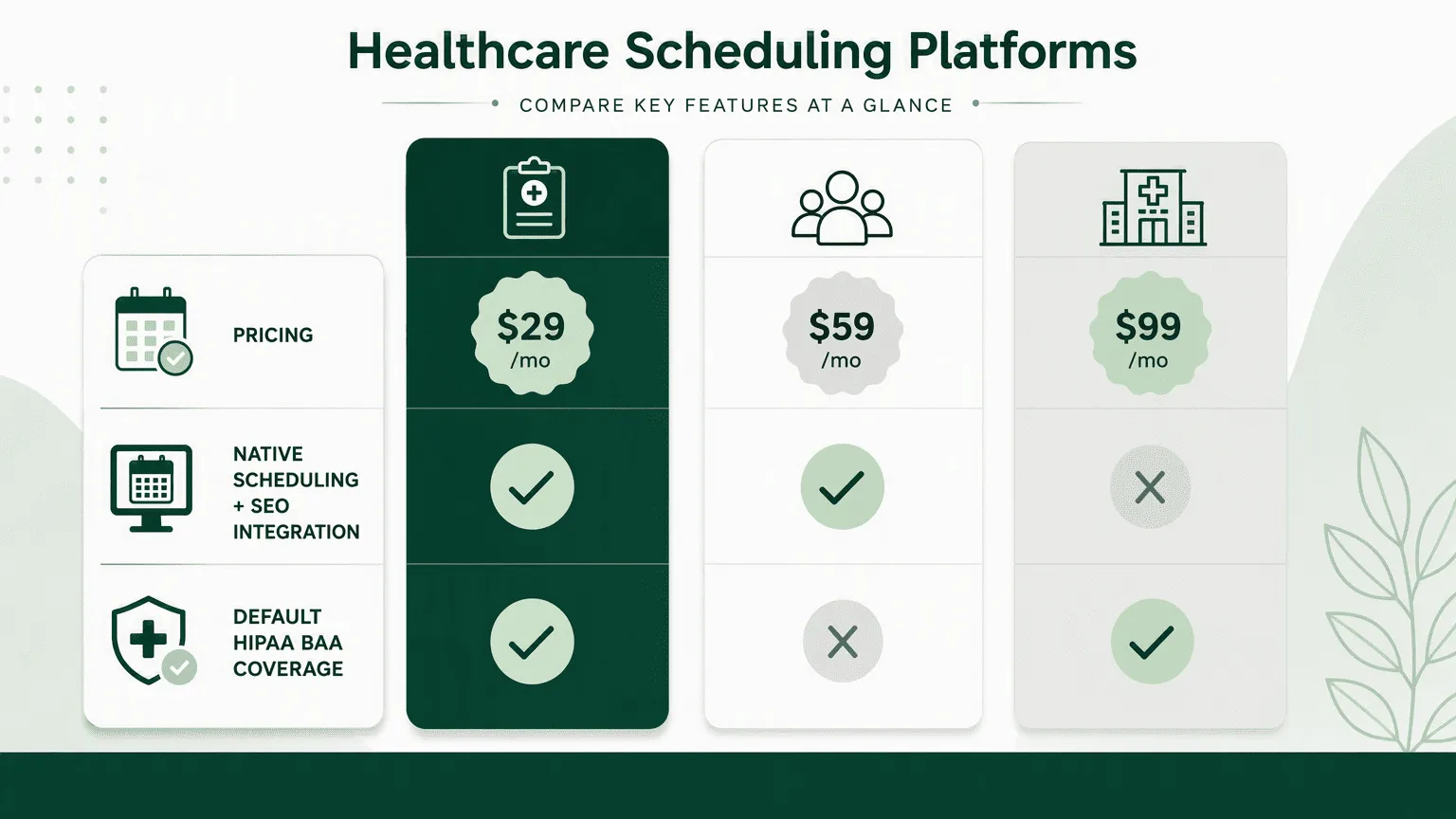
Here is how the options compare across the dimensions that matter most.
| Platform | Starting Price | Integrated Scheduling & SEO | HIPAA BAA Included by Default | Best For |
|---|---|---|---|---|
| PatientGain PLATINUM Plus | Custom quote | Yes, native CRM and AI chat with local SEO-optimized websites | Yes | Multi-location practices seeking vendor consolidation |
| Luma Health | ~$300/month for small practices | Yes, patient engagement platform with smart scheduling and SEO tools | Yes | Medium to large clinics needing workflow automation |
| Phreesia | Custom quote | Yes, patient intake and scheduling integrated with marketing automation | Yes | High-volume practices focused on pre-visit completion |
| SimplePractice | $49 to $99/month for solo | Limited; scheduling and website are combined but SEO is basic | Yes, on mid-tier and above | Solo therapists and small private practices |
| OmniMD | Custom quote | Yes, AI front desk schedules provider rules directly from EHR | Yes | Clinics wanting AI-driven scheduling integrated with clinical records |
| Acuity Scheduling | $15 to $35/month | No; standalone scheduling widget, SEO is separate | No, must upgrade to higher-tier plan | Practices needing a low-cost standalone booking tool |
| Iridium Suite | Custom quote | Yes, CRM with scheduling and reputation management for multi-location | Yes | Multi-specialty groups requiring HIPAA-compliant automation |
What Are Healthcare Marketing Tools with Integrated Scheduling and SEO?
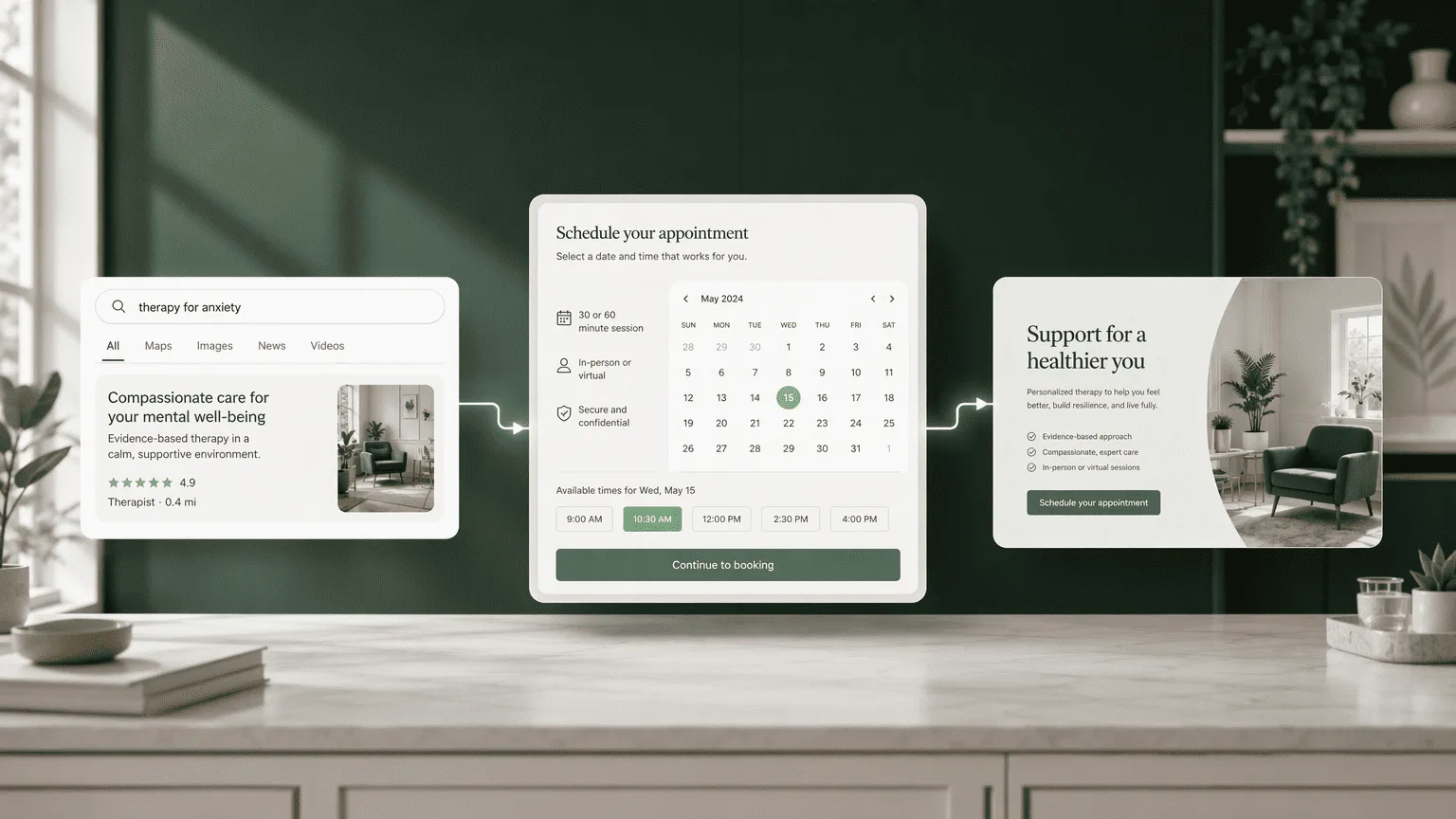
Healthcare marketing tools with integrated scheduling and SEO are practice-growth platforms where patient-facing search optimization, self-booking, and clinical workflow logic share a single database. The booking calendar is not a disconnected widget embedded in a website. It is the conversion endpoint of every content page, ad landing page, and local profile the platform manages. When a patient finds your hypertension management page through organic search and books an appointment, that click path never crosses between separate SaaS tools.
Standalone alternatives force the break. A practice might run a search-optimized site on WordPress, bolt on an Acuity Scheduling link, and house patient records in an EHR that none of those tools can query. An integrated platform joins those pieces.
PatientGain, for example, bundles custom websites built for local visibility with a native CRM and AI chat under one login. The session source, the booked appointment, and the patient record sit together. OmniMD anchors from the clinical side instead: it embeds AI scheduling directly inside its EHR and practice management system so booking data never leaves the clinical workflow.
How Scheduling and SEO Integration Drives Patient Acquisition and Revenue

The mechanism is simple enough to miss: a patient searching for a specific condition, treatment, or symptom is the highest-intent signal your marketing budget can buy. When that search leads to a landing page where the patient can self-book in seconds, you convert intent into a confirmed appointment before a front-desk phone line ever rings. Traditional workflows add friction at the handoff.
The patient clicks, calls during business hours, waits on hold, and negotiates a slot that may or may not align with what the website promised. Every minute of delay shaves conversion rate. Eliminating that handoff turns search traffic into a direct revenue line rather than an expensive top-of-funnel hope.
The revenue math is unignorable. AI scheduling tools reduce no-shows through intelligent reminders and workflow optimization, and Luma Health's automated outreach, smart waitlists, and multi-channel reminders consistently move the needle on no-shows. A reduction in no-show rate does not just protect a single visit. It preserves the entire lifetime value of a patient relationship that would have stalled at the first missed appointment.
HIPAA Compliance and Data Privacy in Patient Marketing Tools
The compliance architecture of your scheduling tool is a legal exposure, not an IT preference. A business associate agreement, or BAA, is the contract that extends HIPAA liability to your software vendor. Platforms like Luma Health and Phreesia issue a BAA as a default layer of the service because their infrastructure was built to carry protected health information from day one. Their patient communications are encrypted end-to-end, and the booking data flows through channels designed with audit controls in mind.
General-purpose tools operate under a different assumption. Acuity Scheduling, for instance, gates its BAA behind a higher pricing tier and lacks native EHR integration, which means the booking slot and the clinical record are disconnected by design. This architecture increases privacy risk for a simple structural reason. Every data handoff between a general-purpose scheduler and your EHR is a junction that must be manually secured, audited, and maintained. Healthcare-native platforms collapse those junctions into a governed pipeline, which is why the BAA is baked into the base contract.
The trade-off is concrete: using a general-purpose tool without a signed BAA means you are placing protected health information on infrastructure that the vendor has not formally committed to safeguarding under HIPAA.
Follow these compliance prerequisites before any patient record touches the new system:
- Signed BAA in hand: Get the business associate agreement in writing before the first patient record lands on the system.
- Cover the full data path: Make sure your integrated marketing and scheduling platform covers every node of the data flow, not just the scheduling module in isolation.
- Apply to all contact points: Extend the same scrutiny to any tool that will touch appointment data, patient names, or reason-for-visit fields.
Specialized vs. General-Purpose Platforms: Making the Right Choice
Sorting by price and clicking the cheapest tool that mentions scheduling is how practices end up with software that fights them. The market splits into two tiers built for different clinical realities. Pick the wrong one and you either pay for complexity your front desk ignores or limp along on infrastructure that craters under a real Tuesday-morning patient load.
Emerging AI Front-Desk Trends in 2026

The phrase 'front-desk automation' undersells what is shipping in 2026. The tools landing now do not just push an appointment reminder. They triage, route, and book without a receptionist ever seeing the interaction.
OmniMD's AI Front Desk, for example, handles appointment booking through phone, text, and patient portal without staff involvement, applying provider availability rules and appointment type configurations from the EHR directly. That sentence contains the entire disruption. A patient calling about a same-day sick visit is not put on hold for triage. The AI reads the reason, checks provider schedules against the EHR's configuration, and books the slot. If no slot exists, it places the patient on a smart waitlist that sends re-engagement prompts the moment a cancellation opens.
The patient journey compresses into a straight line: SEO-driven search lands on a self-booking page, an AI chat agent qualifies the visit type, and the patient checks in with one click on arrival. Practices running this stack are cutting more than administrative payroll. They are capturing acquisition that historically leaked out of phone trees during lunch hours and weekends. Clinics still routing every booking through a human receptionist now compete against a front desk that never clocks out.
For a practice evaluating tools right now, the question is simple. Ask any platform vendor whether their roadmap includes AI triage, predictive scheduling, and channel-agnostic booking. If the answer is a brochure about 'patient engagement,' the tool was built for 2022.
Step-by-Step Guide to Implementing a New Marketing and Scheduling Tool

A rushed implementation burns more patient trust in the first month than the tool recovers in a year. The sequence below is designed to run the new platform in shadow mode long enough for staff to build muscle memory before your phone system goes quiet.
- Vendor Selection Lock-In: Finalize the platform contract only after the BAA is signed and you have walked a mapped data flow showing exactly where patient records enter, transmit, and land inside your EHR. Reject any vendor that cannot produce this diagram.
- 90-Day Parallel Run Activation: Configure the new scheduling tool and keep your existing booking workflow live simultaneously. Patients continue booking through the old system. Staff use the new one for internal-only appointments and test bookings, validating that provider rules, slot durations, and room assignments replicate correctly.
- Phase 1 Training (Booking Interface Only): Train front-desk staff on the scheduling interface first. Marketing dashboards, reporting modules, and campaign tools are a distraction in this phase. The objective is to ensure that anyone who touches a patient appointment can book, reschedule, and cancel without hesitation.
- Phase 2 Training (Marketing and Reporting Modules): Once the parallel run has a month of clean, error-free scheduling data, bring the marketing team onto the platform. Train them on the SEO dashboard, campaign attribution, and the connection between a search session and a booked appointment inside the native CRM.
- Data Migration Validation: Run a reconciliation report comparing the old system's appointment counts against the new system's logs for at least two full weeks of the parallel run. Anomalies larger than 2% in any provider's calendar must be resolved before go-live.
- Go-Live Cutover with Reduced Booking Volume: Flip the patient-facing booking widget to the new system during a low-volume period, typically a mid-week window on a non-holiday week. Keep the old system running in read-only mode for 72 hours to catch stray bookings.
- Post-Live Monitoring Cadence: For the four weeks following cutover, run a weekly audit of the booking-to-EHR pipeline, patient no-show rates, and marketing attribution accuracy, comparing each to the parallel-run baseline.
Conclusion
Stop treating integration as an IT project. It is a revenue problem dressed in a compliance question. When your SEO, scheduling, and EHR operate in separate silos, a Google search might land a patient on your site at 11 p.m., but they cannot book the slot they just found. That gap costs you money every night.
A platform that ties those pieces together under a single BAA closes the loop. The prospect searches, sees an available appointment, and books it. No call.
No email. No break in the chain.
Practices running a scattered marketing stack still get traffic. But they convert that traffic at a level far below what integrated platforms deliver right now.
The urgency is not about buying another tool. It is about collapsing the tools you already pay for into one system that earns its own BAA and fills your schedule while the front desk is dark.
Frequently Asked Questions
What are healthcare marketing tools and which platforms combine scheduling and search optimization?
Healthcare marketing tools with integrated scheduling are practice-growth platforms where search optimization, self-booking, CRM, and EHR data share one system. PatientGain bundles custom SEO websites with native AI chat and scheduling. OmniMD embeds AI booking directly inside its EHR to keep patient data in the clinical workflow.
How do these tools ensure HIPAA compliance and data privacy for patient communications?
Healthcare-native platforms like Luma Health and Phreesia provide a business associate agreement by default with end-to-end encryption across the booking path. General-purpose tools such as Acuity Scheduling gate their BAA behind higher pricing tiers and lack native EHR integration, increasing the compliance burden on your practice.
What impact does integrating SEO and online booking have on patient acquisition and healthcare revenue?
Integration converts high-intent search traffic into booked appointments before a single phone call. AI scheduling tools reduce no-shows through intelligent reminders and workflow optimization, preserving the lifetime value of a patient relationship and compressing the acquisition cost per visit.
How do I choose between a healthcare-specific marketing tool and a general-purpose platform?
Match the platform to practice complexity. Solo therapists often run cleanly on a $49 to $99 per month general-purpose tool. Multi-specialty groups need healthcare-native platforms for deep EHR integration, default BAAs, and AI-driven triage that general-purpose tools do not offer.
What are the emerging trends in US healthcare digital marketing for 2026?
AI front-desk automation is the dominant 2026 trend. Tools now handle appointment booking through phone, text, and portal without staff, apply provider availability rules directly from the EHR, and compress the patient journey from SEO-driven search to one-click check-in.
Step-by-step, how can a US medical practice implement a new marketing and scheduling tool while minimizing disruption?
Follow this sequence to migrate to a new integrated platform without disrupting patient bookings:
- Run a 90-day parallel environment with the new system in shadow mode, processing live data alongside the existing system.
- Train front-desk staff on the booking interface first, then layer on marketing dashboards and reporting.
- Validate data migration through reconciliation reports that compare patient records, appointments, and contact information between the old and new systems.
- Cut over during a low-volume window with the old system in read-only mode, ensuring you can revert if discrepancies emerge.
Sources
- All in One Marketing Solution for Healthcare Practices - www.patientgain.com
- Best AI Patient Scheduling Tools for Small Practices - omnimd.com
Want help executing this for your clinic?
Book a 30-minute call and we will map what a real ad engine would look like for your specific service mix.
Book a call