
7 Platforms That Unify Google Rankings and Patient Bookings in 2026
IntroductionMost medical practices lose appointments because they treat Google rankings and patient booking as separate problems. They pay one vendor for local SEO and another for scheduling, then stare at a dashboard wondering why new patient volume is flat. A prospective patient finds the practice on Google Maps, taps the booking link, and lands on a broken redirect or an intake form that asks for the same data the scheduler already collected. That friction kills the conversion before the phone ever rings.
The channel works. Google delivers the traffic. The problem is the stack underneath it.
Patient impatience has real teeth now. 54% of millennial age patients will switch providers this year, and 80% of patients reported that they would switch providers for more digital convenience factors alone. A practice that makes booking feel like paperwork gets dropped silently while the admin team blames the SEO campaign. Separately, a standard local SEO tool and a standalone scheduling platform run a practice between $500 and $1,200 a month. Add the integration labor nobody budgets for, and the combined cost is higher than most line items on the marketing report.
The market has started responding. You sacrifice some ranking depth for operational simplicity. The trade-off is real, and this article spells out which platform makes it worth accepting.
Key Takeaways
The bottom-line findings for any practice operator evaluating a unified rankings and bookings platform in 2026:
- Unified platforms save $200 to 400/month by cutting integration work and vendor overlap. Total spend lands around $300 to 800/month versus $500 to 1,200+ for a fragmented stack. The savings are real; the rankings impact depends on execution.
- Birdeye is the ranking-strength benchmark for multi-location groups. Its local SEO engine consistently outperforms bundled EHR solutions in search visibility, making it the pick when rankings are the primary driver.
- DexCare is the enterprise play for organic patient acquisition at scale. Its routing logic, paired with a 75 to 80% organic/direct traffic concentration, is purpose-built for health systems managing demand across dozens of locations.
- AI-driven answer engine optimization is the next fault line. With AI Overviews compressing organic clicks from 1.6% to 0.6%, platforms that optimize for structured, voice-search-ready answers will separate winners from the invisible within 24 months.
1. Clinads: A Comprehensive Healthcare Growth Platform Unifying Local Search Dominance and Intelligent Scheduling
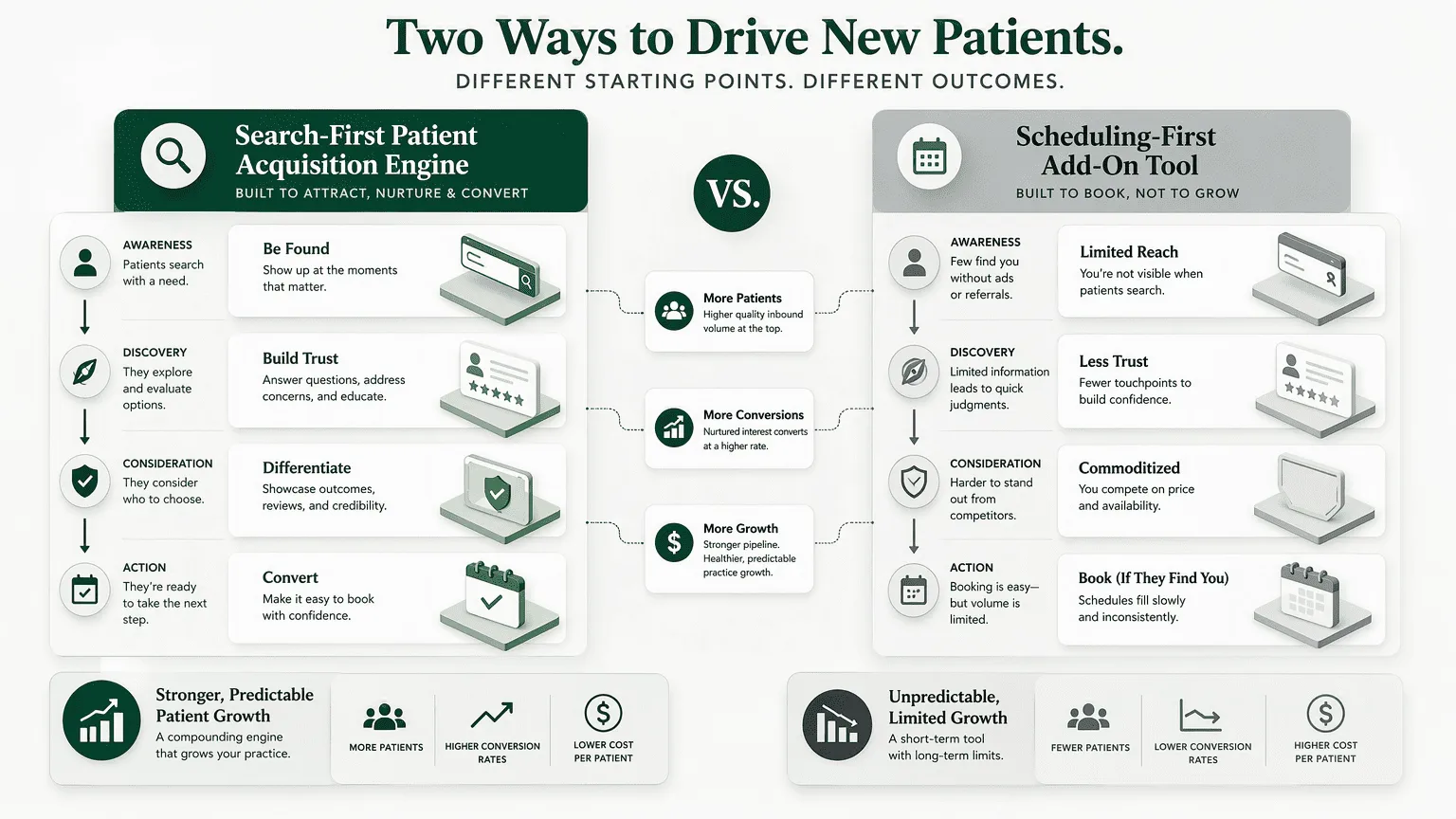
Clinads enters the conversation as a platform built for medical practice growth, not a generic listings tool with a booking widget attached. It ties Google Business Profile ranking management directly to patient acquisition workflows. The search listing functions as a conversion asset, not a vanity metric.
| Feature | Clinads | Typical EHR-Bundled Tool |
|---|---|---|
| Core Philosophy | Search-first patient acquisition engine | Scheduling-first with SEO as an add-on |
| HIPAA Handling | Audit-ready handling across public search data and booking flows | Varies by EHR; often siloed within scheduling module |
| Real-Time Schedule Sync | Bidirectional sync designed for instant booking confirmation | Often one-directional or batch-processed |
| AI Automation | Applied to review response, ranking signal enforcement, and listing accuracy | Typically limited to AI note-taking and basic review replies |
| Target Market | Independent medical practices and multi-location groups | Primarily independent practices tied to a core EHR |
| Pricing Model | Flat monthly platform fee, not per-location surcharges | Often bundled into EHR subscription tiers |
The table above is the decision architecture. Where most EHR vendors treat local search as a checkbox feature, Clinads starts with the ranking problem. You can use a platform like Clinads to fix the specific ranking signal gaps that cause one clinic to appear below a lower-rated competitor, then route that captured traffic into a scheduling flow that actually converts.
2. Tebra: The All-in-One Practice Management Ecosystem with Built-in Reputation and Booking for Independents
Tebra wins on the bundling argument alone. The math is compelling when your alternative is three vendors and a spreadsheet.
The trade-off shows up in search depth. When benchmarked against reputation-centric platforms like Birdeye, Tebra’s local SEO capabilities rank a tier below. It will keep your listings accurate and reviews flowing, but it won’t give you the granular citation control or competitive ranking signal optimization a dedicated tool provides. For a solo practitioner losing patients to a health system that outspends them 10-to-1 on search ads, the all-in-one convenience is the right lever. If your growth plan depends on unseating three competitors in the Google Map Pack, Tebra alone is an incomplete weapon.
3. DexCare: Enterprise Digital Front Door Orchestrating Search Demand into Intelligent Care Access

DexCare is not a tool for a three-physician private practice. It is an enterprise operating system for health systems that need to convert organic search traffic into booked appointments across dozens of locations and specialties. The platform’s routing logic is the differentiator: it matches a high-intent search visitor to an available, clinically appropriate provider in real time, which is how the company can credibly claim a 30% increase in new patient acquisition.
That claim is grounded in search behavior that DexCare is engineered to capture. 75 to 80% of visits are organic and direct, meaning the vast majority of appointment traffic arrives not through paid ads but through Google searches, map queries, and direct navigation. The platform powers patient access for 57 million patients across all 50 states, a scale that implies the underlying infrastructure can handle the scheduling complexity of a multi-hospital network without breaking the search-to-booking chain.
The problem is that organic search is compressing. AI Overviews have pushed organic click-through rates down from 1.6% to 0.6%, which puts enormous pressure on the clicks that remain. DexCare’s bet is that intelligently routing those scarce clicks, rather than dumping them onto a generic appointments page, is the only margin left.
For the health system CMO, the DexCare decision is an acquisition-cost conversation disguised as a technology purchase.
4. Birdeye: A Reputation-Centric Powerhouse Bridging the Gap Between Rankings and Bookings for Multi-Location Practices

Birdeye is the local SEO engine that booking platforms wish they had. For a multi-location group where ranking signal depth is the primary patient acquisition lever, Birdeye's position as a dedicated reputation and listings management platform makes it the comparative benchmark.
In direct comparisons, Birdeye delivers deeper citation management, review velocity, and local ranking signal enforcement than EHR-bundled tools like Tebra. When search visibility is the revenue driver, that depth makes it the default choice.
Expect $300 to $800 a month in total platform cost. The platform integrates scheduling into a profile that is already optimized for ranking, rather than starting from a clinical workflow and building outward to search. That sequence matters when you are trying to unseat competitors in the Map Pack.
Marketing directors managing dozens of clinic profiles can enforce brand consistency while pushing local ranking optimizations, a workflow that breaks under single-practice tools.
Birdeye is not an EHR, and its HIPAA posture around the scheduling handoff is a configuration challenge you must own.
5. Next Health: AI-First Answer Engine Optimization Connecting Patients Directly to Provider Schedules

Next Health is betting that the search interface your patients use in 2026 will not be a blue-link results page. It will be a voice assistant, an AI Overviews excerpt, or a structured answer box pulled directly from your provider data. The platform optimizes for answer engine visibility, the logical successor to traditional local SEO, by structuring a practice's scheduling data, provider details, and service information in the machine-readable formats that AI models consume and cite.
This matters because the visitor coming through an AI-generated answer is not less valuable. The data suggests AI search visitors are 4.4 times more valuable than traditional organic visitors, likely because they have completed more of the intent funnel before the click. What Next Health is building is a pipeline from a structured healthcare answer directly into a confirmed booking, a connection that short-circuits the traditional Google listing altogether.
For a practice owner, the immediate tactical takeaway is that scheduling real-time availability on an answer-engine-optimized platform turns your appointment slots into search inventory. The channel is not broken. The brief is.
6. Decision Flowchart: Selecting the Right Unified Rankings & Bookings Platform for Your Practice
The correct platform is not a function of feature checklists. It is a function of practice architecture and the ranking gap you are trying to close. For a solo independent practice drowning in administrative overhead, Tebra’s bundled ecosystem wins because eliminating vendor fragmentation is worth more than squeezing out two extra ranking positions. The trade-off: accept serviceable local SEO depth in exchange for operational simplicity, and acknowledge that a dedicated tool like Birdeye would rank you higher, but at a cost of integration you cannot afford.
For a multi-location group or a health system, the calculation inverts. DexCare becomes the choice when routing organic demand across locations and specialties is the primary growth lever, while Birdeye is the platform when the pain point is that your individual location profiles rank below competitors whose care quality your staff knows is inferior. Clinads slots in as the option for the practice operator who refuses the false choice between ranking depth and booking integration, and wants a platform built to solve both problems from the search signal outward.
7. Cost-Benefit Analysis: Unified Platform ROI vs. Stitching Together Separate SEO and Scheduling Tools
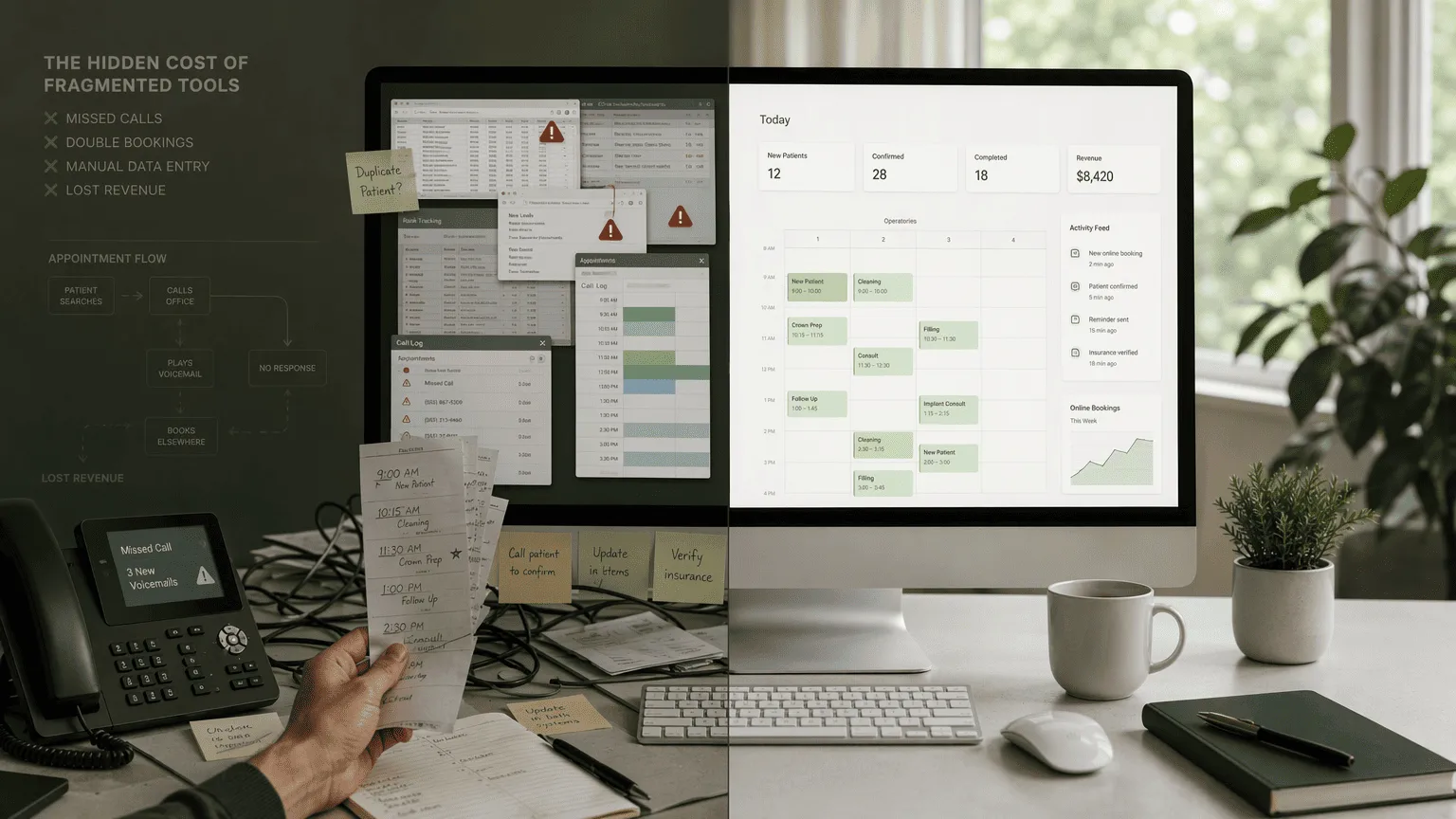
The fragmented stack is expensive in a way most practice operators do not measure: the integration labor. Paying $500 to $1,200 a month for separate listings management, review software, and a scheduling tool looks defensible on a vendor line-item spreadsheet. What is invisible is the staff time spent reconciling a listing's inaccurate appointment link, the front-desk calls from patients who booked on a widget that did not sync with the EHR, and the new-patient revenue lost when a search visitor bounces from a broken scheduling flow.
A unified platform at $300 to $800 a month eliminates that invisible cost as its primary value proposition: one vendor, one sync pipeline, one audit trail when something breaks. The compromise is depth. Moz Local offers a granularity of citation management and review monitoring that a bundled platform rarely matches, but it does not connect to an appointment slot. The question is whether the incremental ranking gain from that depth materializes into enough new-patient revenue to justify the stack complexity. For most practices under 10 locations, the answer is no.
The operator's math: calculate your cost per new patient from organic search, multiply by the estimated volume lift a dedicated SEO tool would realistically deliver, and compare that number against the $200-to-$400 monthly premium of the fragmented stack. If the revenue gap is larger than the complexity cost, run the separate tools. Expect a unified platform to total $300 to $800 a month. That is a realistic range, and for most small practices it lands closer to the lower end.
Conclusion
The market has answered the question: platforms that manage Google rankings and patient bookings in one place exist, and the right one depends on your practice's scale and the ranking distance you need to cover. For independents, the all-in-one EHR bundles have matured. Fragmentation now costs more than it earns.
For enterprises, the demand-routing logic of a platform like DexCare or the ranking depth of Birdeye justifies the investment. The next 24 months will belong to platforms that treat answer engine optimization as the conversion pipeline to own.
Want help mapping which platform fits your patient acquisition math? Book a 30-minute intro call.
Frequently Asked Questions
What does it mean to have a single platform that handles both healthcare SEO and online patient scheduling?
It means you manage your Google Business Profile ranking signals, review responses, and listing accuracy in the same system that holds your real-time appointment availability. A prospective patient finds you on search, clicks, and books a confirmed slot without leaving the platform's workflow or hitting a broken integration.
Which software solutions combine local search ranking management with patient booking functions, and are they specialized for healthcare?
Clinads, Tebra, DexCare, and Birdeye all combine ranking management and booking, with varying depth. Tebra bundles it inside an EHR for independents. DexCare targets enterprise health systems. Birdeye leads on local SEO depth. Clinads builds both functions around healthcare acquisition logic specifically.
How effective are all-in-one reputation and scheduling tools at actually improving Google rankings for medical practices in the US?
They are effective at baseline ranking hygiene: accurate listings, steady review velocity, and correct appointment links. For competitive displacement in the Map Pack, dedicated tools like Birdeye or Clinads outperform EHR-bundled options. A platform that is scheduling-first rather than search-first will rarely win on ranking depth alone.
What key features should a US medical practice look for when selecting a unified rankings and bookings platform?
Look for the following criteria when evaluating a platform:
- Real-time bidirectional schedule sync: prevents double-booking.
- AI automation: handles review management and listing enforcement.
- Transparent per-location pricing: no hidden fees.
- Audit trail capability: the platform must demonstrate the connection between a Google listing and a booked appointment, if it cannot, walk.
Yes, the risk lives at the handoff point where a public booking widget passes protected health information into the practice’s EHR. A compliant platform encrypts that data in transit and maintains a Business Associate Agreement (BAA) that covers the entire workflow, not just the scheduling module.
What does a combined rankings and bookings tool typically cost compared to using separate best-of-breed solutions for a small to mid-size practice?
A unified platform typically costs $300 to $800 per month. Assembling a fragmented stack of a dedicated local SEO tool, a review management platform, and a standalone scheduler runs $500 to $1,200 plus unmeasured integration labor. The all-in-one saves money but may sacrifice best-in-class ranking depth.
Sources
- Search and Schedule – DexCare - dexcare.com
- Announcing All-in-One Patient Management Software | PatientStudio - patientstudio.com
Want help executing this for your clinic?
Book a 30-minute call and we will map what a real ad engine would look like for your specific service mix.
Book a call