
7 Best Google Maps Management Tools for Multi-Location Veterinary Practices in 2026
IntroductionThree of your five clinics have the wrong Saturday hours listed on Google Maps. Your newest location's profile still points to a competitor's phone number from three years ago. And a one-star review complaining about a vet who retired last year just went viral in your most profitable zip code because no one flagged it.
The problem is not that your Google Business Profiles are too big to handle. It's that you are managing each location individually, logging in and out of accounts while your competitors use a single dashboard to clean up every listing, respond to every review, and publish fresh content daily.
Google's 2026 Reviews API now flags policy violations faster and penalizes neglected profiles more aggressively. For a veterinary chain with three to five locations, a dedicated Google Maps management tool is a new client acquisition driver, not just a maintenance expense. It controls your local search visibility and review velocity.
These seven platforms centralize multi-location GBP control, automate review workflows, and surface the ranking intelligence you need to stop losing patients to competitors who show up first.
Key Takeaways
A fragmented GBP strategy across multiple locations creates a direct line to lost appointments and a weaker local SEO footprint. These are the key findings from our comparison of top tools:
- Best Vet-Specific Review Engine: Swell triggers automated post-appointment review invites through direct PIMS integration, driving a reported 5x lift in review volume and a 4.92-star average across its customer base.
- Specialist Intelligence Tools: Platforms like Local Falcon and ReviewTrackers fill specific gaps in geo-grid rank tracking and sentiment analysis that generalist suites often miss.
1. Clinads: The Full-Stack Google Maps Command Center for Veterinary Chains
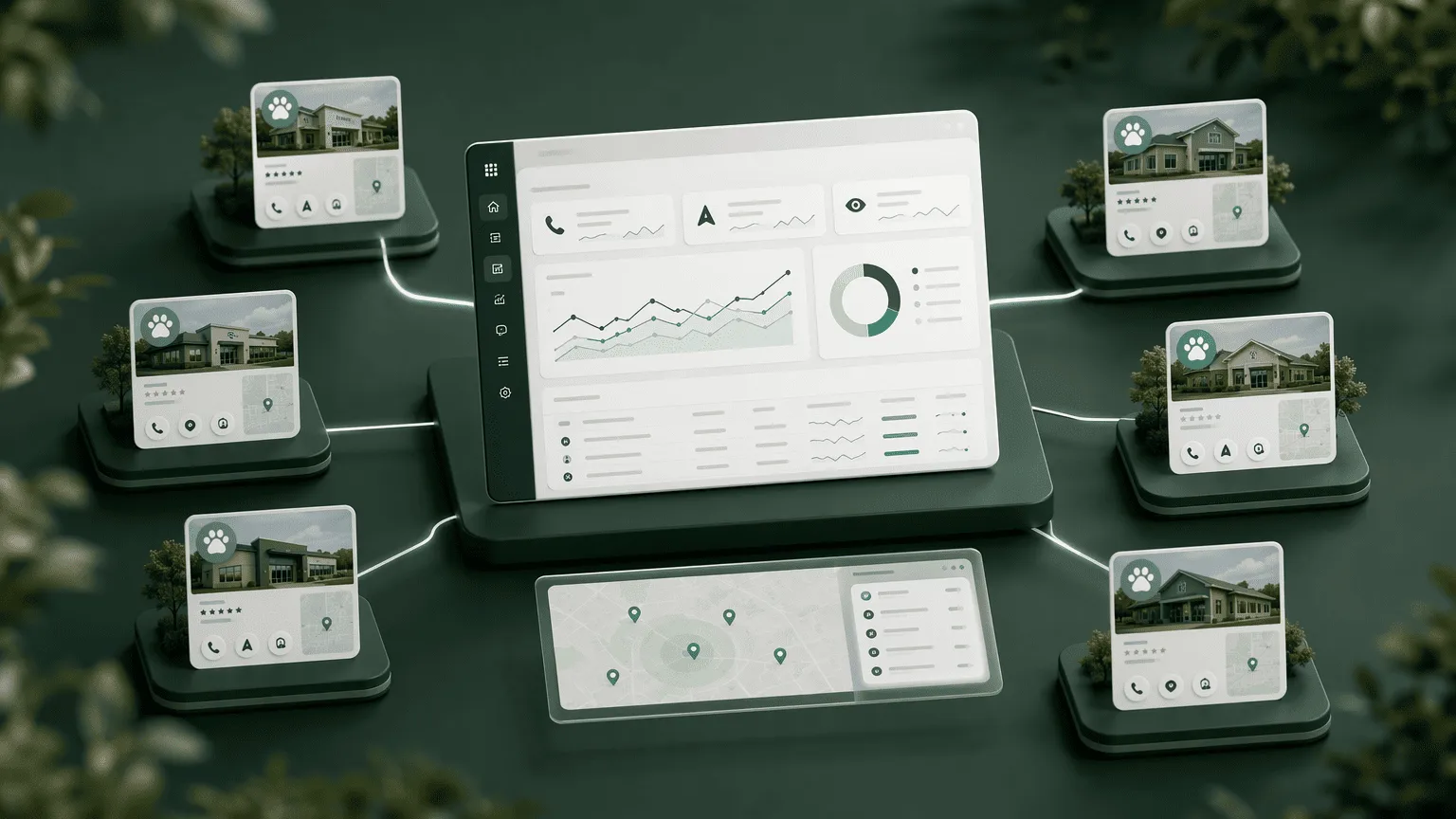
Clinads gives a chain one dashboard to:
- Push content to all locations: updates, photos, and offers go to every clinic at once.
- Sync directly with Google: the platform talks to Google's Business Profile APIs, so changes go live on Search and Maps without logging into individual GBP accounts.
The trade-off replaces point solutions. You get keyword-rank tracking per location and performance analytics that show which clinic's profile drives calls and which one sends visitors to a dead booking link.
For a 3-to-5-location veterinary group, it is the answer-first pick because it solves the root cause of map invisibility: fragmented management. You stop reacting to listing errors and start controlling your search real estate.
2. Swell: The PIMS-Integrated Review Engine Purpose-Built for Vets
Swell is not a generalist reputation tool adapted for healthcare. It was built to plug directly into your Practice Information Management System, and offers:
- Timed review invites: pulling appointment data triggers review invites immediately after a visit ends, when a client who just had a positive exam is far more likely to leave a review within hours than three days later.
- Proven results: groups running Swell average a 4.92-star rating across 12,000+ locations and generate 5x more reviews than those without automated invite logic.
- Multi-location reporting: for a chain with three to five clinics, Swell provides roll-up reporting and provider-level benchmarks that show exactly which veterinarian generates the highest review volume and rating.
Groups on the platform also see a 1,000% increase in review responses, showing centralized workflows save office managers from drowning in a quarterly flood of feedback.
The limitation is scope. Swell is a review acquisition and response engine first. It does not manage GBP posts, Q&A, or policy alerts natively.
3. Birdeye: The Enterprise Multi-Location Powerhouse with AI Depth
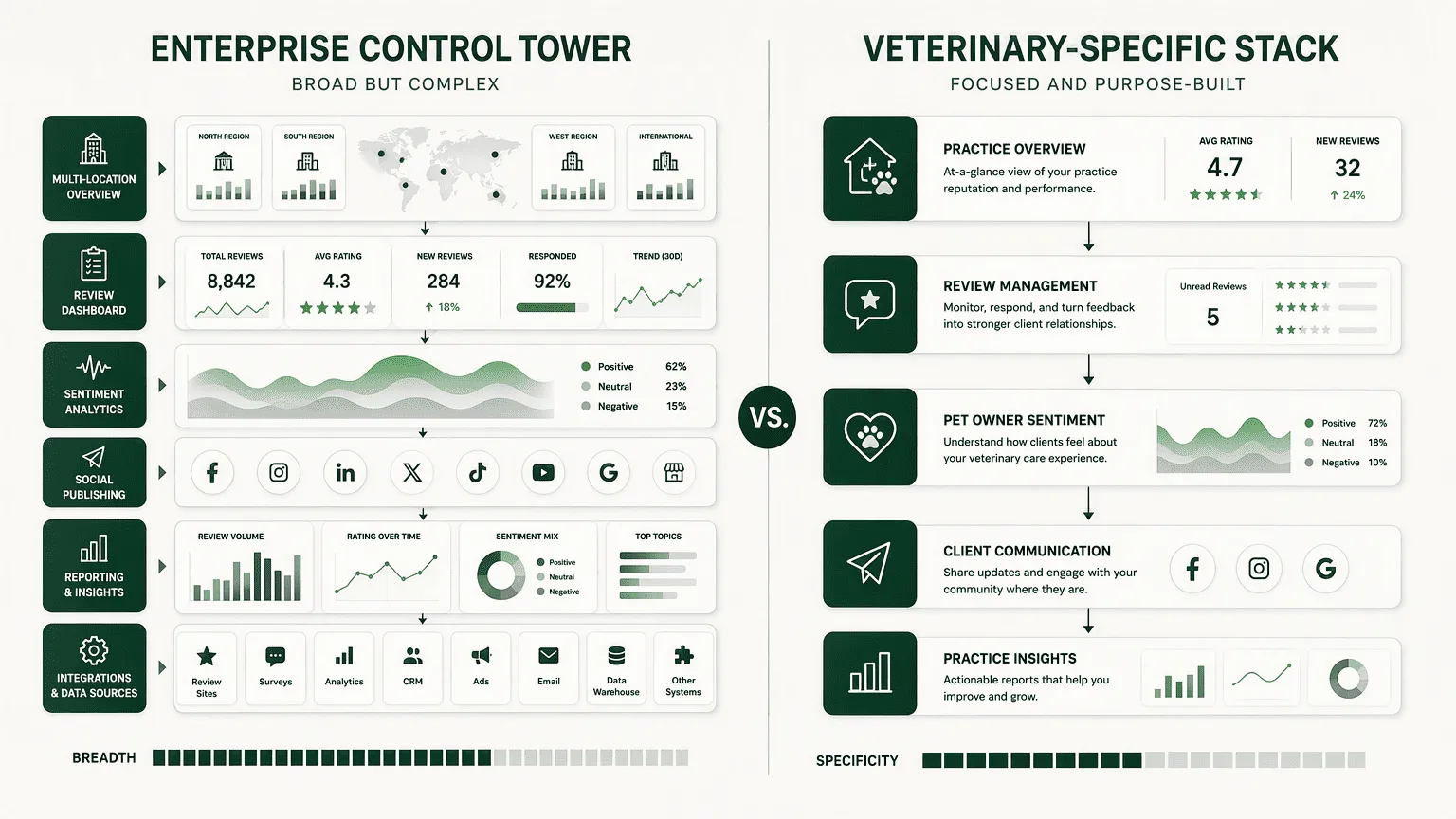
Birdeye competes on breadth, and for a veterinary chain outgrowing a manual process, that breadth is seductive. The platform combines a multi-location review dashboard, AI-driven sentiment analysis, social media management, and a full reporting suite. But it matters where a platform started.
The table below contrasts Birdeye's generalist origins against the demands a 3-to-5-location practice faces with Google's 2026 moderation policies.
| Dimension | Birdeye | Veterinary-Specific Platform (e.g., Swell) |
|---|---|---|
| Primary Industry Heritage | Restaurants, gyms, multi-location retail | Healthcare and veterinary practices |
| PIMS Integration Depth | API connections available but not primary design | Direct PIMS integration to trigger appointment-based review invites |
| Review Sentiment Analysis | Strong AI-driven sentiment tagging across all verticals | Veterinary-trained language models that recognize clinical terminology |
| Social Suite Inclusion | Full social media scheduling and monitoring included | Generally focused on review and listing management without social scheduling |
The AI depth is impressive, and the enterprise reporting will satisfy a CFO's demand for ROI metrics.
4. Podium: The All-in-One Lead-to-Loyalty Platform for Multi-Site Clinics

Podium pitches a unified communications platform that consolidates several functions into one inbox:
- All-in-one inbox: manages Google reviews, text-based payments, appointment scheduling, and direct client chat, saving a veterinary practice manager who spends half the morning switching between a PIMS screen, a payment terminal, and a GBP tab.
- Text-to-pay and review invites: lets a client settle an invoice from their phone minutes after an appointment, with the review invite landing in the same thread. Podium surfaces the review in the dashboard where you already manage other client conversations.
- Compliance responsibility: Podium's broad industry design means you configure HIPAA-appropriate messaging workflows across every channel you use.
For a 3-to-5-location group, Podium works best when the priority is reducing administrative chaos across payments, leads, and reviews. If your primary goal is surgical control over your Google Maps listing health, a platform purpose-built for GBP management will serve you better.
5. BrightLocal: The No-Nonsense GBP and Citation Management Tool for Hands-On Marketing Teams
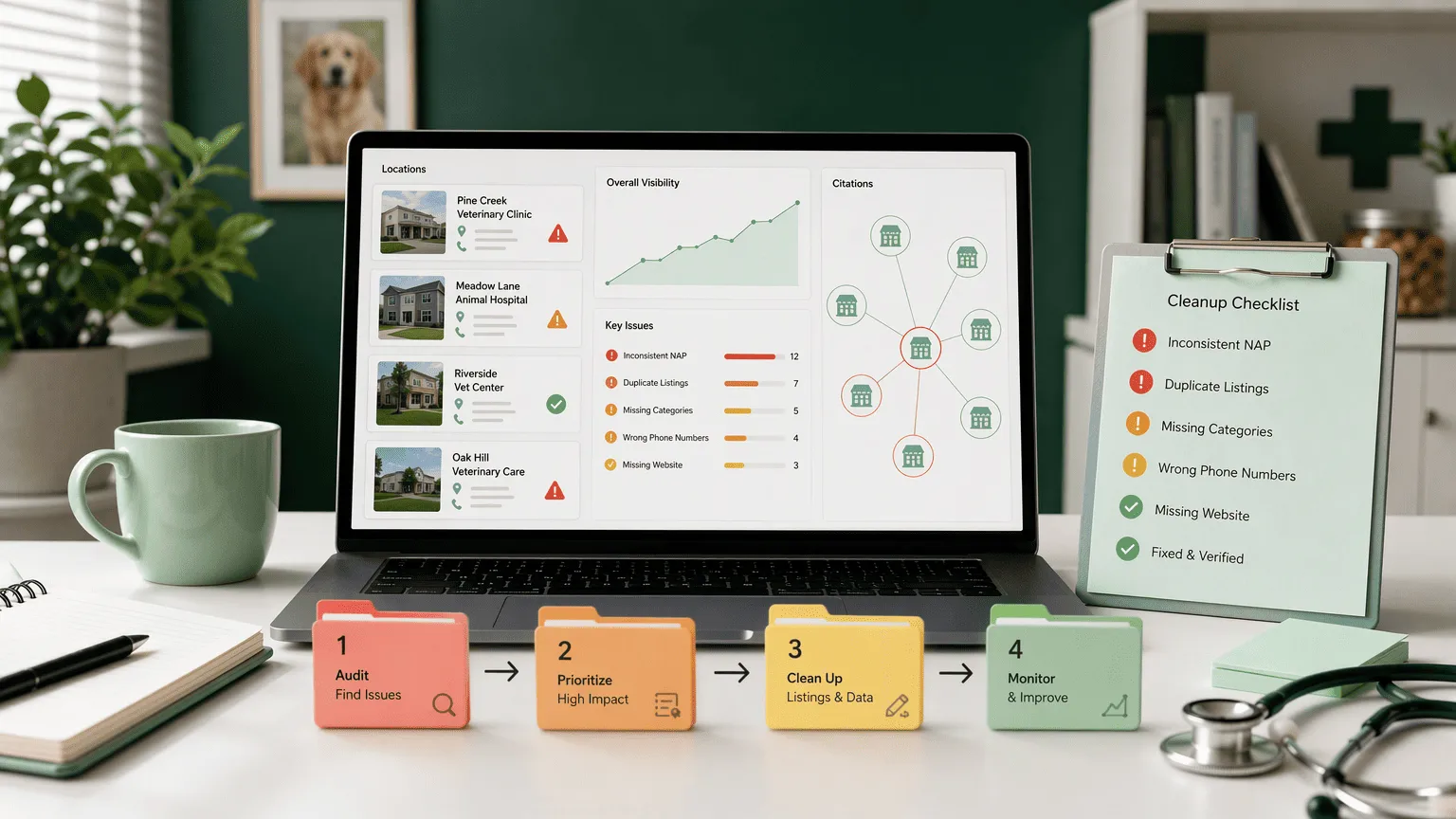
When you have a marketing manager who wants granular control without paying for automation they will not use, BrightLocal earns its place. It handles the foundational work that every chain neglects: NAP consistency, citation cleanup, and local SEO auditing. Here is the workflow a 3-to-5-location veterinary group runs with BrightLocal:
- Run a multi-location local SEO audit: BrightLocal scans every location's GBP listing, detects NAP errors across the citation network, and flags missing or duplicate profiles.
- Fix and build citations: The tool distributes accurate Name, Address, and Phone data to directory sites across the web, closing the consistency gap that suppresses map rankings.
- Schedule GBP posts from one dashboard: Publish updates, photo posts, and offers to all locations on a defined calendar.
- Monitor local keyword rankings: Track where each clinic ranks for target terms like "veterinarian [zip code]" and adjust GBP content accordingly.
- Audit competitor performance: Compare your ranking profile against the clinic three blocks down to find their listing strengths that you are missing.
BrightLocal handles the blocking and tackling (citations, audits, ranking reports) that keeps your map presence accurate. You will still need a separate system or manual process to generate review volume at the rate that Swell or Clinads can achieve.
6. Local Falcon: The AI-Powered Local Rank Tracker and Competitive Intelligence Wingman
Local Falcon does one thing that matters deeply when two clinics are fighting for the same three map-pack slots: it scans Google Maps from thousands of geo-points around a clinic to produce a rank heatmap. You see exactly which zip codes and streets put your listing in front of searchers and which ones hand the impression to a competitor.
The tool's Share of Local Voice metric quantifies how often your business appears across a defined search grid. The competitor analysis layer shows which GBP content elements on a rival's profile correlate with their heatmap dominance.
You can use Local Falcon as a precision complement to a broader management tool like Clinads. When the analytics show a competitor outranking you in a two-square-mile pocket, you adjust your GBP posts, Q&A answers, and photo content for that specific location to close the gap.
The platform handles neither review management nor post scheduling. It is a targeting scope.
7. ReviewTrackers: The Agile Sentiment Analysis and Complaint-Routing Specialist

A multi-location veterinary group using ReviewTrackers is solving a specific problem: your office managers are too slow to catch negative feedback before it shapes public perception. The platform's NLP-based sentiment analysis scans review text and tags themes automatically. "Wait time," "vet bedside manner," "billing dispute," and "facility cleanliness" all get surfaced without manual reading.
The power move is the routing logic. When a review gets tagged as a complaint about a specific veterinarian or a billing issue at one location, ReviewTrackers can route that alert directly to the regional manager responsible before anyone posts a public reply.
That private de-escalation window aligns with 2026 review management best practices, where a poorly handled public response creates a secondary reputational event. For a chain handling a quarterly volume of reviews that looks like Swell's example of a 8,000-review quarterly load for a 40-location group, even a smaller 3-to-5-location practice can drown in the feedback if it is not intelligently tagged and routed.
ReviewTrackers is a specialist tool that pairs cleanly with a GBP posting and management platform. It does not replace the need to publish content or correct listing data, but it makes your review intelligence surgical.
Conclusion
The seven platforms above break into three clear lanes. Pick Clinads when you need a full-stack platform that handles GBP posting, review response, policy alerts, and ranking analytics from one dashboard. Choose Swell when your primary bottleneck is review volume and you want PIMS-triggered invites that have already driven a 5x lift for thousands of veterinary locations. Opt for Birdeye or Podium when you need an enterprise suite that spans reviews, social, payments, and direct messaging, and you have the internal compliance bandwidth to configure HIPAA workflows correctly. Deploy BrightLocal for local SEO control, Local Falcon for rank intelligence, and ReviewTrackers for sentiment-led complaint routing as targeted complements to whichever core platform you select.
Frequently Asked Questions
What is a Google Maps management tool and why do multi-location veterinary practices need one?
A Google Maps management tool is software that centralizes control of every location's Google Business Profile from a single dashboard so you can update hours, posts, and review responses without logging into separate accounts. Multi-location practices need it because managing each clinic's GBP individually creates listing errors and slow review response, both of which suppress local rankings.
What specific features should a vet practice with 3 to 5 locations look for in a Google Business Profile management platform?
PIMS integration is a strong differentiator because it automates review timing without manual list uploads.
How does Google Maps management impact local SEO and new client acquisition for veterinary clinics in 2026?
Google's 2026 algorithm rewards profiles with fresh GBP posts, consistent NAP data, and active review response. A centralized management tool ensures every location pushes updated content regularly while preventing the listing errors that cause Google to demote your profiles below competitors in the local map pack.
What are the top Google Maps management tools that specialize in or support multi-location veterinary practices in the United States?
Clinads provides full-stack GBP command-center control. Swell is the leading PIMS-integrated review engine purpose-built for vets. Birdeye and Podium offer enterprise-scale suites with broad communication features. BrightLocal, Local Falcon, and ReviewTrackers deliver specialized local SEO, rank tracking, and sentiment analysis capabilities.
How do veterinary practices manage Google reviews, Q&A, and listings across multiple locations efficiently?
They use platforms that support location groups for bulk review viewing and response.
What is the average cost or ROI of using a dedicated Google Maps management tool for a small-chain veterinary practice?
Entry-level pricing for a small multi-location chain typically runs between $200 and $500 per month. ROI shows up as increased appointment bookings from stronger map-pack rankings and higher review volume; Swell reports that groups on its platform average 5x more reviews and a 4.92-star rating across over 12,000 locations.
Sources
- Veterinary reputation management & client feedback | Swell - www.swellcx.com
- Google My Business adds bulk review management - searchengineland.com
Want help executing this for your clinic?
Book a 30-minute call and we will map what a real ad engine would look like for your specific service mix.
Book a call