
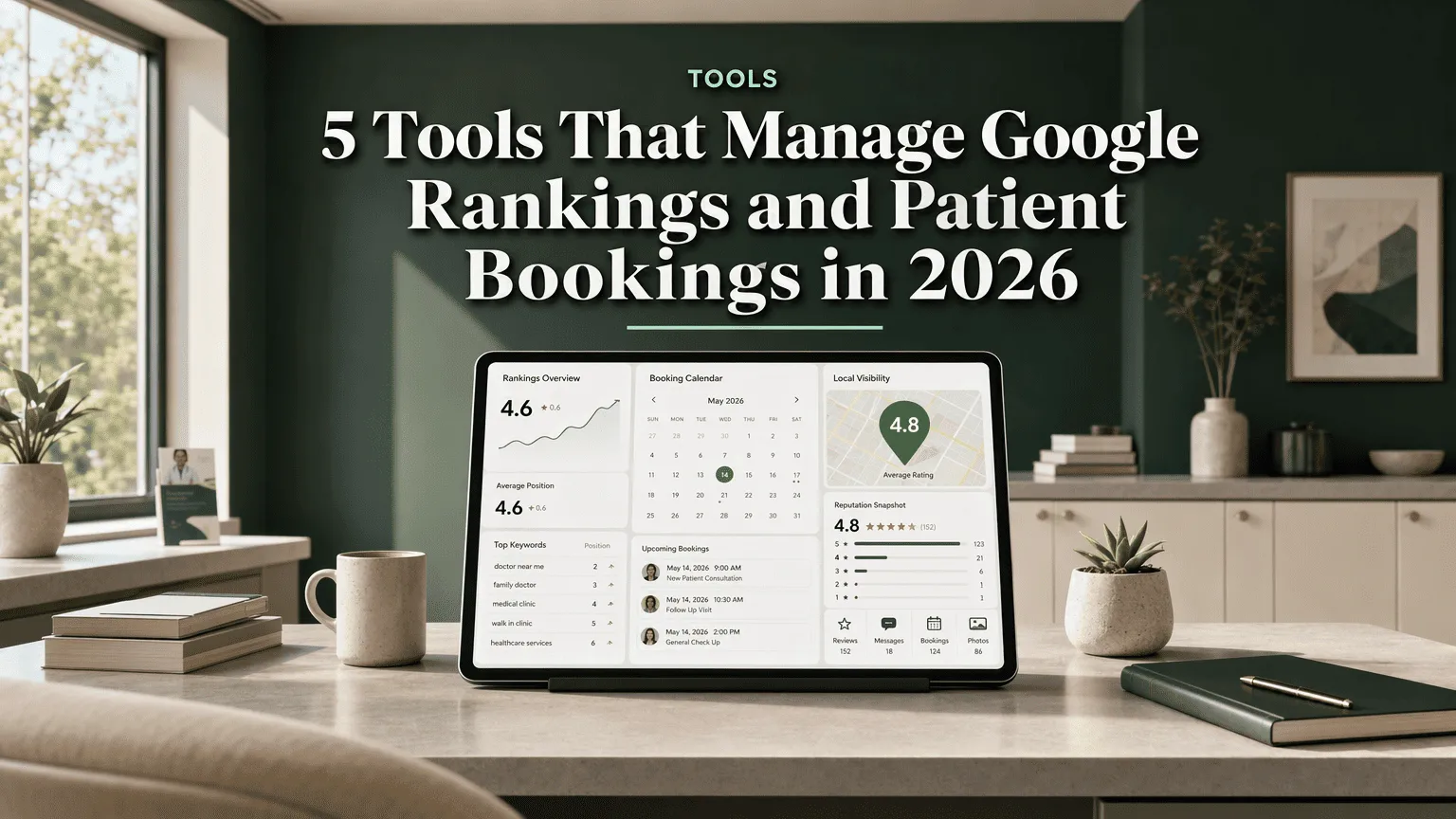
5 Tools That Manage Google Rankings and Patient Bookings
Summary: The article highlights five tools that help manage Google rankings and patient bookings, emphasizing the integration of Google Business Profile (GBP) with booking systems. Clinads offers a unified view of SEO and scheduling, while Birdeye and Podium focus on reputation management and appointment conversions. These platforms aim to connect search visibility with actual patient visits, enhancing efficiency and ROI for healthcare practices.
Introduction
Most clinic owners assume there is a single SaaS dashboard that pulls your Google map pack rank and your next-day hygiene appointments into one pristine column. That assumption is the wrong question. The right question is which set of connected platforms gives you the truest read on whether your visibility is producing paying patients.
Google has never released a full ranking-to-scheduling console. The system runs on Google Business Profile (GBP) feeding real-time booking clicks back into its own performance dashboard, a native integration that most third-party tools cannot replicate. What you can control sits directly adjacent: the booking partner that triggers those tracked conversions, and the reputation engine that fuels the ranking signals.
The tools below are the closest bridges available as of 2026. Some own the booking event. Some own the ranking trigger. Only Google's own ecosystem shows both in a single pane of glass, but a few platforms get you closer to a unified workflow than anything else on the market.
Key Takeaways
Here are the non-negotiable conclusions before you commit to a vendor:
- The purest unified data lives in GBP: Google Business Profile's native booking metrics are the only integration that counts a search impression and a completed appointment inside one dashboard.
- No third-party platform merges both controls fully: Ranking management and scheduling remain distinct functions. Clinads optimizes the GBP layer while connecting a booking provider beneath it.
- Booking events are the conversion that matters: Impressions mean nothing without a booked patient. Platforms that automate the link from profile click to scheduled time slot close the loop that ROI calculations require.
- Reputation automation is the hidden ranking engine: Automated review solicitation tied to a completed appointment cycle is the most scalable way to move ranking signals without adding headcount.
- Pricing scales by location count, not ranking need: Most platforms charge per location or per provider. A solo practice should budget $200 to $500 per month for a platform that covers GBP optimization and reputation, plus the booking provider's subscription.
1. Clinads: The All-in-One Healthcare Growth Platform Merging Local SEO and Direct Scheduling
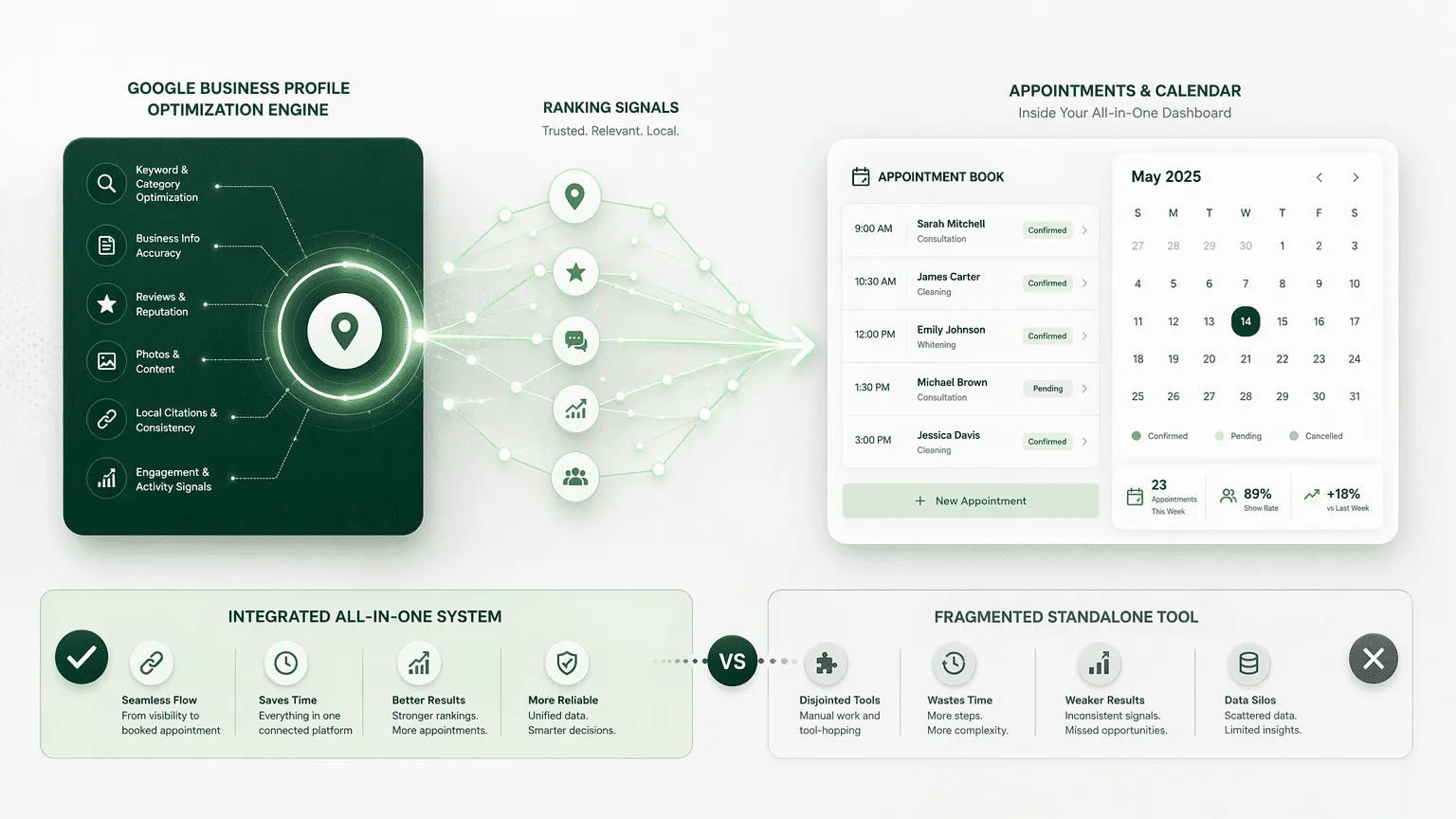
Clinads is built to connect your Google Business Profile performance directly to your appointment book. It's the only platform here that shows you whether yesterday's ranking work produced today's patient visits, without logging into a separate scheduling tool.
| Feature | Clinads | Typical Standalone GBP Tool |
|---|---|---|
| Google Business Profile optimization | Multi-location dashboard with post scheduling and Q&A monitoring | Often limited to audit without publishing |
| Performance analytics | Single view of search impressions, clicks, booking conversions | Typically limited to profile-level metrics |
| Pricing model | Per-location subscription, scaled to practice size | Often per-seat or unbundled add-ons |
The architecture is what makes it different. Clinads treats GBP optimization, review velocity, and direct scheduling as one conversion chain instead of three separate software purchases. A practice owner who wants to see last month's booking volume against last month's profile views, without stitching screenshots together, gets that single-pane view. That eliminates the friction of jumping between dashboards to connect marketing spend to actual arrivals.
2. Google Business Profile: The Free Foundation for Unified Visibility and Booking Metrics
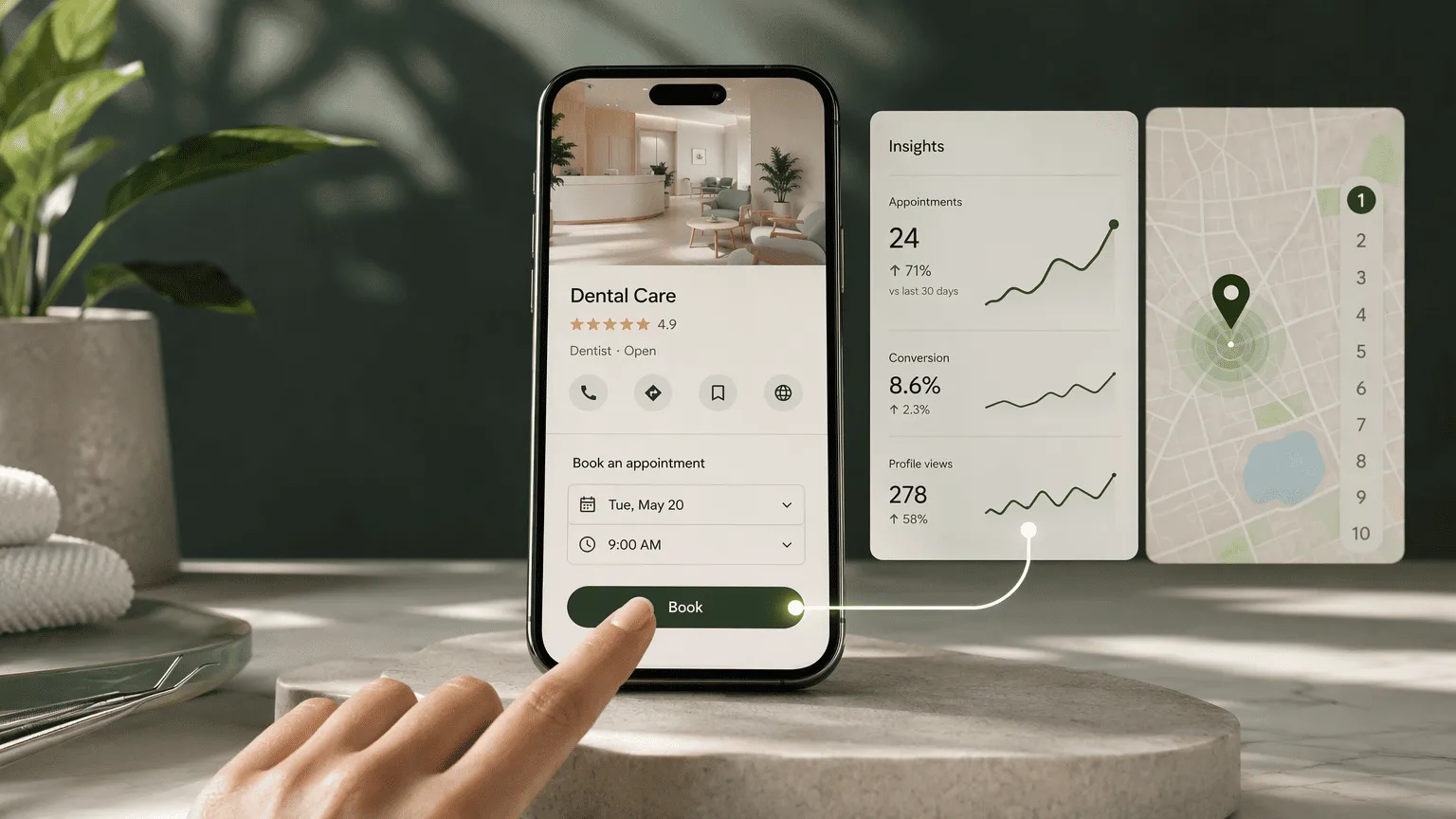
Google Business Profile does what no third-party tool can: it connects your map pack position to actual booked appointments in one dashboard. It is free to create and list your business. When a patient finds your profile, clicks to book, and completes the appointment, that event lands in your insights as a tracked conversion. You are not guessing whether rank changes drove volume. You can watch the booking count move alongside your position month over month.
The performance dashboard surfaces search queries, profile views, and a booking clicks metric that fires only for completed appointments through a connected provider. The searches metric doubles as a ranking proxy by showing you the exact keywords patients typed to find you. That data updates at the start of each month and can take up to 5 days to appear. Views count unique visitors once per day regardless of device, so you get a clean denominator for calculating your booking rate. Performance data is available only for verified Business Profiles.
3. Birdeye: Reputation and Ranking Management with Integrated Mass Scheduling

What gets a practice into the map pack isn't the review count you glance at inside Birdeye. It's the velocity of new reviews hitting your Google Business Profile, and Birdeye's core job is to keep that velocity high. The system sends automated review requests after each visit and distributes those reviews across Google and the directories that matter for local SEO.
At the same time, Birdeye runs mass appointment reminders, confirmations, and two-way messaging. For a practice seeing high patient volume with a front-desk backlog, this combination matters: reminders cut no-shows, and automated review capture builds the ranking signals that Google's local algorithm rewards, all without adding staff. The thing you won't find inside Birdeye's dashboard is your actual Google ranking position.
The platform doesn't surface whether that increase in review velocity moved you from position four to position two in the map pack. You still need to check GBP directly to confirm the lift. Practices that accept that gap, because they value the scheduling and reputation automation running side by side, tend to get the most out of the tool.
4. Podium: Consolidated Local SEO, AI-Powered Messaging, and Appointment Conversion
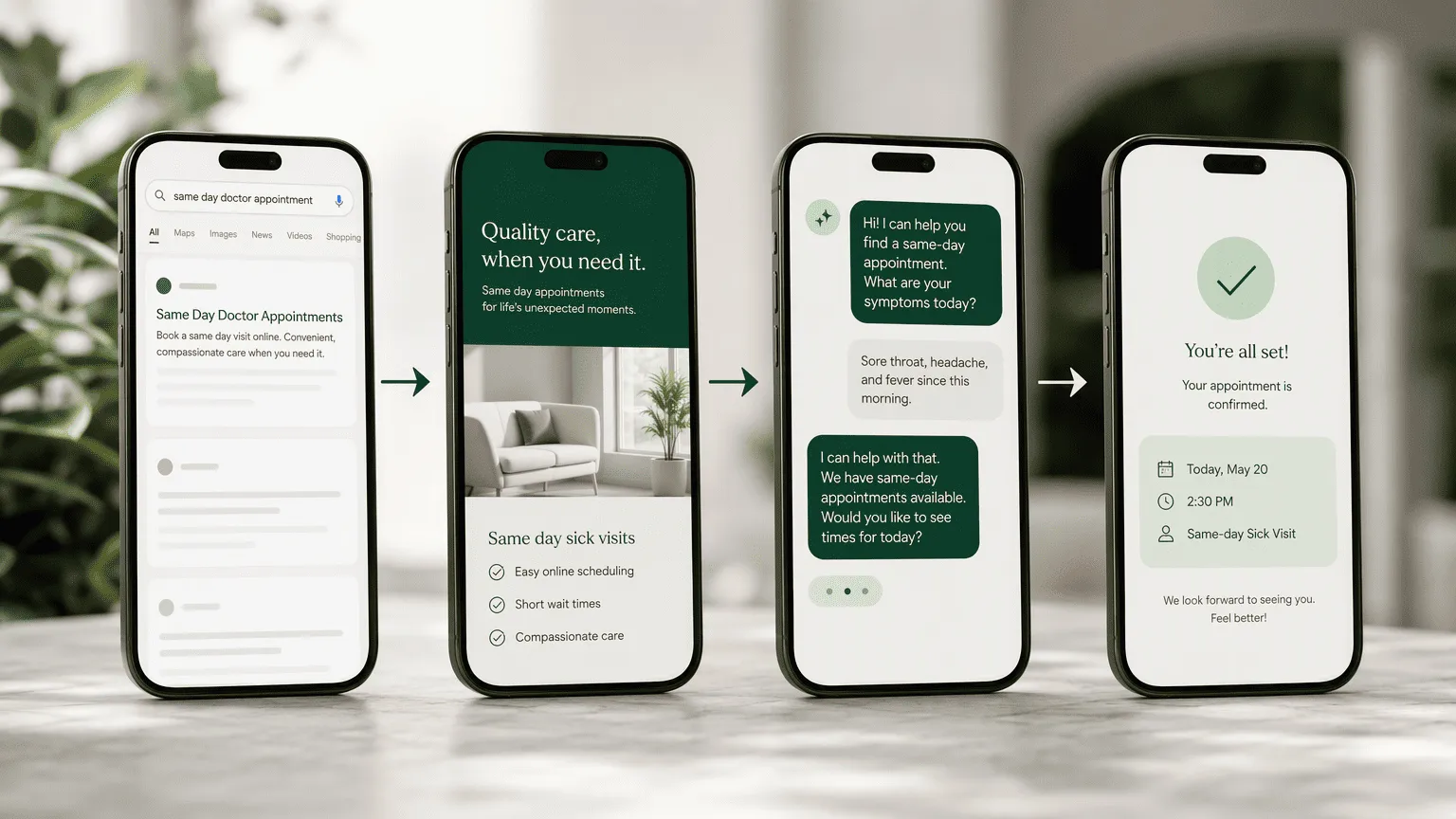
Podium connects local search visibility to booked appointments through a single workflow: a patient finds your practice on Google, lands on your site, and converts over text. That tight handoff from search impression to confirmed time slot is the reason practices that rely heavily on map-pack volume end up here.
The platform's AI webchat kicks in the moment a visitor arrives. Someone searching for a same-day sick visit doesn't fill out a contact form and wait; the chat layer asks what they need and routes them toward an open slot right then. A local-search lead either converts in that session or it usually goes cold, and this tool is built for that reality.
Behind the scenes, automated review requests go out after completed appointments. More reviews, posted faster, correlate with higher map-pack visibility, so the review cycle feeds the ranking cycle without the front desk chasing patients down.
Every channel funnels into one inbox. Texts, webchat threads, and the leads that come from better local rankings all land in the same dashboard, so you can see how many of those ranking improvements actually turned into scheduled patients. Booking confirmations and reminders live inside the same messaging layer that generated the appointment, which keeps the conversion event tied to the communication that created it.
5. Nextdoor: Hyperlocal SEO and Booking for Neighborhood Healthcare Practices
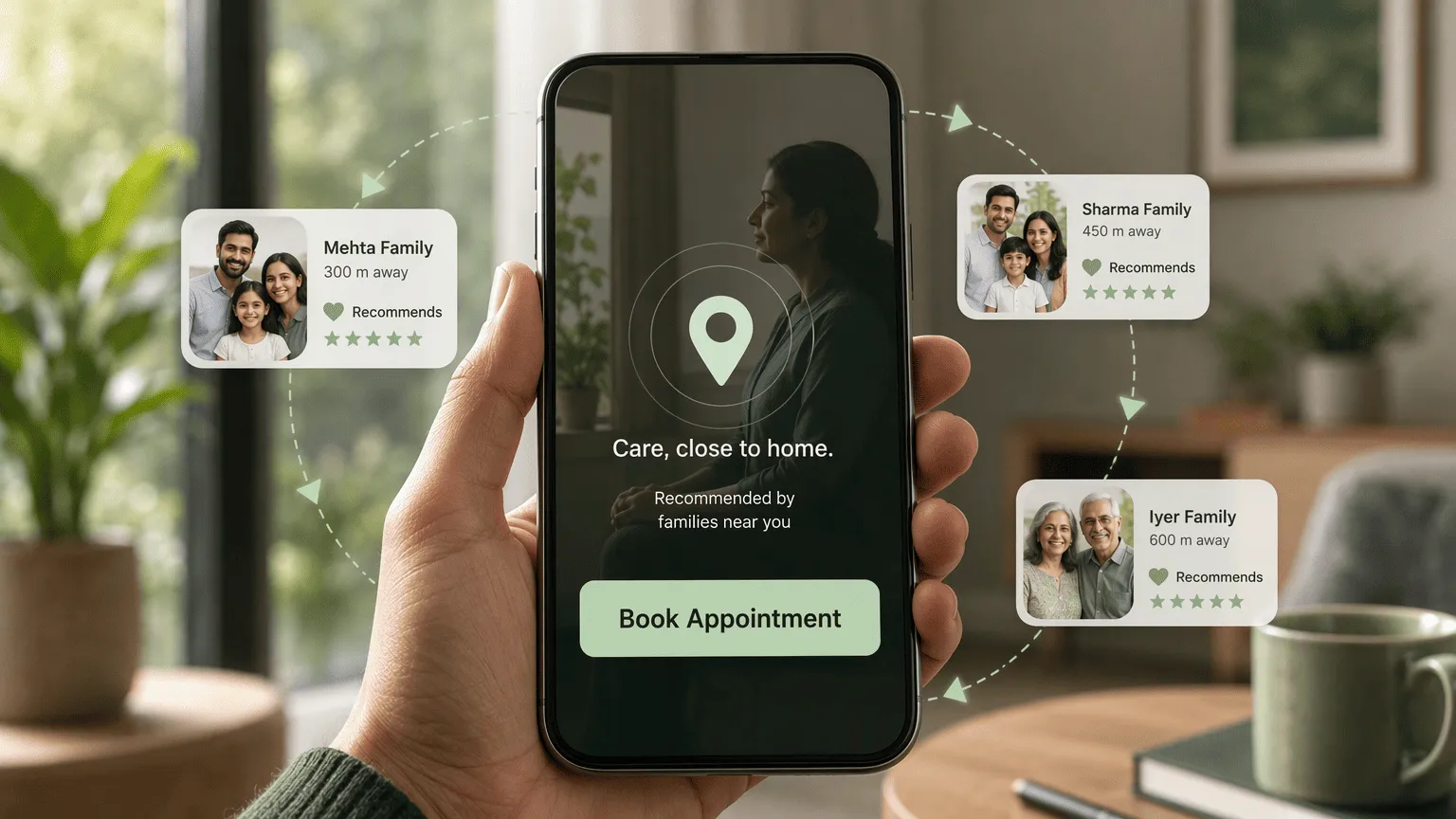
Nextdoor turns your practice into a neighbor, not a search result. When someone in a five-mile radius scrolls their feed and sees three nearby families recommending your pediatric clinic, that endorsement carries weight Google reviews cannot match. The platform's Business Page feeds a local recommendation loop that acts as its own ranking signal.
The "Book Appointment" button closes the loop without a search engine. A patient reads the neighbor recommendation, clicks to schedule, and converts inside the same scrolling session. Nextdoor tracks that entire path in its dashboard: impression to booked visit, one environment. For primary care and family medicine, where the catchment area is tight, that proximity-driven booking flow matters.
The audience skews older and residential. Geriatric practices and family docs fit here naturally because the recommendation currency is repeated neighbor mentions, not review-count competition.
One limit: Nextdoor keeps its booking data to itself. Those conversion signals do not feed into Google's ecosystem or strengthen your map-pack position. If your pipeline depends on Google visibility, run Nextdoor as a neighborhood capture channel alongside, not instead of, your GBP work.
Conclusion
Start with Google Business Profile and a booking provider that sends conversion events into its dashboard. That foundation is free. The data you get there sets the benchmark for every third-party tool that promises to merge ranking and scheduling in one screen.
You see the connection between a ranking change and an actual booked appointment without jumping between tabs.
Birdeye and Podium handle some adjacent pieces well: review requests, multi-location messaging, social scheduling. But they spread ranking and booking data across separate modules. PracticeMojo targets the dental front desk specifically. Nextdoor tackles hyper-local visibility. Each solves a narrower piece of the problem.
Your budget and how tightly you need booking volume tied to local rank should drive the choice. A single multi-function platform that surfaces both in one pane of glass, or Google's native architecture plus separate best-of-breed tools for the parts it does not cover.
Frequently Asked Questions
What are the key features of an all-in-one tool that manages both Google rankings and patient bookings for healthcare practices?
The non-negotiable features are:
- GBP post and review manager: handles content publishing and reputation responses.
- Booking link feeding Google’s booking clicks metric: ensures each appointment registers as a tracked conversion.
- Reporting layer tying search impressions to completed appointments: shows which search activity actually drove scheduled visits.
How does combining Google Business Profile optimization with online scheduling improve patient acquisition for US medical practices?
It removes the highest-friction step: when a patient finds your profile on Google, they click a prominent booking button and schedule instantly. That event feeds back into your GBP dashboard as a tracked conversion, letting you measure exactly how many profile views converted into appointments without forcing the patient to call your front desk.
What are the leading software platforms in the US market that integrate local SEO and patient appointment scheduling as of 2026?
Birdeye and Podium tie reputation management to scheduling via messaging layers. Google Business Profile itself remains the free foundation, tracking booking clicks through any connected booking provider.
What should a US healthcare practice expect to pay for a combined rankings and booking tool, and how does pricing typically scale?
A solo practice should budget $200 to $500 per month for a platform covering GBP optimization and reputation. The booking provider subscription typically adds $50 to $150 per month per location. Pricing generally scales by number of locations or providers rather than by ranking complexity.
What specific ROI or performance metrics can US providers track when using a unified rankings and bookings platform?
The core metrics are search impressions, profile views, booking clicks, and completed appointments. Providers can calculate a conversion rate dividing appointments by views. Google tracks user views once per day per device, and a dedicated booking clicks metric fires only through connected booking providers.
The platform must separate publicly visible content like Google posts and review responses from protected health information in the scheduling layer. Purpose-built healthcare platforms maintain a Business Associate Agreement for the scheduling component while keeping the SEO layer public.
Sources
- Understand your Business Profile performance & insights - Google Business Profile Help - support.google.com
- Get Listed on Google - Google Business Profile - business.google.com
Want help executing this for your clinic?
Book a 30-minute call and we will map what a real ad engine would look like for your specific service mix.
Book a call