
5 Best AI Tools to Predict Optimal Ad Times and Channels
Summary: The article highlights five AI tools that help predict optimal ad times and channels for healthcare marketing. These tools include Google Ads Smart Bidding, Meta Advantage+ for Healthcare, Invoca AI for call-based patient acquisition, AdRoll for seasonal demand modeling, and a fifth tool not detailed in the excerpt. They leverage data to enhance ad targeting, reduce waste, and improve patient acquisition by analyzing booking patterns, search behavior, and call conversions.
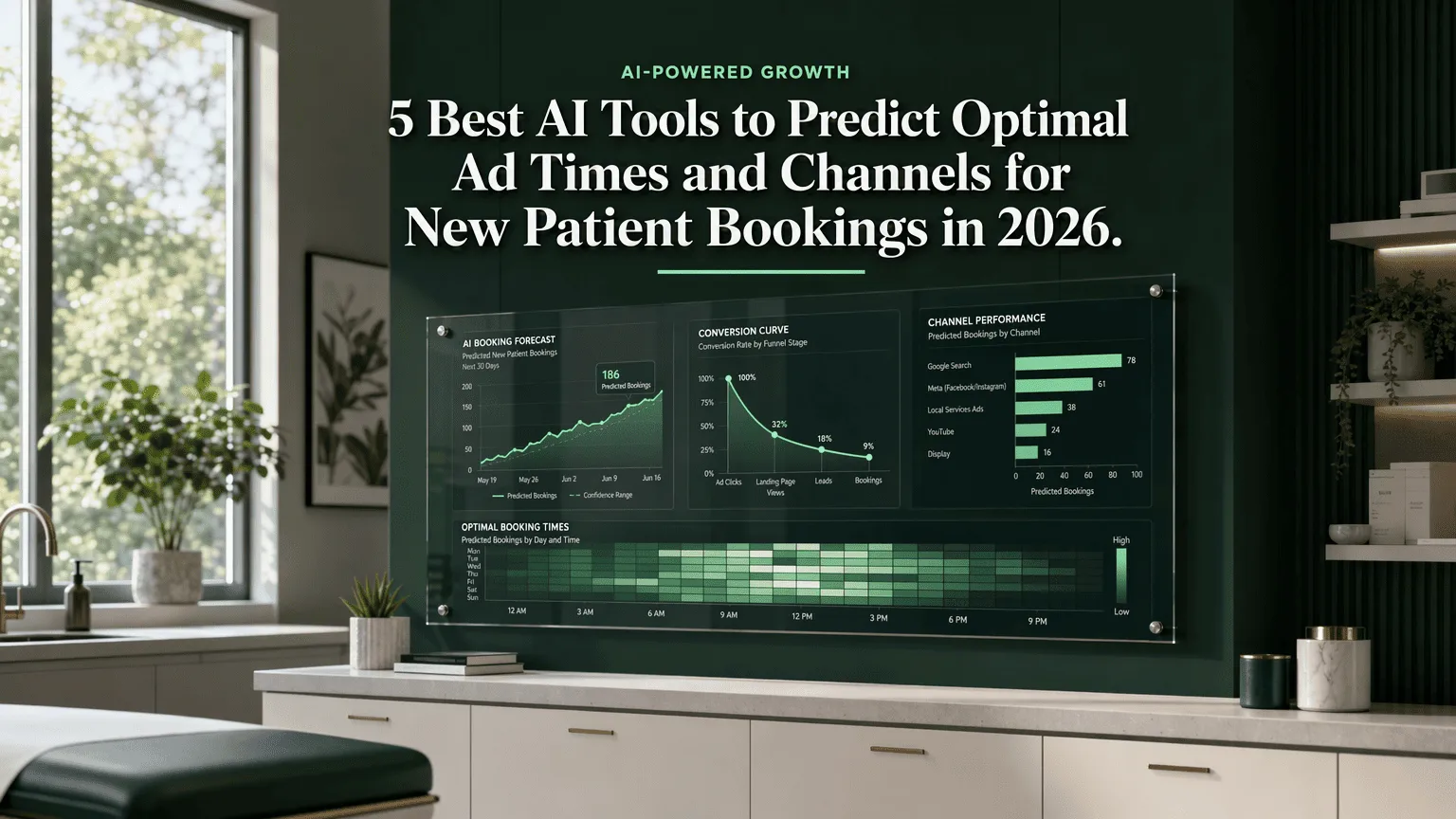
Introduction
Most clinic marketing budgets hemorrhage cash into the wrong channel at the wrong time. You see competitors with full schedules and assume they have a bigger ad spend. The problem is not budget.
The problem is that your ad timing and channel mix are based on intuition, not data. Meanwhile, AI tools are quietly analyzing booking patterns, search behavior, and call conversions to predict exactly when and where your next new patient will appear. This is the current landscape of AI-driven healthcare marketing, and it is changing patient acquisition faster than most clinic operators realize.
Key Takeaways
Here is what separates a profitable AI deployment from a compliance violation and wasted ad spend:
- First-Party Data Is Non-Negotiable: AI prediction accuracy depends entirely on uploading your CRM's patient conversion data into the ad platform's algorithm.
- Channel-Specific AI Exists: Google, Meta, and call-tracking platforms each have distinct AI engines optimized for search intent, social prospecting, and phone conversions, respectively.
- Suppress Existing Patients First: Running new patient acquisition campaigns without uploading a suppression list means you are paying to re-market to people already in your appointment book.
- The Feedback Loop Matters Most: AI for ad timing only works when post-click and post-call conversion signals are fed back into the bidding algorithms in near real-time.
1. Google Ads Smart Bidding with First-Party CRM Data Upload
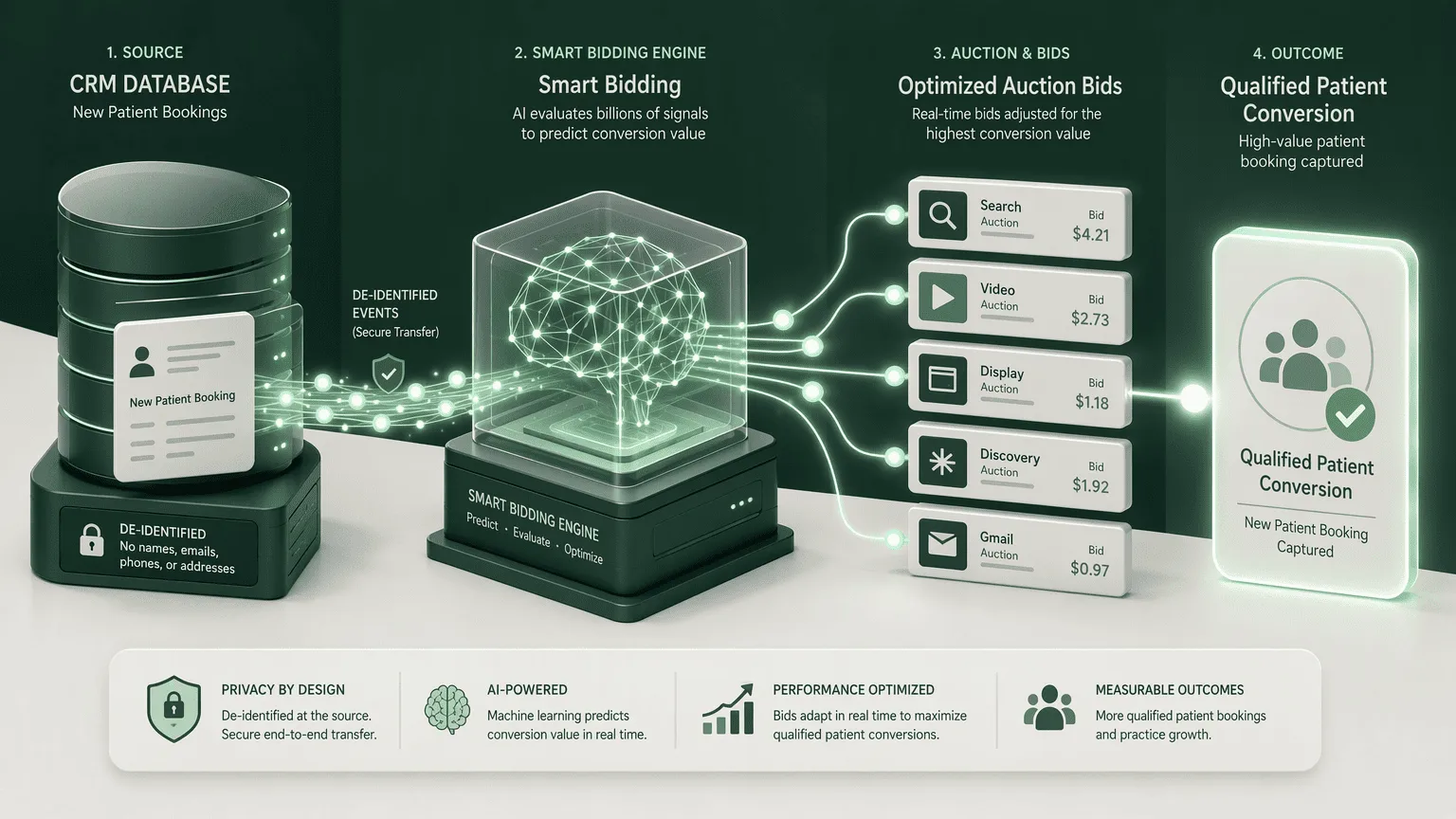
Google's Smart Bidding does not guess. It runs on conversion data, and when you upload de-identified, encrypted patient booking events from your CRM, the algorithm predicts which auction-time bids will produce a real new patient. This is not theoretical. After integrating HubSpot's Marketing Hub with Google Ads, Mesa Labs saw Google Ads become their #1 lead generator.
The technical imperative here is clean data. If your CRM has ghost entries, duplicate records, or lead sources that are not tracked, Smart Bidding trains on noise and produces random output. The output is only as good as the upload.
Google's published policies require a BAA and strict handling of PHI before any CRM data upload. Do not connect any Google Ads account to patient data without an active BAA in place. Beyond compliance, the operational lift is modest: you configure offline conversion tracking, map your booking events, and let the algorithm do the time-of-day and device optimization that no human media buyer can manually adjust at scale. Mesa Labs also increased qualified leads by 43% and saw a 20% boost in conversion rates and a 164% ROI increase through this precise targeting loop.
The outcome is a paid search engine that stops bidding aggressively during low-conversion windows and surges during the hours your future patients actually book. For a surgical practice, that might mean 9 a.m. to 11 a.m. on Tuesdays. For urgent care, it could be 7 p.m. on a Sunday. The algorithm discovers those patterns from your data, not a marketing manager's assumptions.
2. Meta Advantage+ for Healthcare with Existing-Patient Suppression

Running Meta ads without a suppression list will burn through a clinic's marketing budget quickest. You serve Botox ads to patients who just had their appointment yesterday.
Meta Advantage+ campaigns use AI to predict the best creative combinations, placements, and delivery timing across Facebook and Instagram. For healthcare advertisers, the workflow starts with a Custom Audience upload of your active patient roster set to exclusion. This forces the platform to prospect for net-new patients only, so you stop paying to reach people who already bring revenue to the practice.
It is also an ethical boundary. Serving medical ads to your own patients after they have booked communicates that you aren't handling their data responsibly.
The health-related advertising restrictions on Meta are a constraint you have to navigate. Certain health conditions and treatment categories face restricted or prohibited targeting. Advantage+ operates within those guardrails by finding lookalike audiences that resemble your highest-value new patients without leaning on prohibited interest targeting. The AI predicts the creative format and the time of day a receptive new patient is scrolling, based on engagement probability patterns rather than a health profile. The trade-off is real: you hand a layer of manual audience control to the algorithm, and you get placement and timing decisions that adjust faster than any manual campaign could.
For a med spa spending $2,000 to $4,000 a month on social ads, the difference between suppressed and unsuppressed campaigns often passes a 30% waste factor on re-impressions to existing patients. That is budget you could put toward acquiring someone entirely new.
3. Invoca AI for Call-Based Patient Acquisition and Attribution

Phone calls remain the highest-intent conversion event for most medical practices, yet the industry still leaves 30% of calls and inquiries never answered. Invoca's AI addresses this gap through conversation intelligence that listens to call recordings, identifies which calls resulted in a booked appointment, and feeds that signal back into your ad platforms in real time. This is signal-based attribution that does not stop at the click.
What this produces is a timing and channel optimization loop that a purely digital analytics stack cannot provide. A Google Ads click at 10 a.m. from mobile search might generate a call at 10:05 a.m. that books a new patient appointment. Invoca's AI tags that call as a conversion, sends a weighted signal back to Google, and the Smart Bidding algorithm adjusts its bid for that search query, device, and time window accordingly. The feedback loop is near-instantaneous.
The specific problem Invoca solves is the attribution cliff that exists between an ad impression and a phone booking. Without conversation AI analyzing the content of patient calls, clinics are optimizing advertising against incomplete data: a phone call, counted as a conversion, that was actually a billing question. Between 35 and 45% of new patient interactions don't book, and unless the AI can distinguish between a booked appointment and a hang-up, your ad budget keeps optimizing toward the wrong outcome. Recovering those missed interactions can yield over 30% incremental new patient volume.
For high-consideration specialties such as orthopedics, dermatology, and cosmetic surgery, where the call is the most common conversion action, Invoca's AI becomes the translator between human sales conversations and machine-learning ad platforms. Without it, you are bidding on half the data.
4. AdRoll for Seasonal Health-Plan Enrollment Demand Modeling
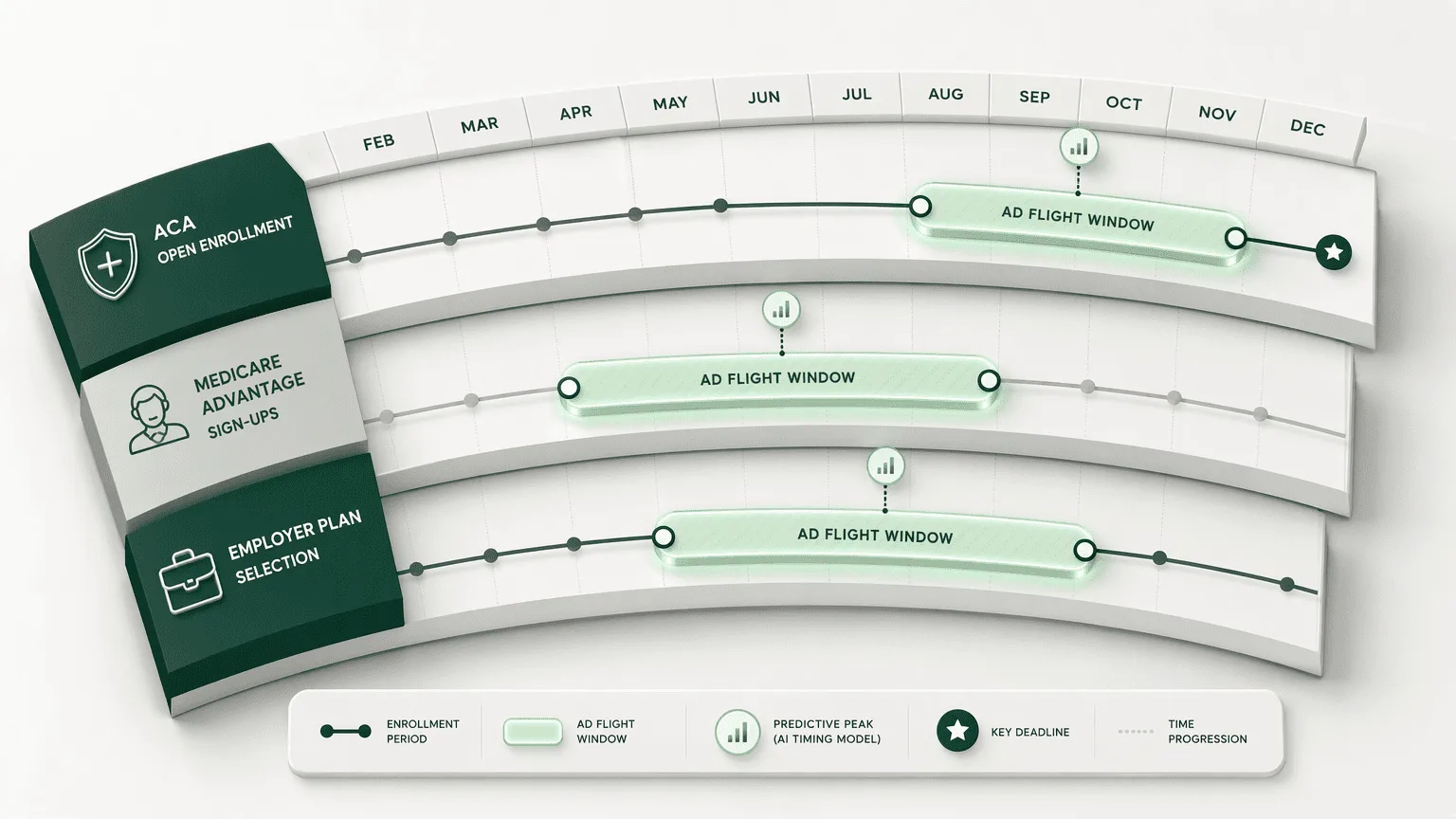
Patient advertising follows a calendar, and the loudest spikes are dictated by insurance enrollment. AdRoll's AI models these demand patterns, predicting optimal ad-flight windows tied to Open Enrollment for the ACA, Medicare Advantage sign-ups, and employer-sponsored plan selection periods. The table below maps the seasonal timing mechanisms against the AI actions that capitalize on them.
| Seasonal Demand Trigger | AI Model Action | Why It Matters for Patient Bookings |
|---|---|---|
| ACA Open Enrollment (Nov 1, Jan 15) | AdRoll's demand modeling predicts the 45 to 60 days of highest intent search and browsing activity | Newly insured patients book primary care, dental, and specialist appointments immediately after coverage activates on January 1 |
| Medicare Advantage Enrollment (Oct 15, Dec 7) | Algorithm adjusts retargeting sequences and ad-flight start dates to capture early shopping behavior | Seniors research new provider networks; waiting until December loses the early-decision cohort |
| Employer Open Enrollment (varies; concentrated in Q4) | Bid weighting shifts toward channels and times when employed adults research plan changes | Elective and family medicine practices see a booking surge once plan deductibles reset |
AdRoll's retargeting engine sequences creatives across display and social based on where an insurance shopper is in their decision window. A visitor who lands on a weight-loss clinic page during an enrollment period but does not book receives sequential ads that acknowledge they are in the coverage-activation waiting period, keeping the practice top of mind until their new plan goes live. This is time-windowed, demand-aware follow-up that aligns with insurance-driven patient readiness.
For a clinic allocating $60,000 to $100,000 annually on marketing, failing to model these seasonal enrollment spikes means you are not present during the precise weeks that newly covered patients pick their providers for the year ahead.
5. CallRail with Conversation Intelligence for Landing-Page Conversion Feedback
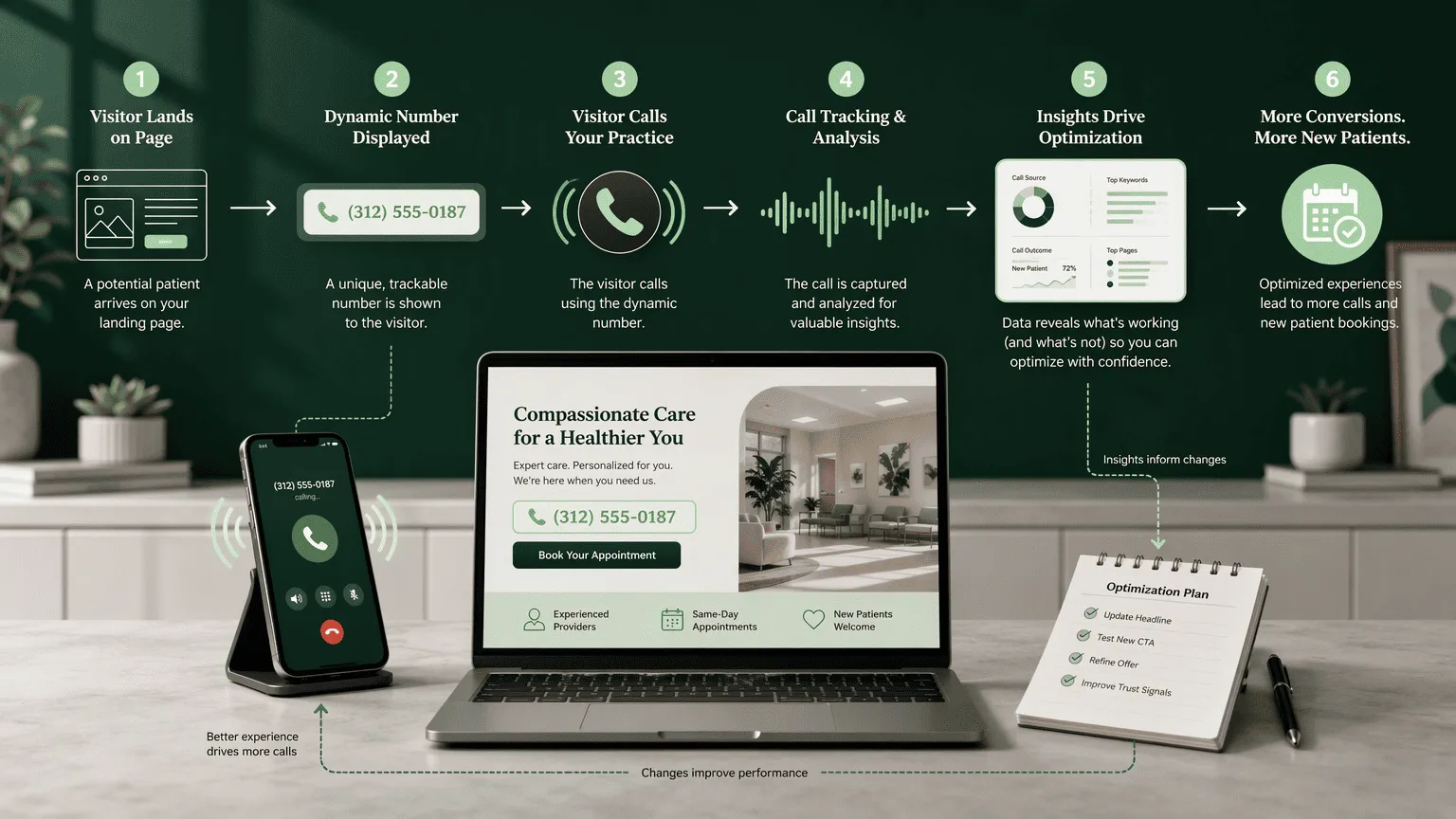
The timing and channel predictions your ad platforms generate are worthless if the landing page the ad sends patients to is leaking conversions. CallRail's AI closes this loop by analyzing call recordings sourced from specific landing pages and diagnosing exactly which page elements, offers, and call-to-action prompts produce qualified new patient bookings. Here is how the feedback mechanism works:
- Landing-page-level call attribution: CallRail's dynamic number insertion assigns a unique phone number to each landing page variant, allowing AI to correlate the page a patient viewed with the call outcome.
- Conversation intelligence scoring: The AI transcribes and scores each call for a positive new-patient-booking outcome. Calls that end without scheduling are flagged for root-cause analysis.
- Time-and-day signal enrichment: Call data includes the timestamp and lead source, feeding back into Google and Meta algorithms to refine the 'best time to advertise' calculation with actual booked-appointment data, not click data.
- Conversion leak detection: If a specific landing page is generating a high volume of booked calls, and a variant is not, the AI isolates the messaging difference, enabling rapid A/B testing of headlines, trust signals, and form placement.
This makes CallRail the diagnostic layer between your ads and your front-desk scheduling team. Combined recovery of missed interactions and lost opportunities with tools that apply this feedback loop yields a combined lift of over 30% in total new patient acquisition when deployed correctly. Without this feedback, even the best AI ad-timing predictions will dump high-intent patients onto a page that cannot close them.
Conclusion
Predicting the best time and channel to advertise for new patients is not a standalone AI feature. The hierarchy of needs is clear: start with the data upload and a signed BAA, add channel-specific AI on Google and Meta with existing-patient suppression lists active, then close the loop with call analytics that tell the algorithms whether the booking actually happened. Skip the foundation, and your AI predictions will optimize toward clicks that never pay the practice's payroll. ClinAds was built for that exact sequencing, and a 30-minute intro call is the fastest way to see if your current ad setup is actually doing what the AI claims it's doing.
Frequently Asked Questions
Can AI accurately predict the optimal times to advertise for new patient bookings?
Yes, when trained on your practice's own first-party CRM data. AI analyzes historical booking timestamps, call conversions, and search patterns to identify high-probability windows. Accuracy degrades without a direct data feed of confirmed appointments; feeding the algorithm click-based signals instead of actual bookings produces misleading predictions.
Which advertising channels does AI recommend for healthcare practices seeking new patients in the US?
AI does not recommend channels in a vacuum; it optimizes the channel mix you define. Google Ads often dominates for high-intent search, Meta Advantage+ for visual prospecting, and call-tracking platforms for phone bookings. The algorithm shifts budget weighting within your defined channels based on conversion probability, not channel preference.
How does AI analyze patient behavior to improve medical advertising ROI?
AI correlates time-stamped booking data with ad exposure, click timing, and call recordings. It identifies patterns such as symptom-searchers converting on Tuesday mornings or cosmetic consultations booking via Instagram Reels on weekends, then adjusts bids and creative delivery to those high-probability intersections automatically.
What are the compliance risks of using AI for healthcare advertising under HIPAA?
The central risk is transmitting protected health information to ad platforms without a Business Associate Agreement and proper encryption. Patient email lists, phone numbers, and appointment data uploaded for custom audiences or offline conversion tracking must be de-identified and hashed. Using non-compliant tools can trigger breach notification requirements and substantial penalties.
What US healthcare advertising metrics can AI tools optimize for maximum bookings?
AI tools can optimize for qualified new patient bookings, confirmed appointment rate, cost per new patient acquisition, and call conversion rate. The critical shift is moving past click-based metrics. Upload confirmed appointments as the conversion event rather than a form fill, so the algorithm bids toward revenue-producing outcomes, not vanity metrics.
Sources
- Increase Healthcare Conversion Rates with HubSpot's Smart CRM | HubSpot - www.hubspot.com
- AI Revenue Activation for Healthcare Practices and MSOs - Patient Prism - www.patientprism.com
Want help executing this for your clinic?
Book a 30-minute call and we will map what a real ad engine would look like for your specific service mix.
Book a call