
Your Telemedicine Website Is Invisible to Google. Here Is the Fix That Actually Works in 2026.
IntroductionYour telemedicine platform ranks nowhere on Google because you treat it like a SaaS startup. Google categorizes your site as a YMYL (Your Money or Your Life) entity. The algorithm measures your clinical legitimacy.
When compliance and marketing operate in separate worlds, the output is a polished site that generates zero traffic and zero bookings. The consequence is not a temporary dip. It is a permanent state of invisibility that starves your patient pipeline and hands the market to competitors who understand the rules.
The competitive landscape for virtual care has compressed. Service-ready queries no longer belong to scrappy direct-to-consumer brands. You face established health systems that hold massive domain authority.
You cannot outspend them. You can out-optimize them. Telemedicine SEO means making a genuinely available, clinically appropriate service easy to discover, easy to understand, and easy to book through organic search.
The eight steps below rebuild your acquisition engine from the ground up, connecting technical performance, medical E-E-A-T, and local authority into one defensible system. This is a prescriptive playbook. No general theory. Each step corrects audit failures I see across telehealth platforms every week.
Key Takeaways
Here are the non-negotiable levers for ranking a telemedicine website in 2026:
- YMYL Survival Rule: Your site faces a higher standard of clinical accuracy and safety; real medical professionals must review your content.
- Provider Schema Is Table Stakes: Without Physician and MedicalOrganization schema, Google's AI cannot parse your credentials, killing your eligibility for medical rich results.
- Local Intent Still Drives Virtual Care: State-by-state location pages, even without a physical clinic, capture regulated Google Business Profile signals when you stay legitimate and compliant.
- Stop Tracking PII on the Client Side: If Google Analytics 4 pulls raw patient data, your data becomes a regulation time bomb. Treat it as a liability to contain, not a growth metric to chase.
- AI Doesn't Crawl; It Synthesizes: Structure your data for Google's AI Overview agents, or your site disappears from the expanding zero-click answer space.
- To build trust and meet regulatory standards, healthcare sites must address five critical areas:
- SSL and HTTPS enforcement: Ensure your SSL certificate is current and force HTTPS globally; eliminate any mixed content errors that leak insecure images, which signal a fundamental lack of care for data security.
- Load speed optimization: Compress oversized medical diagrams, audit third-party scripts for tracking pixels that could leak data, and cut server response times, because patients in medical emergencies or high-stress situations will not wait 10 seconds for a page to load.
- Secure booking flow: Avoid leaking patient data into the URL fragment; implement server-side redirects to strip those parameters and prevent HIPAA violations.
- Focused Core Web Vitals improvement: Pass Core Web Vitals on your 5 highest-intent service pages rather than chasing perfection on low-priority pages like a dusty 'About Us' page.
Step 2: Implement Medical E-E-A-T at Scale with Provider-Level Schema Markup

Google cannot read your 'Our Team' page and verify board certifications. It relies on structured microdata. To rank, you must feed the algorithm explicit schema.org markup that connects your organization to licensed providers:
- Deploy MedicalOrganization schema on your homepage to define the legal entity, services, and contact points. Link it directly to your Organization identifier in Google.
- Implement Physician schema for every clinician treating patients. Populate the
medicalSpecialty,image,alumniOf, and, critically, embed hospitalaffiliationwith anaffiliationOfproperty linking to the hospital's own schema page. - Add Review and AggregateRating data, pulled directly from a verified, compliant review feed, as a sub-property of the Physician node.
- Validate with Google's Rich Results Test, ensuring you aren't hiding data in the markup that is invisible to the user. The visual content and schema must be stringently aligned.
Step 3: Map High-Intent Keyword Themes to Patient Search Intent
Keyword volume is a vanity metric if you ignore the underlying intent that triggers a search. A patient searching 'virtual urgent care' has completely different expectations than one searching 'is virtual urgent care safe.' You need to categorize your content against a transaction-to-information grid, matching each query archetype to the asset most likely to convert.
The top of that grid starts with queries that signal a readiness to book. Someone who types 'online dermatology appointment' does not want a blog post, they want a condition-specific landing page with a booking widget embedded on it.
Cost and insurance queries sit one tier below in conversion immediacy but carry high transactional weight. A search for 'virtual doctor visit cost' requires a pricing clarity page that names the fee without forcing the patient to pick up the phone. A search for 'does virtual care accept insurance' needs a plain-language list of covered treatments and plans. When you answer the money question without friction, you keep the patient on your site instead of sending them back to Google.
At the far end of the grid sits research intent, where the job is not to sell but to earn trust. A query like 'what happens at a virtual dermatology visit' maps to an in-depth Q&A reviewed by a clinician, content that nurtures the reader toward a future appointment rather than pushing for one today. The key is building every page against the specific intent so the visitor lands on exactly what they came for.
Step 4: Build a Local SEO Ecosystem for State-by-State Patient Acquisition

You do not need a Google Maps listing to win patients for a purely virtual care business. An organic search strategy pulls in relevant patients from every licensed state, no fake address required. The real operational mistake is simpler: creating one national 'Telehealth' page and expecting it to rank across 50 states. Google cannot serve hyper-local results without hyper-local content. You build separate syndication hubs for each state where you hold a license.
Your location pages must earn their ranking. A boilerplate template spun for 50 locales triggers the duplicate content filter. Use at least 500 words of copy per page, with organized headers, body copy, bulleted lists, and details tied to that state's regulatory environment.
Include the specific medical licenses applicable there. Mention local partnerships if they exist. Never generate fake addresses.
If you operate a physical administrative office, optimize the Google Business Profile following U.S. HHS cross-state licensure guidance. Do not manufacture a local listing using a mailbox, virtual office, or any location where patients never meet the business. Google's local algorithm actively punishes ineligible telehealth listings.
Step 5: Develop a Content Engine That Demonstrates Clinical Authority
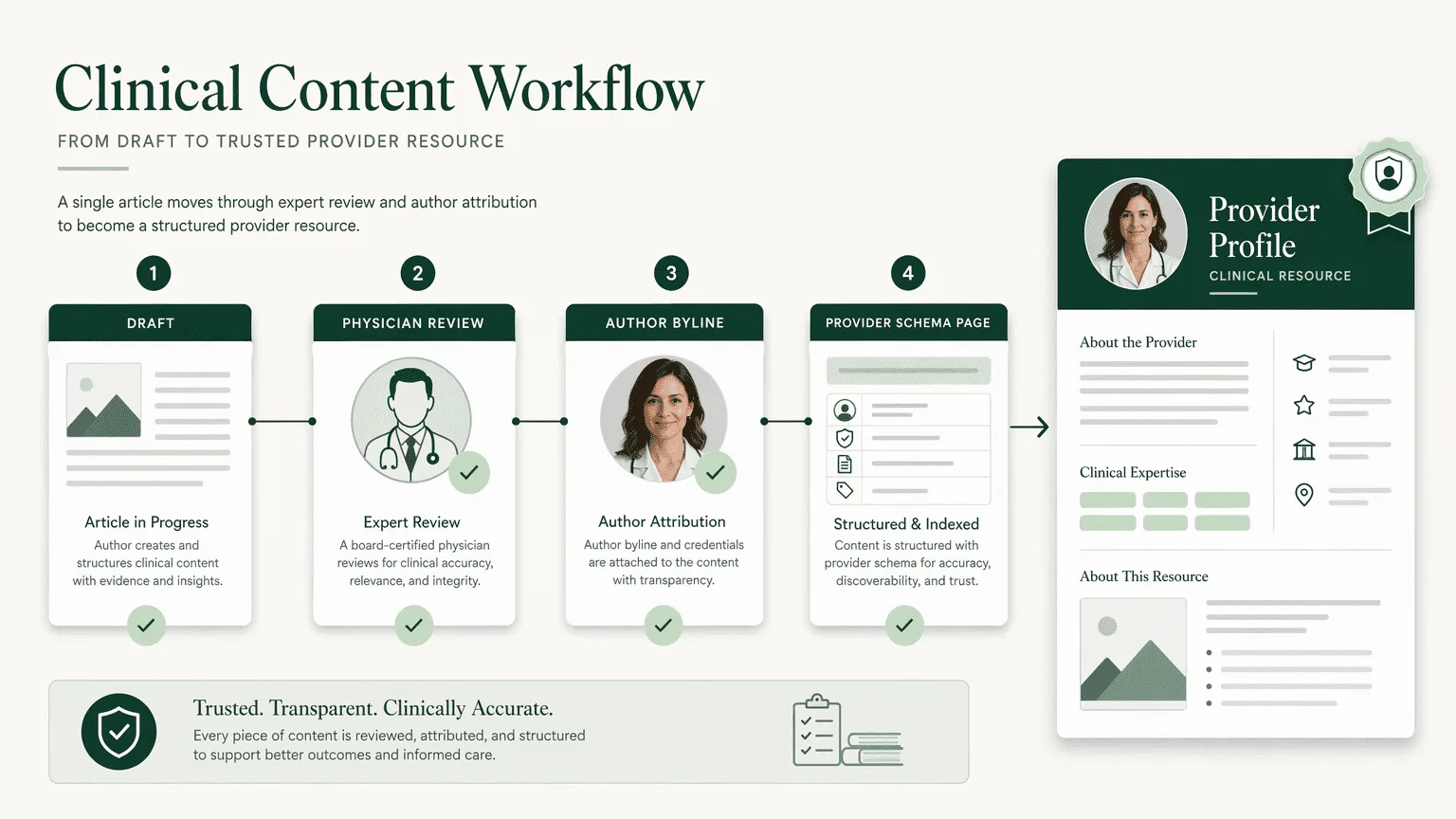
An AI-generated blog post about 'top 10 anxiety tips' with no medical reviewer attached is a YMYL violation waiting to happen. Your content library builds trust.
Your content engine needs strict guardrails. Embed author bylines that link to fully detailed Physician schema-enhanced provider pages, including state license numbers. A faceless 'Editorial Team' block signals zero expertise to Google's Quality Raters. The E-E-A-T and YMYL framework for clinical websites demands the people behind the content are visible and credentialed.
Focus on problem-solution clusters. For an online dermatology practice, a core cluster is 'itchy rash treatment' with sub-topics that include 'how to get a prescription for allergies online' and long-form guides on isotretinoin risks. Link every subsidiary article back to the booking-enabled pillar page.
Do not publish reactive news without deep peer review. For every revised guideline from the FDA or NIH that you cover, cite the primary source explicitly, note the publication date, and add a 'last medically reviewed by' datestamp. Stale medical advice tanks your domain-wide authority score.
Here is exactly how the intent walls break down across search query archetypes:
| Intent Category | Query Archetype | Content Asset Required | Conversion Level |
|---|
Step 6: Construct Trusted Medical Citation and Link-Building Playbook

Most clinics chase links from every healthcare directory they can find and get nothing except a spam signal. Google classifies medical websites as YMYL sites, so the standards for quality, accuracy, and safety run significantly higher. For a telemedicine brand, a backlink from a local newspaper's wellness blog does not carry the same authority as a citation from a state medical board or a peer-reviewed journal. You are being judged by an algorithmic standard that expects your content to cite credentialed sources and be cited by them. One link from a.gov or.edu domain referencing your clinical protocols carries more ranking weight than fifty directory submissions.
Earning these links requires a reverse approach to traditional outreach. Skip the mass guest post pitches to medical associations written by your marketing intern. Instead, publish original condition-specific research, survey data on patient outcomes, or case studies authored by your clinical director.
If you track readmission rates for a telepsychiatry program, publish a whitepaper with the data and distribute it to relevant academic institutions. This content becomes a linkable asset that medical librarians and health policy writers reference organically. Tools like ClinAds, an AI-first growth platform, help healthcare practices structure this authority content so it surfaces in both search engines and AI-generated answers on platforms like ChatGPT and Perplexity.
Patient testimonials and links from reputable medical sources demonstrate authority, but handle them carefully due to healthcare advertising regulations. Collect reviews through compliant post-visit email flows. When a physician's professional profile earns a mention on a hospital affiliate page or a telehealth industry analyst report, ensure the hyperlink points to your most clinically rigorous service page, not your homepage. A November 2026 analysis demonstrated that Google's AI map result directly surfaced three businesses to users even when the search lacked a geographic modifier. Your link profile must signal trust before a patient ever clicks, not after.
Step 7: Measure What Matters: HIPAA-Safe Conversion Tracking for Telemedicine
Standard Google Analytics tracking is incompatible with regulated healthcare. Default GA4 implementations expose protected health information (PHI) to the ad pixel layer, which puts you in direct breach of HIPAA. You cannot fix this with a consent banner alone. The architecture has to be rebuilt server-side.
Start by configuring data redaction in your tag manager. Strip URL query parameters that contain keyword, diagnosis, or procedure identifiers. Add data exclusion rules by matching regex patterns for common PHI leaks. Also explicitly disable Google's 'Signals' and 'Ads Personalization' data sharing settings; these features transfer residual identifiers, breaking the legal partition between your database and Google's ad stack.
Move to server-side tracking immediately. Route conversion signals through a client-owned server container before they hit Google's endpoint. Filter out identifiers and pass only hashed, anonymized signals. This setup lets you track 'appointment requested' as a secure, abstract goal. You never need the patient's name to know which channel closed the sale.
Measure patient acquisition cost (PAC) per state and per service line weekly. If you cannot attribute bookings to source or medium without exposing PHI, your tracking setup is the bottleneck capping your growth.
Step 8: Execute a Tactical Playbook for AI-Assisted Patient Discovery

Half your potential patients are no longer clicking a blue link. They are asking Google's AI Overview what their symptoms mean. To rank inside that synthesized response, you must structure data for algorithms that consume entire knowledge graphs:
- Own the entity space. Ensure consistency across Wikipedia, Wikidata, and your Google Business Profile. Conflicting physician names or outdated taxonomy on a third-party directory will confuse AI agents and remove you from the recommendable set. A deep GEO Expert strategy closes this gap.
- Cluster content for MUM. Google's Multitask Unified Model crosses languages and formats. If a patient uploads a photo of a rash, your video transcript describing 'erythematous plaques in a photo' might serve an answer. Write alt text and transcripts surgically.
- Deploy extensive FAQ schema. You win the zero-click space by answering secondary, adjacent questions preemptively. Mark up the Q&A immediately below your headings to capture voice search volume.
Conclusion
Ranking a telemedicine site is a contest of precision. You're fighting for a limited pool of fully qualified patients, not raw traffic. The eight-step recipe outlined here tracks identically to what an operational CDO would audit every month: measure where you start, map searches to pages, fix the technical side, create and improve content, win local ground, earn authority, feed the AI assistants, and then repeat. Start by auditing your server-side tracking today.
Book a 30-minute intro call.
Frequently Asked Questions
What are the core Google ranking factors unique to telemedicine and healthcare websites?
Google evaluates telemedicine sites under strict YMYL guidelines, meaning clinical accuracy and author expertise are critical. Core factors include explicit provider schema markup, HTTPS security, professional medical bylines, and transparent privacy policies. A generic retail SEO playbook will fail here without meeting these elevated trust and safety benchmarks.
Mixing PHI with client-side Google Analytics violates privacy laws and forces a hard technical separation. Search engines penalize insecure sites; a valid SSL, a BAA-hosting solution, and compliant server-side tracking are functional ranking signals, not just legal checkboxes, for medical entities.
What local SEO strategies can a US telemedicine practice use to attract patients in specific states or cities?
Build state-specific location pages with at least 500 words of unique copy. Highlight per-state licensing and local telehealth regulations. Do not use PO boxes for Google Business Profiles; an organic local on-page strategy is safer and more effective than risking a suspension for a purely virtual care service.
How should a telemedicine provider build E-E-A-T (Experience, Expertise, Authoritativeness, Trustworthiness) for medical content?
Implement Physician schema that links each clinician to their medical affiliations, specialties, and board certifications. Publish content with strict 'medically reviewed by' bylines, not anonymous authors. Cite peer-reviewed journals, keep content updated, and demonstrate direct patient care experience within the text.
What content marketing and keyword themes work best for virtual care services in the current competitive landscape?
Focus on high-intent, problem-solving clusters. Transactional terms like 'online urgent care appointment' convert, but informational assets like 'typical cost of an online X prescription' capture users earlier in the funnel. Align condition-focused treatment guides with the specific medications your clinicians commonly prescribe.
How can telemedicine sites acquire and manage online reviews while complying with healthcare advertising regulations?
Never solicit reviews in a way that pressures patients to disclose PHI in a public comment. When responding professionally, confirm appointment processes without validating any specific medical condition mentioned.
Sources
- SEO & GEO Expert | Careers at ClinAds - getclinads.com
- Telemedicine SEO: How to Attract More Qualified Patients (2026 Guide) | Charles Kirkland - www.charlesrkirkland.com
- E-E-A-T and YMYL for clinical websites: what the framework actually asks for | Pontem One - pontemone.com
- How to rank your website on Google, step by step | Tagorising - tagorising.com
- Telemedicine SEO Guide : Rank Your Healthcare Platform - qrolic.com
- How to Boost Local Rankings for Multi-location Medical Groups | Cardinal Digital Marketing - www.cardinaldigitalmarketing.com
Want help executing this for your clinic?
Book a 30-minute call and we will map what a real ad engine would look like for your specific service mix.
Book a call