AI Search in 2026: 9 Reasons Your Clinic’s Marketing Has to Change
IntroductionTraditional organic search ranking is no longer a reliable patient-acquisition engine. The problem isn't a budget shortfall. The problem is that the interface patients use to find care has been replaced by an answering machine.
Google’s AI Overviews now appear on 43 to 48% of US searches, and on a staggering 89% of healthcare queries. When your potential patients ask a medical question, they aren't scrolling a blue-link list. They are reading a synthesized answer sourced directly from your website, or your competitor's.
If your clinic's content architecture reads like a medical brochure rather than a cited, authoritative source, you’ve already lost the top-of-funnel. This isn't a future-state prediction. It's a structural change that demands a rebuild of how you approach digital visibility, authority, and compliance.
Key Takeaways
A rapid-response overview for clinic owners and operators who need to make a call this quarter:
- Visibility is already zero-sum: Only 8% of users who see an AI Overview click a traditional result. If the answer doesn't cite you, the patient doesn't find you.
- Authority requires named people, not logos: Adding expert clinician authors and inline citations delivers a 27 to 40% boost in AI answer visibility. Anonymous “our team” copy performs worse.
- Your tech stack likely blocks AI crawlers: Server-side rendering is rated a 9.5/10 citation factor. JavaScript-heavy clinic sites are invisible to most answer engines.
- The citation standard just changed: Perplexity now indexes named medical journals directly. Generic clinic content has been structurally demoted in its premium tier.
- HIPAA risk moved faster than your intake forms: A staff member pasting PHI into a consumer AI tool is a breach with no BAA in place.
1. Perplexity Premium Health Sources: The New Two-Tier Citation System for Clinics

On 5 May 2026, the rules of clinical credibility in AI search were rewritten. The gatekeeper stopped being a backlink profile and became a journal access pass.
| Feature | Premium Health Sources (Tier 1) | Standard Web Content (Tier 2) |
|---|---|---|
| Example Sources | The BMJ, NEJM, BMJ Best Practice | Generic clinic site, WebMD, non-cited blogs |
| Citation Likelihood | High; direct integration into the answer engine | Low; must prove consistent alignment with peer-reviewed data to be surfaced |
| Visibility Trajectory | Default answers for clinical queries | Secondary suggestions or omitted entirely on specific prompts |
| Required Clinic Action | Align site content with these primary sources using inline citations | Shift from broad topic pages to precise, question-led references citing Tier 1 journals |
Perplexity’s integration of BMJ and the New England Journal of Medicine directly into its answer engine changed the economics of content creation. A clinic describing treatment protocols without citing recognized research is structurally excluded from Tier 1 visibility. The trade-off: publish content that’s peer-review-aligned, or accept AI invisibility.
2. Google AI Overviews: Confronting the 89% Healthcare Dominance
Google no longer treats healthcare as a niche vertical. It’s the dominant AI use case. 89% of healthcare queries trigger an AI Overview, higher than any other industry. Specifically, 100% of treatment queries and 98% of pain-related queries (US data) now display an AI answer above the fold.
This means a patient asking 'how much does an MRI cost without insurance' or 'recovery time for a knee replacement' sees a machine-generated box that pulls a direct quote from a specific page. A review of 15.7 million citations found that 80% of answers took the source material from the article’s first sentence. To be the quoted source, your page must open with a hard, quotable fact, not a vague introduction.
3. Answer-First Content Architecture: Engineering Snippets AI Crawlers Cite
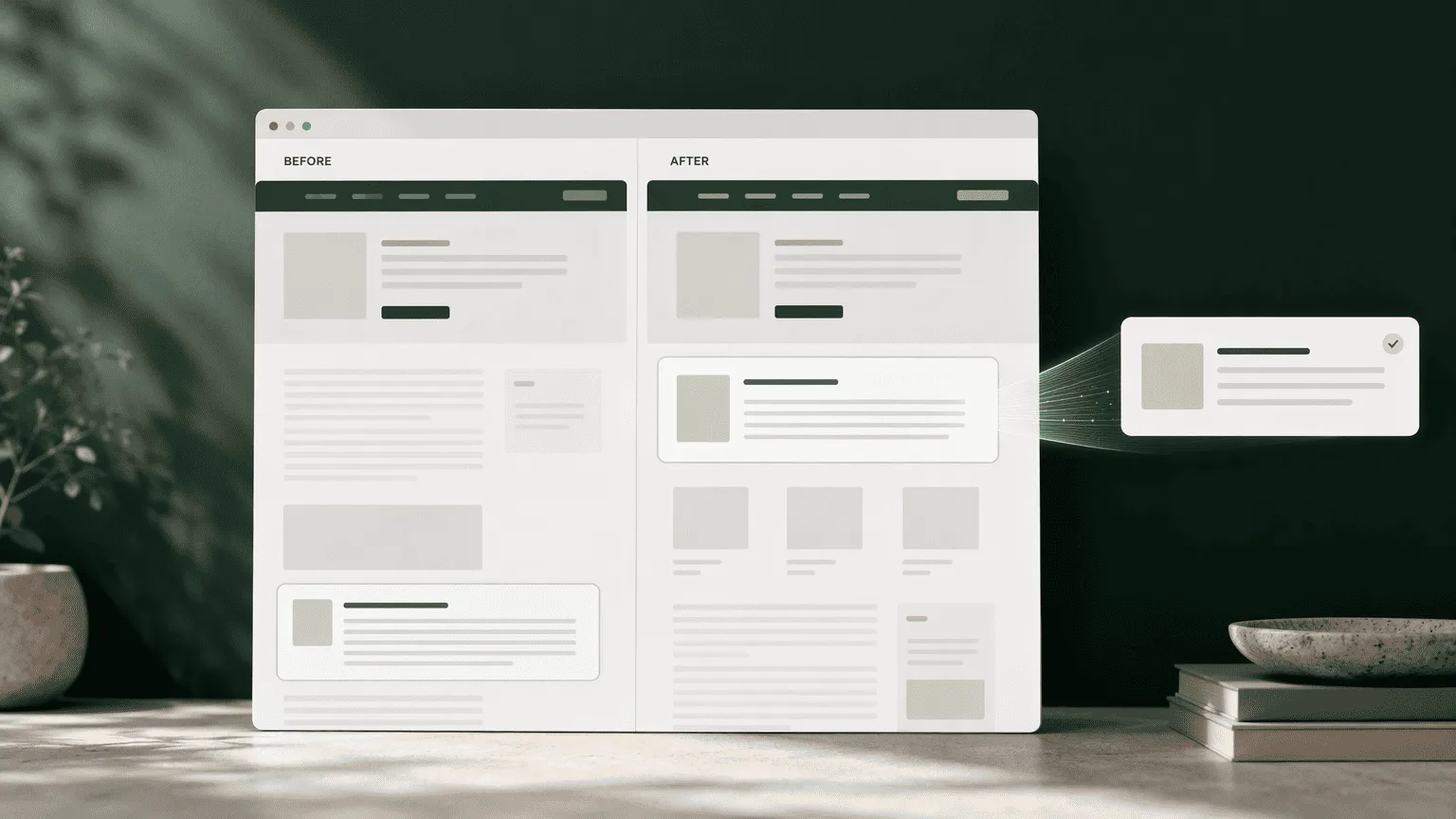
AI crawlers don't 'read' pages like a human. They extract specific blocks to satisfy a query. If your first sentence describes your clinic's founding year, and the competitor's first sentence states a mortality rate, the algorithm cites the competitor. Structuring your content for extraction reliability is the new SEO:
- Lead with the answer: Place a self-contained, quotable 40 to 60-word answer directly under every section header. Research confirms that AI models reuse question-led passages twice as often as narrative prose.
- Kill the accordion pattern: Google removed FAQ rich results in May 2026. Hiding clinical answers behind expandable toggles now provides zero markup benefit and hides copy from crawlers that prefer visible, flat text.
- Replace procedure pages with protocol questions: 'Total Hip Replacement at Midtown Clinic' underperforms '40% of patients regain mobility within three weeks of hip replacement, according to a 2024 study published in the Journal of Bone and Joint Surgery.' Question-led, stat-led pages dominate.
4. The Authority Stack: Named Clinician Authors and Inline Citations
Generic clinic copy is a commodity signal. The data is clear: AI search engines raise content that mirrors academic publishing conventions. A study involving Princeton and IIT Delhi quantified this, testing strategies across 10,000 queries. Adding expert quotations lifted visibility by 27 to 28%. Adding statistics lifted it by another 25 to 26%.
The mechanism is simple. Assign a named clinician author to each content section, not just a generic clinic byline. Then, support every clinical claim with a linked inline citation to a recognized journal. This combination signals “domain authority” in a format an LLM can verify. Anonymous, citation-free pages are treated as marketing vapor.
5. Server-Side Rendering Overhaul: Making Your Clinic's Site Legible to AI Crawlers

AI search researchers rank one technical factor at 9.5 out of 10 for citations: whether an AI crawler can read the text on your page. That factor is server-side rendering.
Most clinic websites, especially those on drag-and-drop builders, load content dynamically with JavaScript. An answer-engine crawler hits the URL, sees an empty shell, and indexes nothing. The AI can't quote what it can't see. Your surgical outcomes stop mattering.
Implement server-side rendering (SSR) so your HTML arrives fully formed. Ask your web team: 'Does this page's source code contain the full text content before any script runs?' If the answer is no, or they can't answer, get a rendering audit. Fix this single constraint and your clinic can surface ahead of a more authoritative competitor whose content is trapped behind JavaScript.
6. HIPAA-BAA Vendor Vetting: A Tactical Checklist for Evaluating AI Marketing Tools
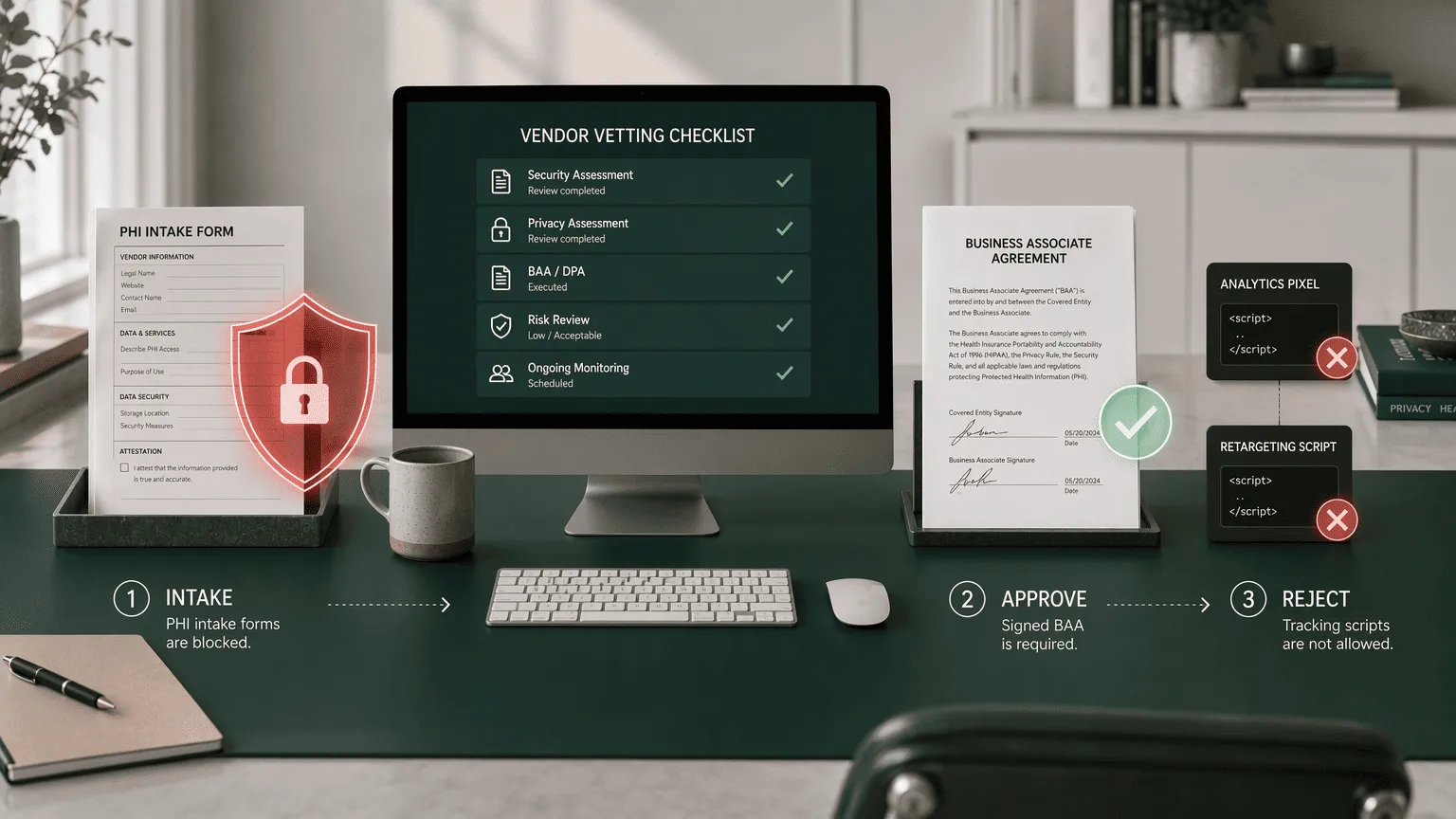
The biggest legal threat to your clinic right now is not a bad review. It's a staff member in the marketing department pasting a patient intake form into a free AI tool to 'summarize' it.
That single copy-paste action is a reportable breach. The problem multiplies when analytics pixels and retargeting scripts fire on appointment-request pages, sending PHI to ad platforms that explicitly prohibit it.
Here is the non-negotiable verification sequence for any AI marketing tool touching patient data:
- Require a signed BAA: Obtain a signed Business Associate Agreement before any data is processed. If the vendor demurs or offers only an enterprise tier that 'comes with a BAA at scale,' eliminate them.
- Map the PHI flow: Document exactly which endpoints in your site, forms, or call tracking pass through the vendor's infrastructure. Analytics pixels on symptom-specific pages have drawn regulatory attention and litigation.
- Demand no training on your data: Require a written statement confirming the vendor does not train AI models on your input data.
- Verify audit logging access: Ensure you can access audit logs to demonstrate compliance during a breach investigation.
The rule is straightforward: if a tool is marketed for clinic growth but lacks baked-in HIPAA controls, it was almost certainly built for e-commerce with the word 'patient' swapped in. Walk away.
7. Consolidating Service Pages: Eliminating Internal Competition Across Locations
Multi-location clinics often publish 15 near-identical pages, each targeting '[City] Knee Replacement,' expecting that footprint to capture local AI traffic. A model will happily write those 15 near-identical pages, and AI crawlers will happily ignore all of them.
Answer engines run deduplication logic that is stricter than traditional Google filters. When a crawler sees multiple pages whose substance repeats with only the city name swapped, it flags the whole set as low-authority noise and cites none of it. The fix is one definitive procedure page. Give it location subsections that differ materially: the equipment list for one site, the surgeon profiles for another, the parking instructions and public transport stops for each. One real page per location beats fifteen templates.
8. Measuring AI Search ROI: Attribution Models for an Answer-Engine World
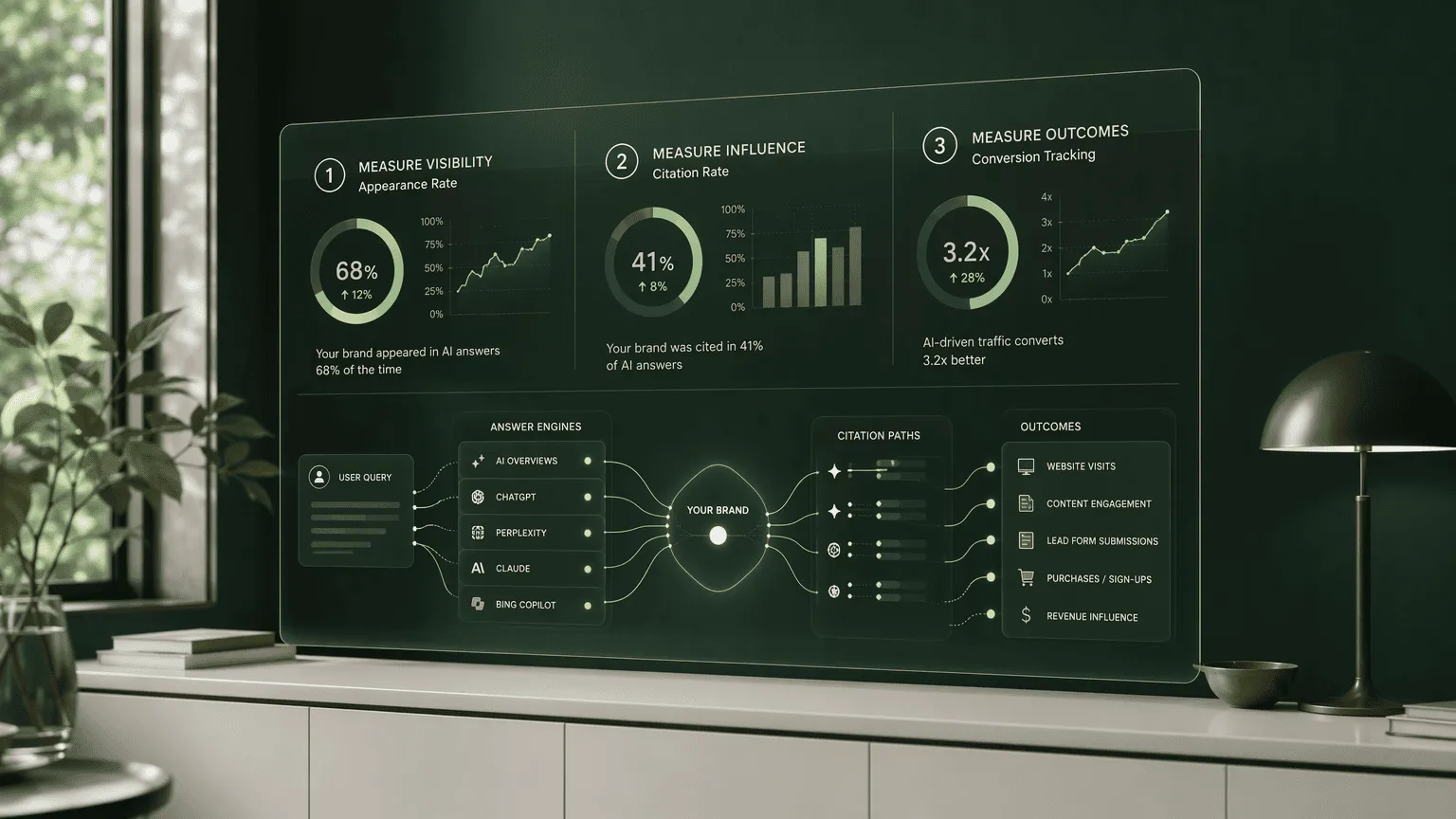
You can't manage what you can't measure, and traditional rank-tracking tools were built for a world of ten blue links. Those tools cannot accurately report your presence in an AI Overview or a Perplexity citation. Declaring a page as 'ranked #1' on a keyword is misleading if 92% of traffic never touches a traditional result.
The new measurement framework requires tracking your presence inside AI answer engines in aggregate. Follow these steps:
- Monitor your appearance rate: Across your 50 highest-value clinical questions, measure in what percentage of AI Overviews or chatbot answers your domain is cited. This replaces the obsolete keyword position metric.
- Implement zero-click impression monitoring: In an answer-engine world, a citation may answer a patient's question without a click, yet that exposure isolates your clinic as the authority they book with.
- Build a GEO-oriented map: Involves mapping fifty or more core clinical and commercial questions that matter to your therapy area and then measuring your domain's citation presence on those queries over time.
- Correlate citations with conversions: Connect your citation tracking data with actual slot utilization data from your scheduling system. The hard metric to watch, as always, is appointment conversion. A page that ranks third and fills the Tuesday afternoon MRI slots is outperforming one that ranks first and generates calls the front desk can't book.
Attribution is still imperfect. There is no clean UTM tag for 'ChatGPT mentioned my surgeon.' But you can correlate increases in AI citation volume with changes in branded search volume and direct-path new-patient inquiries.
Conclusion
Half of consumers now use AI intentionally to make a decision. If your clinic's content can't be read by those engines, you've already lost their traffic. The algorithm that surfaces a practice today looks for named physician authors, peer-reviewed citations, and instant-loading server-side HTML. Meta tags stopped carrying the conversation months ago.
Three fixes separate visible clinics from invisible ones. Get your technical foundation right first: server-side rendering so AI crawlers can parse every page. Then restructure the content itself.
Write an answer-first architecture around the exact clinical questions patients type. Last, build an authority stack.
Assign a real clinician's name to every asset and include inline citations that link to source material. Marketing that skips even one of these is already silent.
Frequently Asked Questions
What exactly is AI-powered search and how does it differ from traditional Google search?
Traditional search returns a list of links for you to click. AI-powered search, such as Google AI Overviews or Perplexity, generates a direct, synthesized answer by pulling a quoted passage from a specific webpage. You get an answer in the engine itself, not a referral to an external site.
How are AI search platforms changing how patients find healthcare providers?
Platforms prioritize direct, citable answers over link rankings. A patient asking about recovery timelines now sees an AI-generated quote sourced from a clinical page. If your site isn’t the cited source for that specific query, the patient never encounters your brand in their decision process.
What specific steps should a medical clinic take now to ensure its AI search visibility?
To optimize your clinic site for AI search visibility, address these key areas:
- Implement server-side rendering so AI crawlers can read your site.
- Rewrite key pages to open with a specific, self-contained 40 to 60-word answer.
- Assign a named clinician author to each page and back every clinical claim with an inline citation to a peer-reviewed journal.
Do AI search engines prioritize different signals compared to traditional SEO?
Yes. AI engines heavily weight first-sentence clarity, named expert authors, and peer-reviewed citations over backlinks. Server-side rendering is the highest-rated technical factor, rated 9.5 out of 10. Question-led, statistically dense copy reuses better than descriptive brochure text.
How can I track whether patients find my clinic through AI search tools?
Abandon keyword rank tracking as a primary metric. Monitor your domain’s citation rate across AI-generated answer sets for your top clinical queries. Correlate increases in AI citation volume with branded search traffic and direct appointment calls, accepting that precise attribution remains imperfect.
What are the biggest HIPAA risks in using AI tools for clinic marketing?
Several common practices pose immediate compliance risks for clinics using AI marketing tools:
- Staff pasting PHI into free consumer AI tools without a BAA is an immediate breach risk.
- Analytics pixels firing on appointment-request or symptom pages can expose PHI to ad platforms.
- Any vendor without a signed BAA and a guarantee not to train on your data is non-compliant.
Sources
- AI in Medical Marketing: What Clinics and Pharma Brands Need to Know - www.bams-digital.com
- What Changed in AI Search: Q2 2026 | Co-Kinetic - co-kinetic.com
- AI Search for Clinics: How to Get Mentioned in AI Overviews - bookedsolid.health
Want help executing this for your clinic?
Book a 30-minute call and we will map what a real ad engine would look like for your specific service mix.
Book a call