
Your Dental Practice Is Missing on Google Maps. Here Is the Unforgiving Reason Why.
IntroductionA prospective patient is standing three blocks from your clinic, phone in hand, searching for a dentist. Your name does not appear. Instead, a competitor with a mile more distance and fifty more reviews takes the top local pack spot.
The channel is not broken. Your Google Business Profile is.
Google’s local algorithm cares about three signals: relevance, prominence, and proximity. Most practices fixate on proximity, assuming a shorter physical distance guarantees a ranking. That assumption leaves the other two signals neglected, and that is why you are invisible.
This article walks through the technical factors suppressing your Maps presence and lays out a recovery path that starts with a brutal GBP audit and ends with a 90-day re-ranking window.
Key Takeaways
Invisibility on Google Maps is a technical debt problem, not a mystery. These five findings drive every recovery case we see:
- Prominence overrules proximity every time: A more popular competitor will beat a closer practice with a neglected profile, because Google’s local algorithm asks, "Which businesses are the most popular and the most well regarded in their local market area?" first.
- A complete GBP is non-negotiable: Relevance is the degree to which a listing matches the search, and it is improved by adding complete and detailed business information. A thin profile signals to Google that you are a less relevant answer.
- Duplicate practitioner listings suppress your practice: Multiple doctor profiles at a single address confuse Google’s entity matching, splitting authority and often filtering your primary practice page out of the local pack.
- HIPAA-compliant review generation is mandatory: Prominence relies heavily on review velocity and sentiment, but a single response containing protected health information can trigger a compliance violation. You need a scripted, safe request protocol.
- Your website is the authority signal: Google assesses website content matching GBP categories, backlinks, and on-page optimization as core prominence inputs. A slow, thin site starves your Maps ranking of fuel.
The Three Local Ranking Pillars That Decide Your Maps Visibility

Google has told us directly that the main factors that determine local ranking are: Relevance, Proximity, and Prominence. Here is exactly how each one filters your practice in or out when a patient searches for a dentist nearby:
- Relevance: The algorithm asks, "Does this business do or sell or have the attributes that the searcher is looking for?". If your primary category is "Crown" instead of "Dentist," or you have not specified secondary categories like "Emergency Dental Service," you fail the relevance check immediately.
- Proximity: The question is, "Is the business close enough to the searcher to be considered to be a good answer for this query?". Note the word "enough." Proximity is not a fixed radius from your door. It stretches and contracts based on how many relevant, prominent options exist in the searcher's area.
- Prominence: Here, Google asks, "Which businesses are the most popular and the most well regarded in their local market area?". The algorithm assesses directories, reviews, website optimization, backlinks, and website content matching your GBP categories. A rival with 120 reviews and consistent NAP citations across Healthgrades will outrank your 12-review profile every time, regardless of which building is closer.
Your Google Business Profile: The Core Diagnostic Checklist
A cold audit of your Google Business Profile is the single highest-ROI move you can make right now. Follow these steps in order:
- Verify ownership, An unverified profile cannot appear in local pack results, which means it simply does not exist for patients searching nearby.
- Set your primary category to "Dentist" and nothing else, Practices drift toward sub-specialties like "Cosmetic Dentist" or "Dental Hygienist" as the primary, but that throttles your relevance for the broad "dentist near me" queries that bring in the most patients. Load every other applicable sub-specialty as a secondary category. "Emergency Dental Service," "Pediatric Dentist," and "Oral Surgeon" each unlock a different search intent without weakening your main signal.
- Fill in every hard-filter detail, In the "from the business" section, list every accepted insurance plan, every language your team speaks, and every accessibility feature your office has. A patient who searches for a dentist that takes Delta Dental or speaks Spanish won't see your practice if those fields are blank. Google treats these attributes not as nice-to-have descriptions but as gates that either include you or exclude you from the results. Audit your hours down to the minute. A profile showing "Closed" on a holiday when you are actually seeing patients suppresses your listing for every single search made that day. Block off an hour and update your holiday hours for the next twelve months in one sitting. Most practice owners blame the algorithm when their listing disappears, but missing hours create a silent suppression that is entirely self-inflicted. The rankings impact is quick and visible. Practices that correct their primary category to "Dentist" and add four or more relevant secondary categories routinely see a lift within two weeks. They stop competing against themselves for mismatched queries, and the local pack responds.
The Proximity Paradox: Why Being Closer Doesn't Guarantee a Top Spot
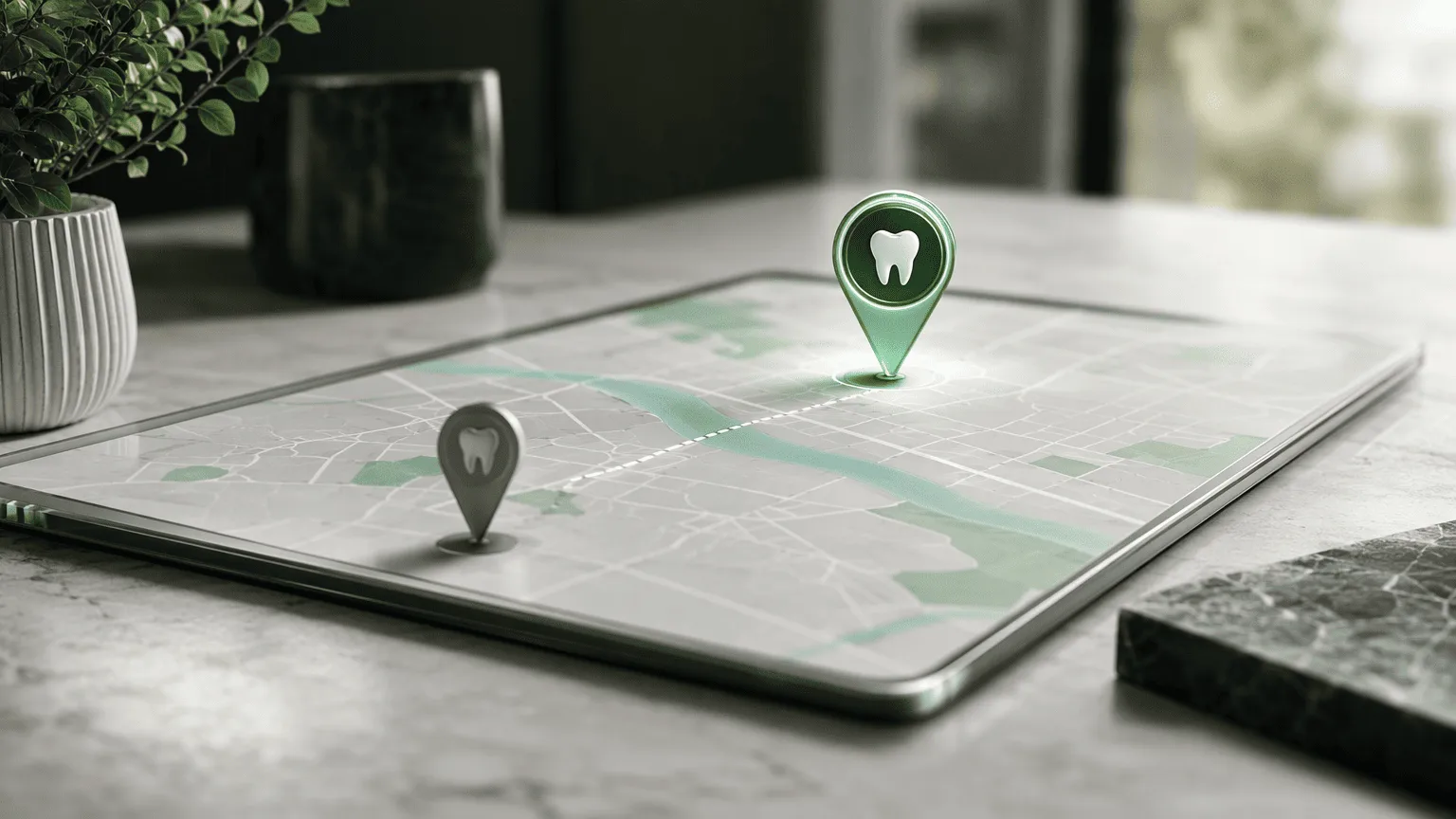
You assume the practice two blocks closer to the searcher always wins the map pack. That assumption is costing you patients.
The problem is treating proximity as a fixed radius. Google measures it as a fluid, query-dependent signal that stretches and contracts based on relevance and prominence.
A dental practice three miles away with 85 five-star reviews and a fully optimized Google Business Profile will routinely outrank a closer competitor with a half-built listing and seven stale reviews. Proximity alone is weak. Google's algorithm asks, "Is the business close enough to the searcher to be considered to be a good answer for this query?" Closeness is one variable.
You cannot move your physical location, but you can make your practice digitally heavier. When your GBP category precision, review velocity, and citation consistency signal authority, Google stretches the proximity band around your address. A complete profile with verified categories like "Emergency Dental Service" can pull your pin into a local pack from farther away than an incomplete competitor sitting on the same block.
How Duplicate Practitioner Listings Suppress Your Practice
If your practice employs multiple dentists, and each one has claimed an individual practitioner GBP at the same address, you are likely suppressing your own main practice listing. Google's entity matching algorithm struggles to distinguish between a practice and its practitioners when multiple profiles share a phone number, address, and overlapping category sets. The result is a split authority signal where none of the listings accumulate enough prominence to rank. This is the single most common self-inflicted ranking wound we diagnose in dental offices. Here is how to decide which profile type to maintain and which to clean up:
| Scenario | Practitioner Listing Strategy | Practice Listing Strategy |
|---|---|---|
| Solo practitioner, no public-facing associates | Keep one practitioner profile that includes the practice name; do not create a separate practice listing | Optional; a single well-optimized practitioner profile is sufficient |
| Multiple dentists at one location, each seeing their own patients | Maintain an individual practitioner listing ONLY for doctors with distinct patient books; add the "Practitioner" category and remove clinic-level categories | Keep one primary practice listing with the "Dentist" category; this is the listing designed to rank for "dentist near me" searches |
| Multiple dentists, but only one public-facing brand name | Do NOT create separate practitioner listings for associate dentists without a public patient book; these will be flagged as duplicates | Reinforce the single practice listing with practitioner bios on the website instead of separate GBP profiles |
Google's rules on individual practitioner listings state that a practitioner profile is appropriate when the practitioner is a public-facing professional with their own distinct patient base. When you create practitioner listings for every hygienist and associate dentist simply to occupy more Maps real estate, Google identifies the pattern as a violation and suppresses the entire cluster. Remove the duplicate profiles and direct all review generation and citation building toward one authoritative practice listing. Authority consolidates. It does not spread.
Building Prominence Ethically: HIPAA-Compliant Reviews and Citation Authority
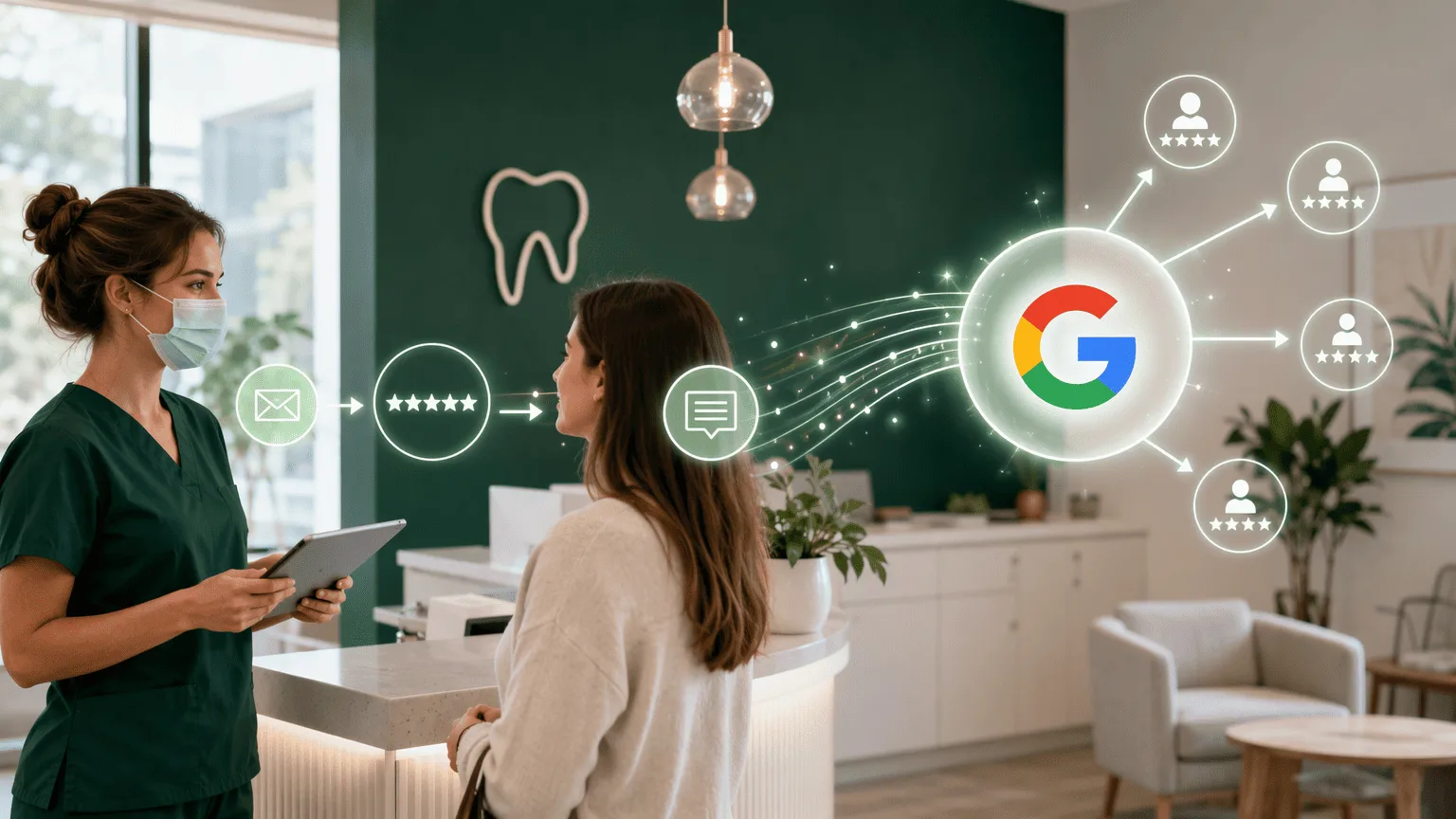
Reviews are the loudest prominence signal Google hears, and the volume required is higher than most clinicians assume. A practice with 12 reviews cannot compete with one that accumulated 85 reviews with a consistent 4.7+ star rating and a 90% owner response rate. The challenge is not marketing bravery. It is HIPAA. Soliciting reviews from patients who have just completed a procedure requires a script that never reveals protected health information in a public forum, and your response to any review must be so generic that it could apply to any patient who ever walked through the door.
The safe mechanism is a review-generation workflow that strips identifiable details before the request ever hits Google. After a visit, direct patients to a HIPAA-compliant internal feedback form first. Segment the satisfied respondents, then send a follow-up email or SMS that links directly to your Google review URL with language like, "We value your feedback on your recent experience with our practice."
Never mention the procedure, the date, or any clinical outcome. When responding to a posted review, use a templated reply: "Thank you for trusting our team with your care.
We are glad you had a positive experience." That single sentence, repeated, satisfies both the engagement signal Google wants and the compliance boundary HIPAA demands.
Citation consistency provides the foundation underneath reviews. Google assesses whether your practice name, address, and phone number match exactly across the web. Two directories carry particular weight: the ADA's Find-a-Dentist tool and your NPI registry entry. A practice address that reads "Suite 200" on your GBP but "Ste 200" on Healthgrades introduces a mismatch that weakens your prominence score. Audit these core citations first, before you chase new review volume, because even a flood of five-star ratings cannot compensate for a fractured NAP foundation.
The Website Connection: How Organic SEO Fuels Your Maps Ranking

Your GBP does not rank in isolation. Google evaluates the website linked from your profile as a primary authority signal, assessing everything from title tag relevance to mobile page speed. A practice with a slow, five-page brochure site that has not been updated since 2021 is telling Google that it has low prominence, regardless of how many citations you have cleaned up.
Local landing pages are the most direct lever you can pull. Create a dedicated page for each location and each core service, structured with a title tag formula that follows "[Service] in [City, State] | [Practice Name]." Embed LocalBusiness schema that maps precisely to your GBP categories, and ensure the page loads in under three seconds on a mobile device. Google's mobile-first indexing means a desktop-fast site that crawls on a phone will cost you Maps visibility.
Screaming Frog can surface keyword cannibalization across your URLs. When multiple location pages or blog posts target the same "dentist" keyword, they compete against each other. The fix is straightforward: consolidate thin pages into one authoritative service page and 301-redirect the rest.
A Real-World Timeline for Regaining Maps Visibility in 2026
Practices abandon their SEO efforts after one week because they expect the three-pack to magically populate. The algorithm does not index changes at human speed, and the recovery cadence follows a predictable sequence that stretches across approximately 90 days. In days 1 through 7, complete the GBP corrections and deduplication work: verify the profile, correct the primary category to "Dentist," load secondary categories, standardize hours, and remove or merge duplicate practitioner listings. These changes trigger an initial re-index, but do not expect a ranking jump yet. Google's systems are ingesting the new entity signals and reconciling them against existing web data.
Days 8 through 30 are the review velocity ramp. Implement the HIPAA-compliant review request workflow immediately. The goal here is not a specific star rating.
It is consistent acquisition momentum. A practice that adds three to five new reviews per week signals active patient engagement, and Google's lookback windows for review freshness reward recent activity disproportionately. By day 30, you should see incremental improvements in your local pack positioning for branded searches.
The ranking curve steepens in days 31 through 60 when citation growth compounds. Distribute your corrected NAP to the ADA directory, NPI registry, Healthgrades, and your state dental board listing. Google crawls these high-authority sources on a regular schedule, and each matching citation reinforces the entity confidence that underpins your prominence score.
The final stretch begins after day 60. Your domain authority gains accumulate from the website optimization you started in phase one: faster mobile load times, consolidated local landing pages, and correct schema markup. Combined with the now-steady review stream and consistent citations, the algorithm has finally assembled a complete, authoritative picture of your practice.
By day 90, if your prominence work has outpaced the competitors who ignored theirs, you should see stable placement in the local pack for your core service area queries. The ranking is not a reward for patience. It is the mechanical result of stacking enough signals to force the algorithm's hand.
The Proximity Paradox: Why Being Closer Does Not Guarantee a Top Spot

Most dentists assume a practice physically closer to the searcher will automatically outrank a more distant competitor. The data says otherwise. Proximity is fluid, like a rubber band, and depends on the query, the searcher's location, the relevance to the query, and the prominence of the business. Google will stretch that rubber band past your front door to reach a practice two miles farther away if that competitor has a fully optimized GBP, 200 recent reviews, and a website with strong domain authority. You lose the local pack not because you are unfindable, but because you are unremarkable in the algorithm's eyes.
The centroid effect in metropolitan areas amplifies this further. When a searcher is downtown, the local pack often clusters around the city center's density of optimized listings, not around the closest physical address. A suburban practice sitting just outside that centroid can fall out of the three-pack entirely while a downtown competitor three miles away dominates. You cannot move your physical location. You can build the prominence and relevance signals that force Google to stretch the proximity band in your direction.
Service-area business designations add another wrinkle. If your GBP is set as a service-area business without a visible street address, your proximity signal weakens further. Google must interpret your coverage area rather than a fixed point. For brick-and-mortar dental practices, verify that your address displays publicly and matches the exact physical location on your website's contact page and every citation source. A mismatch here erodes the proximity signal you already have.
Conclusion
Your practice's absence from Google Maps is not a glitch. It is a signal, one that traces directly back to weak relevance and insufficient prominence. Proximity sits outside your control. The other two decay over time when you ignore them.
The fix starts with a 90-day sprint that begins with a GBP category and duplication audit, picks up speed with review velocity, and compounds when citation consistency and site authority lock into place. Pull the audit this week. For a detailed technical sweep of what is suppressing your specific profile and a recovery brief you can work from, the ClinAds blog carries the field notes and walkthroughs.
Frequently Asked Questions
What are the most common reasons a dental practice does not appear in Google Maps local search results?
The most frequent causes are these five factors:
- Incomplete or unverified Google Business Profile, Without full verification and completion, your listing is invisible to the map pack.
- Primary category set to something other than Dentist, Using a sub-specialty like "Cosmetic Dentist" as primary weakens your relevance for broad "dentist near me" searches.
- Duplicate practitioner listings at the same address, Multiple listings for the same practice split reviews and confuse Google's entity recognition.
- Insufficient review volume relative to nearby competitors, A practice with few reviews can't compete with a competitor that has dozens of recent, positive ratings.
- Inconsistent name, address, and phone data across directory citations, Mismatched NAP details erode the prominence signal that Google trusts.
How does Google Business Profile optimization directly affect a dental practice's visibility in the Google Maps Local Pack?
Optimization improves relevance, the degree to which a listing matches a search. Adding complete business information, accurate categories, services, and attributes directly helps Google understand your business and match it to relevant searches, which raises your eligibility for the local pack.
What exact steps can a US dentist take to verify, claim, and improve an existing but underperforming Google Business Profile?
Verify the profile through postcard, phone, or video verification. Then correct the primary category to Dentist, load all relevant secondary categories, update business hours including holidays, add insurance and language attributes, publish recent office photos weekly, and respond to every review within 48 hours.
How do proximity, prominence, and relevance work as Google's local ranking factors specifically for dental practices?
Relevance matches your profile attributes to the searcher's query. Proximity considers the physical distance from the searcher but stretches based on available competitors. Prominence measures your practice's popularity through reviews, website authority, and citation consistency across the web, and frequently overrules proximity.
Why do I see a competitor farther away ranking above my dental practice on Google Maps?
This is the proximity paradox. Google treats proximity as a fluid factor that stretches when a slightly more distant practice has significantly higher prominence signals, such as more reviews, a stronger website, and consistent directory citations. A neglected nearby profile loses to a well-maintained profile every time.
What is the most dangerous self-inflicted ranking error a multi-dentist practice makes on Google Maps?
Creating separate Google Business Profile practitioner listings for every dentist at the same address without distinct patient books. This confuses Google's entity matching, splits authority across multiple profiles, and frequently triggers a suppression filter that removes the main practice listing from local pack results.
Sources
- Clinic Marketing & AI Advertising Insights | ClinAds - getclinads.com
- Understand the Main Google Business Profile Local ... - www.google.com
- The Local Algorithm: Relevance, Proximity, and Prominence - Moz - moz.com
Want help executing this for your clinic?
Book a 30-minute call and we will map what a real ad engine would look like for your specific service mix.
Book a call