
The Small Clinic Marketing Trap (and the Agencies Who Fix It)
IntroductionMost small private clinic owners are running two businesses: the one they trained for, and a marketing department they never wanted. You're a clinician who now has to figure out ad spend, and your appointment book stays empty unless someone's running the engine. The default panic move is hiring the same big-agency model the hospital down the road uses, and it eats your budget alive without filling chairs. That game is built for system-wide branding, not booking your next 15-minute consult.
The question "Are there marketing companies that specialize in small private clinics rather than big hospitals?" isn't academic. It's the single most profitable thing you can get right this quarter.
And the answer is yes. Pulse Digital Health works exclusively with over 40 UK private clinics and no other industries.
Castle International built its entire practice around clinics, dental practices, and aesthetics. Both deliberately exclude hospital systems because the unit economics, patient journey, and regulatory exposure are completely different.
What follows is a diagnostic rundown of who these agencies are, how their approach differs from the hospital-marketing machine, what it costs, and how to vet them before you sign a retainer that underdelivers.
Key Takeaways
Here's what a small clinic operator needs to internalize before evaluating any marketing partner:
- Specialist agencies exist and are searchable: Boutique firms like Pulse Digital Health (40+ UK clinics) and Castle International build their entire book of business on independent practices, not NHS trusts or large hospital groups.
- Small-practice marketing is a different discipline: Hospital marketing scales brand awareness; clinic marketing answers "Is this right for me? What does it cost? How fast do I recover?" and must clear regulatory bars the big-agency teams often miss.
- Local SEO is the non-negotiable foundation: Google Business Profile optimization and location-specific content pages dominate the patient acquisition funnel before paid media ever enters the picture.
- ROI benchmarks exist to hold agencies accountable: Castle International reports a 12.3:1 return on ad spend for Google Ads campaigns and a £42.20 cost per consultation across channels for clinic clients. These are the numbers your retainer needs to beat or explain.
- Regulatory competence is a gate, not a bonus: If an agency can't explain how the CAP Code section 12 restricts promotion of prescription-only medicines or how GMC advertising guidance constrains your testimonials, you're carrying compliance risk they created.
- Budget fit is knowable before you engage: Transparent pricing structures (rare but available) and fractional retainers mean you can start professional marketing without betting the practice on a 12-month contract.
What Types of Agencies Specialize in Small Private Clinic Marketing

The market breaks into three categories. Knowing which one you're talking to before the proposal hits your inbox prevents a six-month detour.
- Healthcare-only boutiques: These turn away hospital RFPs as a rule. Pulse Digital Health is the cleanest example, it works exclusively with private clinics, consultants, and medical groups, and the agency's own site draws a hard line that media buyers from retail or e-commerce are not part of the team. That filter matters because a GMC-compliant treatment page and a DTC product landing page are built by different muscles, and most agencies won't admit they only have one.
- Private-practice specialists: These treat clinic vertical as their whole addressable market, even if they occasionally serve adjacent aesthetics or dental practices. Castle International operates here: its casebook is clinics, dental practices, and private patient services like Clatterbridge Private Clinic, the private patient arm of an NHS cancer centre. These agencies live and die by the patient acquisition economics a solo practitioner cares about, not the system-level volume metrics a hospital marketing director reports to the board.
- Hybrid shops with dedicated healthcare divisions: These run a healthcare division staffed by people who understand PECR consent rules and CQC registration requirements, but whose parent company also services non-healthcare clients. The distinction test is simple: if the person writing your treatment pages also writes copy for a SaaS company, keep looking. The regulatory stakes are too high. Generic agencies often fall short in this space because healthcare marketing fails quietly. The ad that attracts a complaint rather than a patient doesn't look broken on the analytics dashboard.
How Small-Practice Marketing Differs from Hospital-System Marketing
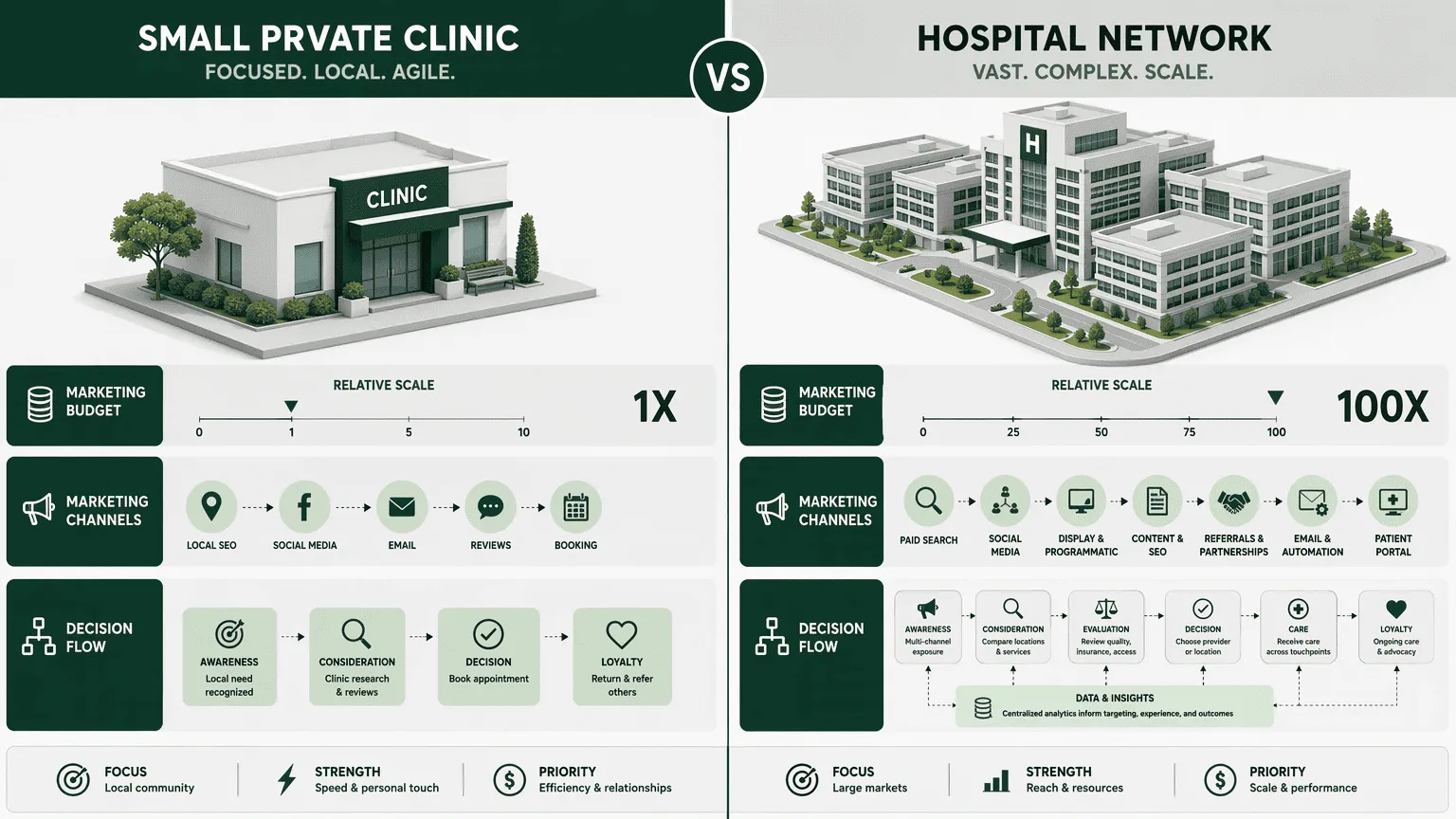
The single largest mistake a clinic makes is copying hospital marketing tactics and expecting the same results with a fraction of the budget. The two disciplines share a vocabulary but not a playbook.
| Dimension | Small Private Clinic | Large Hospital System |
|---|---|---|
| Core objective | Convert a searcher into a booked consultation for a specific treatment | Build system-wide brand preference and referral volume across dozens of service lines |
| Patient decision triggers | Suitability questions, recovery time, cost transparency, clinician credibility | Reputation breadth, insurance network coverage, specialist availability, facility prestige |
| Primary digital channel | Local SEO via Google Business Profile and location pages; high-intent Google Ads on treatment keywords | Broad paid search, programmatic display, television, and sponsorship |
| Content compliance exposure | Every page must clear CAP Code, GMC guidance, and CQC registration requirements; complaints hit the individual practitioner | Legal and compliance departments review campaigns; risk is distributed across the institution |
| Budget scale | Retainers often in the low thousands per month; cost per consultation is the North Star metric | Campaign budgets can reach six or seven figures monthly; share of voice and market perception drive measurement |
| Agency revenue model | Performance-based or fixed monthly retainer with transparent deliverables | Multi-year agency-of-record contracts with blended hourly rates and large account teams |
For a small clinic, every page published is a compliance document. Pulse Digital Health states that every page they publish is written against the CAP code, GMC advertising guidance, and CQC registration requirements, because the alternative is a website that generates a complaint rather than a consultation. A hospital's agency might never need to navigate those regulations at the individual page level. That gap is why clinic-specific specialization matters.
The Core Digital Strategies That Drive Patient Acquisition for Clinics

Most clinic owners mistake a channel for a strategy. Posting on Instagram or running a Google Ad is a tactic. A strategy is the unified plan that answers patient questions before they book, surfaces your clinic where they're searching, and converts curiosity into a consultation across every touchpoint. The problem is not that digital marketing doesn't work for small clinics. The problem is that a single-channel pilot, run without a content engine behind it, burns budget for six months and produces nothing but a bad taste for the whole discipline.
The foundation is local SEO built around a fully optimized Google Business Profile and location-specific landing pages that answer suitability, recovery, and cost questions directly. A specialist agency like Pulse Digital Health, which works exclusively with 40+ UK private clinics, consultants and medical groups, and nothing else, builds every page against the CAP Code, GMC advertising guidance, and CQC registration requirements because non-compliant content costs you a complaint, not a patient. For paid acquisition, the math must be transparent: Castle International reports a 12.3:1 return on ad spend for Google Ads and a £42.20 cost per consultation across channels for clinic clients.
Those numbers only hold when the landing page, ad creative, and follow-up sequence are built as one system. What most clinics miss is that patients form opinions long before the first phone call. Patients rely on online research before choosing a provider, often forming opinions long before the first appointment request.
That means your content must work across three surfaces simultaneously: blog pages that capture informational searches, social proof that validates your authority, and email sequences that nurture existing inquiries without violating consent rules under PECR. The agencies that deliver this well are healthcare-only shops whose default client looks like your practice in size, revenue model, and channels.
What Does It Cost to Hire a Clinic Marketing Agency
Below $2,500 a month, you're invisible on paid search in any competitive metro. The arithmetic is simple: a single consultation inquiry in private healthcare runs $40 to $80 per click depending on specialty and geography. Most small clinics learn this after signing a six-month contract with a generalist agency that spreads the same budget across four channels and delivers nothing. Spend less, and you're confined to organic-only strategies that take four to eight months to produce consistent inquiry volume.
For an independent practice, real agency engagement typically starts between $2,500 and $6,000 per month for a scope that includes Google Ads management, local SEO, and content production. Castle International's reported £42.20 cost per consultation is a useful benchmark, but it assumes the agency controls both the ad account and the conversion path. Hand over a budget without letting the agency fix your landing pages, and that number doubles.
Some agencies make costs transparent: PatientGain publishes its packages and pricing structure openly, which makes budgeting predictable for a small practice. The line item most clinics overlook is content cost. Every page published needs objective claims supported by evidence under the CAP Code.
Clinician review adds time and expense that a non-specialist won't quote upfront. If your budget sits below $2,500 a month, skip the agency retainer. Put the money into a platform like ClinAds, which starts at $399/mo for the AI marketing software, handles creative production and SEO, and avoids long contracts while you build the case for a larger spend.
How to Evaluate Qualifications, Compliance Expertise, and Fit

The best healthcare marketing agency for an independent practice is the one whose default client looks like you: same practice size, same revenue model, same channels. Skip the "who does healthcare marketing?" filter and ask whose landing-page case studies show practices identical to yours. A specialist flag is healthcare-only with your exact practice type in their case studies. The generalist red flag is any version of 'We serve all industries.'
Compliance expertise separates agencies that protect your license from those that risk it. Ask for their written process on CAP Code section 12 compliance around prescription-only medicines, their approach to before-and-after imagery, and their consent framework under PECR for email marketing to existing patients. Marketing email needs consent under PECR, and the ICO publishes direct guidance. If they cannot answer in specific protocol language, not generalities, you are the compliance department they do not have. Generic agencies often fall short in the healthcare space precisely because they treat regulatory guardrails as afterthoughts rather than as the brief's first constraint.
Fit comes down to a short checklist. Know whether fulfillment is in-house or outsourced, how transparent their reporting is, what their contract terms and minimum budgets are, and how deep their engineering bench runs. Ask about specialization and revenue model experience.
Choosing a healthcare marketing agency comes down to seven questions: specialization, revenue model experience, in-house vs. outsourced fulfillment, reporting transparency, contract terms, minimum budgets, and engineering depth. The engineering question especially matters. If the agency relies entirely on third-party contractors for technical SEO and conversion tracking, your data quality and site performance will drift the moment the project handoff is complete.
What to Do When a Full-Service Agency Isn't in the Budget
Do not hire a cut-rate generalist. The damage is not just wasted spend. It is six months of zero inquiry volume that convinces you digital marketing does not work for your clinic.
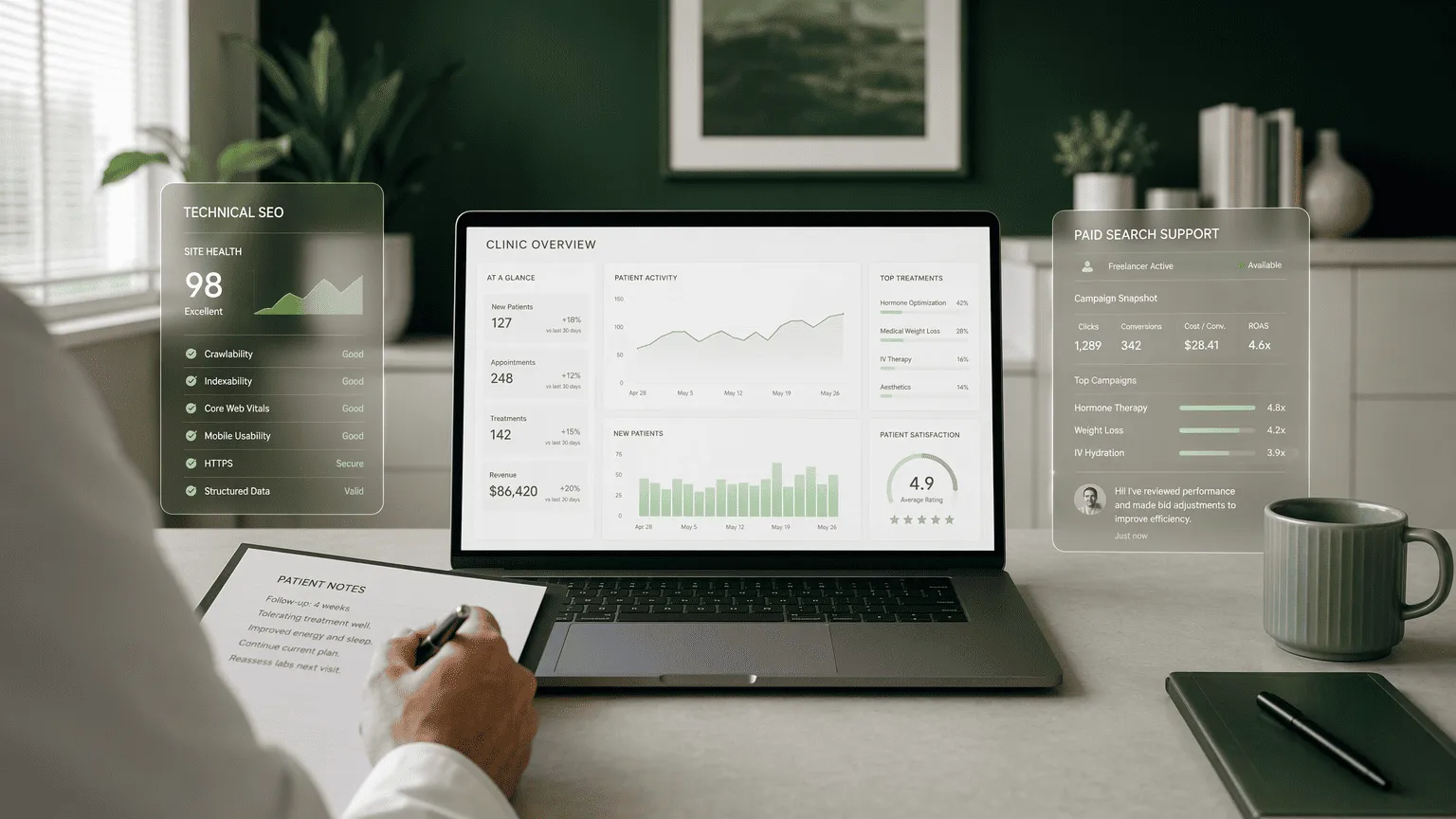
Instead, run the core SEO and paid search fundamentals yourself with tools built for clinics, and bring in fractional help only for the gaps you cannot cover. The split is straightforward: you own patient communication and clinical review internally. You use software and a freelance specialist to handle technical SEO, Google Business Profile optimization, and ad creative production.
For clinics under $1 million in revenue, the practical stack is a clinic-specific marketing platform for creative and SEO plus a freelance media buyer on a flat monthly retainer. ClinAds, for instance, generates on-brand static and video ads, builds search-optimized content, and runs for $399/mo without a long contract, which covers the tooling cost while you direct budget to media spend and the media buyer. A case study on a clinic brand called Clincy showed 1.14K Google impressions in 30 days with a 23% CTR and 297 new referring domains, numbers that a $2,500 retainer agency would claim as a win after three months.
The channel is not broken. The brief is. If even that feels like a stretch, start with one channel only: local SEO.
Claim your Google Business Profile, populate it completely, publish location-specific service pages with clinician-reviewed content, and build structured citations on healthcare directories. This produces no immediate inquiry spike. It compounds over four to six months into search visibility that a paid ad budget cannot buy, and it works whether you have $400 or $4,000 a month to deploy.
Conclusion
Yes, marketing companies that specialize exclusively in small private clinics exist. Pulse Digital Health works with 40-plus UK private clinics and nothing else. Castle International lives in the same lane. In the US, firms like Innovational Marketing operate with a healthcare-only mindset, serving clinics, hospitals, wellness brands, and healthcare startups across the country. The pool is small, but it exists, and the specialist-generalist distinction determines whether your spend produces patients or just reports.
The decision tree is simpler than the industry makes it look. If your monthly budget clears $2,500 and you need full-service management with compliance oversight baked in, hire a clinic-specialist agency with verifiable case studies in your exact practice type. If your budget sits below that threshold, do not sign an agency retainer. Use clinic-specific marketing software to handle creative and SEO, find a freelance media buyer who understands healthcare, and run paid search on a single channel until the unit economics prove out. ClinAds is built exactly for that second path: $399/mo AI marketing software that generates ads and SEO content without a retainer or a long contract, so you can scale spend to what the numbers justify rather than to what an agency minimum demands.
Want to see what your first month of ClinAds creative would look like for your clinic? Book a 30-minute intro call, and we will walk you through a sample campaign built from your actual treatment pages, your competitor's gaps, and the current search landscape for your specialty.
Frequently Asked Questions
What types of marketing agencies specialize in helping small private medical practices attract patients?
Three agency types serve small practices:
- Healthcare-only boutiques: turn away hospital work entirely (e.g., Pulse Digital Health).
- Private-practice specialists: focus on clinic, dental, and aesthetics verticals (e.g., Castle International).
- Hybrid firms: have dedicated healthcare divisions.
How does healthcare marketing for a solo or small group practice differ from marketing for a large hospital system?
Clinic marketing converts searchers into booked consultations by answering suitability, cost, and recovery questions, using local SEO and high-intent ads. Hospital marketing builds system-wide brand awareness across broad channels. The compliance exposure is also different: a clinic's ad can generate a personal regulatory complaint.
What specific digital marketing strategies like local SEO, Google Business Profile, or social media are most effective for small private clinics?
Local SEO built around an optimized Google Business Profile and condition-specific location pages is the foundation. High-intent Google Ads on treatment keywords generate measurable ROI (Castle International reports a 12.3:1 return), supported by clinician-reviewed content marketing that complies with regulatory standards.
What are the typical costs for hiring a marketing company for a small private clinic, and what services are included?
Specialist retainers typically start in the low thousands monthly, with performance-based or fixed-fee structures covering SEO, Google Ads management, and content production. Expect a cost per consultation around £42.20 across channels based on Castle International's reported clinic benchmarks.
What key qualifications, regulatory knowledge like HIPAA compliance, or experience should a small clinic look for when hiring a healthcare marketing agency?
The agency must demonstrate working knowledge of CAP Code section 12, GMC advertising guidance, CQC registration requirements, and PECR consent rules. Look for clinician review workflows on content, case studies from same-sized practices, and transparent reporting structures rather than generic marketing credentials.
What are the alternatives to hiring a specialized marketing company for a small practice that has a limited budget?
Fractional retainers, consulting-led DIY models, and a la carte services like GBP optimization-only packages are practical entry points. Prioritize highest-ROI activities first: local SEO foundations and high-intent search ads before building out full content programs or social media campaigns.
Sources
- Pricing: Clinic Marketing Software & SEO | ClinAds - getclinads.com
- Clincy Case Study: 1.14K Google Impressions in 30 Days | ClinAds - getclinads.com
- Best Healthcare Marketing Agencies for Independent Practices (2026 Review) | Health Biz Scale - www.healthbizscale.com
- Top Healthcare Marketing Agencies in the USA for 2026 - Innovational Marketing - innovational-marketing.com
- Healthcare Content Marketing Agency for Private Clinics | Pulse Digital Health - pulsedigital.health
- Healthcare Marketing Agency | Private Clinics | Castle - castle.co.uk
Want help executing this for your clinic?
Book a 30-minute call and we will map what a real ad engine would look like for your specific service mix.
Book a call