6 Ways to Get ChatGPT to Recommend Your Clinic Over the Competition in 2026
IntroductionOne of your patients walked in and told you ChatGPT sent them to the clinic across town. You rank well on Google. Your reviews are strong. The recommendation still went to someone else.
The problem is that Google rankings mean nothing to ChatGPT. The AI works off a two-layer system: it pulls the written recommendation from 20 to 30 of the top web results out of Bing's index and assembles the map cards from separate structured place records. Your competitor did not win on merit. They won on better technical plumbing.
That competitor almost certainly lets OAI-Searchbot crawl their site, indexes properly in Bing, and carries complete structured data. Across 212 dental practices scanned in June 2026, only 1.9 to 5.2% had complete LocalBusiness schema, and ChatGPT named just 1.3% of 154 clinics in Charlotte and zero out of 58 in Columbus. The fix is narrow, technical, and entirely within your control.
Key Takeaways
Five specific corrections will close the gap between you and the clinic ChatGPT just recommended:
- AI crawler access: Allow OAI-Searchbot and OpenAI's published IP addresses through your robots.txt and firewall. Across 6,497 US dental sites, 7.6% still block AI crawlers. Fixing this takes one line of code.
- Bing indexing: Submit your sitemap through Bing Webmaster Tools and activate the IndexNow protocol. ChatGPT reads Bing's index, not Google's. A clinic invisible to Bing is invisible to ChatGPT.
- Structured data: Deploy complete LocalBusiness or Dentist schema. Over 95% of clinics lack this markup, and ChatGPT names almost no practice without it. This is your biggest competitive gap.
- Review recency on Bing-indexed platforms: The AI favors freshness. About three in four consumers weight recent reviews more heavily. Prioritize Google Business Profile, Yelp, and Healthgrades where Bing can crawl them.
- NAP consistency: Mismatched name, address, or phone data across directories creates entity confusion. ChatGPT reconciles signals and discards noise.
Verdict
The clinic across town got the recommendation because they executed basic technical infrastructure that you have not yet completed. The ranking is fixable. Ads play zero role.
- Confirm Bing indexing first. Open Bing Webmaster Tools today and check whether your domain appears in the index. If it is absent, nothing else you do will matter. ChatGPT's web search layer depends on Bing alone.
- Validate your robots.txt. Search your file for a directive blocking OAI-Searchbot or for a blanket block on unknown bots from your CDN. The 7.6% block rate among dental practices comes from firewall and CDN defaults, not a deliberate decision to hide.
- Check your schema. Run your homepage through Schema.org's validator. If you see no LocalBusiness or Dentist type with name, address, telephone, geo coordinates, and opening hours, you are in the 95%+ of clinics ChatGPT ignores.
- Audit review recency and source visibility. A competitor averaging 4.3 stars with reviews from the last 30 days will outrank a 4.8-star practice where the last review is six months old and lives on a platform Bing cannot crawl.
- Ignore the urge to pay. OpenAI's published ads policy states directly: advertisers 'have no ability to shape, rank, or alter ChatGPT's responses'. Money cannot buy the recommendation.
Comparison Table
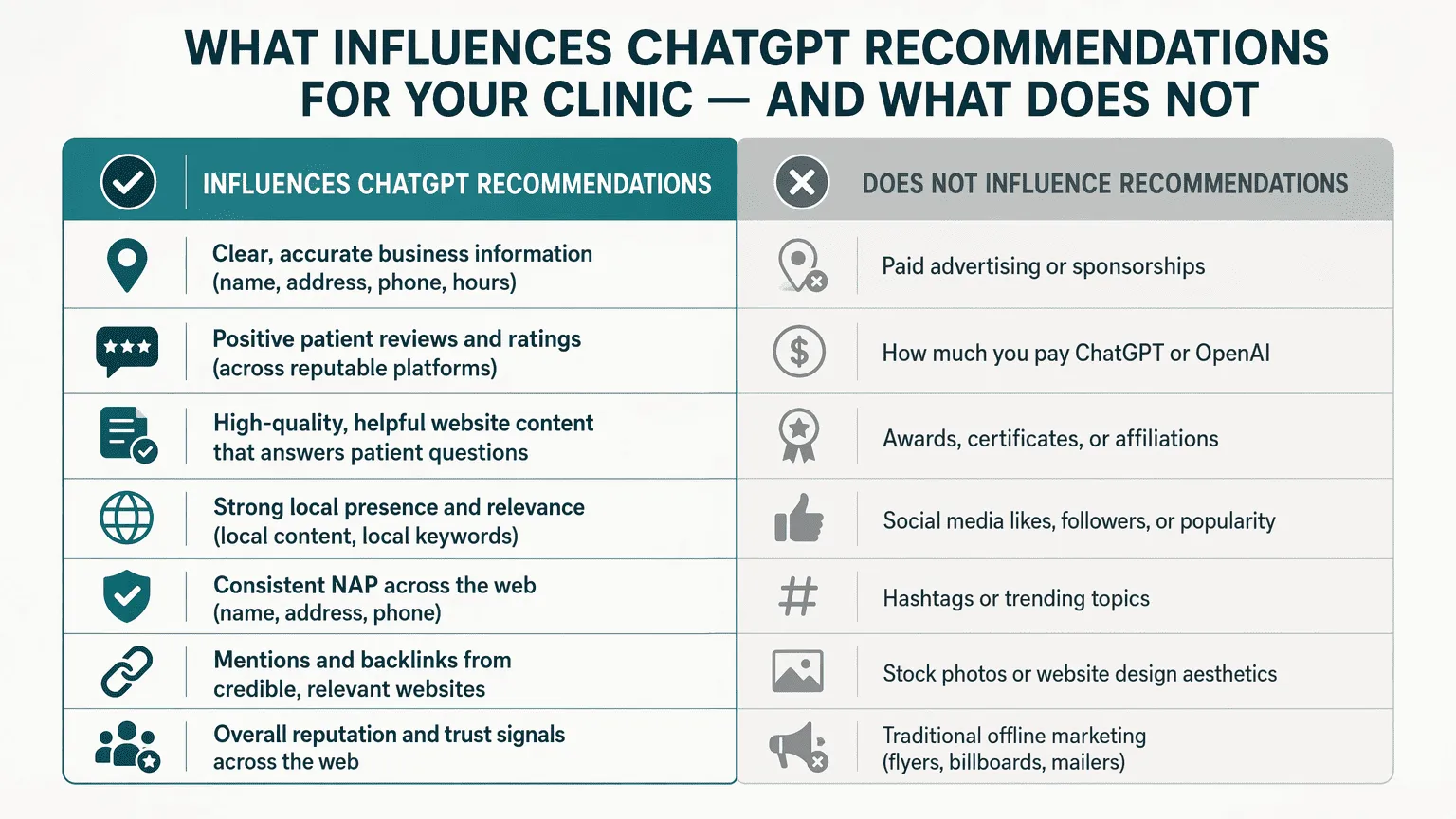
Not every visibility factor that influences Google will move the needle inside ChatGPT. The table below separates what matters from what does not:
| Factor | Influence on ChatGPT Recommendation |
|---|---|
| Complete LocalBusiness schema | Influences |
| Bing indexing via Bing Webmaster Tools | Influences |
| Review recency and volume on Bing-crawlable platforms | Influences |
| NAP consistency across directories | Influences |
| OAI-Searchbot and IP whitelisted | Influences |
| Google organic ranking position | Does Not Influence |
| Paid ads (Google Ads, social) | Does Not Influence |
| Physical proximity to the searcher | Influences indirectly through Bing's local ranking but is not the primary signal |
1. Clinads: The All-in-One AI Visibility Platform for Local Clinics
Most clinic operators do not have time to learn the Bing Webmaster Tools interface, write JSON-LD schema from scratch, or audit robot directives across a CDN. Clinads handles the full stack that ChatGPT cares about: AI crawler access, Bing indexing via IndexNow, structured data implementation, and review signal monitoring, without requiring an in-house technical hire.
That stack costs more in management time than the platform fee, and it breaks the first time your developer pushes a robots.txt update that accidentally reintroduces a crawl block.
If you are starting now, run your current stack through our platform's initial visibility audit first. In 30 minutes, the audit flags the exact OAI-Searchbot block and schema gap that are hiding you from ChatGPT right now. It also catches the NAP mismatches across directories that fragment your local authority.
Want to see what your first month of Clinads creative would look like? We produce a diagnostic deck that maps every visibility gap to the specific technical fix, no obligation. Book a 30-minute intro call.
2. Bing Webmaster Tools: The Non-Negotiable Indexing Gateway
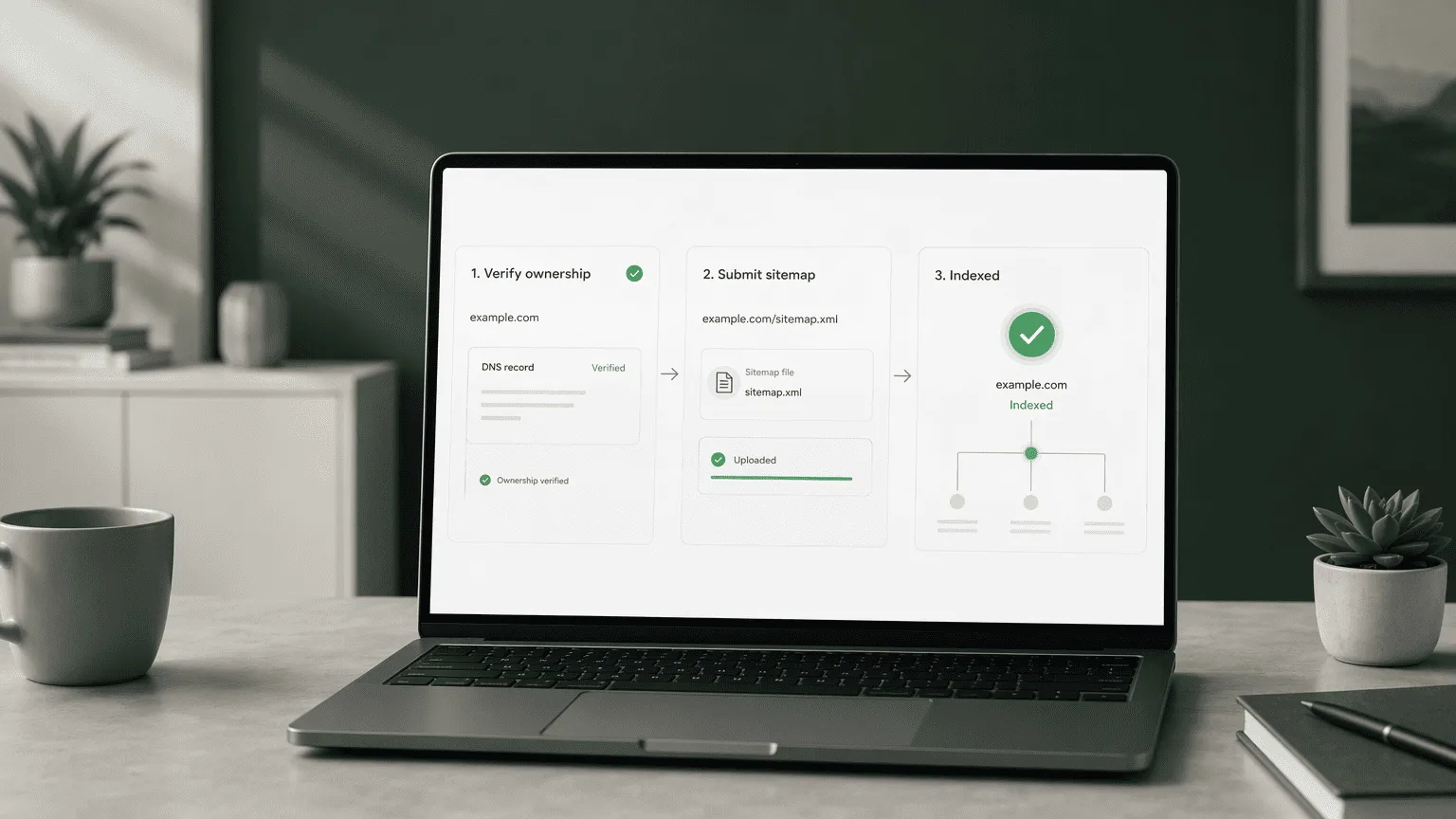
ChatGPT does not use Google's index. It retrieves web results from Bing. If Bing cannot find your site, ChatGPT cannot read it. Most clinic operators assume strong Google rankings create crossover visibility. They do not.
Submit your sitemap through Bing Webmaster Tools immediately. The verification process mirrors Google Search Console: add a TXT record, a meta tag, or a DNS CNAME to prove ownership. Once verified, upload your full XML sitemap and enable the IndexNow protocol. IndexNow pushes updates directly rather than waiting for Bing's crawler to revisit, which is critical given that 40 to 60% of the domains an engine cites for a local query change within a single month. If you are not in the index when ChatGPT rewrites a query, you do not get cited.
ChatGPT rewrites the question using the city it detects from the user before running the search. A request for “a good dentist near me” from Denver becomes a search for “top dentists Denver,” according to OpenAI's documentation. If Bing does not return your pages for that rewritten query, the AI assembles its 20 to 30-source recommendation entirely from competitors who are indexed.
This is the gate. Fix it first.
3. Robots.txt and OAI-Searchbot: Unlocking the Front Door
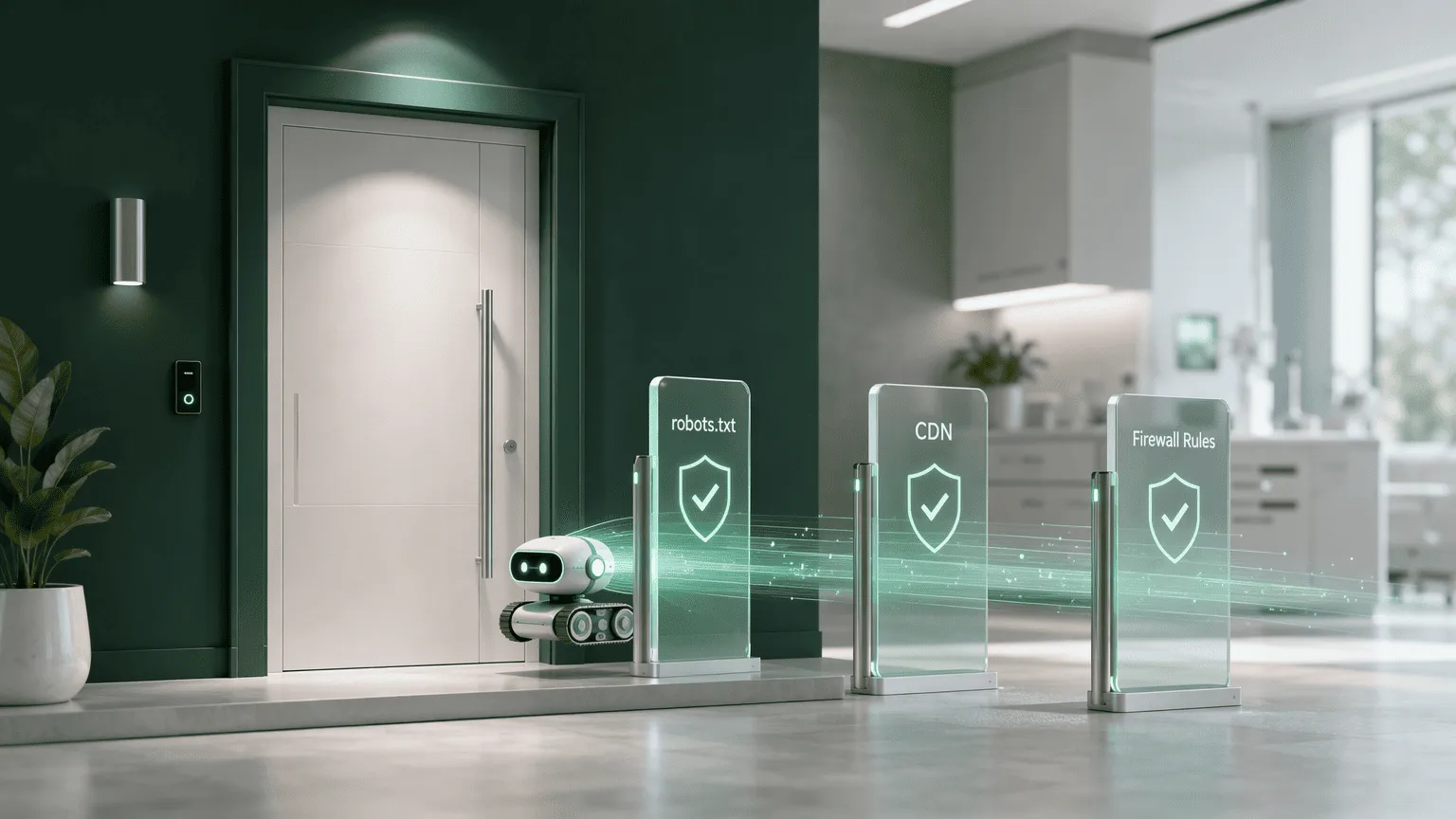
OpenAI operates its own crawler, OAI-Searchbot, and publishes a list of IP ranges that need to pass through any CDN or firewall. The user-agent token to allow is, literally, OAI-Searchbot. Across 6,497 dental practice domains, 7.6% are currently blocking an AI crawler. Many of those blocks come from developers deploying generic security rulesets.
The fix is a single line in robots.txt: User-agent: OAI-Searchbot Allow: /. Check your CDN's bot management rules and whitelist the published IP ranges too. One missed firewall rule is enough to make a site invisible.
4. Bing-Indexed Review Platforms: Feeding the Reputation Engine
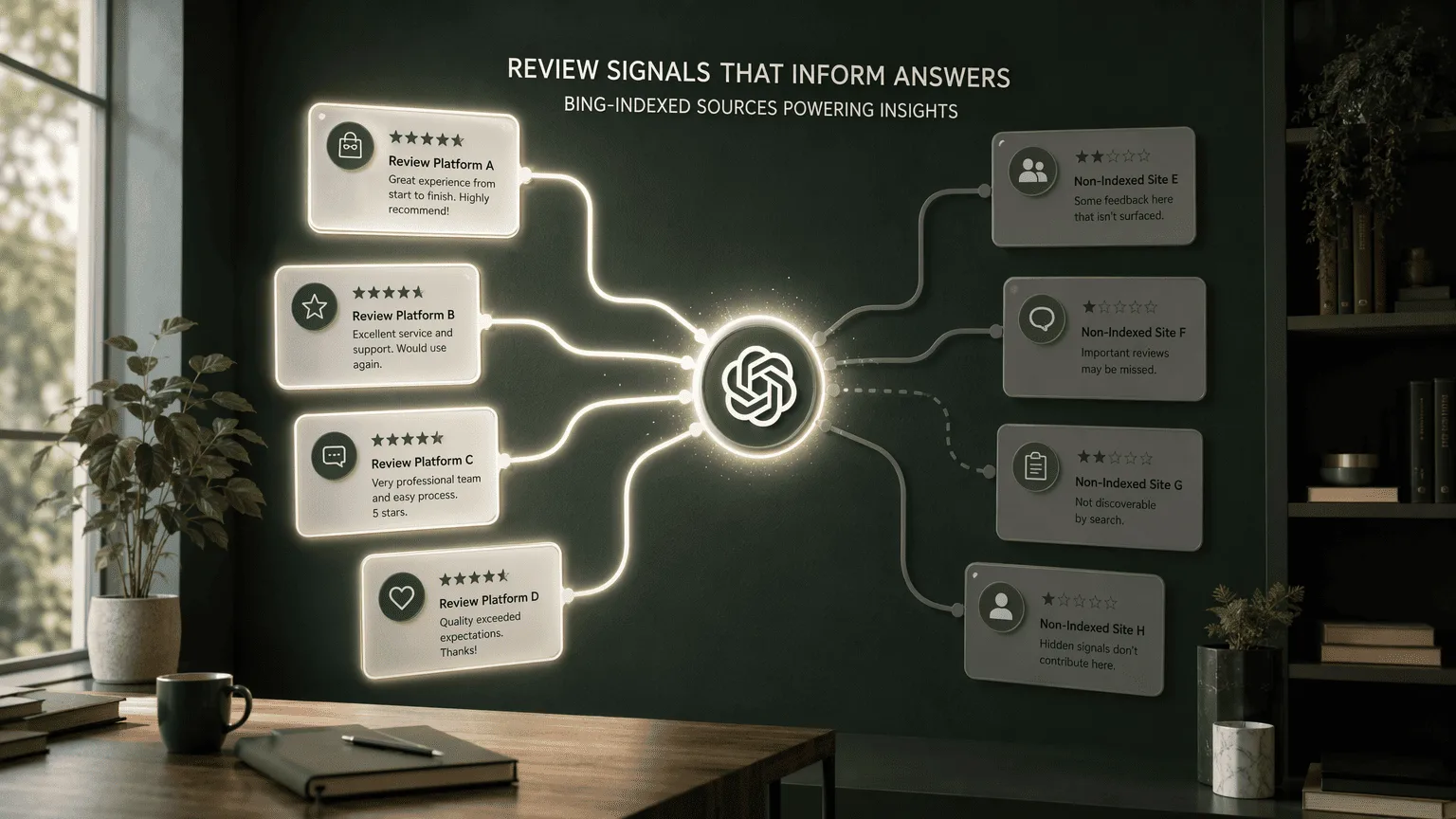
Reviews influence ChatGPT only when they live on platforms that Bing crawls and indexes. A five-star rating on a vertical-specific directory with no Bing footprint is invisible to the AI. The platforms that matter are the ones that rank for your clinic's name plus "reviews" in a Bing search. Your review distribution strategy needs to match where Bing looks:
- Google Business Profile remains the single most crawled review source across both search engines. ChatGPT's place records match Google listings field for field, tracking tags included, based on testing.
- Yelp and Healthgrades carry the domain authority Bing rewards for local queries and appear consistently in the top 20 to 30 results English-language AI pulls from for a health query.
- Review recency outweighs a perfect average. The AI-recommended average sits around 4.3 stars. A clinic with a 4.3 and five reviews from the last month will surface ahead of a 4.9 with a last review dated eight months ago.
- Avoid platforms Bing ignores. Before investing time in a niche directory, run a site: search for that domain on Bing. If it returns zero indexed pages, no review posted there will ever reach ChatGPT.
5. Structured Data Markup (Schema.org): The Missing Signal for 95% of Clinics
The single biggest gap between clinics that ChatGPT recommends and clinics it ignores is not Google rank, ad spend, or location. It is structured data. In a June 2026 scan of 212 dental practices spread across Charlotte and Columbus, 95% or more lacked complete LocalBusiness schema.
Those practices averaged 4.7 to 4.8 stars. Their robots.txt was open. ChatGPT named almost none of them.
The required schema type is LocalBusiness, with the subtype Dentist or MedicalClinic where applicable. Required fields are name, address, telephone, geo coordinates, opening hours, and aggregate rating. Format it as JSON-LD in your page head. A schema block missing geo coordinates tells Bing's parser less than a competitor's block that includes them. Schema.org's documentation lists the full field set.
Structured data is the signal that allows ChatGPT to treat your clinic as a named entity rather than a block of text. Without it, your practice is invisible to the machine.
6. NAP Consistency: Building Certainty Across the Web
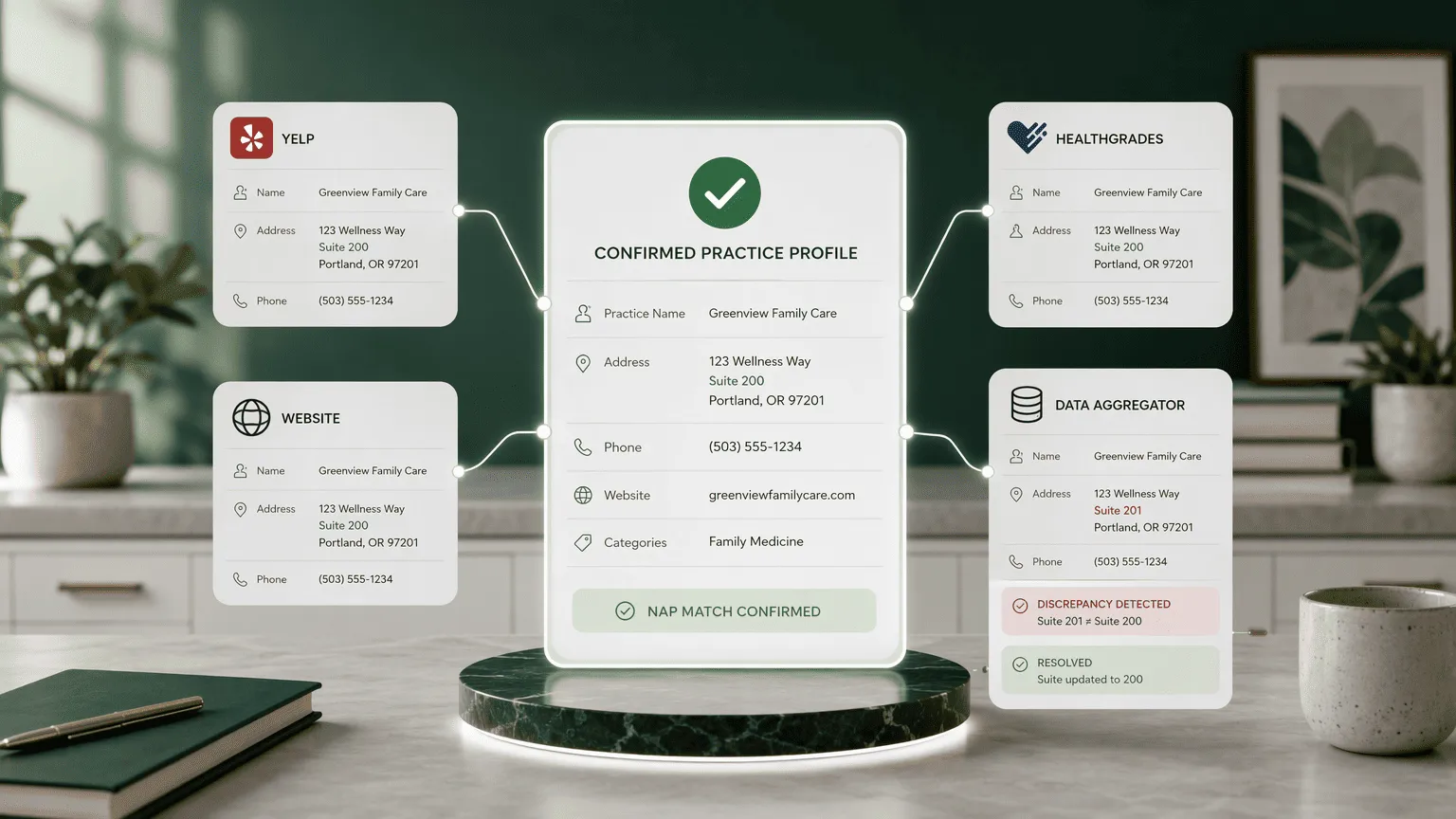
LLMs like ChatGPT reconcile business entities by matching signals across sources. When your name, address, or phone number appears differently on Yelp, Healthgrades, your website, and a data aggregator like Infogroup, the model cannot confirm those listings describe the same practice. It resolves that uncertainty by omission.
The specific mismatch that trips most clinics is a suite number or street abbreviation. One directory lists "123 Main St, Suite 4A." Another says "123 Main Street #4A."
A third drops the suite entirely. To a human, they are the same clinic.
To an engine reconciling entities from a search corpus, they are conflicting records. ChatGPT will discard a business rather than risk recommending the wrong one.
Run a NAP audit across the platforms that Bing indexes for your market: your Google Business Profile, Facebook page, Yelp listing, Healthgrades profile, and the three major data aggregators. Correct every mismatch. This is data hygiene that determines whether a machine trusts you enough to name you.
Conclusion
The competitor ChatGPT sent your patient to did not buy that recommendation. OpenAI's policy locks advertisers out of answer influence. The win came from three narrow technical moves: the competitor allows OAI-Searchbot, their pages live in Bing's index, and they carry complete structured data markup that 95% of clinics still lack.
Start today with two immediate actions. Open your robots.txt file and confirm OAI-Searchbot is explicitly allowed. Then pull up Bing Webmaster Tools and check whether your domain is indexed.
Those two checks expose the yes-or-no gatekeeping most clinics fail. Everything else, the schema, the reviews, the NAP consolidation, compounds from a crawlable, indexed foundation. Fix the gate first.
Frequently Asked Questions
How does ChatGPT decide which local businesses to recommend when a user asks for a nearby provider?
ChatGPT rewrites the user's query using their detected city, then retrieves 20 to 30 top web results from Bing's index. It assembles a written recommendation from those sources and pulls map cards from separate structured place records. Google ranking plays no role in the selection.
What concrete steps can a clinic take today to influence how it appears in AI-generated search results?
To make your clinic visible to ChatGPT, implement these technical fixes:
- Allow OAI-Searchbot in robots.txt and whitelist OpenAI's IPs on your firewall.
- Submit your sitemap to Bing Webmaster Tools with IndexNow enabled.
- Deploy complete LocalBusiness schema as JSON-LD.
- Maintain recent reviews on Bing-indexed platforms.
- Correct every NAP mismatch across directories.
Where does ChatGPT pull its local business data from, and how does that differ from traditional Google Search?
ChatGPT uses Bing's web index for written answers and unnamed structured place records for map cards and business profiles. Traditional Google Search uses Google's own index and Google Business Profile data directly. Strong Google rankings do not transfer to ChatGPT visibility.
How do clinics optimize their online presence for AI answer engines in 2026 versus legacy SEO for Google?
AI optimization shifts priority from traditional SEO tactics to machine-readable signals:
- Bing indexing replaces backlink strategy.
- Structured schema markup replaces keyword content.
- Review freshness on crawlable platforms replaces static content updates.
- Entity-consistent NAP data replaces meta-description tuning.
- Google-first tactics like link building have zero direct impact inside ChatGPT.
If a competitor is ranking higher in AI recommendations despite being further away, what data signals might cause that?
The competitor almost certainly beats you on Bing indexing, complete structured data, or review recency. Proximity matters, but a clinic with schema markup, an open robots.txt, and five recent reviews on Healthgrades will outrank a closer practice missing those signals entirely.
What role do structured data, reviews, and citations play in being cited by ChatGPT?
Three factors determine whether ChatGPT recommends a clinic over a closer competitor:
- Structured data: Makes a clinic machine-readable; over 95% of practices lack it, and ChatGPT ignores nearly all of them.
- Review freshness: Matters only when reviews live on Bing-indexed platforms and are recent.
- NAP citations: Create entity consistency that prevents the AI from discarding a clinic as unreliable.
Sources
- Pricing: Clinic Marketing Software & SEO | ClinAds - getclinads.com
- Get Your Dental Practice Recommended by ChatGPT | Citevio - citevio.com
- How ChatGPT Recommends Local Businesses | SearchOps Blog - searchops.co
- Local Business AI Visibility: How To Get Recommended In 90 Days - www.searchenginejournal.com
Want help executing this for your clinic?
Book a 30-minute call and we will map what a real ad engine would look like for your specific service mix.
Book a call