
Switching Clinic SEO Agencies in 2026: Who Actually Delivers?
IntroductionMost clinics that switch agencies are paying a monthly retainer to watch traffic curves that never connect to a single new patient chart. That gap between a clean dashboard and a full waiting room is where budget goes to die. The issue is structural: most generalist agencies treat a medical practice like a direct-to-consumer brand, tracking clicks while patient visits and cost-per-lead are the only metrics that matter.
Over 70% of patients now search directly for specialists online, bypassing physician referrals entirely. If your agency doesn't understand that direct-access patient journey, you are structurally invisible to the majority of your market.
The fix is a partner that understands healthcare's three non-negotiables: clinical content authority, compliance-safe tracking, and revenue-attributed reporting. The agencies below were built for exactly that.
Key Takeaways
Before you sign another contract, run every candidate through this filter. The agency you keep should make these points non-negotiable:
- Proven ROI threshold: Demand evidence of a 5:1 return or higher, not traffic curves. If they cannot tie their work to patient acquisition cost, they are selling you visibility without substance.
- Data ownership is non-negotiable: You must always have full ownership and control over your website, Google Ads account, and Google Analytics. Any agency withholding login credentials is holding your practice hostage and should be a hard stop.
- Vanity metrics are a red flag: Impressions, clicks, and shares feel productive. If those are the lead story in reporting instead of patient visits and cost-per-lead, you are reading a marketing report, not a practice growth report.
- Your new agency must demonstrate a compliance-first tracking architecture from the proposal stage, not as a post-signature add-on.
- Healthcare content cannot be generic: Agencies using generic templates risk a Google duplicate content penalty. Healthcare content must cite sources, carry clinical review, and meet YMYL standards.
Verdict: The Best Approach to Switching Clinic SEO Agencies in 2026
You are not looking for a marketing generalist who also takes clinics. The DesignRush directory lists 4,373 healthcare SEO companies, and the overwhelming majority apply the same playbook to a med spa that they would to a SaaS startup. That mismatch produces exactly the result clinics keep paying to escape: traffic that spikes, flatlines, and converts nothing.
A healthcare-native partner is the only route that protects you from three structural risks. First, the compliance trap: generic tracking installations leak protected health information, creating liability a generalist will not catch. Second, the content trap: an agency without clinical review infrastructure will default to templates, and agencies using generic templates risk a Google duplicate content penalty that tanks the domain they were hired to grow. Third, the attribution trap: when reporting stops at sessions instead of booked appointments, the metric that should drive every decision is missing.
The switch that makes the other decisions simple is demanding healthcare specialization.
Comparison Table: Top US Clinic SEO Agencies Evaluated by Criteria That Matter
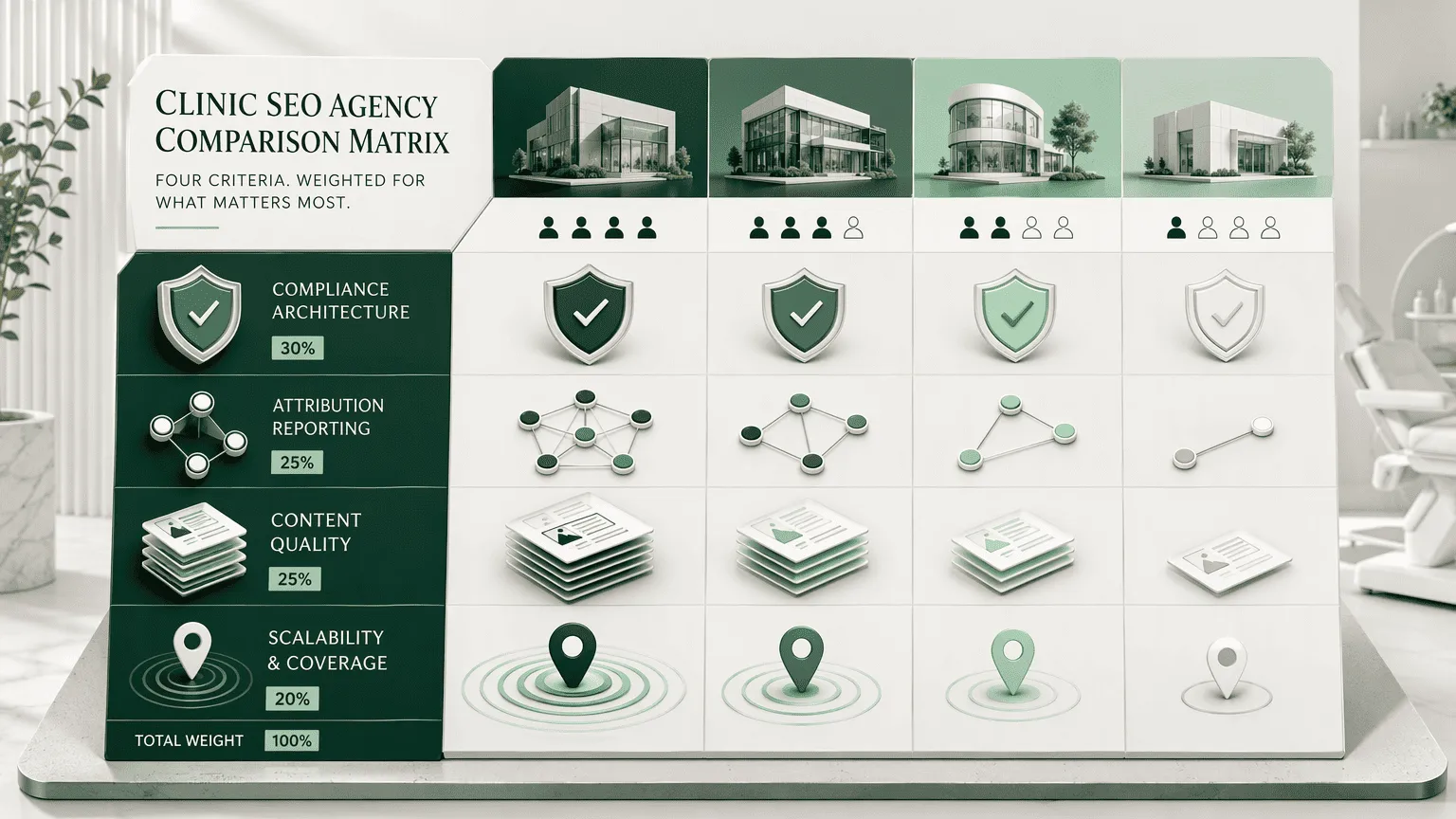
The table below weights the criteria that directly impact practice revenue and regulatory exposure: compliance architecture, attribution reporting, content quality, and the ability to scale across locations.
| Criterion | Clinads | Cardinal Digital Marketing | Practice Bloom | Intrepy Healthcare Marketing |
|---|---|---|---|---|
| Primary Focus | Compliance-first clinic SEO and patient acquisition | Multi-location healthcare performance marketing | Data-driven marketing with practitioner control | Direct-access patient journey and ROI verification |
| Reporting Depth | Patient acquisition cost and booked revenue | Enterprise-level organic insights | Real-time transparent dashboards | Revenue-tied ROI against 5:1 benchmark |
| Content Specialization | AI-assisted with clinical review standards | Scalable multi-location content systems | Practitioner-validated medical content | Direct-access journey content mapping |
| Scalable Multi-Location Support | Multi-practitioner and location architecture | Core offering for multi-state operators | Configurable for group practices | Multi-location patient journey mapping |
| Data Ownership Guarantee | Client retains full asset ownership | Contractual ownership agreement | Central differentiator and brand promise | Client-controlled analytics and credentials |
| Best For | Risk-averse clinics prioritizing compliance and ROI | Large multi-location groups scaling enterprise SEO | Practices wanting full transparency and control | Specialist clinics optimizing direct-booking revenue |
Clinads: A Compliance-First Clinic SEO & Patient Acquisition Partner

Clinads was built to close the gap between a marketing report and a booked appointment, starting from the compliance architecture that most agencies bolt on later. It is an AI-first growth platform that combines SEO with Generative Engine Optimization, designed specifically for healthcare practices that cannot afford a tracking mistake or a content liability.
Reporting is structured around patient acquisition outcomes rather than session curves. The platform tracks booked revenue and cost-per-lead, mapping marketing spend directly to clinical capacity, a framework that treats marketing spend as a practice investment line rather than an expense column. For clinics that have been burned by agencies hiding behind vanity metrics, Clinads’ pricing starts at $399 per month for the AI marketing software, with done-for-you SEO and GEO available on simpler monthly plans with no agency retainer and no long contract.
Cardinal Digital Marketing: Scalable Performance for Multi-Location Healthcare

Cardinal Digital Marketing sits at the intersection of enterprise SEO infrastructure and healthcare performance marketing. For practices scaling across multiple sites, the firm brings the capability to manage complex location architectures without collapsing into duplicate-content penalties. The table below compares key operational dimensions that matter when evaluating an enterprise-level healthcare SEO partner.
| Dimension | What to Verify with Cardinal Digital Marketing |
|---|---|
| Multi-Location SEO Infrastructure | Proprietary or established architecture for managing citations, local pages, and schema across numerous locations without duplication penalties |
| Attribution Methodology | System connecting organic performance to patient acquisition across multiple clinic locations and service lines |
| Content Development Process | Clinical review workflow ensuring YMYL standards are met at scale across providers and specialties |
| Reporting Granularity | Location-level and provider-level reporting that separates high-performing clinics from underperformers |
| Contract and Data Ownership | Clear terms guaranteeing practice ownership of all digital assets and access upon separation |
Practice Bloom: Data-Driven Marketing That Puts You in Control

Practice Bloom has built its identity around a pain point that comes up in nearly every agency-switching conversation: the clinic owner who realizes they do not own their website, their analytics, or their ad accounts. The core promise is practitioner autonomy, the guarantee that you sit in the driver's seat of your marketing data while the agency executes the strategy. For a practice leader who has been locked out of their own digital assets by a previous agency, that positioning solves an immediate, concrete fear before any discussion of SEO tactics begins.
The transparency-first model often requires more client involvement. Practice Bloom's model rewards practitioners willing to engage with real-time dashboards and performance data rather than delegating entirely.
Intrepy Healthcare Marketing: Proven ROI Through Direct-Access Patient Journeys

Intrepy built its methodology around the statistic that opens this analysis: over 70% of patients search directly for specialists, skipping the referral gate entirely. That direct-access pathway is not served by the same content strategy that ranks a retail product page. It requires mapping search intent to clinical decision stages, then building content that meets a patient at the moment they are ready to book, not just the moment they are researching symptoms.
ROI is the agency’s governing metric, benchmarked against the standard that healthcare marketing partners should demonstrate a proven ROI of 5:1 or higher. This is not a traffic agency. The reporting framework connects organic visibility to booked appointments and attributable revenue, treating marketing as a clinical capacity investment. For specialist practices where every new patient carries significant lifetime value, that revenue-tied accountability directly addresses the frustration that drives most agency switches.
The limitation is focus. Intrepy’s specialization in direct-access patient journeys means it is calibrated for practices where patients self-refer, making it particularly strong for specialist clinics and less applicable to primary care groups reliant on insurance-network discovery.
Which Clinic SEO Agency Should You Choose?
The right agency is not the one with the best pitch. It is the one whose architecture matches your specific exposure:
- If compliance risk keeps you up at night, Clinads' HIPAA-safe tracking and patient acquisition reporting is the hedge against the liability that a generalist agency will not see coming.
- If you are running a multi-state group and your primary constraint is scalable infrastructure, Cardinal Digital Marketing's enterprise architecture maps to that problem.
- If your last agency held your website hostage, Practice Bloom's data-ownership guarantee speaks directly to that scar tissue.
- If you are a specialist practice whose entire growth depends on patients booking directly after a Google search, Intrepy's direct-access journey framework is built for exactly that revenue model.
Start the conversation by asking each agency how they track patient acquisition cost, not sessions, and you will filter out the generalists before the proposal hits your inbox.
Conclusion
Switching clinic SEO agencies in 2026 is a risk-management and revenue-protection move, not a marketing decision. Demand a proven ROI of 5:1, verify that content meets YMYL standards with clinical review, and walk away from any agency that reports in impressions. The cheapest retainers always cost the most over twelve months. Make the switch once and make it right.
Frequently Asked Questions
What should healthcare clinics look for when switching to a new SEO agency in the US?
Verify three non-negotiables:
1.
- A proven ROI benchmark of 5:1 or higher tied to patient visits.
- Full ownership of your website, Google Ads, and analytics accounts.
Any agency withholding credentials or reporting only traffic metrics should be eliminated immediately.
Which SEO agencies in the US specialize in medical and dental clinic marketing?
Agencies specializing in clinic SEO include:
- Clinads for compliance-first patient acquisition.
- Cardinal Digital Marketing for multi-location enterprise healthcare SEO.
- Practice Bloom for data-transparent practitioner-controlled marketing.
- Intrepy Healthcare Marketing for direct-access specialist patient journey optimization.
How do specialized clinic SEO strategies differ from general digital marketing?
Clinic SEO requires:
- YMYL content standards with named clinical reviewers and cited sources.
- Conversion tracking tied to appointments rather than form fills.
- Local SEO architecture designed for multi-practitioner and multi-location healthcare entities.
What are the typical costs and contract terms for clinic SEO services in 2026?
Specialized clinic SEO platforms range from $399 per month for AI-assisted marketing software to $1,000 to $10,000 for full-service healthcare SEO engagements. Addiction treatment SEO can run $6,000 to $25,000 monthly. Insist on month-to-month terms with guaranteed data ownership rather than extended lock-in contracts.
How can a clinic verify an SEO agency's healthcare compliance knowledge?
Ask how their analytics setup prevents PHI transmission through URL parameters or event tracking. Request a content sample showing medical review workflows. Verify that their reporting connects organic performance directly to patient acquisition cost rather than stopping at traffic volume or ranking reports.
What are the biggest red flags when evaluating clinic SEO agencies?
Agencies reporting impressions and clicks instead of cost-per-lead, using generic content templates that risk Google duplicate content penalties, withholding website login credentials, lacking clinical review processes for medical content, and treating healthcare clients with the same playbook used for retail or SaaS businesses.
Sources
- Pricing: Clinic Marketing Software & SEO | ClinAds - getclinads.com
- 7 Red Flags When Hiring a Physical Therapy Marketing Agency for 2026 - practicepromotions.net
- Top Healthcare SEO Companies in 2026 - www.designrush.com
- Top Healthcare SEO Agencies Of 2026 (Ranked By Sub-Vertical) - webserv.io
- Healthcare SEO | Healthcare Marketing Agency - www.tidalhealthgroup.com
Want help executing this for your clinic?
Book a 30-minute call and we will map what a real ad engine would look like for your specific service mix.
Book a call