
SEO Services for Doctors' Offices: The 2026 Playbook to Own the Local Map Pack
IntroductionMost medical practices still build their entire patient-acquisition strategy around a website that fewer than half of new patients will ever see. The problem is not that your site needs better content. The problem is that the patient journey has already moved to Google Maps, AI Overviews, and the local pack before anyone clicks through to a service page. Google's local pack now drives 55 to 70% of new patient discovery for solo practices and small clinics, yet most practices treat their Google Business Profile as an afterthought while pouring budget into generic SEO that ignores the two non-negotiable guardrails of medical marketing: HIPAA-compliant tracking and the YMYL evidence standard that Google applies to every health-related page. This article lays out the three-pillar framework that actually works in 2026: map-pack dominance, HIPAA-safe analytics, and content built to the E-E-A-T bar that Google, ChatGPT, and the NMC all now enforce.
Key Takeaways
The short answer: medical SEO in 2026 is a Google Maps-first discipline that runs on review velocity, physician-verified schema, and server-side tracking that keeps PHI out of your ad platforms. Here are the five non-negotiables that separate a practice that books appointments from one that bleeds budget.
- Maps dominance first, website second: 55 to 70% of new patients discover practices through the local pack. A complete GBP with 25 or more real photos and 47+ recent reviews will outperform a stale listing every time.
- HIPAA rewrites your analytics stack: Server-side form validation that strips PHI before it hits Google Ads or Meta is no longer optional. The August 2025 Flo app verdict against Meta turned PHI leakage into a quantifiable liability.
- YMYL content requires visible physician authorship: Google holds medical pages to a higher evidence standard. Every service page needs a named, credentialed author and linked primary-source citations.
- NMC guidelines ban the claims most clinics lean on: If you are marketing in India, you cannot use testimonials, before-and-after images, or superlatives like 'best surgeon.' Compliant content sticks to credentials and treatment explanations.
- CPQL, not traffic volume, is the only metric that matters: A real medical SEO program runs from roughly $1,800 a month to audit and recommend, up to $6,500 a month for full execution. If your cost per qualified lead is not dropping by month six, the strategy is broken.
The New Patient Funnel Starts on Google Maps, Not Your Website

The patient acquisition model most practices rely on is backwards. They audit website traffic, optimize landing pages, and watch organic sessions climb while appointment volume stays flat. The disconnect is simple: when a patient searches 'cardiologist near me' or 'knee replacement surgeon in Mumbai,' Google serves them a map pack with three listings. Your website is a click or two deeper in the results. For most practices the GBP generates more calls and direction requests than the website itself.
If your Google Business Profile has not been claimed, verified, and actively managed with primary and secondary categories correctly set, you are invisible at the exact moment a high-intent patient is choosing a provider. The primary category is the single strongest ranking lever in the profile, yet practices often leave it as 'Doctor' instead of 'Cardiologist' or 'Dermatologist,' forfeiting relevance signals to competitors who got this one detail right.
Review velocity and photo freshness then widen the gap. A verified profile with 47 recent reviews, current photos, and weekly posts signals activity and trustworthiness to Google's algorithm and to patients evaluating you against the other listings in the pack. Practices with current, genuine photos get measurably more engagement than those with a logo and a stock image. A profile that hasn't posted since last year reads as closed. Edits to categories, services and photos are usually live within days, and ranking or call-volume effects typically show within 4 to 8 weeks of a thorough cleanup.
The trade-off: a website-first SEO program chasing ten-point keyword moves while the local pack delivers 55 to 70% of new patient volume is a margin leak. Fix the profile first, then build the content.
What Makes Medical SEO a Different Beast: The YMYL Evidence Bar and E-E-A-T

Google does not treat your service pages like a restaurant's menu or a plumber's about page. Medical content is classified as your-money-or-your-life and held to a higher evidence standard than almost any other topic. The algorithm explicitly evaluates whether health information demonstrates E-E-A-T: Experience, Expertise, Authoritativeness, and Trustworthiness. A page that ranks for 'best acne treatment' today can be algorithmically suppressed tomorrow if it lacks visible physician authorship, linked primary-source citations, or structured data that tells Google who created the content and what medical entity it describes.
This is where generalist SEO breaks. A typical agency will write a 1,500-word blog post with keyword-stuffed copy and consider the job done. A YMYL-compliant medical page requires a named physician author with verifiable credentials (board certifications, institutional affiliations), citations to peer-reviewed literature or established medical bodies, and Physician or MedicalProcedure schema markup.
That schema unambiguously signals to Google and AI crawlers what condition, treatment, or specialty the page addresses. Without it, even well-written content can get filtered out of AI Overviews and rich results, which now synthesize answers from structured, authoritative sources rather than raw text. Google treats medical pages as YMYL and applies stricter E-E-A-T standards: experience, expertise, authoritativeness, and trustworthiness.
The implication is practical. Every service page on your site should surface the treating physician's name, specialty, and credentials in the first scroll, link to a detailed bio page with board certifications and hospital affiliations, and use schema to connect that physician entity to the medical procedures the practice offers. Without this entity layer, your content is competing at a structural disadvantage against competitors who have built the same signal set.
How HIPAA Reshapes Every Marketing Tool You Use, Including Analytics

Most marketing stacks are built in a way that would violate HIPAA the moment a patient submits a contact form. Standard Google Analytics, Meta Pixel, and Google Ads conversion tracking all capture form field data by default. If a prospective patient types a health concern, a medication name, or an appointment reason into a website form, that data can flow into advertising platforms as a parameter, creating a PHI exposure that is both a compliance failure and a legal liability.
The August 2025 jury verdict against Meta over health data from the Flo app turned this from a theoretical risk into an enforceable precedent.
The case established that transmitting health-related form data to an ad platform without explicit, separate consent violates privacy obligations, and the financial exposure is material. For any practice running paid search or social ads, the immediate fix is server-side form validation: stripping form field values client-side before the thank-you page fires any tracking pixel, or routing submissions through a HIPAA-compliant middleware layer that redacts PHI before forwarding conversion signals.
Indian practices face an additional regulatory layer. The NMC's Guidelines on Ethical Advertising, updated in October 2026, restrict promising specific outcomes, showing before-and-after surgical images, and claiming superiority like 'best knee replacement surgeon' or '#1 rated clinic'. This means the entire testimonial and social-proof playbook that works in other markets is off-limits. Compliant content must stick to credentials, experience, and plain treatment explanations without superlatives or visual outcome comparisons.
Responding to negative reviews must never confirm the reviewer is a patient or reference visits, diagnoses, dates or billing details, even if the reviewer disclosed them first.
Every tool in the stack, from analytics to review management to ad retargeting, needs a compliance audit. Start by inventorying every pixel, every form handler, and every third-party script on your site, then route all patient-facing data through a server-side endpoint you control.
A Foundation-First, Crawl-to-Conversion SEO Sequence for Medical Practices
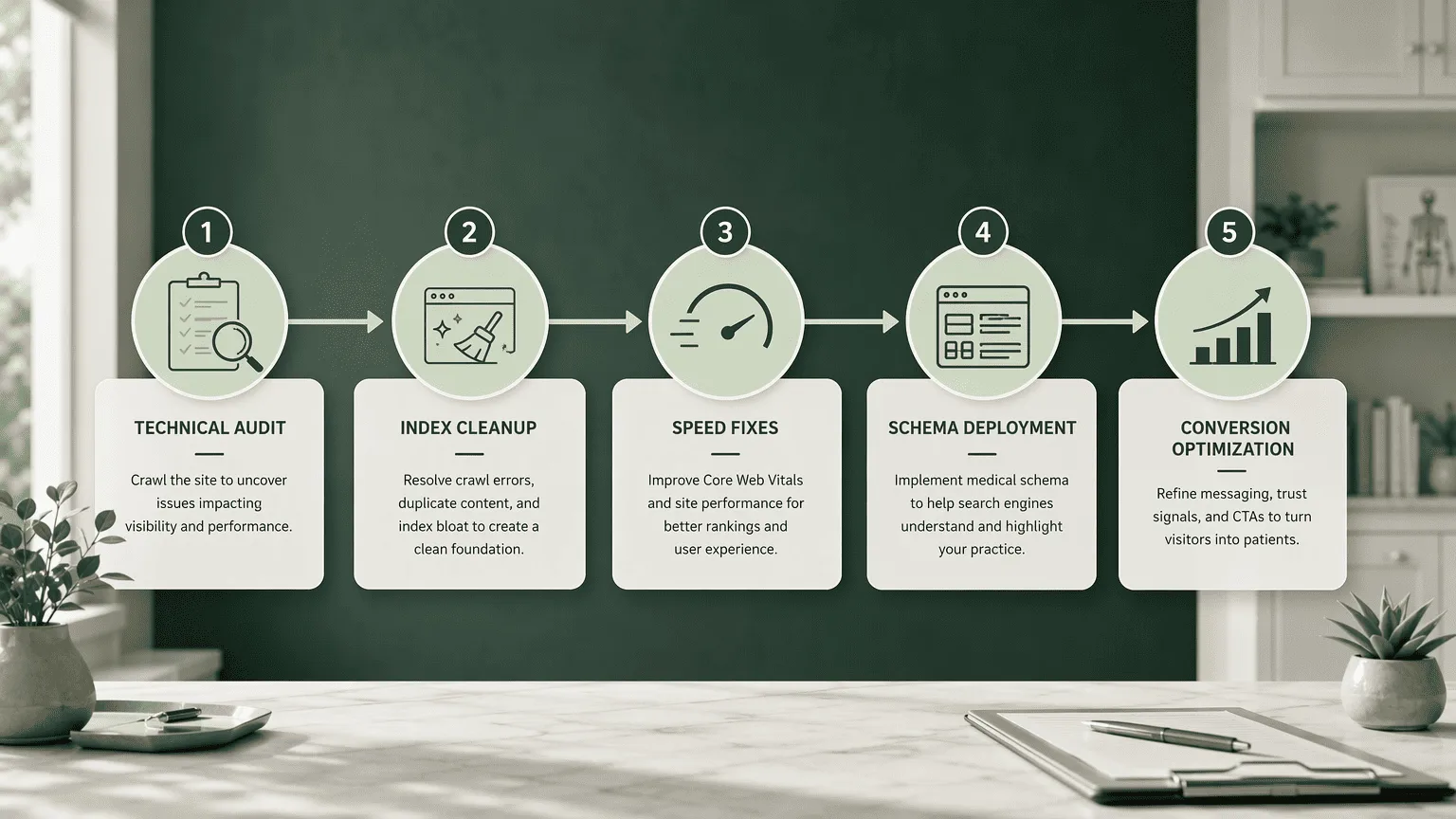
Most practices start with content and skip the infrastructure that makes it rank. A crawl-to-conversion sequence forces the right order: fix what Google cannot see or index before you publish anything new.
- Technical audit: Run a crawl with Screaming Frog or Sitebulb. Identify index bloat (PDFs, tag pages, old event listings) that wastes crawl budget. Fix broken internal links, missing canonical tags, and slow mobile load times. If a homepage takes more than 3 seconds to load on a phone, patients are lost before they see what the practice offers.
- GBP claim and verification: If the profile is not verified with a live video or postcard, nothing else matters. Set the primary category correctly, add secondary categories that describe every service line, and upload 25 or more real, recent photos, not stock images.
- Schema deployment: Add Physician schema on every bio page and MedicalProcedure schema on every service page. AI overviews pull directly from this structured layer. Without it, content stays invisible to generative search.
- YMYL-compliant service page builds: For each core procedure, build a page that names a treating physician in the first scroll, cites authoritative sources (NIH, specialty society guidelines), and uses schema to connect the physician entity to the procedure. No anonymous content, no superlatives that violate NMC or FTC guidelines.
- Review generation system: Set up an automated but HIPAA-compliant review request workflow that sends a link post-visit without referencing the visit itself. You cannot offer an incentive, discount, or gift for a review in healthcare.
- CPQL tracking setup: Tag every appointment form, click-to-call, and GBP direction request as a conversion event. Use a tool that strips PHI server-side. Then measure cost per qualified lead monthly; organic search compounds at six to nine months, while local map-pack work can move within weeks.
Precision Engineering: Medical Schema, AI Overviews, and Specialty-Specific Tactics
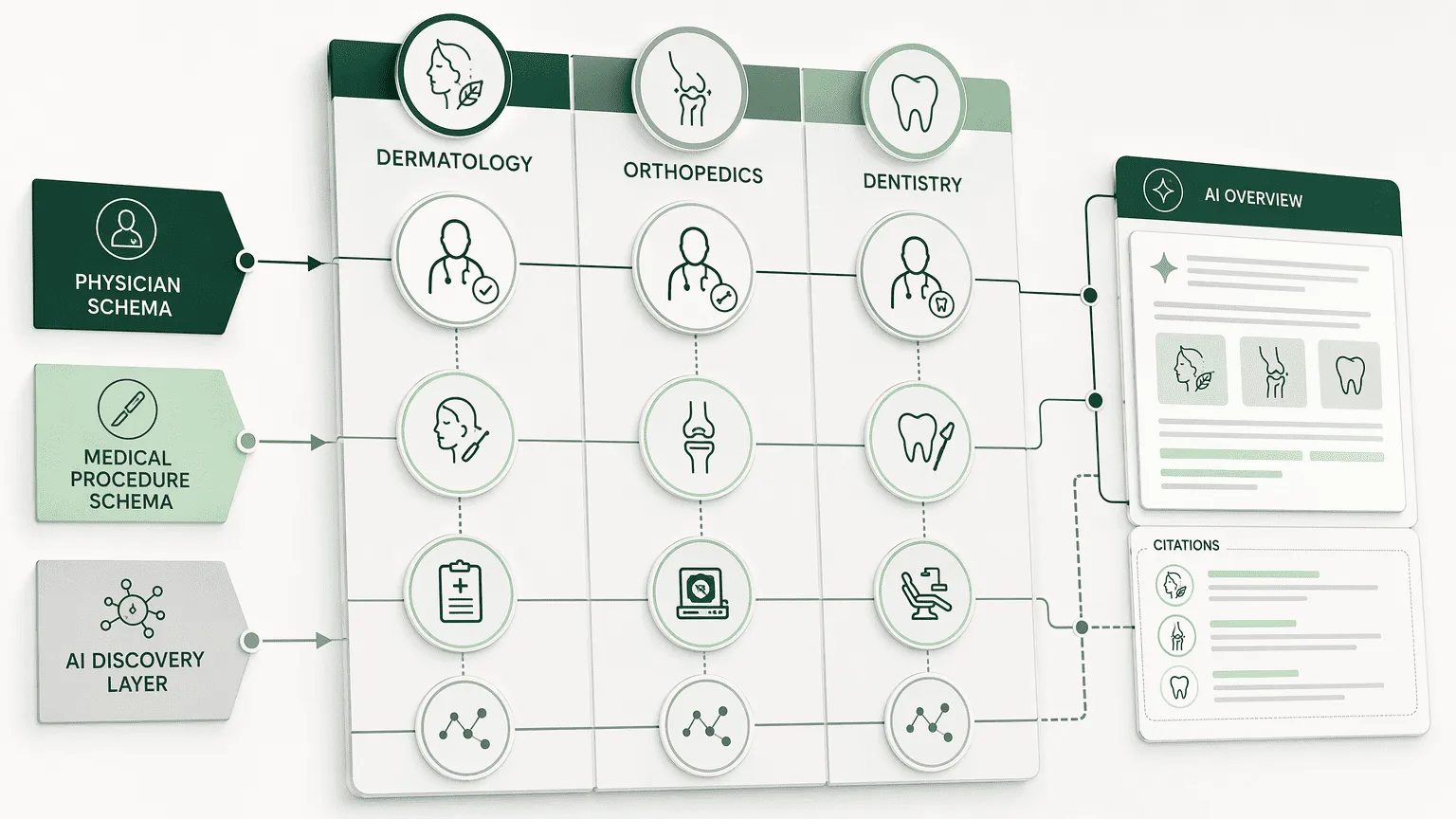
AI Overviews and generative search engines pull answers from structured data. A practice that deploys Physician and MedicalProcedure schema correctly captures citations an unstructured competitor cannot access. Schema requirements shift by specialty. The table below maps the signals that matter for three high-volume specialties.
| Signal | Dermatology | Orthopedics | Dentistry |
|---|---|---|---|
| Primary GBP category | Dermatologist | Orthopedic Surgeon | Dentist |
| Critical secondary categories | Skin Care Clinic, Medical Spa, Dermatopathologist | Sports Medicine Physician, Orthopedic Clinic, Pain Management Physician | Cosmetic Dentist, Dental Clinic, Emergency Dental Service |
| Key MedicalProcedure schema | Acne Treatment, Skin Cancer Screening, Botox Injections | Knee Replacement, Arthroscopy, Spinal Fusion | Dental Implants, Root Canal, Teeth Whitening |
| Physician schema entity connections | Link dermatologist bio pages to procedure pages; include board certification (American Board of Dermatology) | Link surgeon bios to implant and reconstruction pages; include hospital affiliations and fellowship training | Link dentist bios to cosmetic and surgical pages; include DDS/DMD credentials and state license |
| AI Overview trigger content | Treatment comparison pages citing peer-reviewed journals (JAAD); biopsy and pathology protocols | Recovery timelines with journal citations; implant manufacturer comparison tables with safety data | Procedure vs. alternative decision guides; cost breakdowns by insurance and out-of-pocket |
| Conversion tracking nuance | Tag 'book consultation' and virtual visit forms; dermatology CPQL typically 15 to 25% lower than ortho due to higher cosmetic demand volume | Tag surgical consult requests and MRI/imaging referral forms; CPQL is higher but lifetime patient value justifies a wider cost envelope | Tag new patient exam bookings and emergency availability; emergency dentistry converts same-day at high rates but requires real-time GBP availability signals |
Expect 60 to 90 days for first AI citations and roughly 180 days for stable top-5 rankings after schema and content deployment. Specialty practices in competitive metros should budget additional time for the authority layer to compound.
What Professional Medical SEO Actually Costs in 2026 (and How to Measure It)
US medical practices should benchmark a full-scope medical SEO program at roughly $1,800 a month to audit and recommend, up to $6,500 a month for full execution, depending on how much of the work you keep in-house. Below $2,500, you are likely getting content-only delivery with no technical audit, no schema deployment, and no HIPAA-compliant conversion tracking.
In India, monthly retainers run from ₹25,000 for small clinics to ₹1.5 lakh or more for multi-location hospitals.
The line item that separates a real medical SEO program from a content mill is CPQL measurement: cost per qualified lead tracked through HIPAA-safe form submissions, click-to-call events, and GBP direction requests, not total organic traffic. A practice can triple visitors and see zero new patient growth if those visitors are reading blog posts about conditions rather than booking appointments.
Metro CPQL runs 20 to 35% higher than in tier-2 cities, so set internal benchmarks against your own city tier and specialty, not against national averages that mix low-acuity primary care with high-revenue surgical specialties.
Ranking guarantees are a black-hat pattern and a litigation risk in healthcare. Any provider offering a top-3 guarantee is either fabricating results or using tactics that will trigger a manual action when detected. If you want to see what a first month of real medical SEO looks like without the agency retainer, ClinAds offers a done-for-you SEO and GEO program built on the crawl-to-conversion framework above, with server-side PHI-safe tracking and monthly CPQL reporting from $399/mo.
Conclusion
The practices winning patient volume in 2026 treat their Google Business Profile as the primary acquisition surface. They build every service page to YMYL evidence standards, with visible physician authorship and schema markup. They audit their analytics stack so PHI never touches an ad platform.
The August 2025 Flo verdict and the NMC's October 2026 guideline update both make one thing clear: the compliance window is closing.
Audit your GBP today. Check your form-to-pixel data flow. Map every service page to a named physician with schema before you publish a single new blog post.
Frequently Asked Questions
What specific SEO strategies are most effective for medical practices to attract local patients?
Google Business Profile optimization drives the highest ROI. Verify your listing, set a precise primary category, upload 25+ real photos, and generate a steady stream of recent reviews. Pair this with service pages that include physician schema markup and visible author credentials to dominate the local map pack, where 55 to 70% of new patient discovery happens.
How do HIPAA compliance requirements affect the digital marketing and SEO strategies for doctors' offices?
HIPAA prohibits Protected Health Information (PHI) from flowing into standard analytics and ad platforms. Medical practices must use server-side form validation to strip PHI before it hits Google Analytics, Meta Pixel, or Google Ads. The August 2025 Flo app verdict against Meta turned this into a financial liability risk, not just a compliance checkbox.
What is the typical cost of professional SEO services for a small to mid-sized medical practice in the US?
A full-scope medical SEO program runs from roughly $1,800 per month for an audit-and-recommend level to $6,500 per month for full execution that includes technical work, schema deployment, HIPAA-safe tracking, and YMYL-compliant content creation. Below $2,500, practices typically receive content-only delivery without the technical infrastructure layer.
How can doctors measure the ROI of their SEO efforts, specifically in terms of new patient acquisition?
Track Cost Per Qualified Lead (CPQL) by tagging appointment form submissions, click-to-call events, and Google Business Profile direction requests as conversions, using server-side tracking that strips PHI. Avoid measuring raw organic traffic; a practice can triple visitors without adding a single new patient if those visitors are not converting into appointments.
What are the most critical Google Business Profile optimizations for a doctor's office to appear in the local map pack?
Verify the profile and select a precise primary category like 'Cardiologist' not 'Doctor.' Add all relevant secondary categories, upload 25 or more real, recent photos, post weekly updates, and generate a consistent volume of recent reviews. The primary category is the single strongest ranking lever, and active profiles dominate stale ones.
What key differences exist between general healthcare SEO and specialized medical SEO for fields like dermatology or cardiology?
Specialty SEO requires distinct MedicalProcedure schema, secondary GBP categories, and AI Overview content triggers. Dermatology leans on cosmetic procedure schema and treatment comparison pages; orthopedics requires implant and recovery timeline content with journal citations. CPQL and conversion tracking setups also differ based on appointment type (consult vs. surgical).
Sources
- Pricing: Clinic Marketing Software & SEO | ClinAds - getclinads.com
- SEO for Doctors and Medical Practices - www.arcanemarketing.com
- Medical SEO Services · SEO for Doctors · Macbach - macbach.com
- Google Business Profile for Doctors: Guide · Medical Marketing - medicalmarketing.digital
- SEO for Doctors in India: Rank on Google & AI Search Results - www.growthbyte.ai
Want help executing this for your clinic?
Book a 30-minute call and we will map what a real ad engine would look like for your specific service mix.
Book a call