
Most Med Spa Ad Creative Gets the Regulations Wrong. Here’s What It Costs You.
IntroductionA mistaken needle depth is a clinical risk. A mistaken ad claim is a business risk that can shut down your entire Google Ads account in a single review cycle. You cannot afford to run med spa advertising with a generalist who handles your neuromodulator campaign the same way they handle a gym membership offer.
The aesthetic space is a regulatory minefield. FDA warning letters, HIPAA photo consent breaches, and state-by-state physician disclosure laws set the daily boundary lines you cannot cross. One complaint, one flagged creative, and your medical director's license, your ad account history, and your lead flow are suddenly in the daylight.
Most clinics do not realize how exposed they are until a suspension hits and they have no backup channel, no compliant asset library, and no specialist who can rebuild fast.
This article maps exactly why a specialized ad creative agency is the only coverage that holds. It lays out the compliance forces at play, the patient psychology that makes or breaks a cash-pay conversion, the real 2026 pricing windows, and the one metric that cuts through every vanity number: consultations booked. If your current agency cannot name the three FDA trigger words that get an injectable ad flagged, you are already bleeding money you cannot see yet.
Key Takeaways
Here is what this article resolves, in concrete terms:
- LegitScript is a gate, not a checkbox: Google requires LegitScript certification to run ads for many aesthetic treatments. The process cannot be rushed or skipped without account suspension.
- Real pricing lands between $2,000 and $8,000+ per month: Full-service creative retainers for a single location start near $2,000 and climb past $8,000 for multi-location or aggressive growth. Under-$1,000 services signal templated, low-depth output.
- Consultations booked is the only metric that matters: Impressions, clicks, and follower counts are vanity. Demand cost-per-consultation reporting and link it directly to your actual booking constraint.
- Compliance-first creative is your moat: An agency that does not understand FDA injectable advertising rules, HIPAA patient photo consent, and state physician disclosure laws will get your ad account suspended, period.
- Vet for asset ownership and contract terms: If you do not own your ad accounts, audiences, and landing pages, you are building someone else's asset base on your ad spend, and a clean exit becomes expensive.
What a Med Spa Ad Creative Agency Actually Does
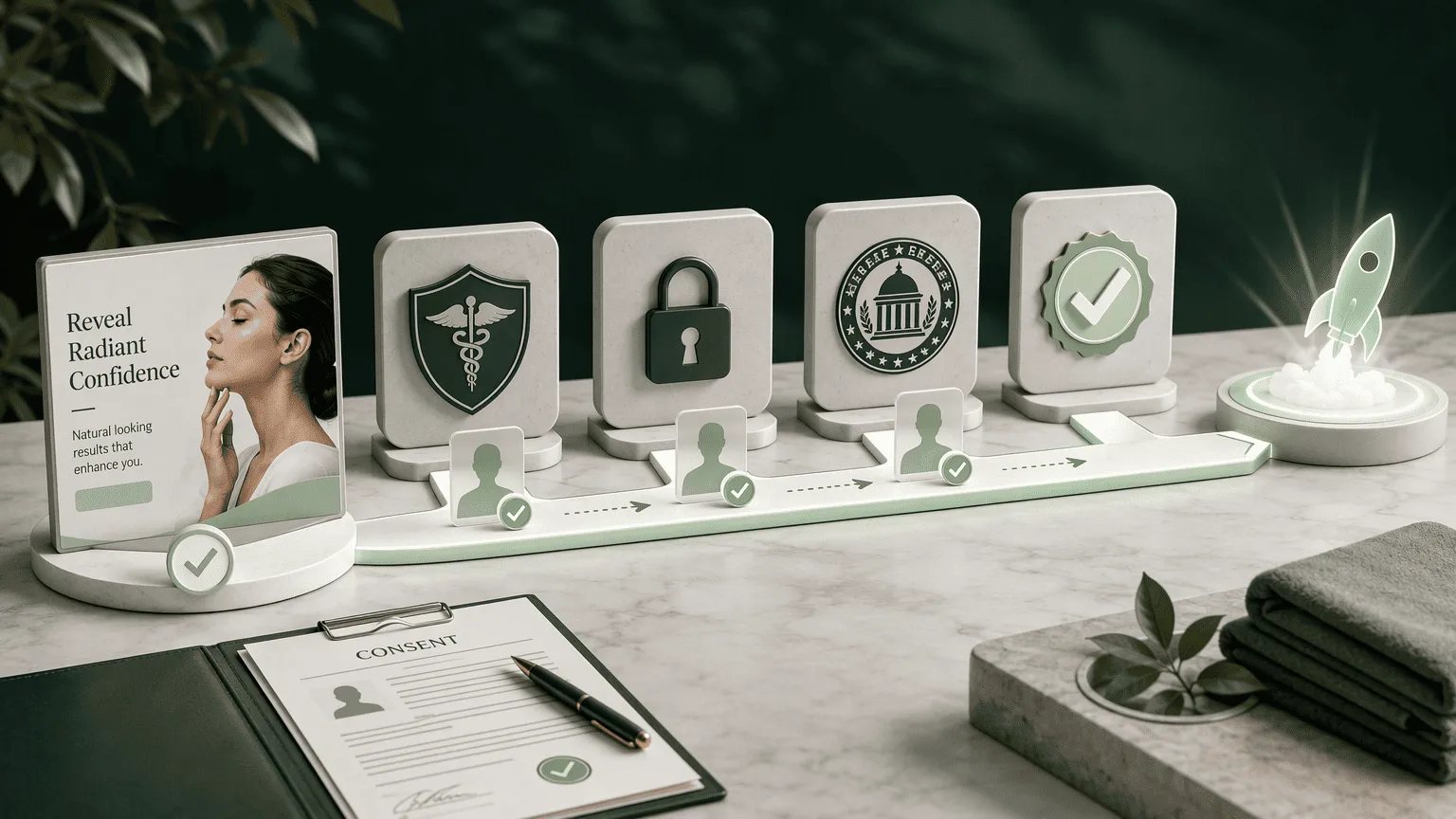
A med spa ad creative agency builds compliant, platform-safe ad copy and visuals that clear the overlapping regulatory hurdles of FDA, HIPAA, and state medical boards before a single dollar goes into Meta, Google, or TikTok. That means writing headlines that sell a neuromodulator without promising a result, building visual assets where patient imagery carries explicit, verifiable consent, and structuring claims so that a platform algorithm does not flag your account into automated oblivion. When a generalist agency builds a campaign for a bakery, the risk is a low clickthrough rate. When that same generalist builds a campaign for a med spa, the risk is a permanent Google Ads suspension and a medical director's license exposed to a board complaint. The difference is structural and it reshapes every part of the creative workflow, from the brief to the final export.
The problem is that most clinic owners cannot see the difference until the damage is done. A generalist can produce visually beautiful ads that run for six weeks and then trigger a policy violation with a single phrase. By then, your account health is flagged and you are fighting a faceless review queue with no specialist to escalate through.
A specialized agency builds creative inside the compliance boundary from the first frame, never as a retroactive fix after a warning. That preemptive architecture is what you pay the retainer for. It is cost avoidance masquerading as a service fee.
Platform-specific policy navigation is the other half of the work. Google's healthcare policy requires LegitScript certification for addiction treatment-related aesthetics and limits what you can claim in responsive search ad headlines. TikTok applies the same healthcare ad restrictions and will reject creative that sails through on other channels. A specialized agency formats each asset to the specific policy of the channel where it will run, which means the same campaign brief produces distinct creative versions for each platform, not one generic export.
The Non-Negotiable World of Aesthetics Compliance
FDA regulation of aesthetic advertising is built on a single principle: you cannot promise a result. Aesthetic advertisers work inside a narrow lane of suggestive language, and straying outside it can trigger a warning letter that becomes public record and a reputational anchor for the practice. Every compliant ad for Botox or Juvederm is a linguistic exercise in saying "you might look refreshed" without ever saying "you will look younger."
Using a real patient's before-and-after photo in a social ad without their explicit, written authorization for that specific marketing channel is a violation. The consent form from a treatment consent is not the same as a marketing release, and many practices learn this distinction only after a complaint is filed. A specialized agency builds workflows where every patient image in a creative asset is traceable to a signed, channel-specific release, and where inventory of usable visuals is systematically maintained rather than gathered haphazardly from an iPhone camera roll at the last minute.
State-level physician disclosure laws layer another compliance dimension on top of FDA and HIPAA. Many states require that any advertisement for medical services clearly disclose the supervising physician's name and license status, and some mandate that the ad specify which services are performed by a physician versus a nurse injector or aesthetician. Failure to meet these requirements is a state medical board violation with separate enforcement teeth. A national campaign that runs identical creative across five states may be compliant in three and illegal in two.
A single enforcement action from any of these bodies resets your marketing timeline to zero. You lose weeks of lead flow, the cash value of ongoing ad spend on paused campaigns, and the soft cost of a flagged ad account that earns slower algorithmic delivery long after you fix the offending asset. The specialist agency fee is, at bottom, an insurance premium against that outcome.
How Specialized Agencies Turn Compliance into Conversion
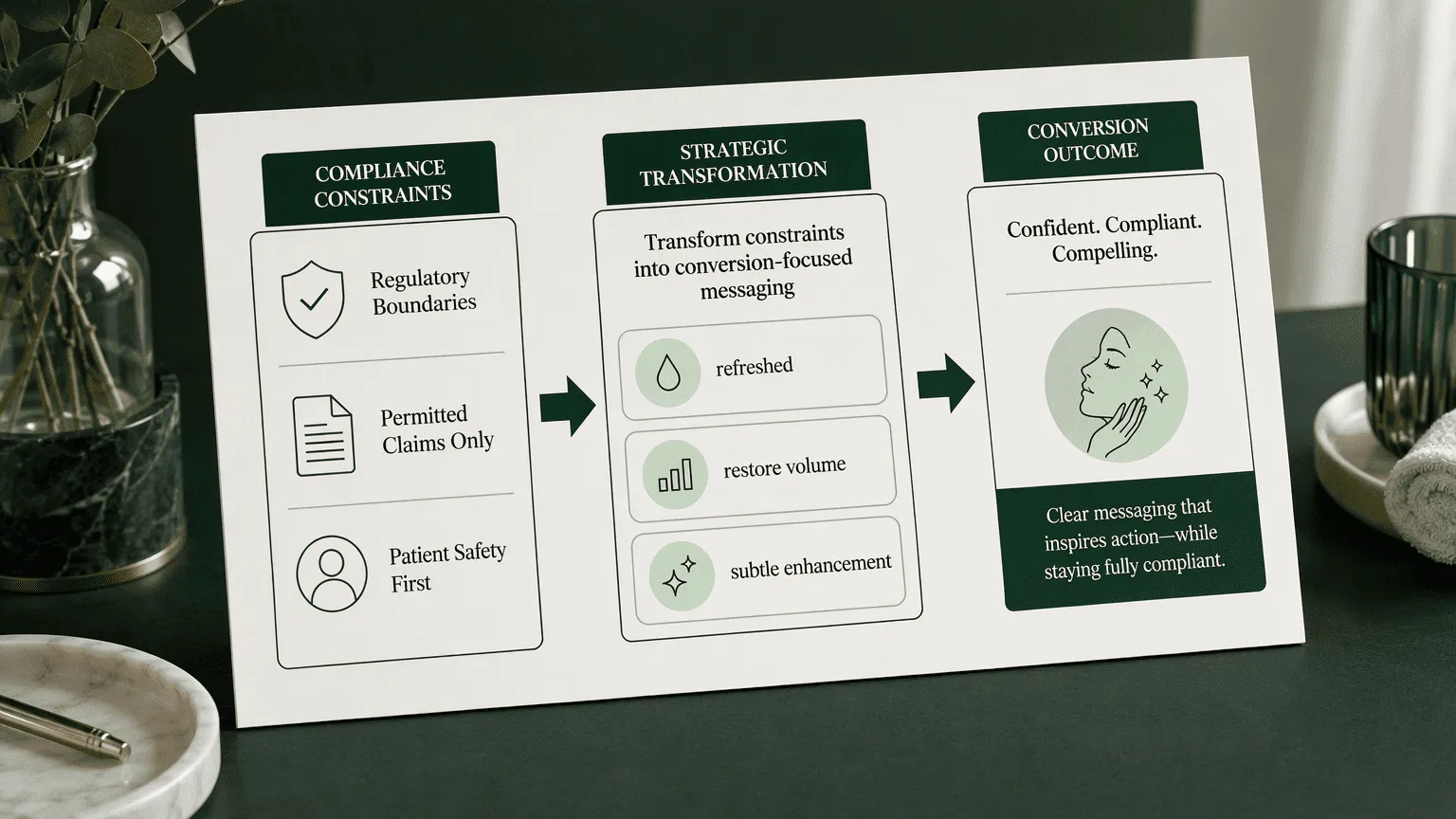
The mistake is treating compliance as a creative ceiling. It is a framing constraint, one that pulls the patient's emotional wiring and clinical expectations into alignment. The language platforms and regulators require, 'look refreshed,' 'restore volume,' 'subtle enhancement', is also language that lands with the aesthetic patient.
Nobody walks into a med spa wanting to look like a different person. They want to look like themselves, optimized. When an agency frames a dermal filler ad around 'restoring the contour you had five years ago,' it satisfies the FDA's prohibition on result promises and slots straight into the patient's internal narrative of getting something back rather than becoming something new.
Educational content is the primary compliant conversion asset in aesthetic marketing. An ad that leads with a 45-second explainer on how hyaluronic acid fillers work, what to expect during treatment, and why medical oversight matters does not make a single prohibited claim. It pre-sells the consultation through expertise signaling and an honest reduction of information asymmetry. The patient who arrives having absorbed this content is farther down the decision funnel and needs less hand-holding to book. A specialized agency builds campaigns where educational creative qualifies, and the lead form is a thin wrapper around an already-sold patient.
Emotional triggers, seasonal timing, and visual architecture do the rest. A campaign that understands the pre-summer body contouring surge front-loads swimsuit-anxiety creative in April. Ads using aspirational lifestyle imagery with medical credibility cues, a practitioner in clean scrubs, a modern treatment room, outperform brand-logo-only creative by a persistent margin. None of this crosses the regulatory line. Aesthetic decisions are emotional decisions made in a clinical setting, and the ad bridges that gap without breaking rules.
The Med Spa Patient Psychology and Cash-Pay Dynamics
The aesthetic patient decides differently than a medical patient working through insurance. Where your ad creative lands inside that decision sequence determines whether it converts. Here is the sequence a specialized agency designs against:
- Trigger recognition: An upcoming event, seasonal mirror-check, or social media exposure creates awareness of a gap between current appearance and desired self-image. This is an emotional ignition point, not a rational weighing of treatment options.
- Information search: The patient searches for a solution that feels safe and legitimate. They see your ad and click. They are scanning your creative for signals that you understand their problem without judgment and that you operate in a medical-grade environment. Price comparison comes later.
- Risk evaluation: Cash-pay treatment means the patient's own money is on the line, with no insurance reimbursement to offset it. The ad creative, landing page, and review profile must collectively answer one question: will I regret spending $600 to $1,200 here, or will I feel taken care of?
- Social proof validation: The patient looks for visual evidence of your work that is compliant but concrete. They want to see that other people have trusted you and emerged looking like the best version of themselves. Compliant before-and-afters, practitioner credentials on-screen, and real patient video testimonials with proper consent become the final nudge.
- Booking action: The booking event itself is a low-friction capstone to a process that was already decided emotionally. If your ad asked for a credit card or a deposit too early, you lost them. The specialized agency knows to make the first commitment as small as possible: a free consultation, a $50 deposit applied to treatment, a callback that arrives within 15 minutes.
2026 Pricing, Models, and What You're Really Buying

Med spa ad creative retainers vary sharply, and the floor and ceiling tell you more about what you are buying than the midpoint. Here is the actual range, grounded in current-year market data:
| Scope | Monthly Fee Range | What's Included | Who It Fits |
|---|---|---|---|
| Template or AI-Only Creative | Under $1,000 | Stock-heavy static assets, limited revision rounds, no platform policy navigation or medical review layer. | Early-stage owners testing offers; risk-tolerant operators who can self-manage compliance. |
| Full-Service Creative Retainer (Single Location) | $2,000 to $5,000 | Compliant static and video ads built for Meta, Google, and TikTok; platform-specific formatting; copy structured inside FDA/HIPAA guardrails; monthly performance reporting. | Single-location practices targeting steady growth with a marketing lead who owns performance. |
| Aggressive Growth or Multi-Location | $5,000 to $8,000+ | Multi-channel campaign architecture, dedicated creative strategist, A/B testing cadence, advanced audience segmentation, LegitScript navigation support. | Multi-location groups and practices scaling past $1.5 million in annual revenue. |
Ad spend is separate and typically runs $1,500 to $10,000+ per month for a single location depending on market competitiveness. A useful budget benchmark for growth-stage practices is 6 to 12% of target revenue allocated across agency fees and ad spend. The trade-off: percentage-of-ad-spend pricing rewards the agency for spending more, not for booking more, and flat retainers tied to scope keep incentives cleaner. Under-$1,000 services cannot support the medical review layer, the platform-policy monitoring, and the creative iteration cadence required to run compliant campaigns at scale. You are buying surface-level design, which carries the acquisition risk yourself.
The Metrics That Matter: Cost-Per-Consultation and True ROI
Impressions are a distraction. Clicks are a directional signal at best.
The only number that ties your ad spend to practice revenue is consultations booked, and the cost-per-consultation figure is the KPI that specialized agencies build their reporting around. A med spa consultation is a scheduled human being who has committed to a specific time slot to discuss treatment with your provider. That person has real lifetime value: a single facial injectable patient can generate $2,000 to $5,000 in annual spend, and a body contouring patient can exceed $8,000 across a treatment package. When you know your cost-per-consultation and your average consultation-to-treatment conversion rate, you know your patient acquisition cost down to the dollar. You can scale ad spend with confidence rather than hope.
A specialized agency should deliver cost-per-consultation data broken out by channel and campaign so you can see exactly what Meta is producing versus what Google is producing. They should also connect that metric to the actual booking constraint in your practice. If your front desk misses 40% of inbound calls, a low cost-per-consultation is pointless because the conversion chain is broken at the last step. The agency that can identify your actual booking constraint and prove how its work reaches consultations is the agency worth paying. Everything else is a reporting dashboard built to look busy while protecting a retainer.
Calculating ROI from this metric is straightforward: divide total monthly ad spend plus agency fees by the number of consultations booked to get your raw cost-per-consultation. Multiply consultations by your practice's close rate to get estimated treatments booked. Multiply treatments by average treatment value to get estimated revenue.
Subtract all marketing costs. What remains is your attributable return. If your agency cannot or will not build this spreadsheet with you, you are paying for advertising theater, not a performance partner.
A Clinads Portfolio Spotlight: Creative That Converts for Injectable Treatments

ClinAds generates campaign-ready static and video creative from a clinic's existing website and brand, built specifically for the compliance and conversion demands of aesthetic advertising. Here is what that looks like applied to a neuromodulator campaign:
- Compliant headline architecture: The creative avoids any language promising a result. Headlines like "Look Refreshed Without the Downtime" and "Subtle. Natural. Yours." work inside FDA boundaries while triggering the emotional self-image driver that brings patients to a consultation.
- Visual risk reduction: Static ads feature clean clinic photography, provider-credential overlays, and on-brand color grading that signals premium positioning. The visual language makes the case for your pricing without a single price claim.
- Educational video hooks: A 30-second video opens with the question the patient is actually asking ("Will I still look like myself?") and spends the next 25 seconds explaining how neuromodulator treatment works under proper medical supervision. No before-and-after, no guarantee, just trust-building that qualifies the viewer before they click.
- Channel-specific formatting: The same campaign assets are resized, re-cut, and reformatted for Meta feed, Google responsive display, and TikTok vertical so that each platform receives creative that fits its consumption behavior and its unique policy enforcement tendencies.
- Call-to-action that matches the stage: The CTA does not ask for a treatment booking. It asks for a consultation, a low-commitment next step that mirrors where the patient is emotionally after watching the ad. This keeps conversion rates higher and cost-per-consultation lower.
The LegitScript Certification Process: A Step-by-Step Compliance Timeline
LegitScript certification is a mandatory gate for any med spa that wants to run Google Ads for aesthetic treatments. The process demands documentation, time, and organizational discipline that most clinics underestimate. The certification verifies that your practice is legitimate, licensed, and operating in compliance with applicable healthcare laws. Google will not serve a single impression for restricted healthcare queries until that verification is complete. Many clinic owners discover this requirement only after their first campaign is rejected, which means they have already burned the budget they set aside for the launch month and have nothing to show for it.
Processing times can range from two to six weeks, and any discrepancy in your documentation resets the clock.
A specialized agency can front-load this process as a prerequisite to campaign buildout, so that by the time creative is ready to deploy, certification is active and you are not paying a retainer to wait on a Google review queue. If an agency pitches you on a Google Ads campaign for your med spa and does not raise LegitScript in the first conversation, that is your signal to end the conversation. They either do not understand the channel, or they plan to run ads until a rejection hits and then figure it out retroactively. You will be the one absorbing the lost revenue.
A Cost-Per-Consultation Calculator Using Real US Market Data

You can estimate what your cost-per-consultation should look like before you hire anyone.
Start with your projected monthly ad spend. A single-location practice in a competitive market might allocate $4,000 to ads. With average cost-per-click for aesthetic search terms in the US running between $4.50 and $9.00, that $4,000 buys roughly 450 to 900 clicks per month.
Apply a realistic landing page conversion rate of 3% to 5%, the range well-built med spa pages reach, and you are looking at 14 to 45 consultation bookings per month from Google search alone. At the midpoint, 25 consultations, your raw cost-per-consultation lands near $160 before agency fees. That is a healthy acquisition cost for a patient whose lifetime value can exceed $3,000.
If your numbers miss this mark, the culprit sits in one of two places: your cost-per-click (wrong keywords, poor Quality Scores) or your conversion rate (weak landing page, slow load times, confusing booking UX). Both are diagnosable, and both respond to specialized intervention.
Conclusion
A generalist creative team can run your ads for weeks before a single regulatory misstep gets the account suspended. Once Facebook or Google flags a cosmetic injectable ad, you lose the pixel data, the audiences, and sometimes the entire Business Manager. Rebuilding from zero costs more than the agency fees you saved.
A specialized ad creative agency builds every asset inside the platform policies that govern aesthetic medicine. The creatives won't mention Botox by name on Meta, won't use before-and-after imagery where it is banned, and won't make claims that state medical boards treat as practicing medicine without a license. You are buying a compliance framework that keeps the channel open.
Cost-per-consultation is the number that matters. Impressions and clicks tell you nothing about revenue if those taps never become a person in a treatment chair. Vet any agency on whether they report consultations booked, not just traffic, and on whether they can walk you through the LegitScript application before they touch a dollar of ad spend. The right partner shows you how creative performs inside the boundaries, because those boundaries are the only thing keeping your ad account alive.
Frequently Asked Questions
What exactly does an ad creative agency for med spas do, and how is it different from a general marketing agency?
It produces ad copy and visuals that comply with FDA, HIPAA, and state medical board rules before campaigns launch. A generalist agency runs standard creative and retroactively fixes violations. The specialist builds inside the compliance boundary from the first frame, navigating platform-specific policies for Google, Meta, and TikTok.
How do med spa advertising agencies navigate the strict medical advertising regulations in the United States?
They structure copy to avoid prohibited result promises, secure channel-specific patient photo consent under HIPAA, and format ads to each state's physician disclosure laws. They pre-clear creative against FDA injectable guidelines and platform healthcare policies before any ad spend goes live.
What are the typical costs, pricing models, or retainer fees for hiring an ad creative agency for a med spa in 2026?
Full-service creative retainers range from $2,000 to $8,000+ per month. Single-location practices typically fall between $2,000 and $5,000, while multi-location or aggressive-growth campaigns exceed $5,000. Services under $1,000 generally offer templated output without compliance depth. Ad spend is separate.
What specific metrics or ROI should a med spa owner expect from a specialized ad agency compared to running ads in-house?
Demand cost-per-consultation, not impressions or clicks. A specialized agency should report this metric by channel and tie it to your booking constraint. Expect a cost-per-consultation that delivers positive ROI against a patient lifetime value of $2,000 to $8,000 depending on treatment category.
Which channels, Meta, TikTok, Google Ads, or others, are delivering the highest conversion rates for med spa advertising in the current landscape?
Google Ads captures high-intent search traffic and often delivers the strongest cost-per-consultation. Meta excels at visual storytelling and retargeting for aesthetic offers. TikTok is emerging and reaches new audiences but applies the same strict healthcare ad policies and requires channel-specific creative formatting to convert.
Sources
- Best MedSpa Marketing Agencies in 2026: Compare Scope & Fit - medspamarketpro.com
- What Should a Med Spa Marketing Agency Cost? | Real 2026 Pricing - aesthetixmedia.com
Want help executing this for your clinic?
Book a 30-minute call and we will map what a real ad engine would look like for your specific service mix.
Book a call