
Do You Need LegitScript to Advertise GLP-1s on Google? The 2026 Reality for Clinics
IntroductionYour Google Ads account is live, your GLP-1 campaign is built, and every ad gets slapped with a "Disapproved: Restricted drug terms" label before it sees a single impression. The problem is not your copy or your bid strategy. The problem is that Google has locked prescription drug keyword targeting behind a third-party accreditation gate, and you walked into it without the key.
Over the last two years, the weight-loss market has exploded while compounding pharmacies operating in legally gray spaces have drawn sharp regulatory crackdowns. Boothwyn Pharmacy began compounding popular injectable weight-loss drugs in early September 2024 and wound up with a $1 million civil penalty and a license on probation after state inspectors found over a thousand doses produced each day in uninspected rooms. Google's response has been to tighten the verification chain. That chain starts with LegitScript. Here is exactly what the requirement covers, who must get certified, what it costs in real 2026 dollars, and what happens if you skip it.
Key Takeaways
Here is what every clinic marketer needs to internalize before spending a dollar on GLP-1 search campaigns in 2026:
- Mandatory gatekeeper: Google requires LegitScript certification before you can keyword-target any prescription drug term, including every GLP-1 brand name and generic variant.
- Two-step sequence is non-negotiable: You complete LegitScript first, then apply for Google's free healthcare advertiser certification. Reversing the order gets you rejected at step two.
- Real 2026 costs: $975 nonrefundable application fee per website, $2,150 annual monitoring fee post-approval, and an optional $2,500 expedited review if the queue is throttling your launch.
- Ad copy loophole is useless in practice: Google's October 2025 policy revision lets you name GLP-1s in ad text without certification, but uncertified advertisers still cannot target drug-name keywords, so the ads never surface where they matter.
- Enforcement is progressive but terminal: You get a warning at least 7 days before suspension, but repeat violations lead to permanent account disablement with no recovery path for that domain.
The Core Requirement: Why LegitScript Is the Gatekeeper for GLP-1 Ads

Google's Restricted drug terms policy draws a hard line: you cannot bid on prescription drug keywords unless you hold both a third-party healthcare accreditation and Google's own advertiser certification. LegitScript is the dominant accreditor for US-based telemedicine providers and online pharmacies because it verifies that your business is properly licensed, prescribes only within lawful clinical protocols, and markets without deceptive claims. Without that seal, your keyword list for "semaglutide near me" or "buy tirzeptatide online" will not trigger a single ad.
The October 2025 policy update let you mention drug names in ad copy without certification. You can write "We prescribe compounded semaglutide" in a headline, but you still cannot target the keyword "semaglutide." The ad sits behind an invisible wall. The policy allows unbranded clinic advertising while leaving the certification requirement in place for any campaign built on drug-name search intent. Keyword targeting for GLP-1 patient acquisition depends on certification.
Who Must Get Certified: A Business Model Breakdown
Telehealth platforms facilitating GLP-1 prescribing need LegitScript. If your business model involves an online consultation flow that ends with a prescription and medication delivery, Google classifies you as either an online pharmacy or a telemedicine provider. Both categories fall squarely within LegitScript’s certification scope.
Online pharmacies dispensing GLP-1s directly to patients face the strictest verification tier. LegitScript checks pharmacy licensure in every state you ship to, reviews your prescribing protocols, and audits your website for transparent pricing and honest marketing language. Compounding pharmacies hit the same requirement plus an additional layer of scrutiny, given the FDA’s compounding enforcement appetite in the GLP-1 space.
Brick-and-mortar clinics occupy the narrow exemption lane. A physical practice that sees patients in person and avoids ads that keyword-target drug names can usually skip certification entirely. A med spa advertising “medical weight loss consults” without naming medications in the keyword list can run Google Ads without LegitScript.
The trap snaps shut the moment you add “semaglutide” or “tirzepatide” to your keyword planner. The second a drug-name keyword enters your campaign, the exemption evaporates and the full certification requirement locks into place. That rule applies whether you are a physical clinic, a telehealth platform, or a compounding pharmacy.
The Certification Gauntlet: A Step-by-Sequence Through LegitScript and Google

The certification process follows two sequential steps:
1. Submit a LegitScript application per website domain, providing pharmacy or medical practice licenses for every jurisdiction, linking your website for a compliance review, and paying the $975 nonrefundable fee; LegitScript then verifies everything against state and federal registries and either approves, denies, or requests remediation.
2.
The review is not instant. Queue lengths fluctuate, but in late 2026, standard turnaround is running weeks to months depending on application volume.
Attempting step two without step one will bounce you immediately. The sequential dependency is hardcoded into Google's review workflow. Every ad you build before both certifications are active will sit in a disapproved state. Budget your launch timeline accordingly: the gap between starting the LegitScript process and seeing your first GLP-1 keyword ad go live is measured in months, not days.
Preparing Your Application: The Pre-Game Checklist for a Smooth Review

Most rejections are preventable. LegitScript denies applications because the website does not match what the licenses claim. Before you submit, audit your online presence against your state registrations.
Your website must display accurate business information, a privacy policy that covers how patient data is handled, clear prescribing protocols that show a licensed practitioner makes every prescribing decision, and marketing language that does not promise outcomes or minimize risks. LegitScript's review explicitly flags exaggerated claims, missing disclaimers, and "too good to be true" pricing. If your landing page reads like a direct-response funnel, rewrite it before you apply.
Your pharmacy or medical licenses must be current and match the exact business entity name and address on your application. The FDA warning letter to Boothwyn Pharmacy cited a failure of sterile manufacturing conditions that included products released after failing sterility testing. That outcome is what LegitScript's compliance review is designed to catch.
The Department of State conducted four inspections of Boothwyn Pharmacy between November 2024 and March 2025 before issuing its $1 million penalty. LegitScript functions as a pre-vetting layer, catching licensing and marketing gaps before Google ever sees them.
Timelines, Queues, and Costs in Q4 2026: A Realistic Look

Before you budget, understand that the total hard cost to certify a single domain is $3,125, not counting any paid-expedite fees, and the clock can run for months if you enter the standard queue. Here is the breakdown you must account for:
- Nonrefundable application fee: $975 per website: You pay this when you submit your initial application. If LegitScript denies your website, the fee is gone, and you will pay another $975 to reapply.
- Annual monitoring fee: $2,150: This is charged only after you receive approval and recurs yearly to maintain your certification. LegitScript continues to monitor your site and your business practices post-certification.
- Expedited review option: $2,500: This add-on fee bypasses the standard queue entirely. It is relevant only if your launch timeline cannot absorb a multi-month wait.
- Google healthcare advertiser certification: $0: Google charges no fee for this secondary step, but you cannot submit your Google application until you hold a valid LegitScript certificate in hand.
- Standard queue duration: Industry reports in late 2026 show standard LegitScript review windows stretching from several weeks to multiple months. The expedited review compresses this wait significantly, but the exact turnaround varies by application volume.
Consequences of Non-Compliance: From Ad Rejection to Account Suspension
The first enforcement action is automatic and silent: every ad that targets a GLP-1 drug keyword without certification is disapproved at review. You will not get an explanatory email. You will see a red "Disapproved" flag in your dashboard, and the campaign will generate zero impressions.
Google’s policy states that violations will not trigger immediate account suspension without warning. You receive a notice at least 7 days before any suspension action. That warning window is your only opportunity to either pull the offending campaigns or accelerate your LegitScript application.
If you ignore the notice, or let the campaigns sit in violation through the notice period, the account moves to suspension. Google’s enforcement is domain and entity-linked.
Once an account is suspended for a Restricted drug terms violation, creating a new account under the same business entity or website domain typically gets flagged and suspended again. The suspension effectively blacklists your domain from Google Ads for prescription drug advertising.
The reputational damage extends further. LegitScript shares compliance data with partner platforms. A suspension pattern on Google can surface during a Meta or Bing healthcare authorization review, compounding the operational impact beyond a single ad channel.
If you are starting now, treat the certification requirement as a pre-launch milestone. The 7-day warning window is a safety net you do not want to rely on as your plan.
The LegitScript Ecosystem: Platform Portability and Alternative Paths
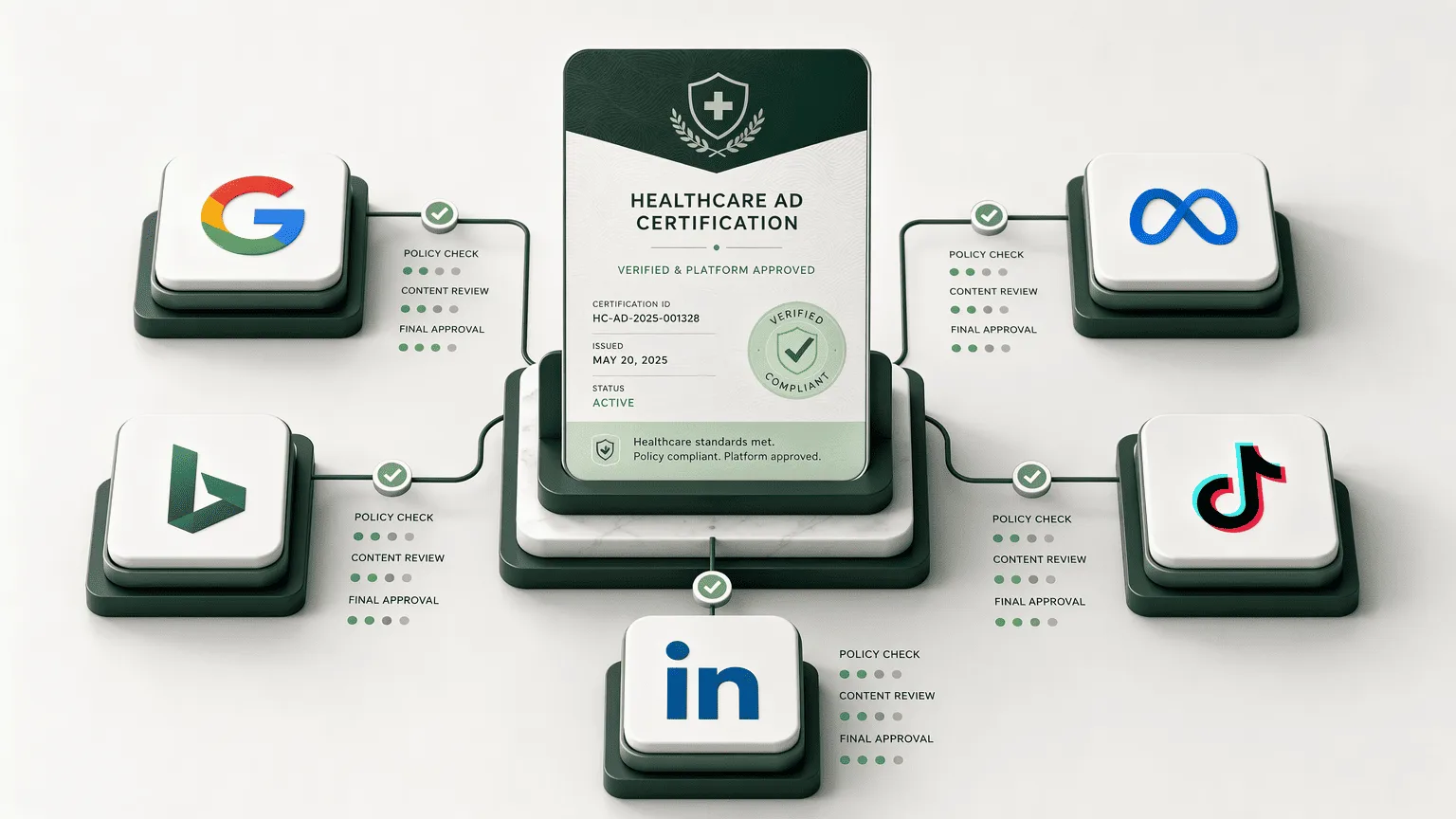
LegitScript certification gets your healthcare ads onto Google, but it also opens doors on Meta, Microsoft Bing, TikTok, and LinkedIn. Each platform has its own extra verification step after certification. The table below shows which accreditations get you onto which platforms and what the alternative certifications actually cover.
| Accreditation | Issuer | Cost | Google Accepted? | Other Platforms Recognizing It | Notes |
|---|---|---|---|---|---|
| LegitScript | Private certification company | $975 apply + $2,150/year per site | Yes | Meta, Bing, TikTok, LinkedIn | Dominant US telehealth standard; required for Google keyword campaigns on drug terms |
| NABP (VIPPS/.pharmacy) | National Association of Boards of Pharmacy | Varies by program | Yes (pharmacy-focused) | More limited cross-platform recognition | Older standard; primarily recognized for online pharmacies, less common for telemedicine-only models |
| G2 Accreditation | G2 | Varies | Yes | Limited cross-platform adoption | Smaller certification footprint; accepted by Google as an alternative for specific advertiser types |
Conclusion
LegitScript certification is non-negotiable for any clinic, pharmacy, or telehealth platform that wants to keyword-target GLP-1 drug names on Google Ads in 2026.
The sequential process runs LegitScript first, then Google certification second. That order adds weeks to months to any launch timeline. The financial commitment starts at $975 upfront, before you know whether the application will be approved.
Budget for the full pipeline. Prepare your website and licenses before you apply.
Treat the 7-day Google warning window as a last resort. If you are leaning on that window, your timeline has already failed.
Frequently Asked Questions
What is LegitScript certification and why does it matter for healthcare advertising?
LegitScript is a private certification company that verifies healthcare businesses are properly licensed, prescribe only within lawful clinical protocols, and market without deceptive claims. It matters because Google, Meta, Bing, TikTok, and LinkedIn all require or strongly prefer it before allowing prescription drug or telemedicine advertising.
Does Google require LegitScript certification to advertise GLP-1 medications in the United States?
Yes. Google’s Restricted drug terms policy mandates third-party accreditation, typically LegitScript, plus Google’s own healthcare advertiser certification before you can keyword-target any GLP-1 drug name. You can mention drug names in ad copy without certification under the October 2025 policy update, but you still cannot target those terms as keywords.
What types of GLP-1 advertisers are eligible for LegitScript certification and what are the specific requirements?
Telehealth platforms facilitating online prescribing, online pharmacies dispensing medications directly, and compounding pharmacies are all eligible and typically required to certify. Requirements include valid pharmacy or medical practice licenses for every state served, a website that passes LegitScript’s compliance review for honest marketing and clear clinical protocols, and accurate business information matching state and federal registries.
How does the LegitScript certification process work and how long does it take to get approved?
You submit a $975 nonrefundable application per website, LegitScript reviews your licenses, prescribing protocols, and website compliance, then either approves, denies, or requests remediation. After approval, you pay a $2,150 annual monitoring fee and apply for Google’s free healthcare certification. Standard review times in late 2026 range from several weeks to multiple months; an optional $2,500 expedited review compresses the timeline significantly.
What are the consequences of advertising GLP-1s on Google without LegitScript certification?
Every ad targeting a GLP-1 drug keyword is immediately disapproved and generates zero impressions. Google issues a warning at least 7 days before suspending the account. Ignoring the warning leads to suspension, after which the domain and associated business entity are effectively blacklisted from advertising prescription drug terms on Google Ads.
Are there any alternative or complementary compliance paths for advertising GLP-1s on Google in 2026?
NABP accreditation and G2 certification are alternative third-party accreditations accepted by Google, though NABP is primarily pharmacy-focused and G2 has a smaller recognition footprint. None of the alternatives bypass the sequential requirement: you still need the third-party accreditation first, followed by Google’s own healthcare advertiser certification.
Sources
- Update to Google Ads Healthcare and Medicines Policy (April 2026) - Advertising Policies Help - support.google.com
- Shapiro Administration Protects Pennsylvania Consumers by Holding Chester County Pharmacy Accountable for Unauthorized Compounding and Distribution of Approximately 30,000 Doses of Injectable Weight-Loss Drugs | Department of State | Commonwealth of Pennsylvania - www.pa.gov
- Boothwyn Pharmacy, LLC - 717525 - 01/16/2026 | FDA - www.fda.gov
Want help executing this for your clinic?
Book a 30-minute call and we will map what a real ad engine would look like for your specific service mix.
Book a call