
ChatGPT Recommended a Competitor Across Town. Here's How to Fix That in 2026.
IntroductionA patient walks in and says the quiet part out loud: “ChatGPT told me to go across town.” Your stomach drops. For a decade you fought Google rankings, knowing the game was to outrank a rival. Now a patient asks a conversational question, an AI names one or two clinics, and yours is invisible.
That punch-in-the-gut moment is a data integrity audit delivered to your front desk. The AI doesn't dislike your practice. It simply cannot find a single, verifiable entity that matches what your clinic claims to be. Columbia's Tow Center found that over 60% of AI search responses contained factual errors in 2026. Your job is to ensure the error isn't you.
Two pieces of the problem hit hardest. First, AI models stitch answers from dozens of sources and often fuse two clinics into one mismatched profile. Second, they fill gaps with statistically probable guesses that read like facts. When your NAP data, licensure, and specialty listings scatter across directories that contradict each other, the model defaults to the practice whose information looks clean and consistent.
Fix that before the next patient reroutes.
Key Takeaways
The fix is deterministic, not mysterious. When an AI recommends a clinic, it's validating data integrity, not clinical reputation.
- The root cause is missing corroboration: ChatGPT's engine is a corroboration machine. It only names a practice when it finds identical name, address, and phone details across six or more authoritative medical directories.
- Google ranking does not transfer here: Most brands performing well in traditional local search fail to appear in AI results. AI visibility is three to 30 times harder to achieve.
- The primary fix is source data correction: Complaining to the AI is useless. You must correct stale directory listings, resolve entity confusion with similarly named clinics, and implement physician schema on your website.
- You need a monitoring habit: AI training data updates on a delay. Expect about 90 days of consistency after corrections before AI assistants reliably reflect the improvement.
Verdict: Why ChatGPT's Recommendation Engine Is a Data Integrity Test, Not a Popularity Contest
The AI is a cold, indifferent auditor. It couldn't care less about your medical degree, your bedside manner, or how many years you've been in the community. These systems operate on what they can verify.
In an era where AI responses often cite just one to three practices, being mentioned becomes more valuable than being #3 in traditional search. The AI doesn't pick a clinic because it's “popular.” It picks it because it's the single most undeniable answer to a data query. The trade-off: you can have 380 glowing Google reviews, but if your name is spelled three different ways across four directories, the AI treats you as an unresolvable entity.
What looks like a popularity signal is actually a purity signal. A practice with clean listings on eight directories crushes one with thin, inconsistent data. Your Google star rating is evaluated by AI only to the extent that it's consistent. For the record, ChatGPT-recommended locations averaged 4.3 stars, and all the stars in the world can't patch a broken digital avatar.
Comparing the Factors That Actually Build AI Recommendation Confidence

You cannot import your 2022 local SEO playbook into a 2026 AI reality and expect it to work. The ranking signal set has fully pivoted from user-generated sentiment toward structured, verifiable truth. Underperforming brands that trusted their old playbook got a brutal wake-up call; data shows brands with low profile accuracy, ratings near 3.4 stars, and review response rates below 5% were effectively invisible to AI engines. The mental model shift is severe: you are no longer optimizing for a search algorithm. You are programming a digital twin that the AI must recognize as the same entity everywhere.
The engine's core logic is corroboration. If six sources all say "Main Street Pediatrics" is at "123 Main," the confidence is high. If one says "Main St. Peds" and another lists a secondary office phone number, the AI opts for the cleaner, more consistent competitor instead.
Understanding ChatGPT's Source Code: How NAP Data and Entity Comprehension Determine Your Clinic's Visibility
Name, Address, Phone data is your clinic's fingerprint in the machine. A clinic gets recommended by ChatGPT and Gemini when three conditions are met: it must be listed with identical details across six or more medical directories, its website must carry schema markup, and authoritative sources must mention it. This is entity resolution. The AI tries to prove a business exists by finding the same exact string in multiple corroborating locations.
| Component | Description | Failure Mode |
|---|---|---|
| NAP Consistency | The exact match of practice name, street address, and primary phone number across all directories. | A “Ste. 101” in one place and “Suite 101” in another creates a split entity that the AI cannot reconcile. |
| Entity Comprehension | The AI’s ability to link your business listing to structured concept labels like “MedicalOrganization” or “Physician.” | Without schema, the AI sees your site as generic text, not as a practicing medical entity with a validated license. |
| Corroboration Threshold | The minimum number of identical citations required to clear the AI's confidence interval for a recommendation. | Operating below the six-directory rule usually keeps you completely out of the shortlist, regardless of reputation. |
Why a Competitor Across Town Just Stole Your AI Referral: The Entity Confusion and Freshness Problem

They didn't outsmart you in a street fight. They out-organized you in a system of record.
While you let your NAP data rot across outdated listings, they cleaned house. The AI doesn't give the tie to the clinic with the better academic pedigree; it gives it to the one with cleaner, fresher data. Freshness is a kill switch: if an AI model trained on a snapshot from months ago still holds your old address because you moved in 2024, your competitor's long-established, static, and verifiable location looks safer to recommend.
The other killer is entity confusion, a digital doppelgänger problem. If "Smith Family Medicine" shares a common name with another practice across town, an AI may fuse the two entities. It grabs your phone number and their address, crafting a Frankenstein profile.
The system walks away from confusion. If it can't verify which Smith is which with absolute certainty, it confidently recommends the dermatology practice five blocks away instead, simply because that dermatologist's entity map was perfectly clean across seven sources. In AI visibility, silence is safer for the machine than a correct but messy aggregation.
Step-by-Step Workflow: Correcting the Source Data to Reclaim Your AI Recommendation
Every major AI model answers differently at this stage. Your first task is to see exactly what ChatGPT, Gemini, and Perplexity say about you right now. Run the prompt that caused the problem: "Who is a good [your specialty] near me?"
Document the results. Tools like thedocmirror.com help here, scoring your practice across several models at once. These outputs are a differential diagnosis. A missing practice usually means a name, address, phone number (NAP) or entity resolution failure. A listed but inaccurate practice points to entity confusion or a freshness lag.
The order of corrections matters. Most clinic owners jump to "I need more reviews." But AI search needs clear infrastructure first. Log into every major directory where you hold a free profile. Healthgrades, Zocdoc, Vitals, your Google Business Profile, specialty board registries, and hospital affiliate pages form the core list.
Precision is non-negotiable. Use the identical street suffix everywhere. If Zocdoc shows "Rd."
and Healthgrades shows "Road," the entity link breaks. Copy and paste the exact practice name from your legal entity into each field. Hit save, and the crawl-and-index wait begins.
Expect a few weeks for changes to register. Your website does the final work of telling AI what sits behind it. The homepage needs Physician or MedicalBusiness schema markup.
That markup declares: "This is a clinic, led by this doctor, practicing these specialties, at this verified location." In a tight geographic pairwise comparison, that structured data is often the only thing separating a recommended practice from an invisible one.
Build Your Verifiable Authority: Implementing MedicalBusiness/Physician Schema and Condition-Led Content
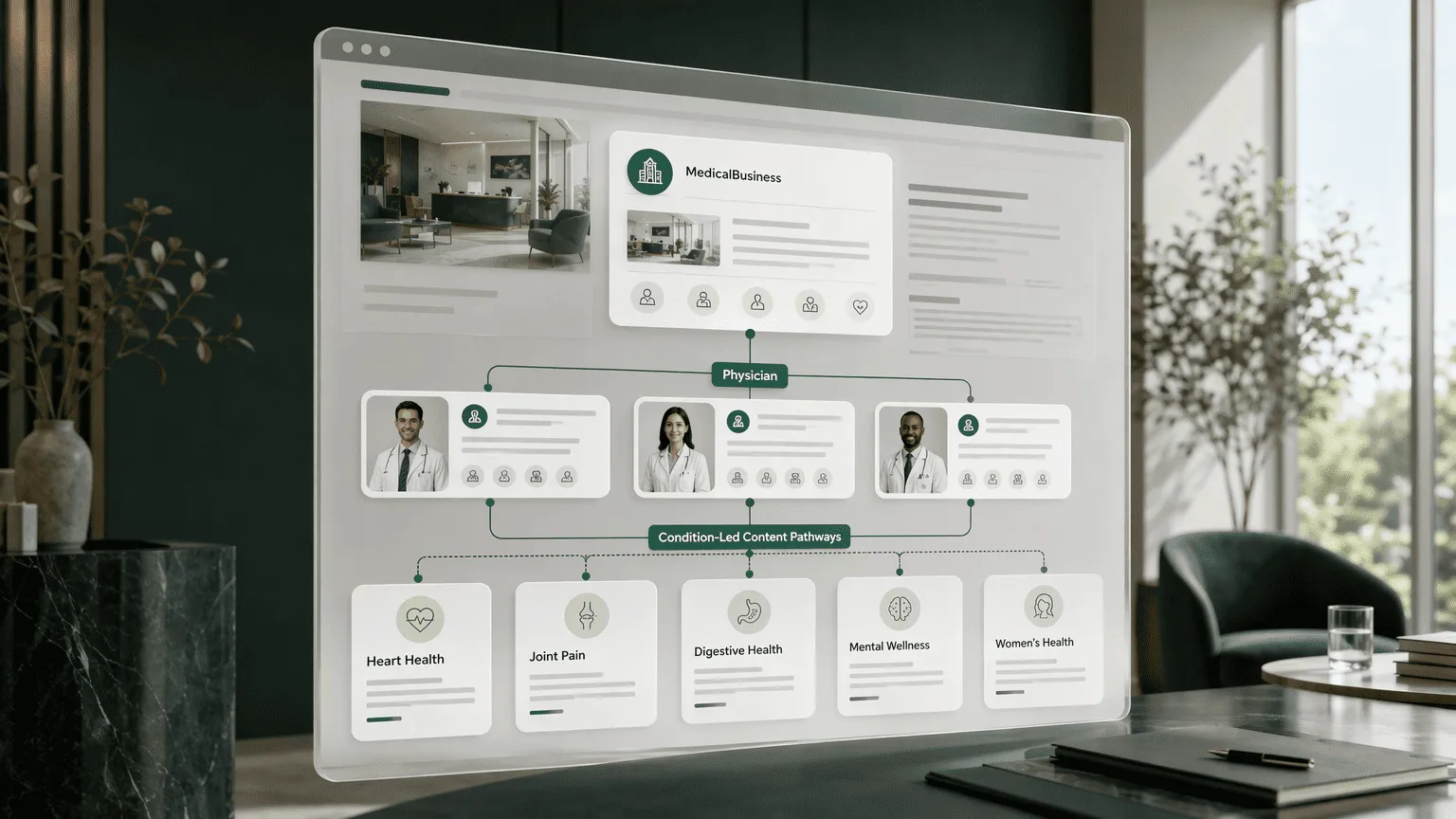
Schema markup is a structured data vocabulary you embed into your website code. Visually, it's invisible to patients. It acts as the translation layer that tells an AI exactly what your webpage represents. MedicalBusiness schema flags your practice as a legitimate clinical entity; Physician schema attaches each named doctor to their specialty and board certifications. In an AI ecosystem short on blind trust but rich in verification priority, a site without schema gets read like a suspicious, uncategorized document.
Once the entity is hard-coded, you must power the context around it. Condition-led content solves this where keyword-stuffed service pages never will. AI models respond to query behavior clusters: recommendation queries, symptom queries, and availability queries.
Writing pages that match how a patient actually describes their problem ("knee stiff after sitting, not after running") captures the long-tail intent that AI surfaces. This approach aligns directly with Google's AI Mode logic: you become the most authoritative source for a specific condition because your page accurately mirrors the patient's lived experience. You feed the AI transparent clinical information that makes ambiguous queries resolve to your clinic with high confidence.
The Directories That Rule US Healthcare AI: A Localized Strategy for Healthgrades, Zocdoc, Vitals and More

The AI value of third-party platforms comes from their domain authority, not their traffic. High-authority medical directories act as verification anchors that raise or lower the AI's confidence in your practice data.
- Healthgrades: Engines treat Healthgrades as a primary cite for physician existence and specialty verification. An incomplete profile here often cascades into a missing entity response.
- Zocdoc: Zocdoc carries heavy authority for availability states. If you are not syncing your latest "accepting new patients" status, the AI may deprioritize you in favor of a clinic with a live bookable signal.
- Vitals: Vitals sits in the entity understanding pipeline for AI models scanning basic practice scope. Any mismatch in specialty tags here corrupts downstream condition-matching queries.
- Google Business Profile (GBP): This is ground zero for Gemini's responses. Business info on Gemini hit 100% accuracy because it is grounded in Google Maps. Your GBP is essentially your Gemini ranking factor.
- Specialty Board & Hospital Affiliate Sites: These function as hard-fact anchors. An AI reads a board listing as a verified credential, not a self-claim, which pushes entity confidence past the threshold the engine needs to surface your practice.
Ongoing Vigilance: How to Monitor and Manage Your Clinic's AI Presence in 2026
In 2026, quarterly AI audits are an operational requirement, not a quarterly nice-to-have. Shifts in training data, mergers across directory platforms, or a new clinic opening across town with a confusingly similar name can silently corrupt your AI avatar in months. Here's the routine that catches those shifts before they cost you patients.
- Run a cross-model scan each quarter. Pick a free tool like thedocmirror.com that queries ChatGPT, Gemini, Claude, and Perplexity simultaneously. Relying on a single model is like checking only one review site and assuming the rest are fine.
- Test the exact prompt mix. Don't just check your brand name. Execute recommendation queries ("best dermatologist near me"), symptom queries, and availability tests. If you only use one prompt type, you're leaving massive blind spots untouched.
- Verify entity resolution instantly. Compare the address and phone number returned by the AI against your true source of truth. A stray "Suite B" that crept back in via a forgotten automation is all it takes to send a prospective patient to the wrong door.
- Revalidate your schema and content freshness. Ensure your schema hasn't been blown out by a website update. Keep condition-led pages updated annually so the AI doesn't treat your content as stale clinical advice. A page last touched in 2023 signals neglect to any retrieval system, including the models that now power local recommendations.
Which Should You Choose: DIY Correction, Automated Audits, or Managed Services?
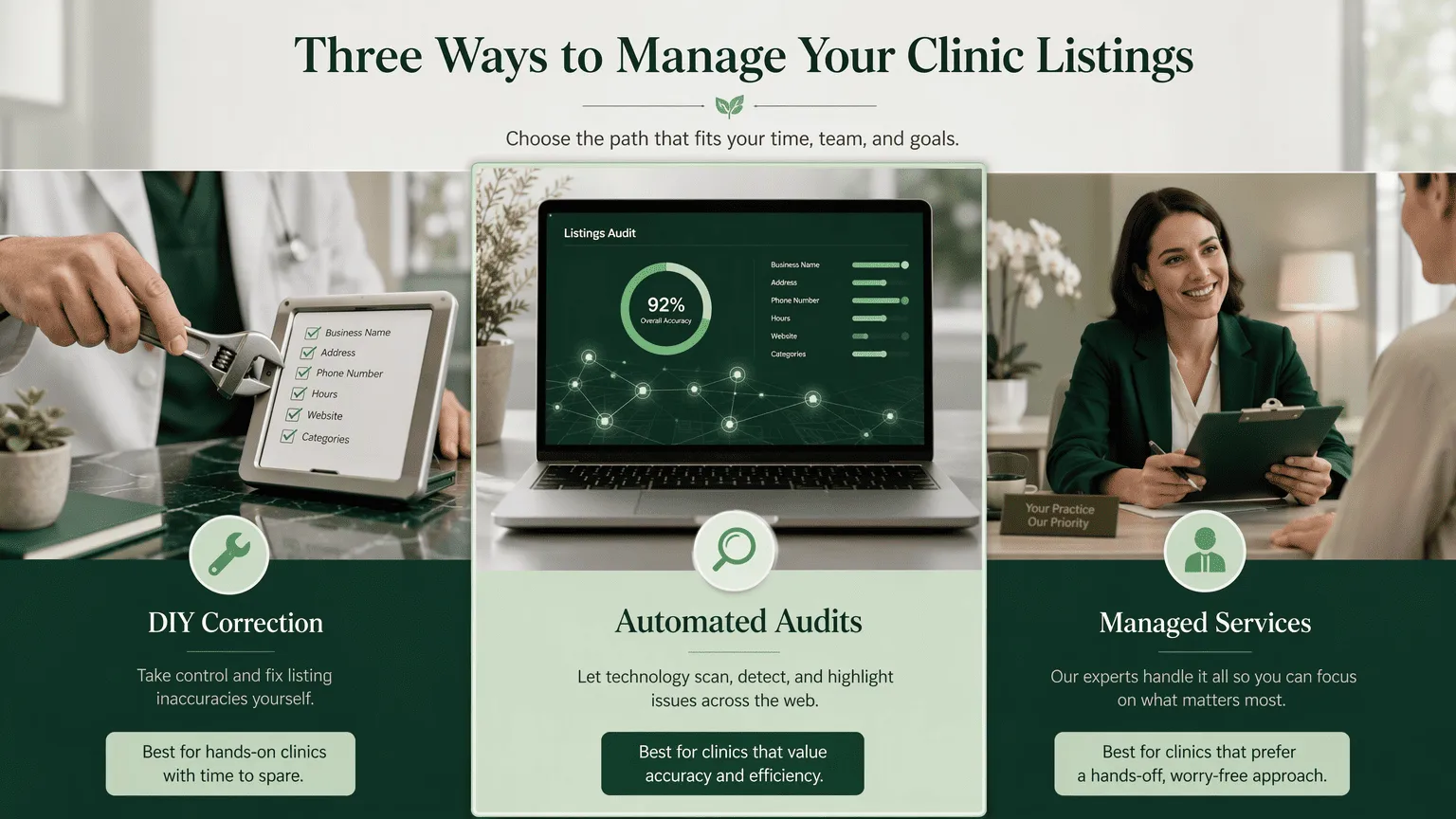
The choice comes down to how much time your clinic can afford to spend away from patients. A fully booked practice with a capable operations team can manage corrections in-house with schema guides and thedocmirror.com scans. Count on ten to thirty hours of manual verification across directories, character-by-character fixes on Zocdoc, and weekly checks to see if your Healthgrades phone number survived the weekend. During the 90-day cool-down before the AI re-trusts your data, you are checking every week.
Automated local listing tools sit in the middle. They push updates to aggregator networks quickly, solving the distribution speed problem. Many fall short on the specialized medical endpoints that AI models treat as authoritative: specialty board portals and hospital web directories. The result is clean, consistent, and incomplete visibility.
Managed services make financial sense once you can measure lost AI referrals in actual patient bookings per week. You need a system that monitors entity hygiene across the three engines that matter. The work is getting a technologist to output deterministic status calls on your digital twin.
If you just finished reading this and you are in the uncertain middle, paste your homepage into ClinAds to see what the machine already thinks you look like. The blind spots surface in seconds. The only losing play is doing nothing and hoping the next patient ignores their ChatGPT results.
Conclusion
That patient who walked into your office with ChatGPT's choice on their phone handed you a free system audit that competitors pay thousands to interpret. You now know the referral didn't go across town because of their awards, their advertising budget, or their renovation. It went there because their entity data formed a single, mathematically irrefutable identity across six or more authoritative sources.
The path to reclaiming your AI recommendation is deterministic. Close out the year by implementing a strict NAP hygiene protocol and entity schema; 2026 is the year the map stops being written by users and starts being written by structured data.
Frequently Asked Questions
How does ChatGPT choose which local clinic to recommend when someone asks for a provider?
ChatGPT corroborates identity. It requires identical name, address, and phone details across authoritative medical directories and verifies the practice via schema markup. Six or more consistent listings usually cross the confidence threshold that triggers a recommendation.
Can a healthcare practice directly influence or correct what an AI like ChatGPT says about them?
No, you cannot directly influence the AI's hidden model weights. However, you can force a correction by fixing the source data it was trained on. Correcting outdated directory listings and adding MedicalBusiness schema will eventually replace the false information when the AI re-indexes.
What steps can a small practice take to update their information in the data sources AI models rely on?
Follow this sequence to get your practice recommended by AI search:
- Log into Healthgrades, Zocdoc, Vitals, GBP, and any specialty board portals.
- Overwrite all NAP data with an exact, copied string.
- Implement Physician schema on your WordPress or custom site.
- Verify the fix with a multi-model audit tool.
Why did ChatGPT recommend a competitor across town instead of our clinic?
AI selects for data fidelity, not reputation. If your competitor’s NAP was consistent across eight directories while yours had mismatched suite numbers or phone history, the AI trusted their entity more. Stale training data or a confusingly similar name likely broke your verification chain.
Are there medical-specific AI search considerations like Google's Healthcare Organization schema or ChatGPT's knowledge sources?
Yes. Google’s AI Mode and Gemini lean heavily on structured data from GBP. ChatGPT relies on broad web entity resolution. Using MedicalBusiness schema on your homepage is critical, as it tells models this is a regulated healthcare entity, not a generic small business.
How do I monitor and manage my clinic's online presence across AI-driven search platforms in 2026?
Maintain AI visibility with this quarterly maintenance routine:
- Run cross-model scans via platforms like thedocmirror.com.
- Test recommendation, symptom, and location queries.
- Monitor NAP string consistency with an aggressive emphasis on exact matching.
- Revalidate your site’s schema and condition-led content freshness every 90 days.
Sources
- AI SEO for Healthcare, Medical Clinics & Doctors: The Ultimate Guide - minamedical.ca
- ChatGPT says wrong things about your business: how to fix it in 2026 | Subscribe PR - subscribepr.com
- AI local visibility is up to 30x harder than ranking in Google: Report - searchengineland.com
- How to Get Your Clinic Recommended by ChatGPT and Gemini | The Doc Mirror - www.thedocmirror.com
Want help executing this for your clinic?
Book a 30-minute call and we will map what a real ad engine would look like for your specific service mix.
Book a call