AI SEO Services for Med Spas: The 393% Traffic Shift That Rewrites Patient Acquisition
IntroductionMed spa owners burning five figures a month on Google Ads are watching their cost per booked patient climb while a parallel acquisition channel delivers visitors who convert at a 42% premium. That channel is AI-referred traffic. In Q1 2026 alone, AI-sourced traffic to U.S. retail sites surged 393% year over year, a structural shift in how patients find aesthetic providers.
AI SEO services are the operational playbook for capturing these high-intent patients: optimizing a med spa’s digital footprint so that ChatGPT, Claude, and other AI assistants recommend your practice when a user asks, 'Best injectables near me.' The traffic is already moving. The question is whether your practice is visible inside the answers.
Key Takeaways
The data demands a reset in how med spas allocate marketing dollars in 2026. Here are the non-negotiable takeaways.
- Conversion premium: AI-referred visitors converted 42% better than non-AI visitors in March 2026; this is not a branding channel but a direct booking lever.
- Technical layer required: Visibility inside AI answers demands structured data, citation-worthy content, and entity optimization that generic med spa websites lack.
- Voice and visual search are live: Multimodal AI models are already pulling treatment recommendations from spoken queries and image metadata, a channel most med spas have not touched.
- ChatGPT dependency: Approximately 87.4% of measurable AI referral traffic flows through ChatGPT, creating a single-platform concentration risk that demands a deliberate diversification plan.
- Operational tempo: AI SEO requires continuous, real-time optimization of content feeds that train models, a fundamentally faster cycle than quarterly blog posts or annual site redesigns.
What AI SEO Services Mean for Medical Spas in 2026
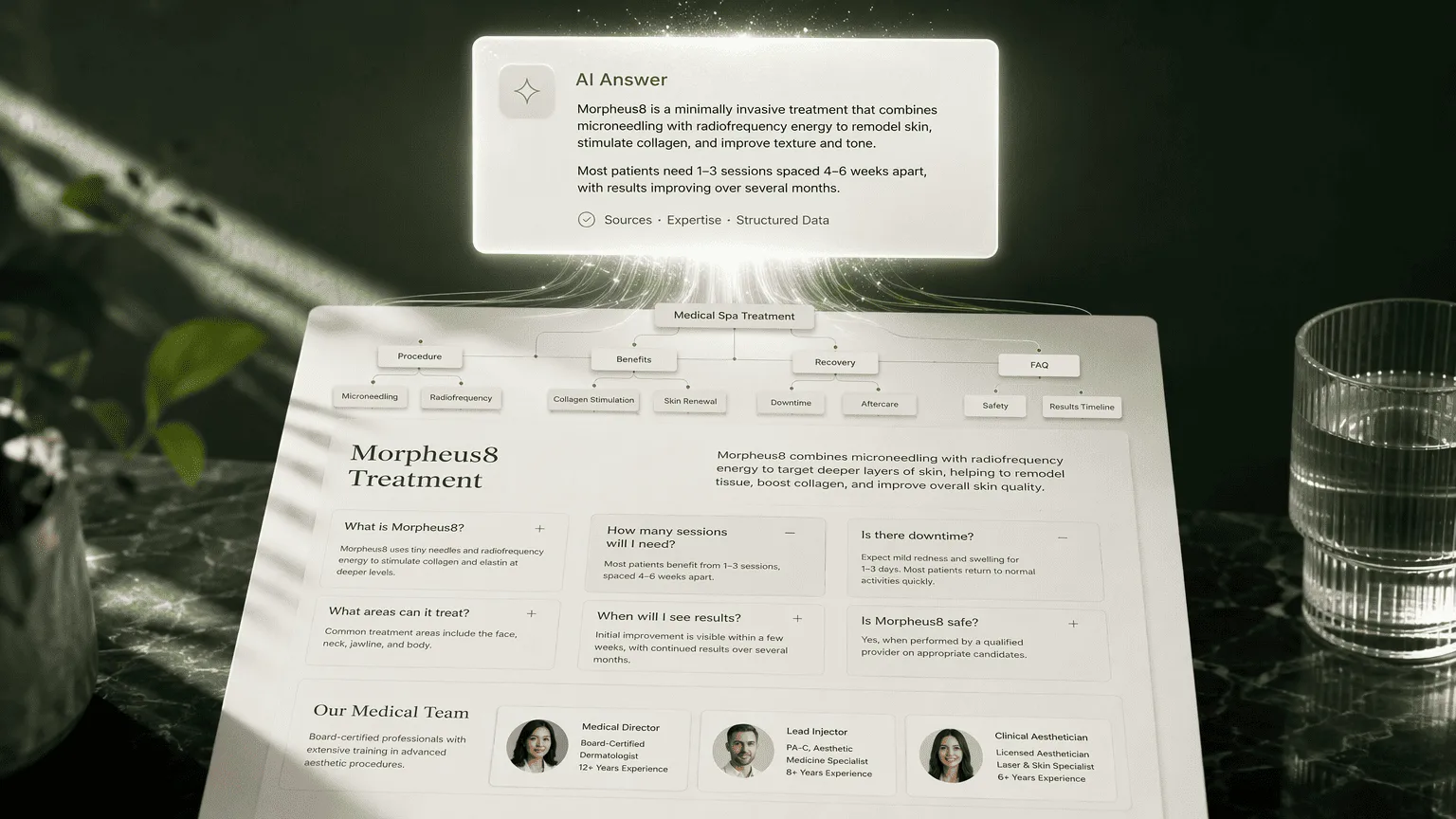
AI SEO services for medical spas restructure your treatment pages into short, question-led sections, nested schema, and the kind of credentialed detail that large language models pull from when they answer a patient directly. The goal shifts from ranking a page to being the source cited inside an answer. The traffic that follows is not speculative. ChatGPT-User crawler activity alone was up 201% from February to March 2026, signaling that AI models are indexing faster and serving more recommendations.
The model is 'answer engine optimization,' and it breaks the Google-centric premise that a blue link is the endgame. AI assistants do not return ten results. They return one or two, and the med spa inside that answer captures outsized attention.
AI SEO services apply this by building a digital footprint that AI models deem trustworthy: structured local service data, authoritative citations on separate domains the models already crawl, and natural-language content that mirrors the exact phrasing a patient uses in a spoken query to Siri or ChatGPT. In aesthetic medicine, where patients are cautious, competition is aggressive, and regulations quietly shape everything, being the cited source is a defensive moat. Legacy SEO did not optimize for this routing layer because it did not exist at scale until mid-2025.
A practical case: Alinea Medical Spa saw organic sessions increase by over 13,000% in Year 1 after its website was rebuilt with AI-search architecture. That is not an SEO tweak. That is a structural rebuild of how the practice presents itself to machine readers.
Why AI-Referred Patients Convert at a 42% Premium, And the Data Behind It
The 42% conversion uplift is not a fluke of sample bias. It is a pre-qualification effect built into the query itself. When a patient asks ChatGPT, 'What med spa in Austin does the best lip filler for someone with thin lips and a fear of needles,' that prompt carries far more intent signal than typing 'lip filler Austin' into a search bar. The AI session begins with context, preference, and objection already stated. The practices surfaced in the answer inherit that intent density.
Adobe's Q1 2026 retail data captured AI-referred visitors in March converting 42% better than non-AI visitors, while Conductor tracks a benchmark of roughly 15.9% conversion on AI-referred sessions in the cohorts it monitors. Even at the lower end, a 15.9% conversion rate on warm traffic redefines unit economics for a med spa where a single neurotoxin patient can be worth $1,200 annually.
The problem is that most med spas have not built content that survives the AI citation tripwire.
AI SEO services close that gap by engineering the question-and-answer architecture models need, then layering on external citations from publishers the models already trust. The outcome is a traffic stream where sessions run deeper, bounce rates compress, and the visitor arrives already halfway to booking.
How a Med Spa Becomes the #1 AI Recommendation for “Injectables Near Me”

Capturing the #1 AI recommendation for a hyper-local query requires feeding the model three interdependent signals. The table below breaks down what each signal controls and how it maps to the mechanics of AI referral traffic.
| Signal Layer | What AI Models Extract | Med Spa Action Required |
|---|---|---|
| Entity optimization | Practice name, services, location, and provider credentials as linked facts | Fully populate Google Business Profile with services and Q&A; align NAP data across all directories |
| Citation authority | Third-party validation that the practice is real and endorsed by trusted aesthetic publishers | Earn mentions on medical journal sites, local news, and industry platforms that AI crawls as reference corpora |
| Content architecture | Short, question-led treatment sections with explicit answers to natural-language queries | Restructure every service page into FAQ-block and definition-block formats with nested schema markup |
| Local signal reinforcement | Proximity, hours, and real-time availability for same-day booking queries | Integrate live booking availability with structured data so the model can surface appointment windows |
The Exact Schema, Content, and Citation Layers That Feed AI Models
The technical blueprint for AI visibility is specific, and skipping any layer leaves the model with incomplete extraction signals. The five-step system that produces measurable ranking inside ChatGPT and Claude follows a precise order.
- AI Visibility Audit: Crawl your existing site and assess which treatment pages, provider bios, and FAQs are already indexed by major AI crawlers; benchmark current citation volume against competitors.
- Patient Question Mapping: Build a structured question bank from real patient queries, including phrasing with modifiers like 'safe,' 'cost,' 'pain,' and 'downtime' that dominate AI-assisted research.
- Treatment Content Build-Out: Restructure every page into question-led sections with LocalBusiness, MedicalBusiness, FAQ, and Service schema layered on and validated against Schema.org.
- Trust Signal Acceleration: Place credentialed, factual content about your practice and providers on authoritative external domains that AI models already cite, such as medical directories, industry publications, and local health portals. This is the signal work that shifts a model from ignoring your brand to citing it as a reference.
- AI Citation Monitoring: Continuously query ChatGPT, Claude, and other models to confirm your practice is cited in relevant answers and flag unsubstantiated claims before they become compliance liabilities.
Voice and Visual Search: The Unseen Patient Acquisition Engine
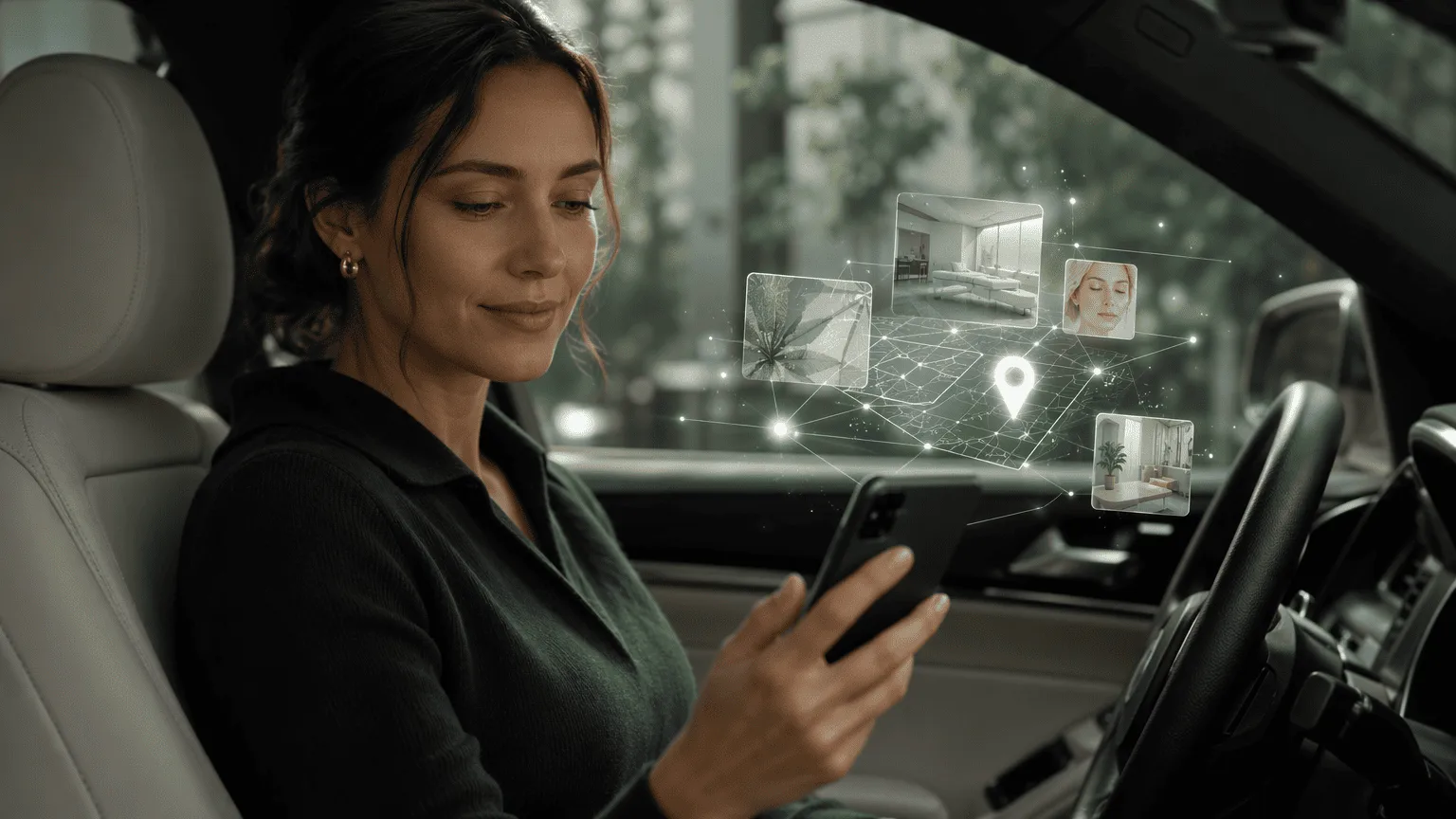
A patient in a car says, 'Hey Siri, find the top-rated Botox clinic near me open before 9 a.m. on Saturday.' That query never hits a screen, a search bar, or a tracked link.
It hits a large language model that must reconstruct an answer from what it has already ingested about local aesthetic providers. AI SEO services optimize for this spoken-query layer by structuring content in natural language patterns that mirror conversational cadence, not keyword strings.
Visual search compounds the effect. A patient uploads a photo of uneven lip filler and asks an AI assistant, 'Who can fix this near me?'. If your before-and-after gallery carries descriptive ALT text, schema-tagged procedure names, and provider attribution, the model can surface your practice as the match. Most med spa websites have image libraries with zero metadata. That content layer sits dormant.
Voice commerce in healthcare is accelerating, and aesthetic medicine sits where personal, urgent, and local queries intersect. The under-optimized multimodal layer is where first-mover advantage compounds fastest in 2026.
Turning AI Visibility into Booked Appointments: Infrastructure, Privacy, and Lead Velocity

AI visibility without a conversion rail is just exposure. The key components are:
- Scheduling widget: accepts real-time availability data.
- Chat-to-schedule handoff: captures the session while intent is hot.
- Call tracking layer: tags the AI-referred source.
The infrastructure must handle the nuance of AI-referred sessions: these visitors often arrive on a specific service page already knowing they want neurotoxin units in the glabella. A generic 'Book Now' button that routes to a multi-step intake form breaks momentum and bleeds conversion rate.
Lead velocity is the metric that matters. AI-referred traffic compresses the research window, so tracking time from first session touch to booked appointment reveals whether the conversion rail is matched to the traffic.
Privacy compliance is non-negotiable. AI lead conversion cannot come at the expense of a regulatory violation.
Risks, Compliance Guardrails, and the ChatGPT Dependency Problem
The platform concentration risk is the most under-discussed number in AI SEO. Approximately 87.4% of measurable AI referral traffic flows through ChatGPT, meaning a single algorithm update, moderation policy change, or citation-weighting adjustment can vaporize a practice's AI referral volume overnight. Diversification across Claude, Perplexity, Google AI Mode, and voice-assistant surfaces is a hedge, but those platforms collectively account for a fraction of current volume. The distribution strategy must be built now, not after the concentration calcifies.
Compliance risks are equally sharp. The med spa is legally responsible for what an AI model says about it, even if the model fabricated the claim. The guardrail is a citation monitoring cadence that catches hallucinated attributions before a regulatory complaint does.
AI SEO vs. Traditional SEO vs. Agency-Led Work: The Operational Reality

AI SEO, traditional SEO, and agency-led work run on different clocks. One adjusts in hours, the other waits for a Google core update, and the third follows a monthly creative calendar.
| Dimension | AI SEO | Traditional SEO | Agency-Led Work |
|---|---|---|---|
| Primary objective | Visibility inside AI-generated answers from ChatGPT, Claude, and voice assistants | Ranking in the top 3 Google blue-link results for keyword targets | Tailored content and ad campaigns built on a human-led, months-long cadence |
| Content structure | Short, question-led sections with nested schema and external citation authority | Keyword-dense, long-form pages designed for crawler indexing and backlink profiles | Brand-narrative content with human editorial voice, often polished over multiple revision cycles |
| Operational tempo | Continuous, real-time optimization; crawler activity shifts weekly and requires monitoring feeds | Periodic audits and refreshes tied to Google core updates (quarterly or bi-annual) | Monthly content calendar with production timelines gated by agency staffing and creative rounds |
| Compliance load | Requires ongoing AI citation monitoring to catch model-generated claims in real time | Standard adherence to website and ad-disclosure regulations; the content you publish is the content you control | Similar to traditional, with added burden of reviewing agency-written claims before publication |
| Channel scope | AI assistants, voice search, visual search, and multimodal model surfaces | Google organic and local pack; indirect spillover into AI if indexing is strong | Primarily paid search, paid social, and owned website content; search channel is one line item |
| Cost signal | Front-loaded technical build, then ongoing citation and feed monitoring maintenance | Moderate initial build with recurring link-building and content production retainers | Highest monthly retainer cost, combining human strategy, creative, and media management fees |
Conclusion
The 42% conversion premium on AI-referred traffic has stopped being arbitrage. In 2026, the practice that captures the number-one AI recommendation for its city runs at a structural cost advantage over every competitor still bidding on the same Google keyword. You build the infrastructure now, or you pay the spread later.
Frequently Asked Questions
What are AI SEO services and how do they apply specifically to medical spas?
AI SEO services optimize a med spa's digital footprint so that AI assistants like ChatGPT cite the practice when users ask for local aesthetic recommendations. For med spas specifically, this means question-led treatment pages, LocalBusiness schema, and external citations on authoritative publishers that models use as training sources.
How can AI-driven SEO help a med spa attract more local, high-intent patients in 2026?
AI-driven SEO captures patients running high-intent, context-rich queries inside AI assistants, where prompts like 'best injectables near me for thin lips' signal booking readiness. Optimizing structured local service data and entity signals pushes your practice into the one or two AI-cited answers those queries return.
What are the key components of an effective AI SEO strategy for a med spa?
The five critical components are:
- AI visibility audit.
- Patient question mapping.
- Treatment content build-out with schema markup.
- Trust signal acceleration through external citations.
- Ongoing AI citation monitoring.
Each layer feeds the extraction signals models need to recommend your practice.
What measurable results can a med spa expect from using AI SEO services?
Adobe's Q1 2026 data shows AI-referred visitors converting 42% better than non-AI visitors. Conductor tracks a roughly 15.9% conversion benchmark on AI-referred sessions, and one documented med spa case saw organic sessions grow over 13,000% in Year 1 after an AI-SEO-focused rebuild.
What are the risks and compliance considerations of using AI for med spa marketing?
Approximately 87.4% of AI referral traffic flows through ChatGPT, creating a single-platform concentration risk. Compliance risks include AI models generating unsubstantiated claims about your practice that trigger FTC or FDA scrutiny, making ongoing citation monitoring and a multi-platform distribution strategy key.
How do AI SEO services compare to traditional SEO and human-led agency work for aesthetic practices?
The differences between AI SEO, traditional SEO, and agency-led work are clear:
- AI SEO: optimizes for visibility inside AI-generated answers in real time, operating on a continuous monitoring tempo.
- Traditional SEO: targets Google blue-link rankings on a quarterly cadence.
- Agency-led work: centers on human-crafted content produced over months, often with higher retainers and slower iteration cycles.
Sources
- AI SEO for Medical Spas | Rank in ChatGPT & Claude - www.wisevu.com
- AI Powered Med Spa SEO - 2Marketing - 2marketing.com
Want help executing this for your clinic?
Book a 30-minute call and we will map what a real ad engine would look like for your specific service mix.
Book a call