8 Best Tools to Track AI Clinic Recommendations in 2026
IntroductionYour next three patients will choose their provider entirely from an AI-generated answer, and one of them will book with a clinic they have never heard of before. The problem is that AI is answering patient questions about where to get care. Your clinic has no idea what those answers say, and your usual dashboards will never flag a missed call that never came.
33% of B2B software buyers bought from a vendor they had never previously heard of based purely on AI chatbot guidance. In healthcare, the dynamic is even sharper: patients often call the first clinic named by an AI assistant when asking questions like "urgent care open now." That slot now decides acquisition volume before a human ever evaluates your bedside manner or your reviews.
The monitoring category that answers this threat is split into passive record-keepers, forensic citation scanners, and standalone command centers. This shortlist picks eight tools worth a clinic operator's time in 2026, ranked by what they surface, the engines they cover, and how they connect visibility gaps to the local SEO actions that close them.
Key Takeaways
The monitoring and optimization stack you choose depends on two things: how many AI engines your patients actually use, and whether you are ready to fix the citations that surface in AI source panels. These eight tools separate into three tiers.
- Best answer-engine tracker for clinics: RadarKit tracks six AI engines while recording competitor ratings and driving citation outreach, making it the most complete pair of eyes for a single-location practice.
- Passive monitoring vs. active source defense: Otterly and Peec AI record AI snapshots without touching your listings; Yext and BrightLocal solve the data problem that causes AI engines to name the wrong clinic in the first place.
- The healthcare-specific architecture: Clinads is the only platform built exclusively for US clinics, layering AI visibility tracking on top of HIPAA-conscious patient acquisition metrics so you measure lost calls alongside ranking changes.
- Enterprise visibility across locations: Profound monitors share of voice across generative engines at scale, which matters for multi-location groups needing competitive benchmarking rather than single-clinic snapshots.
- Pricing floors are low, but gaps are high: RadarKit starts at $29/mo and Otterly matches that, while some enterprise tools exceed $3,000/mo with annual contracts; seeing what patients see no longer takes a budget conversation.
1. Clinads, AI Visibility Command Center for US Healthcare
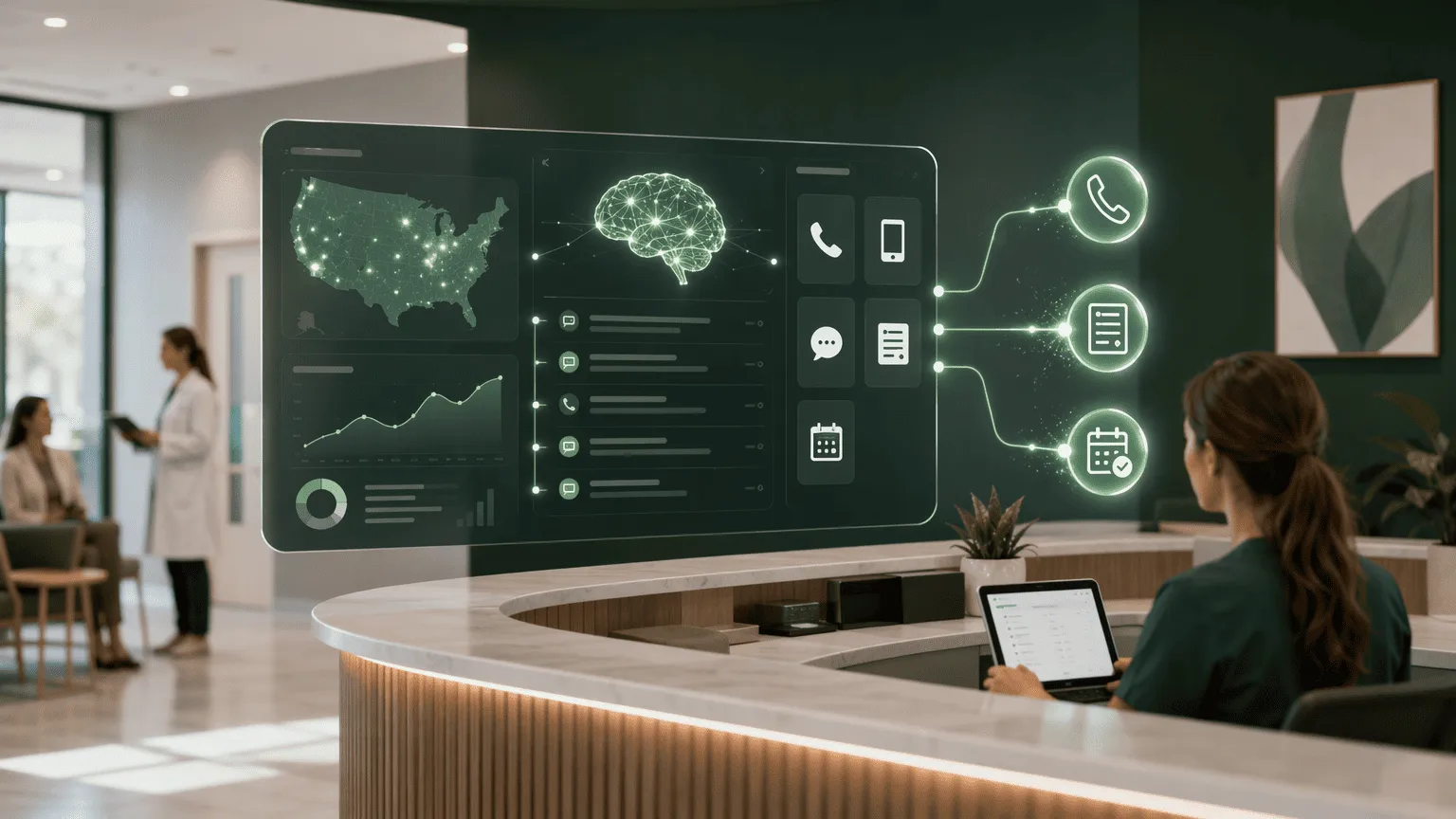
Clinads is the only platform on this shortlist purpose-built for US clinics, not adapted from a general-purpose SEO or brand-tracking tool. It monitors whether your practice shows up in ChatGPT, Google AI Overviews, and similar engines, and then ties that visibility directly to patient acquisition KPIs.
Most generic tools stop at a mention: they tell you the AI named your clinic in position three. Clinads asks a harder question. It measures whether that mention produced a phone call, a form fill, or an appointment. The platform wires AI visibility into the same attribution framework the clinic already uses for paid search and organic traffic. You are buying a healthcare stack, so the minimum commitment runs higher than a $29/mo passive monitor.
The platform audits the citation ecosystem that AI engines crawl, flagging inconsistencies across healthcare-specific directories and Google Business Profile data. The architecture watches public search result pages and AI snapshots only; it does not ingest or store patient queries, so it stays deliberately clear of HIPAA-covered data.
For a clinic where the marketing director also handles operations, four dashboards inside Clinads consolidate creative, SEO, GEO, and paid performance into one source of truth. One case study published by the company shows a practice generating 1.14K Google impressions and 260 clicks in 30 days, alongside a 297 referring domain gain, which they attribute to the same search authority foundations that feed AI trust. Clinads positions itself as a growth platform. The command center answers the narrow question, "Is AI recommending my clinic?" and it answers whether that recommendation is paying for itself.
2. RadarKit, Best Overall for AI Answer Engine Tracking
RadarKit tracks six AI engines on every plan: ChatGPT, Google AI Mode, Google AI Overviews, Microsoft Copilot, Perplexity, and Gemini. For $29/month, that breadth of coverage lets a clinic benchmark whether a named competitor is surfacing on engines you have not yet monitored.
The platform records your clinic and the competing practices showing up in those AI answers, capturing their ratings, review counts, and the specific domains that the AI sourced. Its Citation Analysis and Outreach Agent then build a bridge from passive monitoring to active optimization, identifying exactly which third-party sites need corrected or created listings so the AI pulls from accurate, favorable source material.
3. Otterly, Affordable Passive Monitoring with Google AI Overlap
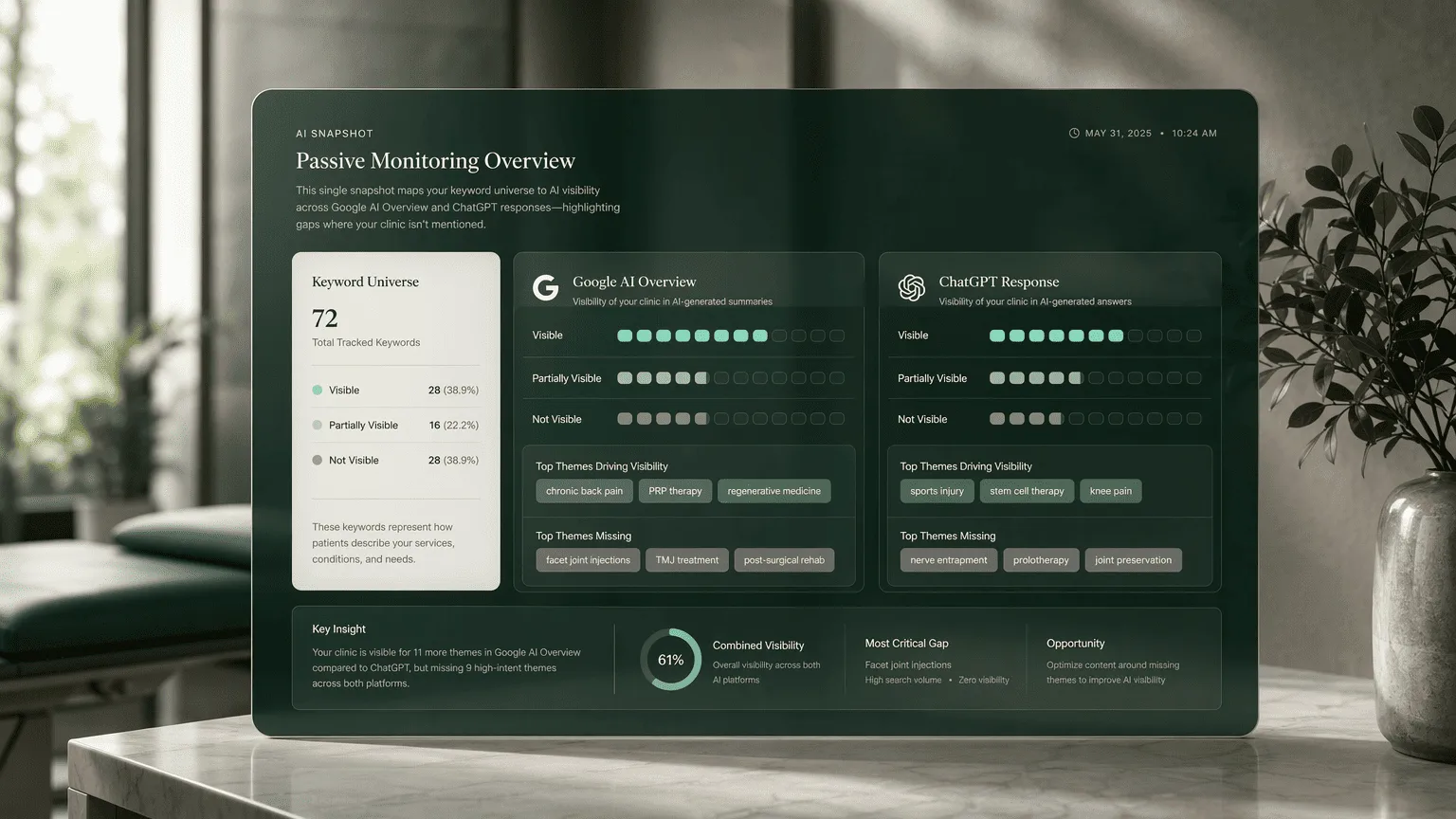
Otterly is a visual dashboard built for a single job: show you when your brand appears in Google AI Overviews and ChatGPT, and map that against your keyword set so you can see where you are invisible. At $29/month, it is the lowest-friction entry point on this list.
Passive monitoring means Otterly records what the AI says without trying to change it. It takes a snapshot, timestamps it, and overlays your tracked keyword universe onto the AI results. A practice manager can scan for gaps in under ten minutes. The keyword overlap visualization is its most practical feature: you see a competitor consistently recommended for "urgent care near me" while the engine blanked on your brand for the same prompt 14 days in a row.
Otterly's limitation is also its clarity. There is no citation audit tool, no outreach workflow, and no sentiment breakdown. The software logs what happened and stops there. For a clinic that decides to handle the fix-it work through another platform or a manual SEO process, Otterly works as a solid baseline recorder.
For budget-conscious practices that suspect a visibility gap but need receipts before spending on optimization, Otterly answers the question with screenshots and trendlines. The passive record becomes the evidence you present to your board or your marketing team: exactly how many times this month the AI named somebody else.
4. Peec AI, Sentiment Analysis and Citation Forensics
Peec AI answers the question that visibility trackers skip: when AI names your clinic, what exactly is it saying? At $95/month, the platform targets operators who need qualitative analysis and source-level forensics rather than position tracking alone. Its core capabilities break into two layers.
- Sentiment classification: The system classifies AI-generated mentions of your clinic as neutral, positive, or negative. It surfaces patterns such as an engine repeatedly describing your wait times or linking your practice to a specific, unflattering review snippet.
- Citation forensics: Peec AI identifies the exact domains the LLM used as source material for each claim about your clinic. You see whether the engine pulled from your Google Business Profile, a third-party directory with outdated hours, or a competitor's blog post that ranks for your name.
- Reputation defense workflow: Seeing which source triggered a negative or factually wrong statement lets you move straight to a targeted fix: update a stale listing or address the root review driving the AI's language.
- LLM-agnostic coverage: The forensic layer works across models. You can trace a Perplexity recommendation back to its sources even when those sources differ from what Google AI Overviews relied on for the same query.
5. Profound, Enterprise Share of Voice Across Generative Engines
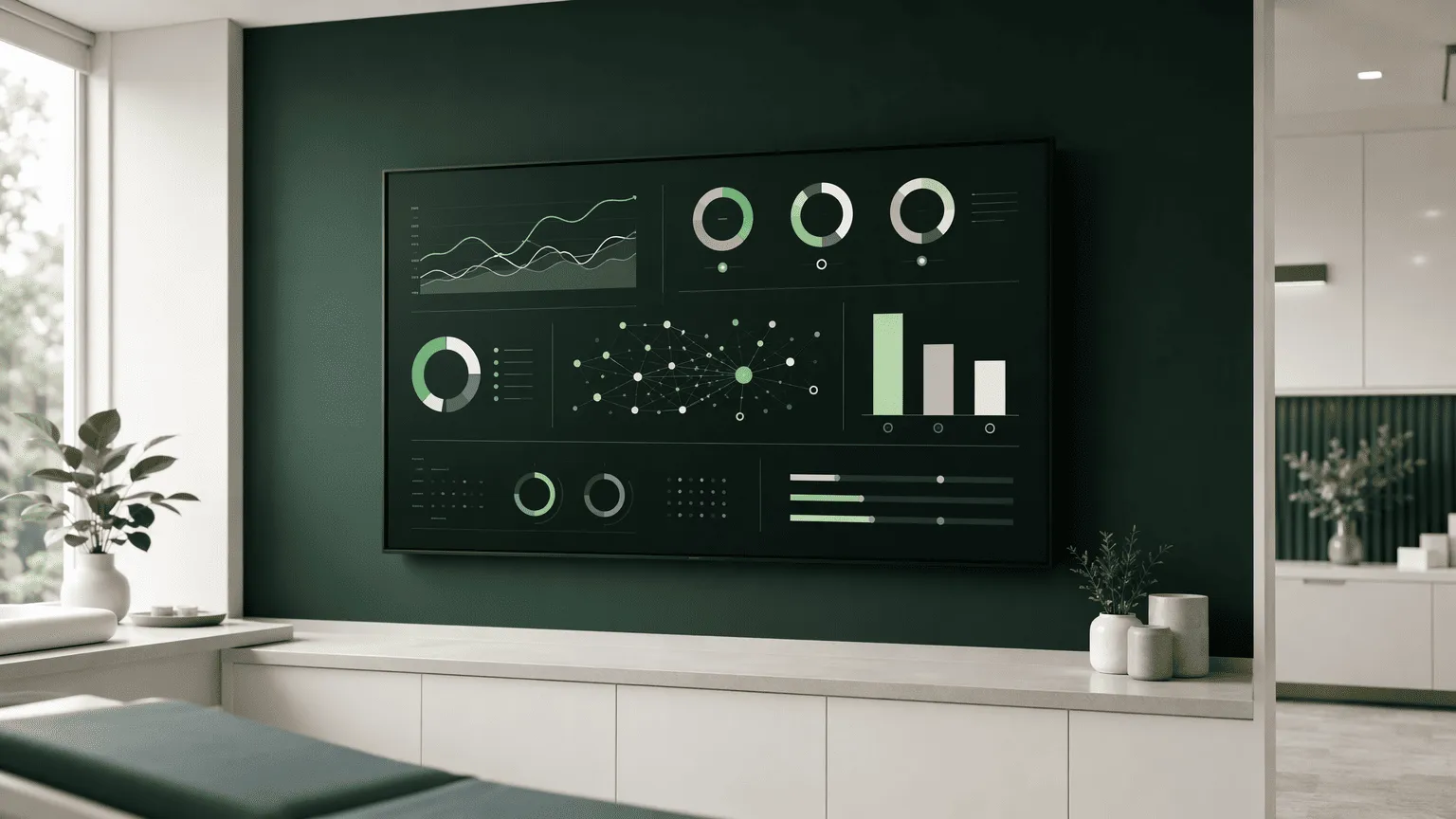
Profound is built for the healthcare network running twenty clinics across three counties and needing one dashboard that shows whether the AI landscape is tilting toward a regional competitor. The core metric is Share of Voice: it measures what percentage of AI-generated mentions in your category go to you versus the competition, and it does so across multiple generative engines simultaneously. For a single-location practice, this is overkill. For a multi-site group where the CEO asks quarterly whether AI is eroding market share, it is the only configuration that delivers an answer with statistical weight.
Share of Voice is the KPI that connects AI visibility to a boardroom conversation. The tool benchmarks your appearance rate against rivals on identical prompt sets, tracking movement month over month so you can correlate visibility gains with the operational fixes your team made, such as correcting NAP data across six locations or launching a specialty service page that AI engines began citing. The limitation is commercial: Evertune, a comparable enterprise tool, costs from $3,000/mo with annual contracts required, no free trial, and no self-serve, and Profound operates in that same enterprise bracket where the tool is a line item in an annual marketing budget, not a month-to-month experiment.
For the operator who is not running twenty clinics, the enterprise tier is the wrong allocation. The tactical work of fixing citations and improving source data starts at the individual location level, and the tools ranked above Profound on this list yield more actionable fixes per dollar. But when scale demands a single pane of glass, Profound is the correct architecture.
6. BrightLocal, Geo-Grid Scanning for Local Clinic Visibility
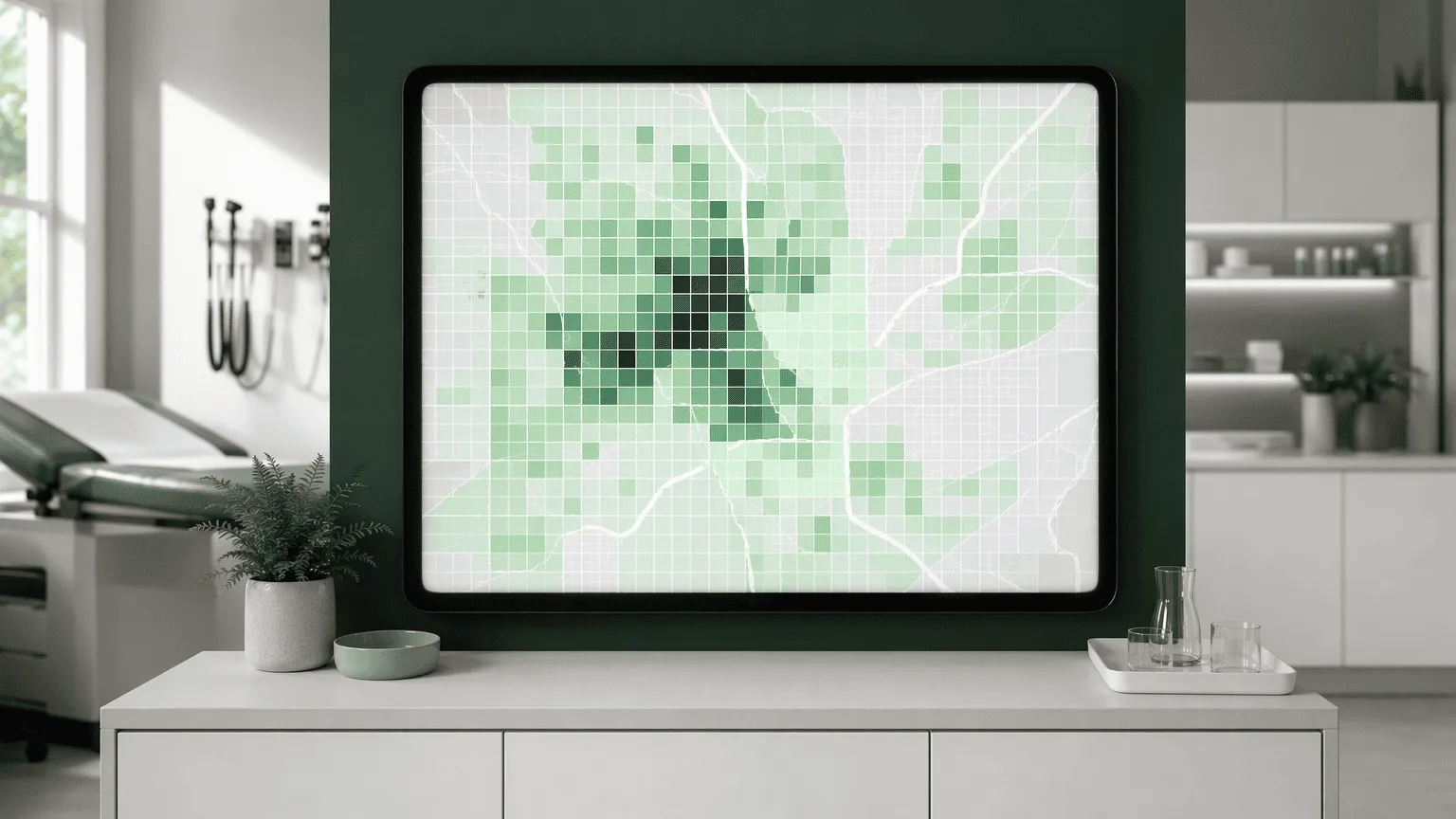
BrightLocal forces an uncomfortable truth onto the AI visibility conversation: where the patient is standing when they ask the question can change the clinic the AI names. Its geo-grid scanner maps visibility in small geographic increments and proves that two patients in adjacent zip codes can receive two entirely different recommendations for the same prompt. For a clinic group with overlapping territories, this granularity separates a real coverage map from a guess.
- Hyper-local AI validation: The geo-grid confirms whether your clinic appears in AI answers for the neighborhoods that actually feed your appointment book, not the city centroid your SEO report assumes.
- Source-data density mapping: BrightLocal connects each geographic cell to the underlying local citations and GBP signals the AI is pulling. A grid square where you are invisible often correlates to a directory listing with an incorrect suite number.
- Proximity-to-recommendation correlation: Scanning at increments fine enough to capture drive-time radius differences lets the tool isolate whether dropping out of AI answers at the 7-mile radius costs you a commuter corridor.
- Competitive geo-overlap detection: When a rival clinic appears in AI results for a zip code where you hold stronger reviews and better hours, the geo-grid flags the anomaly and points to the source-data discrepancy that caused it.
7. Semrush, AI Overview Tracking in a Broader SEO Suite
Semrush folded AI Overview tracking into its existing rank-tracking architecture rather than building a standalone tool. Clinics already paying for the Semrush suite get the feature without adding another vendor. The table below frames the trade-off against a dedicated tool like RadarKit when narrow AI-answer tracking is the priority.
| Dimension | Semrush AI Overview Tracking | RadarKit (Dedicated AI Tracker) |
|---|---|---|
| Primary use case | AI visibility folded into traditional keyword rank monitoring and site audits | Standalone AI answer engine tracking with citation analysis and competitor recording |
| Engines tracked | Google AI Overviews (integrated with SERP features tracking) | Six engines: ChatGPT, Google AI Mode, Google AI Overviews, Copilot, Perplexity, Gemini |
| Price floor | Included in SEO suite plans (pricing varies by tier and add-ons) | $29/month for all six engines |
| Citation actionability | Flags ranking factors; does not identify specific AI-source domains or build outreach lists | Citation Analysis names the domains AI used, and Outreach Agent suggests coverage opportunities |
| Best for | Clinics already running Semrush for traditional SEO who want AI snapshots as a supplementary signal | Clinics needing multi-engine monitoring and citation-level insight as the primary workflow |
The honest fit: if your clinic already pays for Semrush and the question is simply "are we showing up in Google AI Overviews for our top 25 keywords," staying inside the suite avoids tool sprawl. Semrush leaves ChatGPT, Perplexity, and the other engines unmonitored. If you need to know what those engines say about your urgent care versus a competitor's, you will need a tool that covers them.
8. Yext, Listing Accuracy as AI Source Defense
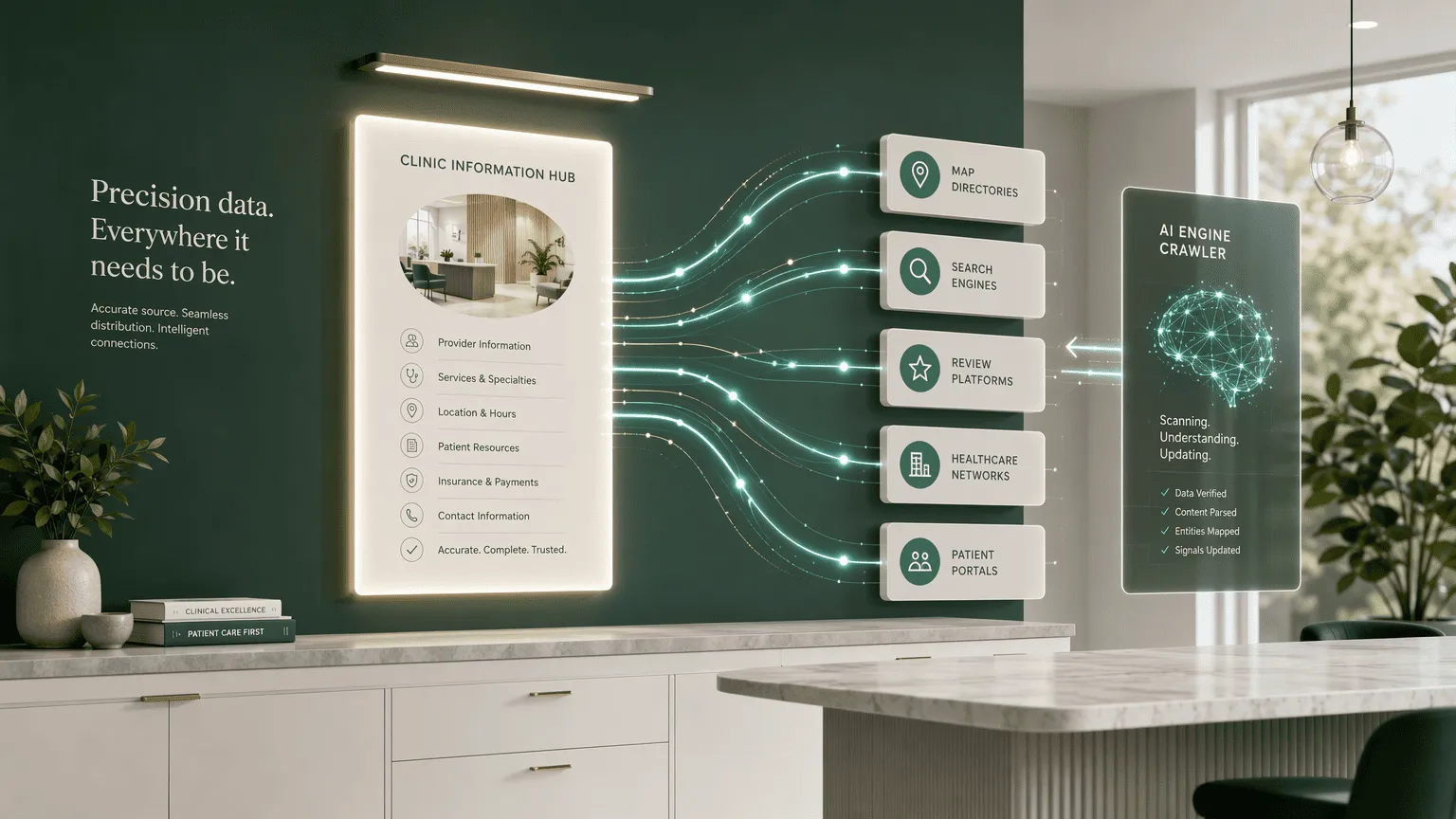
Yext attacks the AI recommendation problem from the opposite direction of every other tool on this list. It does not monitor what AI says. It controls what the AI reads. The platform synchronizes a clinic’s name, address, phone number, hours, accepted insurance plans, and service descriptions across the digital ecosystem that AI engines crawl as primary source material, and it pushes updates in near-real time when something changes.
AI recommendation errors start as a data problem. An LLM pulls from three directories that still list your old Saturday hours, synthesizes an answer that says you are closed on weekends, and the patient drives to a competitor. Yext prevents that scenario by enforcing a single source of truth: accurate, structured data distributed across the exact endpoints, from Apple Maps to voice assistants, that feed AI source panels.
This is defensive medicine for your digital presence. Active optimization tools like RadarKit will tell you that AI is citing a stale listing. Yext solves it before the citation happens. The trade-off is that Yext does not tell you what the AI ultimately said. It raises the probability that the AI’s source material is correct, which is the precondition for any favorable recommendation.
A clinic that just overhauled its service lines or moved locations needs the AI engines to ingest the new data immediately. Competitors with accurate listings will capture your patients otherwise. Pair Yext with a passive monitor like Otterly, and you get confirmation that the fix landed.
Conclusion
The clinic that tracks AI recommendations holds a conversion advantage that compounds monthly.
Every patient who calls the first name an AI suggests is a patient who never called you, and that gap does not appear in your phone-tracking reports or your Google Business Profile insights.
Begin with a passive monitor to establish your current visibility baseline across the engines your patient demographic actually uses. Once you know what AI engines say about your practice, deploy a tool that connects those answers to the source data controlling them. Visibility without correction is expensive observation. The right stack combines a listener and a fixer, and eight tools on this list give you the components to assemble it.
Frequently Asked Questions
How can a healthcare provider monitor whether AI platforms like ChatGPT, Google AI Overviews, or Perplexity are recommending their specific clinic?
Specialized AI visibility tools simulate the queries patients ask, such as “urgent care near me” or “best dermatologist in [city],” and record which clinics appear in the AI-generated answer. RadarKit, for example, tracks six engines including ChatGPT and Perplexity from $29/month and logs both your clinic and competing practices in the results.
What is the difference between passive AI brand monitoring tools and active local SEO for AI-driven search results?
Passive tools like Otterly record AI snapshots without changing them, giving you a baseline of what engines currently say. Active local SEO involves correcting the citations, directory listings, and structured data that AI engines trust as sources, which platforms like Yext handle by synchronizing accurate information across the ecosystem.
Which software platforms offer specific 'share of voice' or 'sentiment analysis' features for AI-generated responses in 2026?
Specialized AI visibility tools provide several distinct capabilities:
- Profound measures Share of Voice, calculating what percentage of AI mentions in your category go to your clinic versus competitors across multiple generative engines.
- Peec AI provides sentiment analysis at $95/month, classifying whether AI mentions of your practice are positive, neutral, or negative while tracing the source domains driving that language.
How do AI search engines source their local business recommendations, and can a clinic influence those sources?
AI engines synthesize answers from a clinic’s Google Business Profile, third-party directory listings, review sites, and structured data across the web. A clinic can influence those sources by correcting inaccurate NAP data, managing reviews, and ensuring consistent information reaches the endpoints that feed AI source panels.
What metrics should a clinic track to measure the ROI of optimizing for AI discoverability?
Clinics should track these key metrics for AI visibility:
- Appearance rate in AI answers for your core patient-acquisition keywords.
- Average position among named clinics.
- Sentiment of those mentions.
- Share of voice against competitors.
The ROI metric that matters is whether AI visibility generates patient acquisition, measured through attributed phone calls or appointment form submissions.
Are there HIPAA-compliant ways to track if AI mentions my practice without violating patient privacy?
Yes. HIPAA-compliant AI tracking tools monitor only publicly available AI responses to generic prompts like “urgent care open now” rather than specific patient health queries. Because they do not ingest, store, or transmit individual patient data or PHI, they operate outside HIPAA’s regulated scope.
Sources
- Clincy Case Study: 1.14K Google Impressions in 30 Days | ClinAds - getclinads.com
- Best AI Brand Monitoring Tools 2026: Track How AI Talks About You - www.ai-visibility-software.com
- HubSpot AEO | AEO Tools to Track & Improve Your AI Visibility - www.hubspot.com
- 7 Best AI Visibility Tools for Healthcare Clinics - Radarkit - radarkit.ai
Want help executing this for your clinic?
Book a 30-minute call and we will map what a real ad engine would look like for your specific service mix.
Book a call