7 Best AI Marketing Tools for Med Spas in 2026
IntroductionMost med spas are running marketing built for retail, not for a $527 average visit with a 73% return rate. That mismatch is why so many clinics feel invisible even while spending. The algorithm isn't punishing you. The tool stack is.
The shift in 2026 is from generic automation to aesthetics-native AI that understands the difference between a one-time Botox curiosity and a 90-day filler recall. Generic platforms see a lead.
The problem is acquisition tools rarely talk to retention tools. Your ad platform celebrates a $28 CPL while your front desk watches that booked consult no-show. The solution is a paired stack: an AI acquisition engine that replaces agency overhead, and an aesthetics CRM that triggers re-engagement based on real treatment history and spend velocity. This ranking separates the tools that solve each half of that equation and ignores everything that tries, and fails, to do both.
Key Takeaways
Here is the compressed decision framework before the deep dive:
- The paired stack rule: The strongest med spa AI architecture in 2026 pairs a flat-rate acquisition agent with an aesthetics-native CRM, a single tool will not handle both sides well.
- Cost replacement, not cost addition: A $49/month AI agent can replace a $2,000 to $5,000/month agency retainer for paid acquisition at a single location.
- Retention ROI dwarfs acquisition: A $527 average visit spend and roughly 73% repeat client rate means rebooking one lapsed high-value patient often exceeds the revenue from three new consults.
- HIPAA splits the stack: Booking and CRM tools must embed compliance because they touch PHI; paid ad tools carry zero medical records, placing the compliance burden on the practice's server-side filtering setup.
- Vertical depth over platform breadth: A general marketing platform flags a missed appointment. An aesthetics CRM flags a patient who completed three syringe appointments then went silent for 120 days, actionable clinical context that a generic tool cannot replicate.
1. Clinads, Best AI Marketing Agent for Med Spa Patient Acquisition
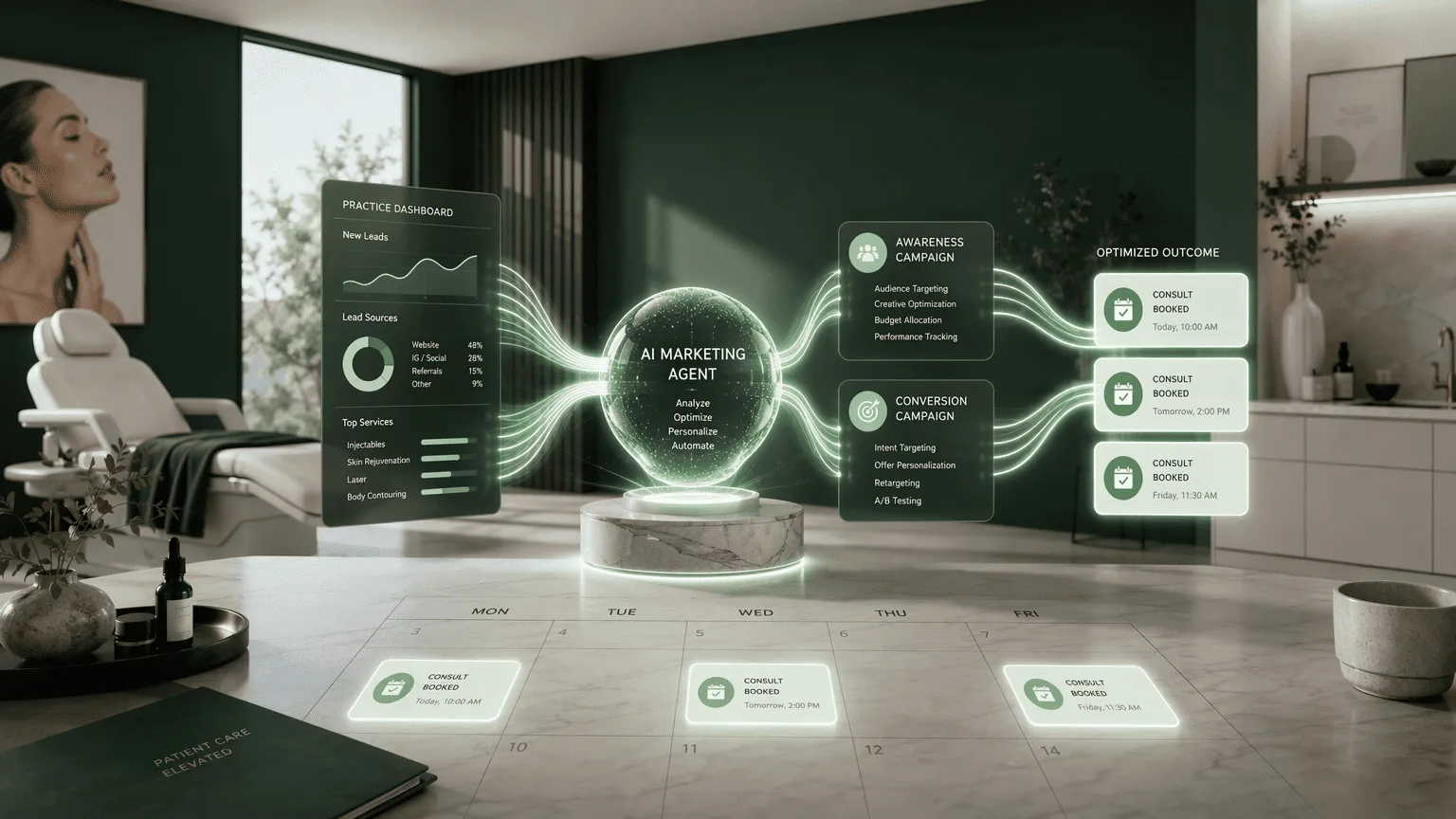
Clinads operates as an autonomous marketing agent that runs itself. You connect your practice data, it builds and manages Google and Meta campaigns, allocates budget across channels, and adjusts bids and creative without you touching a single campaign setting. The trade-off: you surrender direct control over individual ad sets in exchange for an engine that optimizes toward booked consults.
The wrong question is "Does AI build better ads than my agency?" The right question is "How fast can an AI agent correct a failing campaign versus a human media buyer who checks performance twice a week?"
For a single-location med spa burning $3,000 monthly on a traditional agency that charges 15 to 20 percent of ad spend as a management fee, Clinads replaces that entirely with a fixed-cost model that runs the same paid search and social acquisition work. Clinads does not touch patient records. It operates purely on the acquisition side: campaign structure, audience modeling, creative iteration, and bid management. The compliance boundary is clear, your practice retains responsibility for any retargeting that involves treatment-page data, which requires server-side filtering to avoid HIPAA exposure. Compliant retargeting with server-side filtering can increase conversion rates by 30 to 40 percent without creating HIPAA exposure, an uplift that Clinads bakes directly into its audience modeling.
2. PatientNow, Best Aesthetics-Native CRM for AI-Driven Retention
PatientNow segments your database by what actually happens in the treatment room. Its AI clusters patients by clinical behavior: those showing up for every tox appointment, those who completed two of three recommended Morpheus8 sessions and then stopped booking, and high-spend clients who haven't scheduled in over 120 days. PatientNow embeds its automation inside a system that already holds the chart, photos, and payment records.
A med spa owner drowning in fragmented tools feels the structural difference immediately. PatientNow replaces 4 to 6 separate tools that most practices juggle: marketing automation, EMR, payments, and photo management collapse into one interface. When a patient books online at 11 p.m., the AI Concierge (Recura) converts that web lead in under 30 seconds and books the appointment without staff touching a keyboard.
PatientNow fits a practice that has outgrown simple drip sequences and needs automated recall that understands the clinical cadence of aesthetic treatments. Pricing is custom, not transparent. You negotiate it. That is the friction point for a lean single-location owner.
3. Hyper, Best Flat-Rate AI Ads Manager for Single-Location Med Spas
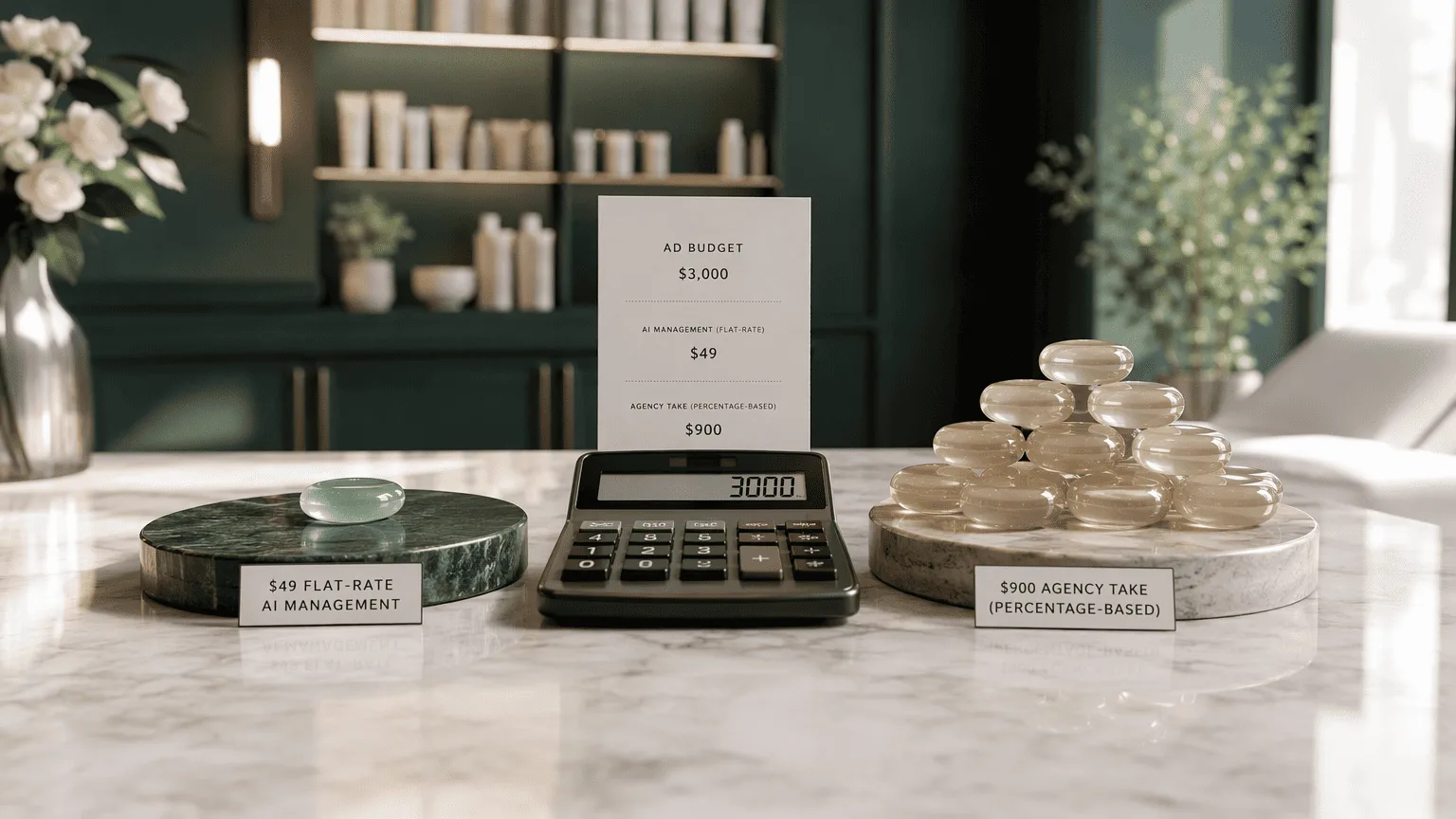
Hyper charges $49 a month flat to algorithmically manage your Google and Meta ad spend, and that structural difference cuts 15 to 20 percent off the top of every media dollar. A traditional agency billing at that rate on a $3,000 monthly ad budget takes $450 to $600 before a single campaign runs. Hyper takes none of it. The model eliminates the incentive misalignment where an agency profits more from spending more, regardless of booking quality.
The wrong question is "Can AI manage ads as well as a person?" The right question is "How many hours a week does your agency actually spend optimizing your campaigns versus reporting on them?"
Hyper runs the full algorithmic loop: A/B testing, budget pacing, and bid adjustments that respond to auction pressure within hours, not during a Monday morning account review. With over 1,000 customers managing more than $10 million per month in ad spend, the system has enough signal density to learn patterns that a human managing three med spa accounts would never see.
The ceiling is multi-location nuance and retention integration. Hyper does not connect to your EMR. It does not know whether that booked neurotoxin consult actually showed up or bought. For a single-location spa that wants predictable acquisition cost and a clean break from agency retainers, Hyper is the most surgically precise tool in this stack. For a group with four locations that needs centralized reporting and cross-location budget rebalancing, Zenoti enters the conversation.
4. Zenoti, Best All-in-One AI Platform for Multi-Location Med Spas
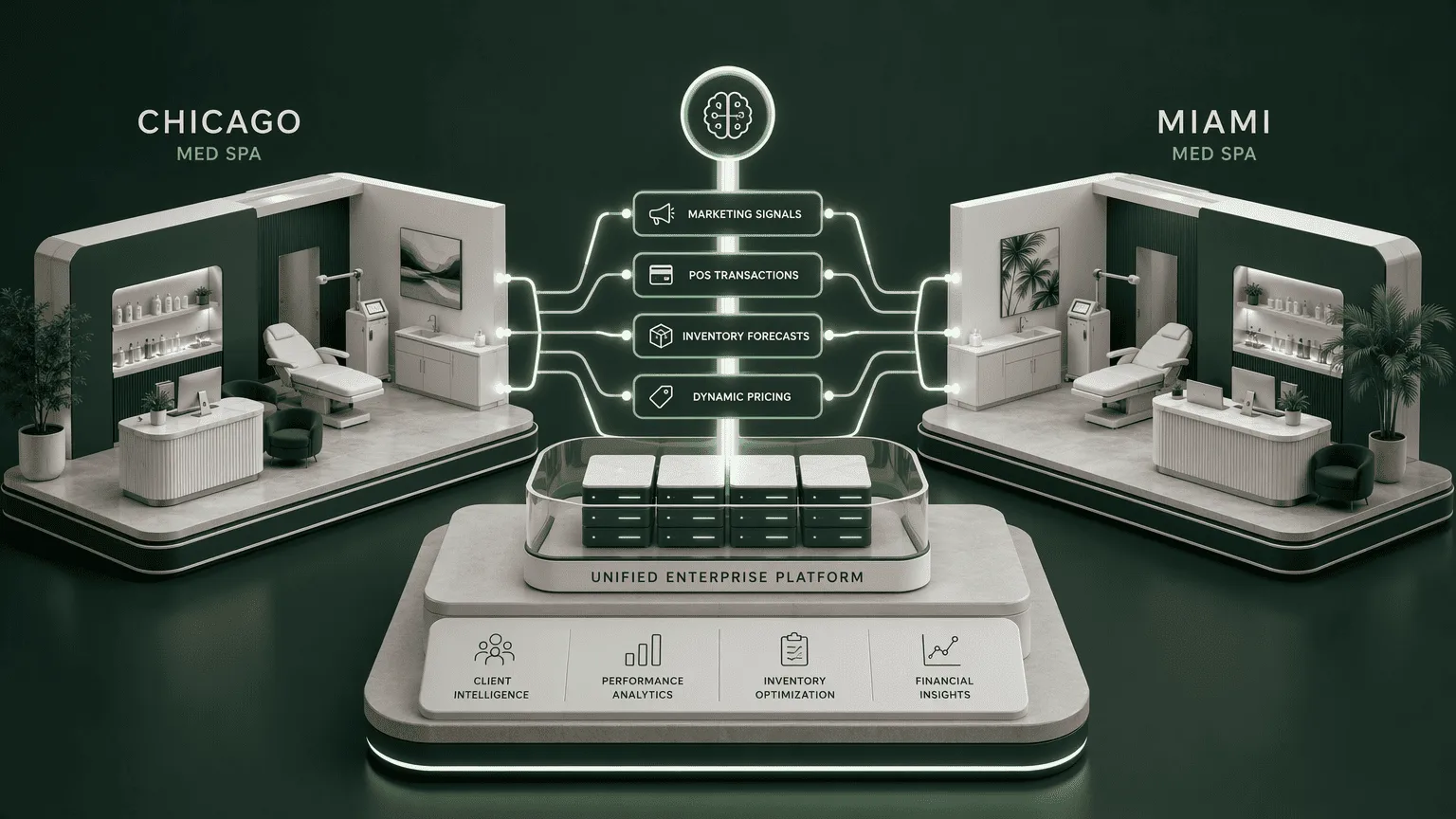
Zenoti is the enterprise spine beneath a multi-location med spa that needs one platform to align marketing, operations, and POS data across every site. Its AI connects what patients spend in Chicago to inventory forecasts for the Miami location and adjusts dynamic pricing based on chair utilization rates that a single-location tool never sees.
| Dimension | Zenoti | Single-Location Alternatives |
|---|---|---|
| Pricing Model | Enterprise/custom, scaled by location count | Fixed or percentage-of-spend models |
| AI Scope | Dynamic pricing, inventory prediction, cross-location campaign dashboards | Ad optimization, booking, or retention individually |
| Compliance Architecture | EMR-embedded, full chain of PHI custody | Varies, acquisition tools carry zero PHI; CRM tools embed HIPAA controls |
| Best Fit | Franchises and group models with 4+ locations | Solo practitioners or single-location clinics |
| Core Trade-Off | Deep cross-location intelligence at the cost of implementation complexity | Fast deployment and pricing transparency with limited enterprise visibility |
5. Boulevard, Best AI-Powered Booking and Client Experience for Self-Care
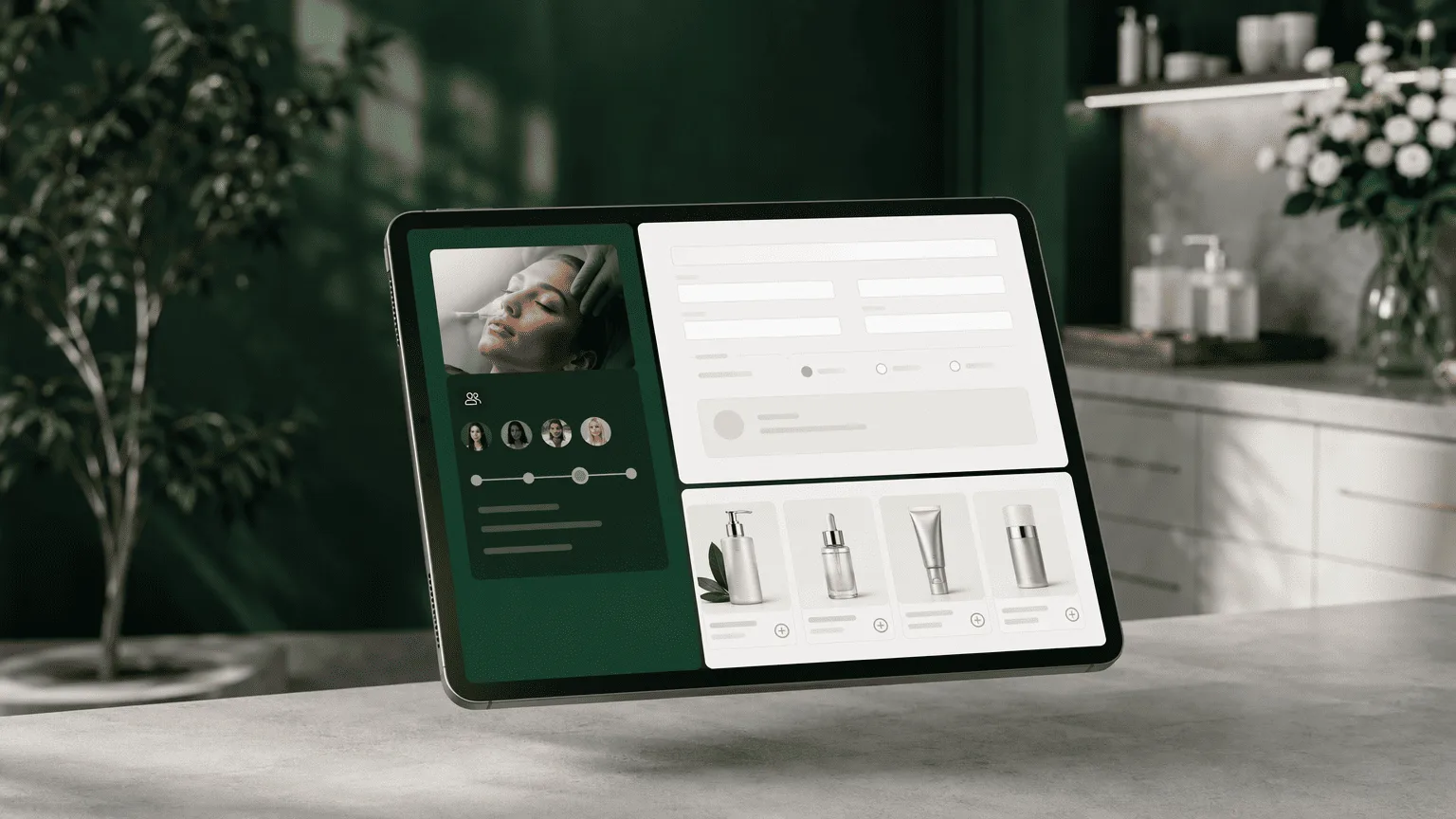
Boulevard positions itself squarely in luxury self-care, where the booking interface is the first treatment a patient receives. Its AI manages smart waitlists that automatically slot patients into cancellations, automated intake forms that populate before the patient walks in, and personalized product recommendations inside the booking flow itself. The booking engine communicates what a med spa values before any provider touches the patient.
A separate tool stack slows work when staff must move or reconcile booking changes, chart information, and follow-up messages between systems. Boulevard solves that by making the client journey a single system from discovery to self-checkout. For a wellness-med spa hybrid where the experience matters as much as the clinical outcome, reducing booking friction directly impacts no-show rates and repeat spend, especially with an AI receptionist that reads the live calendar and follows service rules rather than offering a generic "We'll call you back."
6. Podium, Best AI Messaging and Review Tool for Local Med Spa Visibility
When a prospective patient searches "lip filler near me" on a Tuesday morning, the med spa that responds inside two minutes via text often wins the booking. Podium centralizes that text-based communication.
Its AI Webchat converts search traffic into conversations that a front-desk coordinator can close. The platform then triggers automated review invitations and AI-assisted response drafts that keep your Google Business Profile active.
Local pack rankings correlate with review velocity, recency, and response rate. A med spa generating 20 reviews per month with AI-assisted owner responses will outrank a competitor with 200 legacy reviews and a dormant profile. Podium automates the volume side of that equation. The AI drafts on-brand responses that staff approve in seconds instead of composing from scratch.
In a competitive three-mile radius, the ranking difference often comes down to which listing looks most alive and responsive. A tool that converts text leads at 15 to 20 percent in local services businesses tightens the acquisition funnel faster than any landing page optimization cycle ever could.
7. RetentionX, Best Predictive AI for Med Spa Rebooking and Recall
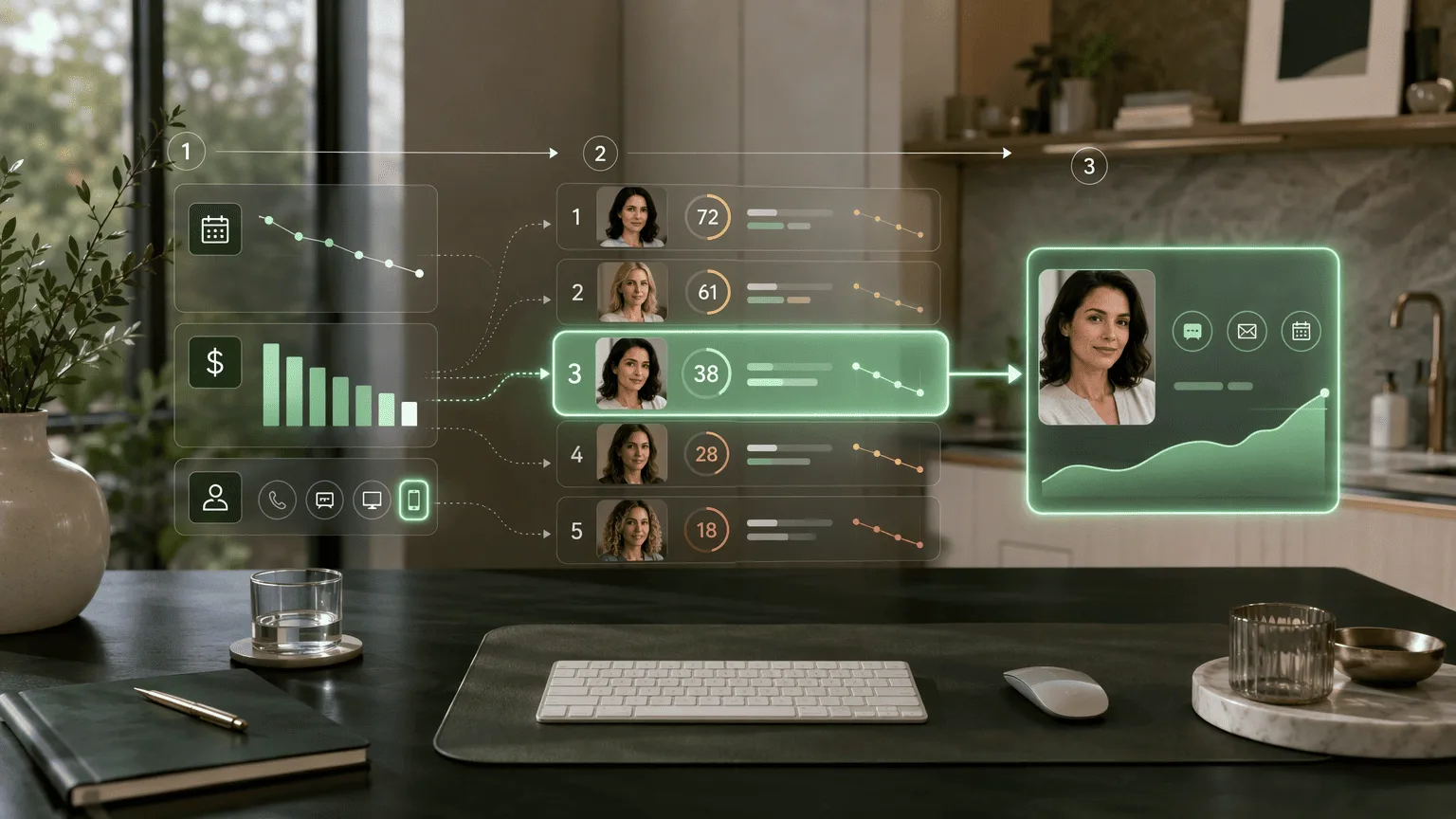
RetentionX monitors the behavioral signals your team is too busy booking active patients to catch. Its machine learning analyzes visit frequency declines, spend pattern drops, and booking channel shifts, then generates a prioritized save-list of patients who will likely churn within 60 days.
You don't stare at a dashboard. You get a direct alert: "Patient 1047 dropped from $1,100 average monthly spend to $375 and their last booking came through a discount channel. Intervention window: 14 days before rebooking probability falls below 15 percent." That intelligence transforms your recall spend from a blanket 20-percent-off email blast into five targeted phone calls with specific high-value patients.
The churn prediction methodology focuses on two leading indicators, spend velocity and booking channel migration, rather than reactionary metrics like a missed appointment.
- Spend velocity decline: A patient who dropped from $900/month to $300/month over two visits is three times more likely to churn than one who simply missed a single appointment.
- Booking channel migration: Patients who switch from direct booking to discount platforms signal price sensitivity that predictive models treat as a churn precursor.
- Treatment cadence disruption: Breaking a neurotoxin cycle by more than 30 days beyond the standard recall window triggers a priority intervention alert before the patient's next cycle goes dark.
Conclusion
The solo practitioner with a single location and a $3,000 monthly ad budget needs Hyper or Clinads on acquisition, PatientNow or Boulevard on retention. The trade-off is control versus automation: an AI agent that builds campaigns versus a flat-rate ads manager that optimizes the ones you build.
Multi-location groups and franchises need Zenoti's centralized intelligence, where marketing spend, inventory, and pricing respond to chair utilization across geography. That's a different problem entirely, one that acquisition-only tools cannot solve.
A med spa with $527 average visit spend and roughly 73 percent returning clients cannot afford to treat retention as a rebooking email and acquisition as a boosted Instagram post. The stack either understands aesthetics, or it costs you appointments quietly. Pick the tools that read your treatment rooms. Want to see what your first month of ClinAds creative would look like? Book a 30-minute intro call.
Frequently Asked Questions
What are the key features med spas should look for in an AI marketing tool?
Split the requirement into two buckets. Acquisition tools need autonomous campaign management, audience targeting that understands aesthetic treatment cycles, and flat or transparent pricing that doesn't scale with spend. No single tool currently delivers both halves at full depth.
Which AI marketing tools are considered the best for med spa patient acquisition and retention in 2026?
For acquisition, Clinads and Hyper lead. Clinads operates as an autonomous agent that builds and manages campaigns. Hyper charges a flat $49/month to algorithmically optimize existing Google and Meta ads.
For retention, PatientNow's aesthetics-native CRM segments patients by treatment history and automates recall. Zenoti handles enterprise multi-location retention at scale. Boulevard dominates the luxury self-care booking and client experience side.
Compliance architecture splits the stack. Tools that hold patient records integrate HIPAA controls into their EMR and scheduling architecture. Paid ad tools never touch medical records, shifting compliance to the practice. A covered entity that engages a business associate handling PHI must obtain satisfactory assurances of safeguarding. Server-side filtering for retargeting can preserve performance without creating HIPAA exposure.
What kind of ROI can a typical US med spa expect after implementing AI-driven marketing automation?
The immediate ROI is cost replacement. A $49/month AI agent replaces a $2,000 to $5,000/month agency retainer for paid ad management. The longer-term ROI flows from retention. With an AmSpa-reported $527 average visit spend and 73% repeat client rate, recapturing a single lapsed high-value patient through AI-triggered recall often generates more revenue than three new consults combined.
How are med spas using AI to personalize patient outreach while staying compliant with US healthcare advertising regulations?
Personalization sits inside the CRM, not the ad platform. Aesthetics-native tools trigger outreach based on real clinical events like unfinished treatment series or 90-day filler follow-ups. The compliance boundary is firm: an email list segmented by treatment interest becomes PHI because it connects identity to a health-related concern. Uploading that list to Meta requires explicit patient authorization since Meta does not sign a BAA for advertising.
What is the primary difference between a general AI marketing platform and one built for aesthetics and med spa workflows?
Depth of clinical context. A general platform flags a missed appointment. An aesthetics-native CRM flags a patient who completed three syringe appointments then went silent for 120 days.
PatientNow triggers campaigns on real treatment history and spend behavior that generic tools cannot access. The difference isn't feature count. It's whether the AI reads your chart or just your open rate.
Sources
- 10 best healthcare marketing automation platforms for aesthetic practices - www.patientnow.com
- AI Marketing Tools, Platforms, and Agencies for Med Spas (2026) - www.hyperfx.ai
- AI Tools for Med Spas: Booking and Front Desk Guide - www.portraitcare.com
Want help executing this for your clinic?
Book a 30-minute call and we will map what a real ad engine would look like for your specific service mix.
Book a call