
7 Platforms That Optimize All Your Clinic Locations’ Google
IntroductionMost clinics pick the wrong platform and pay for it in six months of wasted budget. Seven tools that keep every location's Google presence ranking. A marketing director manages 47 locations by logging into 47 separate Google profiles to fix a phone number. That is the reality of multi-location GBP management without a central command center. The error rate climbs, the reviews pile up unanswered, and the compliance risk in healthcare turns a marketing inefficiency into a potential HIPAA violation.
The problem isn't a lack of tools. It's that most tools treat a dental clinic the same way they treat a pizza franchise. A centralized GBP platform for healthcare has to solve for more than NAP synchronization. It has to handle practitioner-level verification rules, protected health information in review threads, and treatment-intent mapping that a generic dashboard never considers.
Google hands the traffic to the profiles that are complete and active. 40 to 60% of all local search traffic lands on the Local 3-Pack, and a complete profile doubles your shot at being considered reputable. For a multi-location clinic group, that traffic is spread across a map that your manual edits can’t cover fast enough. Below are seven platforms built to fix that, ranked by how well they handle the specific, unforgiving reality of clinic marketing.
Key Takeaways
The decision breaks into four camps: compliance-first healthcare tools, enterprise reach plays, engagement engines, and analytics suites. Choosing wrong means you solve the wrong problem. Here is the compressed verdict.
- The Local 3-Pack is the front door: 40 to 60% of local traffic clicks the 3-Pack, not the organic blue links. A platform that treats the 3-Pack as an afterthought isn't a platform. It's a listing tool from 2018.
- The review reply interface must be locked down.
- General multi-location tools fail the NPI audit test: A DSO or MSO has practitioner-level data, NPI numbers, specialty tags, admitting privileges, that generic directories don't map. Purpose-built healthcare platforms audit that data integrity before optimizing listings.
- NAP sync is a pre-optimization mandate: Before you post an offer or reply to a review, every directory from Yext's network to Apple Maps needs a single source of truth. Starting optimization on dirty data burns your domain's local trust signals.
- Engagement velocity is a ranking signal, full stop: A platform that only fixes NAP and ignores review response rate, Q&A replies, and post cadence leaves the biggest ranking lever on the table.
1. Clinads: The Central Nervous System for Multi-Location Clinic Visibility
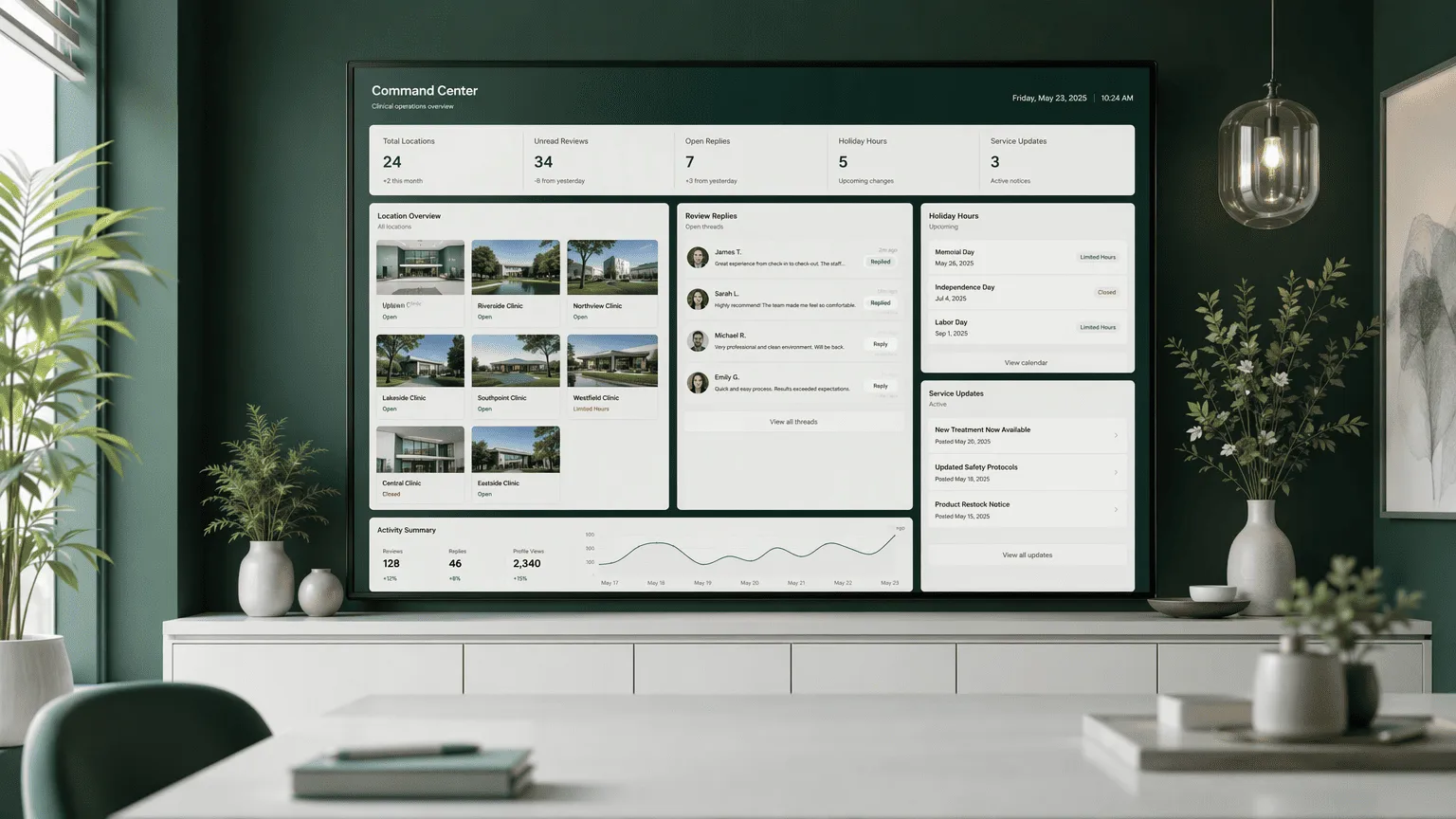
If you're starting now, you need a dashboard that treats Google Business Profile management like an ad campaign, creative, scheduled, and unified across locations. Clinads is built for that. A DSO with 30 practices doesn't need 30 logins to update holiday hours, respond to a negative review, or publish a new service post. That workflow is a burnout machine. Clinads collapses it into a single view where a marketing director pushes updates, review replies, and content across every practitioner's profile at once.
The trade-off: Clinads doesn't pretend to be a 70-directory citation service. Its core is Google presence, posts, reviews, replies, Q&A, and the efficiency of bulk actions. For a clinic group burning $23 or more in patient acquisition cost per visit on paid search, the error reduction alone from not hand-editing profiles justifies the switch.
A platform like this solves the right problem. You can now view the specific policy violations for any of your review replies that have been rejected via API, and bulk-review management lets you catch those rejections across 40 locations in one screen instead of by surprise on a Tuesday morning. That's the efficiency a clinic operator actually needs.
2. WellWoRx Marketing: HIPAA-First Healthcare SEO for the NPI Era
When a patient's name shows up in a review response, that's not a marketing problem. That's a regulatory event. WellWoRx is the pick for clinics that can't afford to separate compliance from local SEO, because for them, the two are the same workflow.
It routes feedback through a secure channel so a positive Google review never echoes protected health information in a public reply.
- NPI data audit before optimization: WellWoRx audits the National Provider Identifier and clinical data integrity across every location before anyone touches a Google profile. A wrong NPI on a practitioner listing isn't just inaccurate, it's a Google suspension waiting to happen.
- Treatment-specific intent mapping: The platform doesn't just push "dentist near me" keywords. It aligns Google posts, Q&A, and service descriptions with the exact treatment searches that convert, "invisalign consultation," "emergency root canal," "child-friendly orthodontist."
- Clinical data integrity over generic listings: A pizza franchise platform syncs NAP and stops. WellWoRx checks that the practitioner's profile matches their state license, their admitting hospital, and the conditions they actually treat. That data layer is what keeps a profile in the 3-Pack when Google runs a verification sweep.
3. Yext: The Citation Colossus for Enterprise NAP Dominance
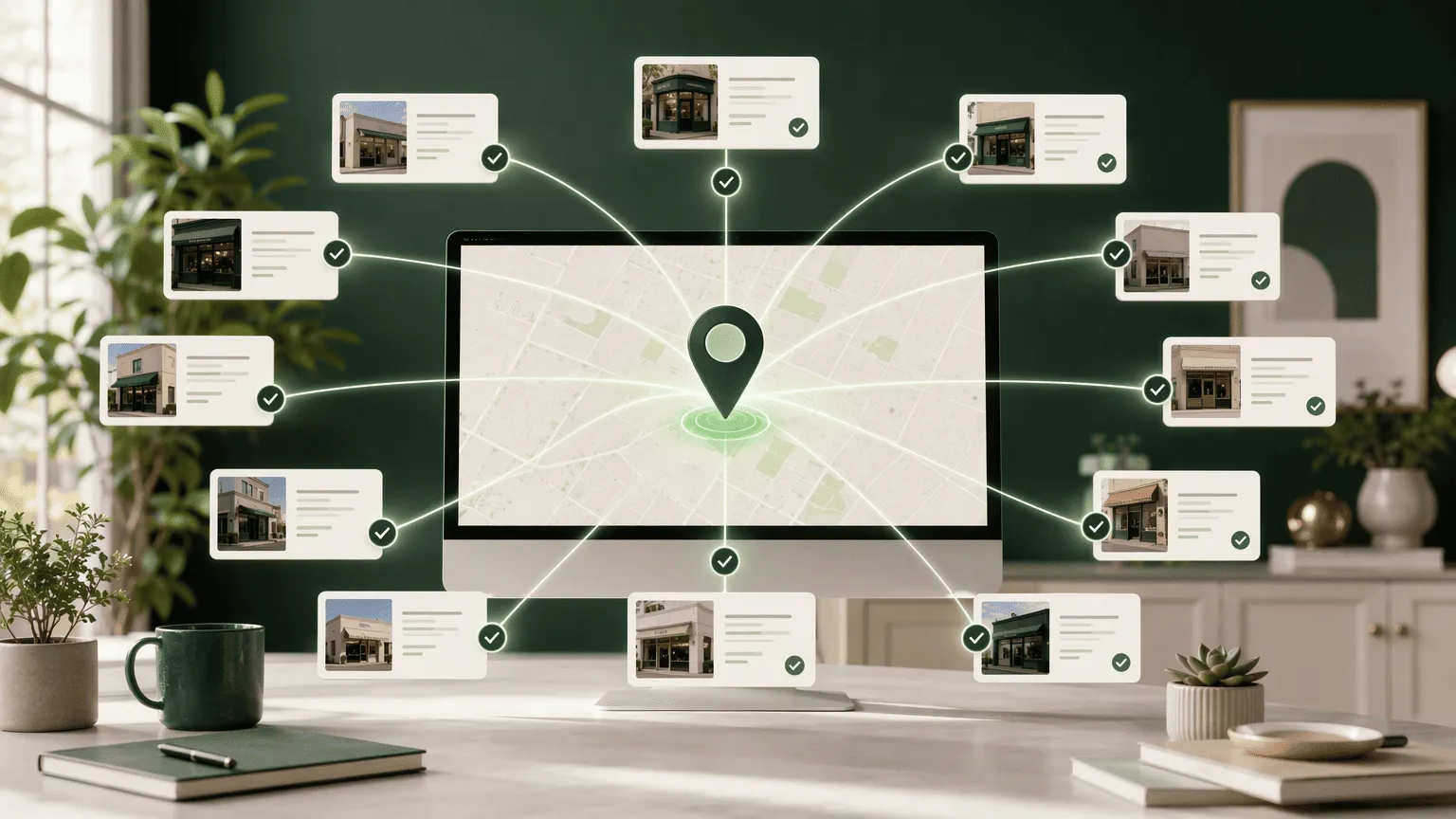
Yext does not optimize for patient engagement. It optimizes for a single, brutal truth: if your address is wrong on Healthgrades or your phone number is a dead line on WebMD, Google demotes the entire clinic group's local trust. The platform's core power is direct-to-directory citation syncing.
When a clinic changes its operating hours across 55 locations, Yext pushes that update to its network of publisher directories in near-real time. Separate Google Business Profiles are permitted for each physical location, but only if the underlying NAP data across every directory is identical. Yext suppresses the duplicate listings and stale practitioner profiles that fragment a clinic's local authority.
The limitation is that Yext is a data infrastructure tool, not a patient experience platform. For a large health system that needs absolute NAP dominance as step one, before any optimization work begins, Yext is the enterprise standard. Expect to pair it with a healthcare-specific engagement layer.
4. SOCi: The Engagement Engine for Multi-Location Review and Social Momentum
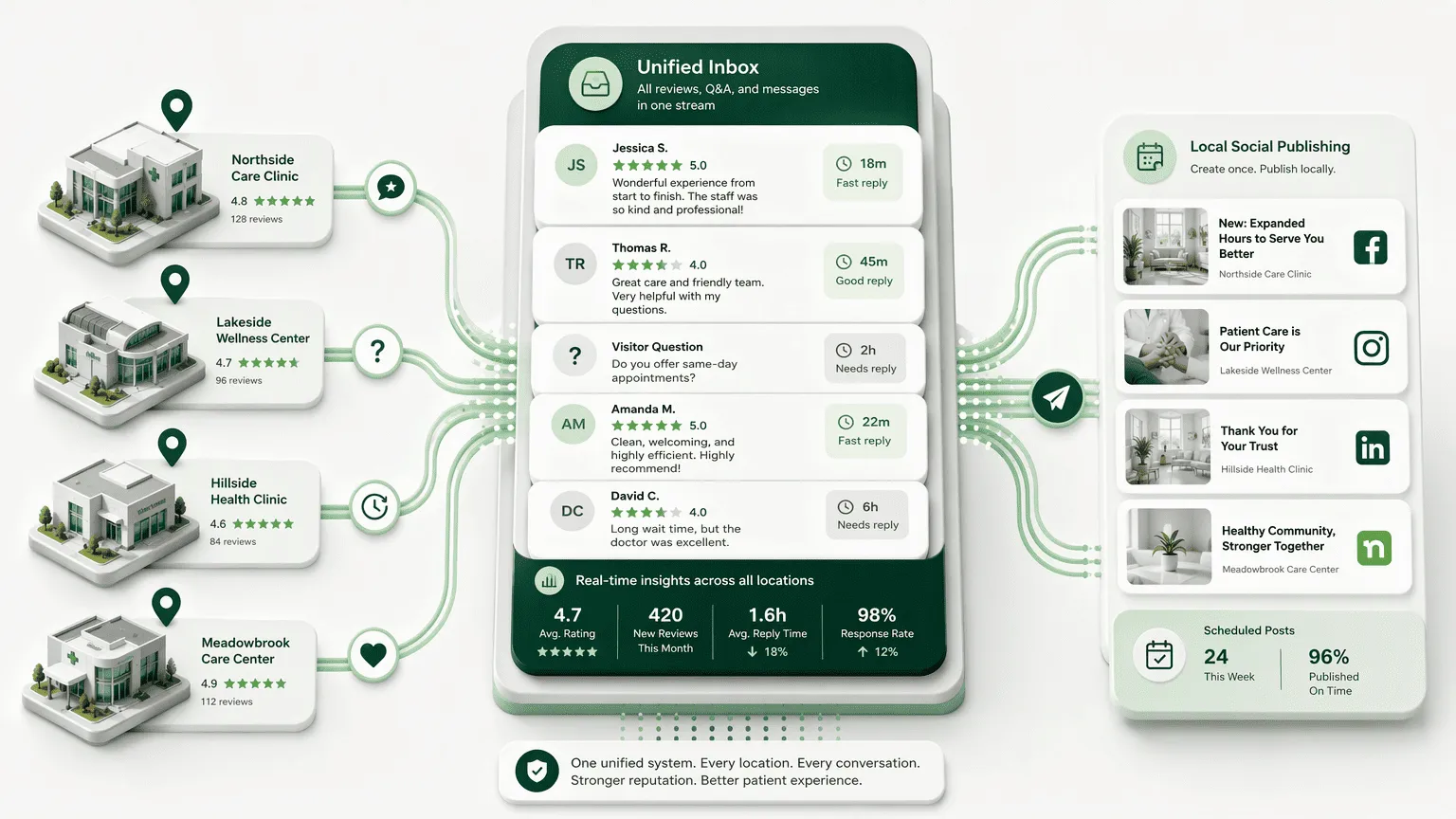
The local search algorithm rewards motion. Review volume, response rate, and reply velocity all feed into Google's ranking signal strength. SOCi is built for that fight. Its dashboard unifies review management and local social publishing across hundreds of clinic locations, so a regional director sees every new review, every unanswered Q&A thread, and every social comment in one stream. That unified inbox is the difference between a 24-hour response time that earns trust and a 72-hour lag that bleeds patients to a competitor.
| Capability | SOCi for Multi-Location Clinics | Typical General-Purpose Platform |
|---|---|---|
| Unified review & social inbox | Single stream across Google, Facebook, and local pages, with bulk-response workflows | Often siloed: reviews in one tab, social in another, no cross-location view |
| Local social publishing at scale | Location-level posts with brand-approved templates and local customization | Requires manual login per page; template enforcement is weak |
| Review velocity tracking | Response rate and response time tracked per location as ranking signal inputs | Response-rate tracking is available but rarely tied to local ranking education |
| Healthcare compliance layer | Not purpose-built for HIPAA review handling; a compliance gap exists | Depends on the platform; generally limited |
The gap for healthcare is clear. Clinics that pair SOCi with a compliance-first audit process get the best of both worlds: momentum without the regulatory risk.
5. Birdeye: The Patient Experience Orbit with AI-Driven Digital Front Doors
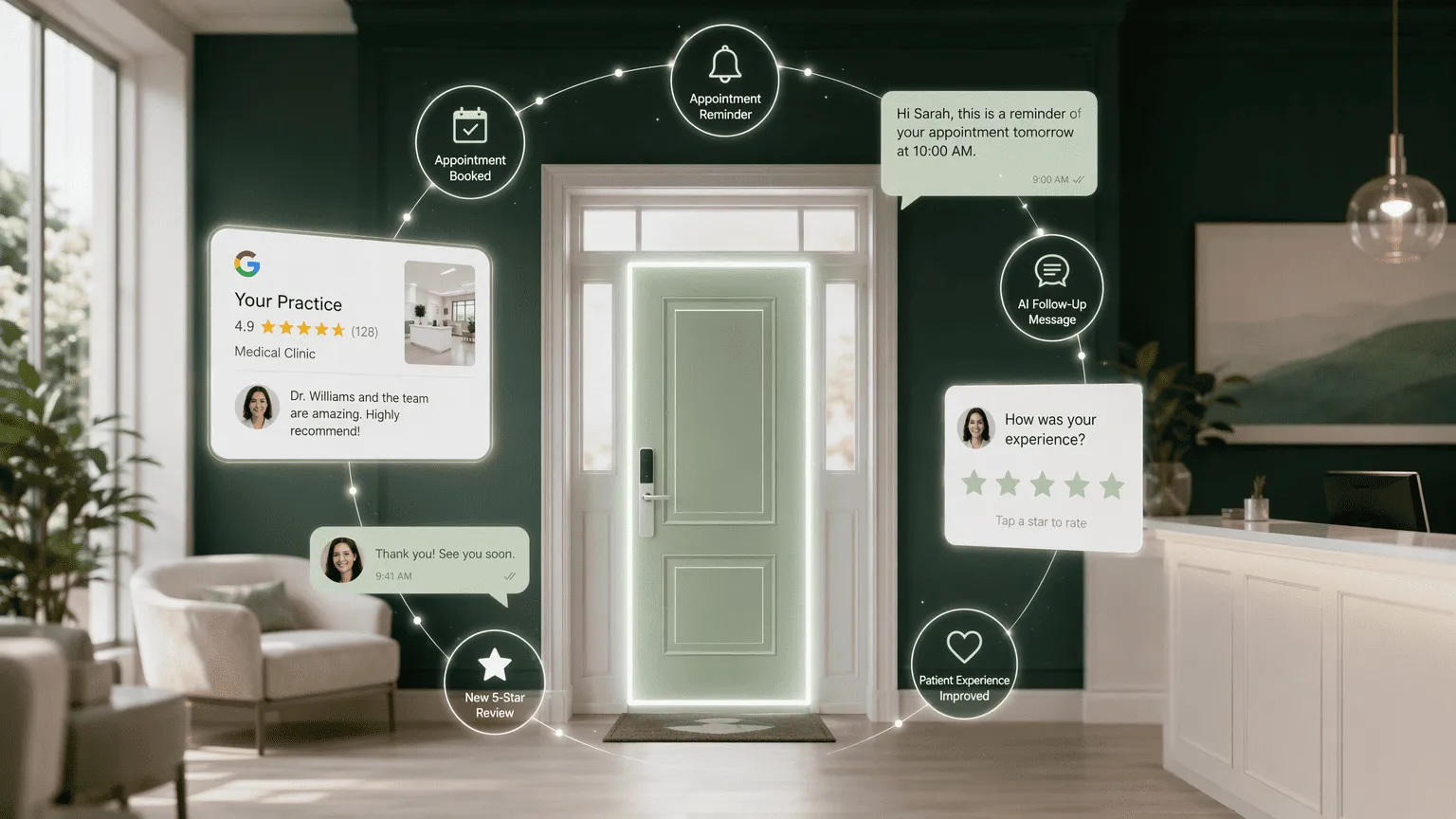
72% of consumers read online reviews before booking a new healthcare provider. That stat is not about vanity. It means the review profile on your Google listing acts as the clinic's real front door, and Birdeye gives you control over that entry point from the start.
The platform wraps Google listing management into a broader patient-experience system. AI-driven review requests go out after appointments and funnel feedback into a dashboard where a marketing lead can respond, or hold off, before anything appears publicly. From there, the system expands: website chat, patient surveys, a unified inbox.
A Google impression becomes a managed conversation. For a multi-location group, that consistency solves a real problem. A patient in Phoenix gets the same pre-booking chat experience as one in Dallas, and the review volume feeds the ranking signal that pushes the clinic into the 3-Pack.
Birdeye's strength in experience architecture has a catch. It can outrun a clinic's data foundation. If a group skips a clinical data integrity audit (cleaning up provider NPI numbers, fixing admitting hospital tags, verifying specialty codes), Birdeye just spreads bad data across more touchpoints. Deploy it after a NAP synchronization phase, not before.
What a DSO gets in return is a consistency engine. AI handles the solicitation cadence. The unified inbox stops a review in Miami from sitting unanswered because the Florida regional manager took a vacation. That operational lift is what a clinic group actually pays for with Birdeye.
6. Uberall: The European Powerhouse with a Core ‘Near Me’ US Strategy
Uberall's advantage is that it built its platform on a mobile-first, store-locator foundation long before Google's "near me" searches became the dominant local query type. A clinic group in the US deploying Uberall isn't buying a listings manager. It's buying a strategic bet that mobile micro-moments, "urgent care near me open now," "pediatric dentist near me Saturday hours", will decide appointment volume over the next 24 months.
The platform connects local pages and location-based content to map listings in a way that matters for patient acquisition. When someone searches "walk-in clinic near me," Uberall's optimization layer ensures the GBP profile surfaces with the right hours, the right service tags, and a local page pre-built for mobile load speed. The European pedigree means the product solves for dense, multi-language, multi-regulator markets by default. That complexity tolerance maps well onto a US health system with locations in five states and three payer networks.
The gap for a US clinic operator is straightforward: Uberall is not a healthcare-native compliance solution. A DSO will need to layer its own HIPAA review-handling protocols on top. The platform handles the "near me" mobile play, but the clinical data audit step still has to happen before any optimization runs.
7. Rio SEO: The Enterprise Local Search Suite with Deep ‘Local 3-Pack’ Analytics

If a clinic’s CMO needs to see, location by location, which keywords rank in the Local 3-Pack and which lost position month-over-month, Rio SEO is the reporting layer that makes that granular. A typical listing tool tells you if a profile is complete. Rio SEO tells a DSO that its “pediatric speech therapy” 3-Pack ranking dropped three spots in Austin after a competitor added five reviews in one week.
That analytics depth is Rio SEO’s core differentiator. The platform tracks local keyword rankings inside the three-pack specifically, not just in organic search. For a clinic group that measures marketing performance by the appointments that originate from the map, this is the signal that matters. Businesses that are complete on Google are twice as likely to be considered reputable, but the complete-profile metric alone doesn’t tell a multi-location group which of its 22 practices has a 3-Pack visibility problem. Rio SEO’s dashboard isolates the underperformers and maps them against review volume, reply rates, and post frequency so a regional director can target the fix.
The local pages and store-finder integration give the platform an enterprise-local architecture that works for large health systems. A hospital network can publish location-specific service pages that feed structured data directly into Google, reinforcing the clinic’s entity authority for specific procedures. The combination of local pages plus rank tracking creates a feedback loop: publish a page, measure the 3-Pack lift, adjust the content.
What Rio SEO doesn’t do is handle the compliance layer or the review response workflow with the same depth as a purpose-built healthcare platform. It’s an analytics and reporting powerhouse best suited for a large clinic group that already has its NAP synchronization and compliance processes in place and needs the data to prove what’s working.
Conclusion
The platform decision isn't about features. It's about the one problem that will cost you the most if it breaks. For a DSO staring down a HIPAA audit, WellWoRx's compliance-first architecture earns its spot.
For a health system that can't afford fragmented directory data across 70 listings, Yext is the foundational play. If review volume and local social momentum are the missing lever, SOCi or Birdeye fill the engagement gap. And if your board wants proof that the local spend is driving ranked visibility, Rio SEO's 3-Pack analytics give you the report.
None of it works without the clinical data audit first. NPI mismatches, stale phone numbers, and ignored review replies will tank a platform migration. Do that audit, sync the NAP across every directory, then deploy the platform that matches your top risk. That is the sequence that actually moves the 3-Pack.
Frequently Asked Questions
What does a multi-location Google Business Profile management platform actually do?
A centralized dashboard lets you manage clinic locations at scale by performing three key actions from one interface:
- Update NAP data: Push name, address, and phone number changes across every clinic location simultaneously.
- Respond to reviews: Reply to patient reviews across all locations without logging into each profile individually.
- Publish posts: Create and schedule GBP posts (services, events, updates) for every location at once.
Google’s Business Profile APIs enable this at scale, letting enterprise brands manage thousands of locations from one interface.
How does bulk GBP optimization differ from managing profiles one at a time?
Bulk management eliminates the error rate and time sink of individual logins. A DSO updates holiday hours once and pushes the change to 40 profiles. Manual management, by contrast, introduces data inconsistencies across locations that fragment Google’s local trust in the brand.
Which multi-location SEO platforms are purpose-built for healthcare clinics in the US?
Clinads is built for healthcare-specific ad and presence management, focusing on bulk Google profile actions without the generic franchise feature bloat.
What real-world ROI metrics exist for platforms managing 10+ clinic GBP listings?
40 to 60% of all local search traffic lands on the Local 3-Pack, and a platform that keeps profiles complete and active doubles reputability perception. A DSO with 30 locations that cuts manual GBP editing hours by 90% recovers that staff cost immediately.
What are the critical HIPAA and patient-privacy considerations when using a third-party platform for clinic location management?
The review acquisition system is the biggest risk vector. Any tool that asks patients for feedback through a non-compliant channel can leak protected health information. The platform must segregate PHI from public review replies and audit review response workflows for accidental disclosure.
How do I evaluate total cost and implementation timeline for a multi-location healthcare GBP platform?
Expect a multi-phase deployment process with these key steps and costs:
- Clinical data audit and NAP sync: Complete a thorough audit and synchronize NAP data across 50-plus directories, which takes weeks to months.
- Platform licensing: Budget $500/month for a small group or enterprise contracts exceeding $5,000/month plus onboarding fees.
- Timeline phasing: Get a project plan that separates the data audit, citation sync, and optimization build into distinct phases.
Sources
- Google Business Profile APIs | Google for Developers - developers.google.com
- SEO For Healthcare: How Multi-Specialty Clinics Can Boost Visibility - www.forbes.com
- Editing Google Business Profiles for Multi-location Businesses - BrightLocal - www.brightlocal.com
Want help executing this for your clinic?
Book a 30-minute call and we will map what a real ad engine would look like for your specific service mix.
Book a call10 minutes setup · No integration · Works with existing tools and campaigns