
Why Competing Clinics Always Appear Above Yours in Local
IntroductionYou built a practice with superior outcomes, invested in a modern website, and collected dozens of glowing reviews. Yet a clinic with peeling wallpaper and a 3.9-star rating consistently sits above you in the local map pack.
The problem is not that Google is broken. The problem is that the algorithm values a specific set of signals you are likely ignoring.
Google's local ranking changes based on where the searcher is standing, what words they type, and the time of day they search. While you are fixated on your website's loading speed, a rival clinic is quietly dominating the three pillars that actually dictate visibility: relevance, prominence, and proximity. New research confirms that proximity drives 55% of visibility decisions for positions 1 through 21. If a competitor is physically closer to the searcher, they often win on that factor alone, regardless of their reputation.
But location does not lock you out. It stretches and snaps based on context. Knowing exactly where that snap happens tells you how to take back the top spots.
Key Takeaways
Google local ranking is a battle of three volatile pillars, not a static list. These are the hard findings that explain why rivals leapfrog you:
- Proximity still dominates the broad map: Proximity influences 55% of ranking decisions across all local positions, but its grip loosens at the very top.
- Review content is a weapon, not just a badge: In the top ten positions, review count jumps to a 26% influence and review keyword relevance soars to 22%, meaning what patients say in reviews matters almost as much as where you are.
- A 'worse' clinic wins on granular relevance: A competitor with fewer or worse reviews often outranks you because their GBP categories and service descriptions align perfectly with the specific query term.
- Multi-practitioner listings are the 2026 advantage: Following Google’s 2025 guidelines, claiming separate GBPs for each practitioner specialty compounds your relevance and allows you to occupy more real estate.
- The gap is diagnosable: Auditing a rival’s profile for keyword-stuffed reviews and exact category selections reveals exactly which levers they are pulling that you are not.
Google’s Three Pillars That Decide Your Clinic’s Rank

The algorithm that builds the local pack is not a mystery box. It asks three distinct questions about your Google Business Profile. When a rival wins, understand which of these questions you are failing to answer correctly:
- Relevance: Does the business do, sell, or have the attributes the searcher is looking for? If a patient searches for 'ACL rehab protocol' and your competitor’s GBP is packed with that exact service language while yours lists generic 'physical therapy,' they win the relevance signal instantly.
- Prominence: Which businesses are the most popular and well regarded in their local market area? This is driven by web presence, directory citations, and review volume. Google measures the digital world’s confidence in your brand beyond your own website.
- Proximity: Is the business close enough to the searcher to be considered a good answer for the query? This is usually the most unfair pillar. It does not measure distance to your office in a straight line; it measures the searcher’s device location at the moment of the search.
The Truth About Proximity: Why Location Isn’t Fixed
Proximity feels like a permanent disadvantage you cannot fix because your building is not going to move. But thinking of proximity as a fixed mile radius is a misunderstanding. Think of proximity as a rubber band.
It stretches and contracts. A broad term like 'dermatologist' in a dense city might have a very tight search radius because Google has hundreds of options nearby. But a niche, high-intent emergency query like 'open now broken tooth dentist downtown' triggers an entirely different radius because the user context demands a specific, urgent result, regardless of a slightly longer distance.
This is the proximity flex. Your competitor appears above you not because they are universally closer to everyone, but because their address is inside the snap radius that Google applied to that specific search at that time.
Winning against entrenched rivals requires recognizing that these location-based ranking boundaries are in constant flux.
How Reviews Actually Move the Needle at the Top
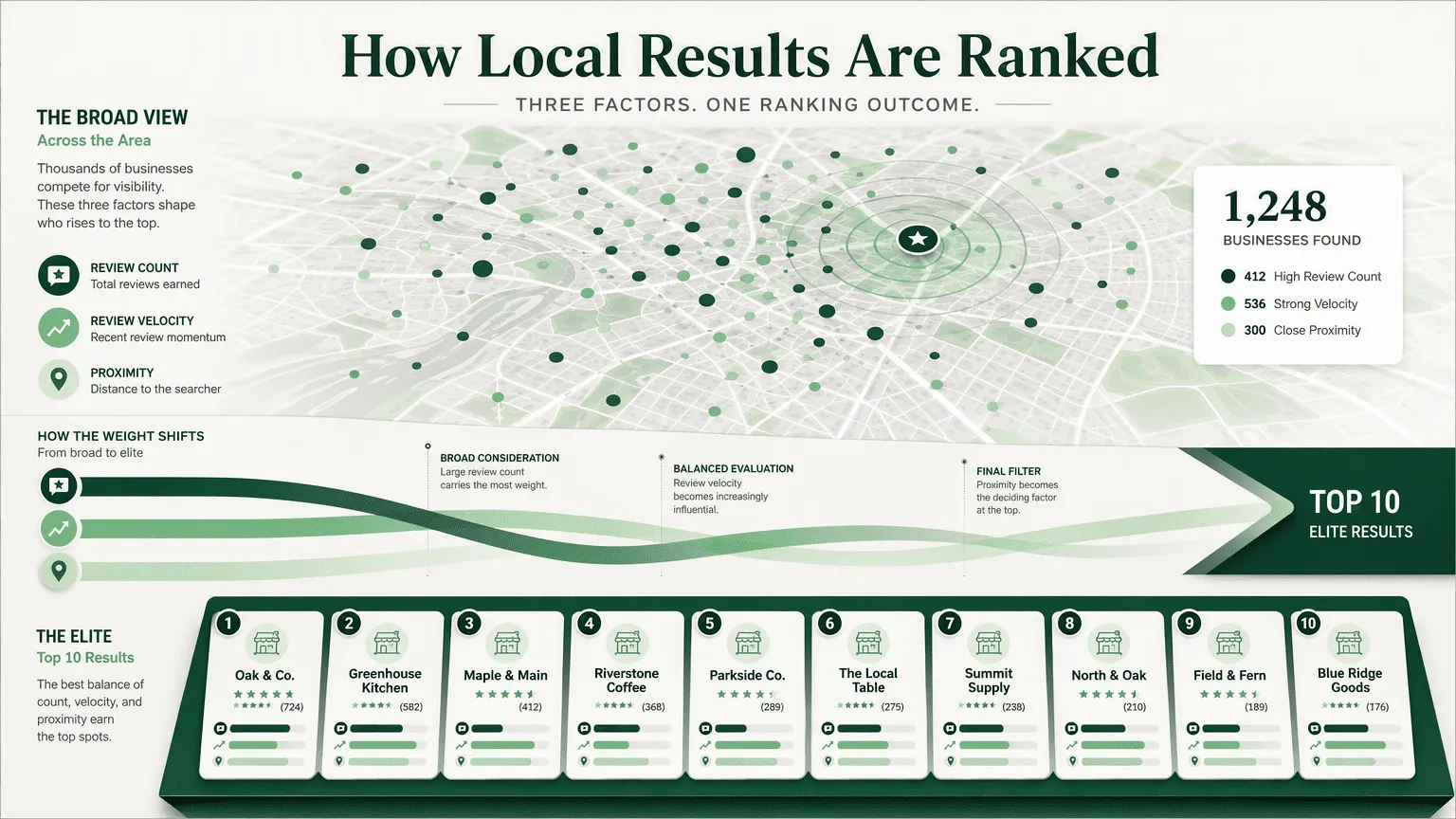
The raw data on review signals upends the conventional wisdom that 'more stars are all that matter.' When you look at the broader map, proximity drives 55% of visibility and reviews feel like a secondary checkmark. But within the elite top-ten strip where actual booking decisions happen, the physics change entirely.
In these money positions, proximity influence craters to 36%. Review count climbs to a 26% weight, but the real story is the explosive rise of review keyword relevance to 22%. This means a competitor's 4-star rating beats your 5-star rating if their patients naturally use high-value clinical terms like 'plantar fasciitis treatment' or 'skin cancer screening' in the review text. You need a steady stream of fresh reviews that explicitly name the procedures patients searched for.
72% of consumers read online reviews before booking a new healthcare provider. Review content is a direct conversion driver and a ranking signal.
Stop praying that patients mention the right words by accident. You must systemize a request process that guides patients to describe their specific treatment, not just their bedside manner.
Why a ‘Worse’ Clinic Often Outranks You
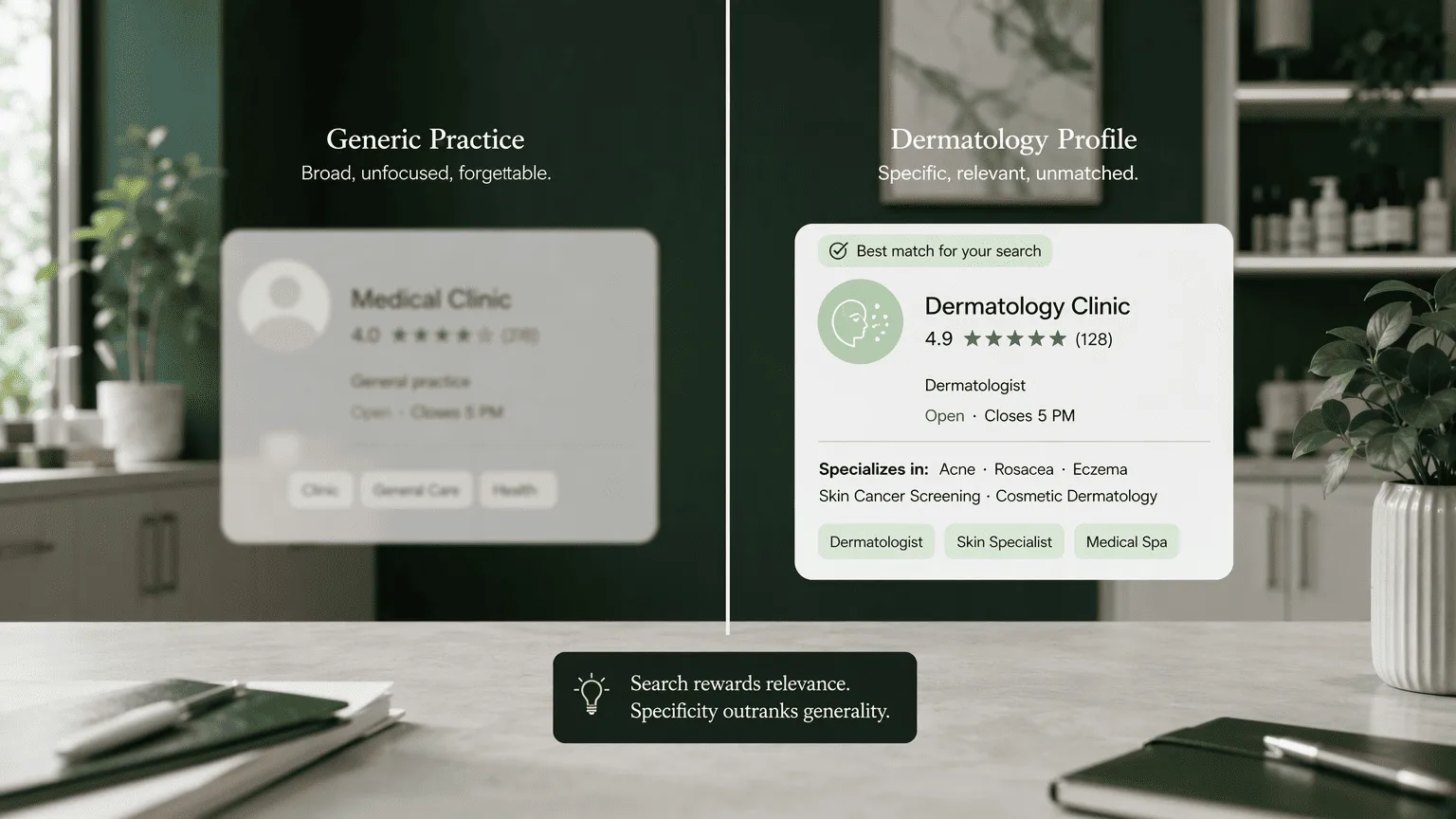
The clinic with the peeling wallpaper outranks you for a specific, diagnosable reason. The most common scenario is that their profile is a perfect mirror for the search query while yours is reflecting a blurry version. They have likely selected hyper-specific secondary GBP categories and service menus that align precisely with what the user typed.
If a user searches for 'Botox dermatologist,' the algorithm first pulls clinics categorized under that exact service rather than a general 'Doctor.' A rival with fewer reviews and a slightly worse rating will surface at the top because their relevance pillar is stronger than your prominence pillar for that narrow, high-intent query. A general reputation cannot overpower a broken relevance match when proximity acts as a tie-breaker.
The other scenario is the rubber band snapping in their favor. A clinic that ranks poorly at 10 a.m. during a broad 'near me' search might suddenly dominate at 6 p.m. when the query gains an 'open now' modifier and the searcher's physical device shifts to a residential location.
Auditing a Competitor’s Profile to Find Their Edge
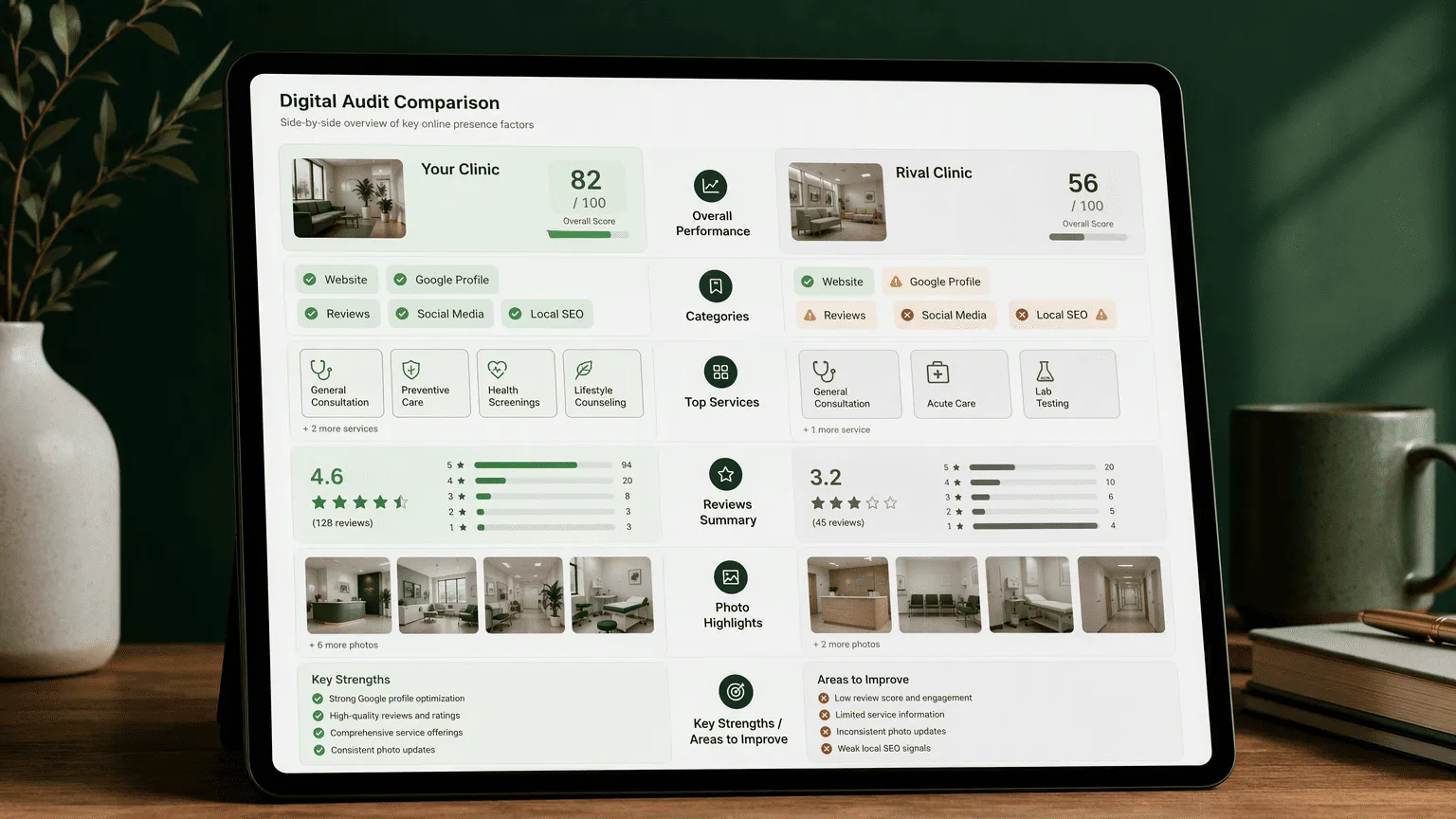
Stop guessing why they win. An audit distills their advantage into a side-by-side diagnostic. Compare your GBP against theirs on three specific dimensions:
- Category selection: Open their GBP information panel and directly compare their primary category and any visible secondary categories against yours. Physical therapy clinics often make the mistake of listing only 'Physical Therapist' while the top rival has added 'Sports Medicine Clinic,' instantly capturing a different and often higher-volume search slice.
- Review content density: Skim their last thirty reviews and pick out the clinical terms that keep showing up. You are not looking at star ratings here; you are counting words. If 'adjustment,' 'laser,' or 'implant' appears noticeably more often in their review stream than in yours, they have accumulated a relevance signal that your location advantage cannot override. The gap usually traces back to a review request process that prompts patients to use those exact terms. ClinAds automates that sequence, so the volume feeds search relevance instead of just generic compliments.
- Landing page match: Compare the landing page their GBP links to against the query you want to rank for. When their profile connects to a dedicated 'Pediatric Dentistry' service page and yours still sends clicks to the clinic homepage, the algorithm reads their entity as the better match. You can fix that right now by pointing your GBP link at your strongest service pillar page.
The Multi-Practitioner GBP Playbook for 2026
The single biggest structural change in local search is the ability to fragment your relevance across multiple entities within the same location. Google's 2025 guidelines clarify exactly how clinics can build a fortress without getting suspended. Execute this playbook systematically:
- Segregate practitioner profiles: Google permits separate GBPs for each practitioner. A dentist, an orthodontist, and a periodontist under one roof can each claim a verified GBP. A single doctor cannot have multiple listings, but distinct specialists absolutely can.
- Customize profile naming conventions: Use the standard format 'Practice Name: Practitioner Name, Specialty.' Avoid keyword-stuffed business names that will trigger a suspension. The goal is to capture searches for the provider's name and the specific procedure.
- Route reviews to the correct target: Direct all marketing automation to ask patients for specialty-specific language on the individual practitioner's profile, not the main brand page. This builds a dense web of keyword relevance signals on each distinct entity.
- Compound content on each profile: Publish unique weekly Google Posts on each practitioner's GBP covering their specific subspecialty (e.g., sports injuries vs. post-surgical rehab), ensuring you feed the relevance engine fresh, targeted content across every entity.
The Hidden Local Signals Beyond the Map Pack
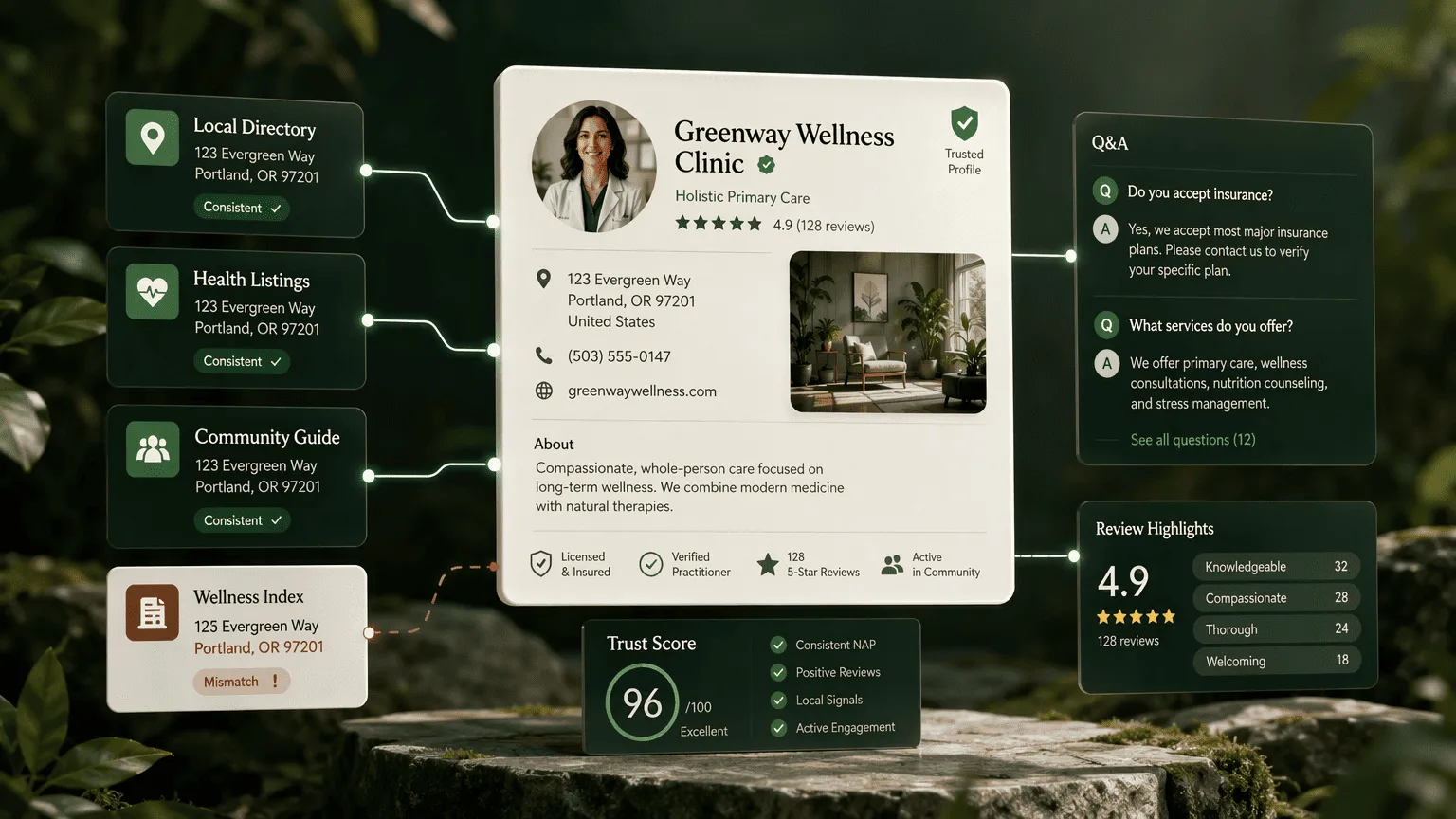
When two clinics are equal on the primary pillars, secondary engagement and trust signals dictate who breaks into the 3-pack. Consistent NAP (Name, Address, Phone) citations across top-tier directories act as a foundational trust mechanism. A mismatch, even a small one like 'St.' vs. 'Street,' introduces friction that demotes your entity's authority.
The Google Business Profile Q&A section is a heavily underused ranking accelerator. Competitors often populate their own Q&A with seeded, service-specific questions and answers using high-intent keywords.
Behavioral signals from Google Posts also serve as freshness indicators. An active profile that publishes weekly updates receives a responsiveness boost. By consistently answering queries and posting updates, your clinic signals to Google that it is an actively operating business worthy of higher visibility over a stagnant competitor with a technically closer location.
Immediate Actions to Climb Past Entrenched Rivals
Rank is fixed by physics, not chance. Execute these specific interventions to weaponize relevance against a competitor's proximity advantage:
| Action Item | Strategic Focus | Expected Outcome |
|---|---|---|
| Verify individual practitioner GBPs | Create separate profiles for each specialty per Google's 2025 guidelines | Captures niche search traffic and compresses rival visibility through entity fragmentation |
| Conduct a category audit and update | Update primary and secondary GBP categories to match high-intent services (e.g., 'Sports Medicine Clinic') | Directly closes the relevance gap that allows 'worse' clinics to outrank yours |
| Deploy a keyword-centric review system | Automate review requests that trigger procedure-named feedback (e.g., 'laser resurfacing') | Increases the 22% review keyword relevance signal in top-ten local pack positions |
| Schedule weekly Q&A and posts | Publish 2 to 3 pre-written service-specific Q&As and Google Posts on each profile weekly | Signals active engagement and adds long-tail keyword relevance that competitors miss |
| Fix all NAP inconsistencies | Audit and update citations across health directories to create perfect consistency | Solidifies the foundational trust that stops a technically stronger clinic from being filtered out |
Conclusion
Lasting rank gains come from systematically dismantling the three pillars, not obsessing over a single website metric. Your path forward is to fragment relevance with a multi-practitioner strategy and weaponize review content to convert generic praise into specific ranking fuel. This turns a perceived proximity disadvantage into a relevance advantage that rivals have no structural defense against. The algorithm rewards the entity that best answers the question, so make your entity the obvious, localized, and keyword-rich answer to every clinical search.
Frequently Asked Questions
What are the most important local SEO ranking factors for physical therapy and medical clinics?
Google's algorithm relies on three pillars:
- Relevance: How well your profile matches the search query.
- Prominence: Your online reputation and review volume.
- Proximity: The searcher's distance from your location. Data shows proximity drives 55% of visibility broadly, but review keyword relevance jumps to a 22% influence in the competitive top ten local pack positions.
How does Google's local pack algorithm decide which clinics to show in the top three positions?
It rapidly assesses proximity, relevance, and prominence for the specific query and device location. Proximity is a fluid rubber band that shifts based on time and modifiers like 'open now,' while relevance requires the GBP to perfectly mirror the searcher's specific clinical terms, not just a general practice category.
What role do online reviews play in local clinic rankings compared to proximity and relevance?
Reviews are a massive conversion and ranking lever. In the top ten most valuable positions, proximity influence drops to 36%, while review count rises to 26% and review keyword relevance reaches 22%. This means review content, specifically patients naturally naming procedures, becomes a high-impact tool against location disadvantages.
Why does a clinic with fewer or worse reviews sometimes rank higher than my well-reviewed clinic?
They are usually winning on hyper-specific relevance or a temporary proximity flex. If their GBP perfectly aligns its categories, service menu, and landing page with a niche search while yours stays too generic, Google views them as the better answer regardless of a slightly lower star rating.
How can I audit a competing clinic's Google Business Profile to understand why they outrank me?
Compare your listed primary and secondary GBP categories directly to theirs. Analyze the last thirty of their reviews for keyword density, specifically clinical terms. Finally, check the landing page URL their profile points to and assess if it leads to a deeply relevant service page or a generic homepage.
What specific actions can a clinic owner take today to improve their local search visibility against entrenched competitors?
Implement Google's 2025 multi-practitioner guidelines by creating separate GBPs for each specialty. Deploy a system that routes review requests asking for specific procedure-named feedback. Populate your GBP Q&A section with high-intent service questions and publish targeted weekly Google Posts from each practitioner profile.
Sources
- The Local Algorithm: Relevance, Proximity, and Prominence - Moz - moz.com
- Review Signals Gain Influence In Top Google Local Rankings - www.searchenginejournal.com
- SEO For Healthcare: How Multi-Specialty Clinics Can Boost Visibility - www.forbes.com
Want help executing this for your clinic?
Book a 30-minute call and we will map what a real ad engine would look like for your specific service mix.
Book a call10 minutes setup · No integration · Works with existing tools and campaigns