
Track The Marketing That Puts Patients In Your Chairs
Summary: To effectively track marketing efforts that bring patients into your practice while avoiding legal risks, establish a HIPAA-compliant foundation by using server-side routing and Business Associate Agreements. Implement disciplined source metrics for traceability from click to appointment, and ensure offline conversions are captured through call tracking and staff logging workflows. This approach helps align marketing spend with patient acquisition without regulatory exposure.

Introduction
Most practices are tracking their marketing backward. You’re spending 76% of your healthcare ad budget on digital channels, yet the pixel tools that promise to show you a return are the same ones landing practices in court. The problem is not that attribution is hard. The problem is that clinics chased fast data before locking down a compliant foundation, and the bill is coming due.
Cumulative pixel-tracking settlements in healthcare exceeded $100 million through 2025, proving that leaking protected health information to ad platforms is not a theoretical risk. It is a documented, recurring liability. The HHS March 2024 bulletin made the government's position explicit, and the June 2024 AHA v. Becerra ruling locked it into case law. Marketing teams can no longer plead ignorance.
This creates a sharp tension. You need to know exactly which campaigns fill chairs, but the old tracking playbook is now a compliance hazard. The solution is a two-part infrastructure shift.
First, you lock down technology that keeps PHI inside your stack through server-side routing and signed Business Associate Agreements. Second, you layer disciplined source metrics on top so every dollar is traceable from click to kept appointment. This guide walks through both.
Key Takeaways
Here is the compressed answer on tracking marketing back to patient volume without creating a regulatory exposure:
- Non-negotiable compliance baseline: Any tracking tool that transmits PHI to a third-party ad platform without a Business Associate Agreement is a legal liability under the current HHS bulletin and AHA v. Becerra ruling.
- Attribution model choice: Source attribution credits the last touchpoint, while multi-touch attribution distributes credit across the journey. Pick one before you tag a single URL so your UTM architecture matches your model.
- Software must pass a two-part test: The platform must sign a Business Associate Agreement and route events server-side through a first-party subdomain. Client-side pixels are a hard stop.
- Cost benchmarks are sobering: Behavioral health patient acquisition costs run $1,000 to $2,500 per acquired patient, and mental health cost-per-lead rose 146% year-over-year. You cannot fix what you don't measure.
- Offline tracking is mandatory: The 60 to 70% of conversions that happen over the phone or at the front desk will never appear in your digital dashboard without deliberate call tracking and staff logging workflows.
Step 1: Anchor Your Tracking in a HIPAA-Compliant Foundation

The compliance regime changed, and most clinic operators haven't absorbed how much. The HHS March 2024 bulletin spelled it out: covered entities have to comply with the HIPAA Privacy, Security, and Breach Notification Rules when they use online tracking technologies. Then the June 2024 AHA v. Becerra ruling hardened that interpretation. Embedding a Google or Meta pixel on a scheduling page and moving on stopped being an option before you finished reading that sentence.
Two controls matter for your tracking program, and neither is optional. Any vendor that touches patient data has to sign a Business Associate Agreement. If they refuse, they can't sit in your stack. You also cannot send PHI to ad platforms without patient authorization. That effectively kills client-side pixels on authenticated pages like patient portals and appointment booking flows.
Start your tracking rebuild here rather than with UTMs. Audit every script that fires on your site. Catalog exactly what data each one sends.
Then strip out anything that pushes identifiers, appointment types, or condition signals to a third-party ad server. The $100 million-plus settlement figure is not a scare tactic. It is a line item in the marketing budget of practices that moved too slowly.
Step 2: Architect Your Attribution Model and UTM Discipline
Source attribution is the right starting point for private practices. It credits the single touchpoint that drove the patient to book, and the model is clean enough to manage without a dedicated ops team. Multi-touch attribution distributes credit across every interaction in the patient journey, which gets closer to the truth for long decision cycles, but it demands a CRM infrastructure that most small clinics do not yet have.
Once you pick your model, enforce the UTM schema like your P&L depends on it, because it does. Standardize five parameters across every paid and organic channel: source, medium, campaign, content, and term. No rogue tagging, no inconsistent capitalization.
Then layer your state licensing data onto the output. Traffic that converts in unlicensed states will inflate your reported cost-per-acquisition and make winning channels look broken.
When a campaign shows a $1,500 CPA but 40% of the conversions are from states where you cannot legally treat, your real CPA is higher than the dashboard reports. Clinads builds campaigns with this licensing layer baked into targeting and reporting, so you are not manually scrubbing unusable leads.
Step 3: Select and Configure Privacy-Safe Software Platforms

Selecting a compliant tracking stack is a sequential process. Work through these five requirements, and do not advance to the next until the current one is satisfied:
- Business Associate Agreement: Eliminate any vendor that refuses to sign a BAA before you discuss features. A signed BAA is your legal backstop, and no analytic capability is worth operating without one.
- Server-side event routing: Routing data through a first-party subdomain, rather than a client-side browser script, keeps PHI inside your controlled environment and strips identifiers before forwarding anything to ad platforms.
- First-party data hosting: Your patient conversion data must live in an environment you control, not a shared ad platform dashboard. This is where your CRM becomes your single source of truth.
- Granular consent management: Your tracking must respect opt-in status at the individual level, with clear audit trails.
- Source-to-appointment visibility: The platform must connect a Google or Meta click all the way through to a kept appointment, surfacing that thread in a dashboard, not a data-engineering project. Platforms such as Zoho for Healthcare's CRM capture leads from multiple sources including website forms, WhatsApp, Google Ads, and Meta, with automated lead assignment and conversion tracking built in.
Step 4: Deploy Call and Offline Conversion Tracking
Most patient conversions never show up in your digital dashboard. A prospective patient clicks your Google ad, reads your service page, then calls the number in your header. Your ad platform records zero conversions. Across every phone call and walk-in, your attribution data misses 60 to 70% of what actually fills your schedule.
Dynamic number insertion fixes this. It swaps the phone number on your website based on the visitor's source, campaign, or keyword. A Google Ads click triggers one number.
An organic search visit triggers another. Every inbound call gets tagged to its origin channel in real time. Your DNI provider must sign a Business Associate Agreement and route those call logs through your HIPAA-compliant infrastructure, not leave them on an unsecured third-party server.
Offline tracking finishes the picture with a simple frontline habit. Your front desk staff logs the source of each new patient inquiry during check-in, picking from a short dropdown in your CRM. Was it a friend referral?
A specific Instagram ad? A provider referral?
This data reconciles with your online conversion logs. You stop optimizing campaigns against partial information.
Step 5: Implement Server-Side and First-Party Data Tracking

The technical architecture that satisfies regulators and still feeds your ad platforms accurate conversion data is server-side routing through a first-party subdomain. Instead of a Meta or Google pixel firing directly from the patient's browser and sending raw PHI, you route the conversion event through a server you control. Your server strips identifying data, keeps the attribution signal intact, and forwards a clean event to the ad platform.
This is not an optional optimization. It is the direct response to the HHS March 2024 bulletin prohibiting unqualified PHI transmission to ad platforms. Tools and platforms that support server-side event routing with HIPAA compliance are the only viable path forward.
The practical outcome is that your Google and Meta campaigns continue receiving the conversion signals they need for bidding optimization, while PHI never leaves your compliant stack. Platforms such as LeadSquared automate inquiries into scheduled patient appointments, and when paired with server-side routing, those conversion events feed your ad platforms cleanly.
Step 6: Structure Your Marketing KPIs and Performance Dashboards

Build your dashboard in three tiers so the right person sees the right metric at the right granularity, and no one is drowning in data that does not drive a decision:
- Executive Tier: Total new patient volume and blended cost-per-acquisition, segmented by service line and payer type. This answers the only question ownership cares about: is our marketing spend profitable?
- Channel Tier: Cost-per-lead and lead-to-appointment conversion rate by channel. Here is where the data gets corrective. Mental health cost-per-lead spiked 146% year-over-year, and behavioral health CPAs sit between $1,000 and $2,500. If your channel metrics do not reflect market reality, your budget allocation is guessing.
- Creative Tier: Ad-level conversion rates and cost-per-click by headline, image, and offer. This is the layer where a bad brief gets misdiagnosed as a broken channel.
4. Licensing Segmentation: Every dashboard must filter by licensed versus unlicensed states. Traffic that converts where you cannot practice inflates reported CPA and distorts your understanding of ad platform efficiency.
Step 7: Map the Full Patient Journey from First Touch to Appointment
The conversion funnel breaks at predictable failure points, and only an end-to-end journey map shows you where. Define five explicit stages: Impression, Click, Call or Form Submission, Appointment Scheduled, and Appointment Kept.
The table below identifies common breakage points and what they mean for your practice. Your CRM, call tracking system, and scheduling platform must feed a unified view of each stage. When Zoho for Healthcare's CRM integrates call logs, form captures from Instagram and Google, and appointment data, you can see which channels produce no-shows versus retained patients.
| Journey Stage | Data Source | Common Breakage Point | What It Tells You |
|---|---|---|---|
| Impression to Click | Ad platform analytics | Ad fatigue, wrong audience targeting | Creative and targeting review required |
| Click to Call or Form Submission | Call tracking, CRM form capture | Landing page mismatch, weak offer | Landing page optimization needed |
| Call or Form Submission to Appointment Scheduled | CRM, scheduling platform | Slow response time, no online booking | Front desk workflow or tools broken |
| Appointment Scheduled to Appointment Kept | Scheduling platform, CRM | No reminder sequence, high no-show rate | Patient communication protocol failing |
Step 8: Calculate and Benchmark Your True Cost-Per-Acquisition (CPA)
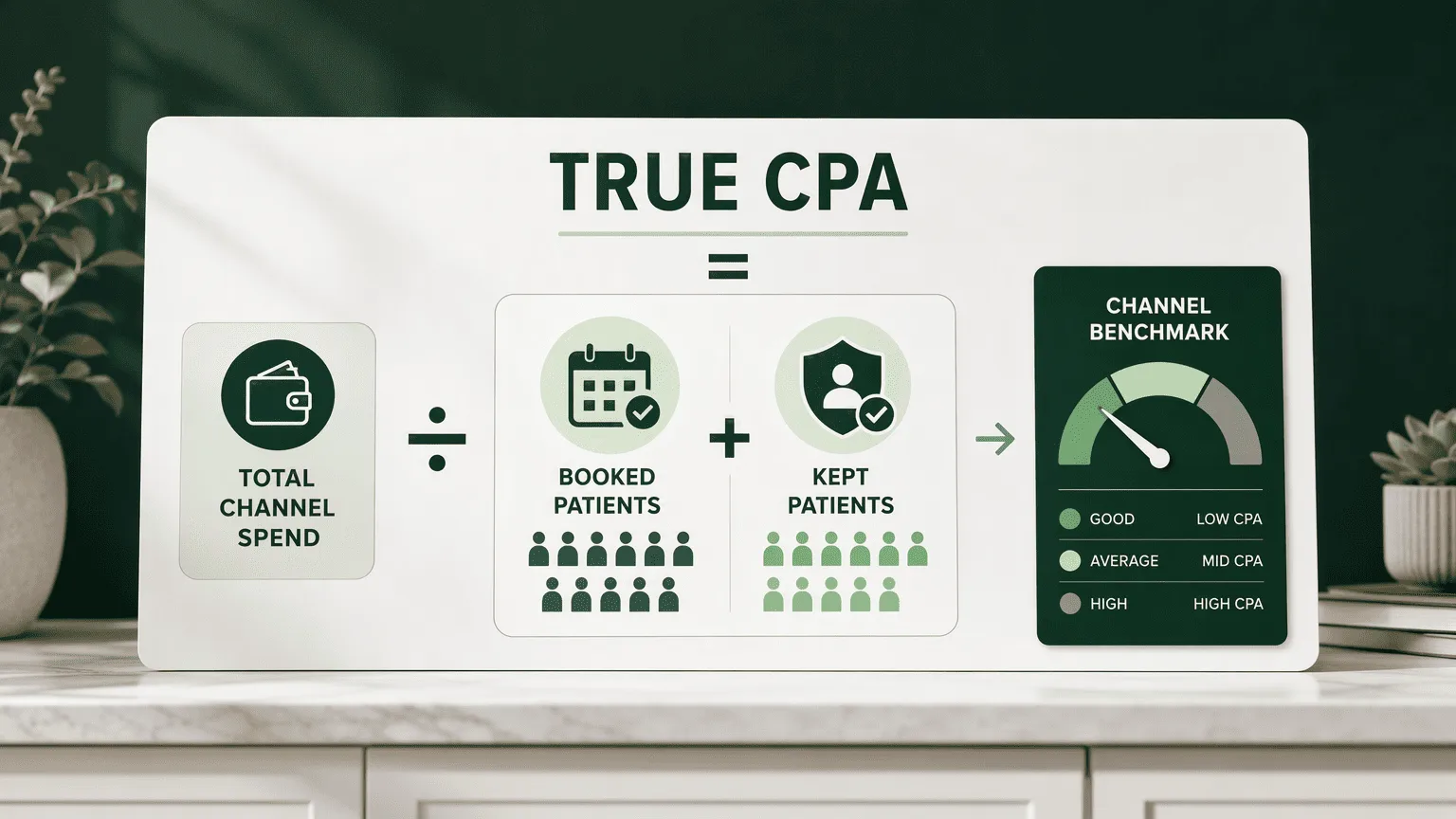
The formula that matters is True CPA equals Total Channel Spend divided by the sum of Booked plus Kept Patients from that specific channel. Do not use leads. Do not use consultations. Use patients who showed up.
The context for that number is that digital health companies spent roughly $26 billion on advertising in 2026 to acquire patients, and behavioral health brands are paying between $1,000 and $2,500 per kept patient, according to the Patient Acquisition Strategies for Digital Health in 2026 report from Matchnode. If your calculated CPA sits above that range with no clear pathway to pull it down, scale something else.
Conclusion
Compliant technology and disciplined metrics hold this entire effort up. Let either one fall, and you are staring at a regulatory fine or marketing blindness, there is no third option. The settlements exceeding $100 million confirm the first risk is real. And the fact that 76% of your ad budget already goes to digital channels tells you the second risk is too expensive to ignore.
Start with a pixel audit and a BAA checklist this week, not next quarter.
Frequently Asked Questions
What are the most effective metrics and KPIs to measure patient acquisition from marketing campaigns for a US medical practice?
Track cost-per-acquisition by channel, lead-to-appointment conversion rate, and kept-appointment volume by source. Segment every KPI by service line and payer type. For example, a practice with 80 new patients out of 800 active patients has a 10% acquisition rate for that period.
How do I set up call tracking and phone attribution without violating HIPAA regulations?
Use a dynamic number insertion provider that signs a Business Associate Agreement and routes call data server-side through a first-party subdomain. Swap phone numbers based on traffic source and log calls inside your HIPAA-compliant CRM, never on an unsecured third-party server.
What is the difference between source attribution and multi-touch attribution in healthcare marketing?
Source attribution credits the single touchpoint that preceded the patient booking. Multi-touch attribution distributes credit across every interaction in the patient journey. Source attribution is simpler to implement for private practices; multi-touch requires full CRM integration but more accurately reflects long decision cycles.
Which CRM or marketing software platforms are best suited for tracking patient lead sources in private practices?
Platforms must sign a Business Associate Agreement and support server-side event routing. Zoho for Healthcare's CRM captures leads from Google Ads, Meta, and website forms with automated lead assignment. LeadSquared automates inquiries into scheduled patient appointments. Pricing starts as low as $40 to $49 per user monthly.
How can I track new patient appointments that originated from online ads versus organic search?
Enforce a strict UTM parameter convention on every link:
- Source: equals Google, Meta, or the specific platform.
- Medium: equals cpc for paid ads and organic for unpaid search.
- Combine: this with dynamic number insertion and front desk source logging inside your CRM to reconcile online data with kept appointments.
What is a realistic cost-per-acquisition benchmark for various healthcare marketing channels in 2026?
Behavioral health patient acquisition costs range from $1,000 to $2,500 per kept patient. Mental health cost-per-lead rose 146% year-over-year. Digital health companies are spending roughly $26 billion on advertising in 2026, so CPA pressure is market-wide and rising across all channels.
Sources
- Dental & Medical Clinic Marketing Agency | ClinAds - getclinads.com
- HIPAA Guidance Materials - HHS.gov - www.hhs.gov
- What's the Difference Between Patient Acquisition Rate and Cost? - Medesk - www.medesk.net
- Best Healthcare CRM Software for Clinics and Hospitals (2026) | Zoho for Healthcare - www.zoho.com
- 7 Best CRM for Healthcare: Reviewed for Providers | 2026 - www.blaze.tech
- Patient Acquisition Strategies for Digital Health in 2026 | Matchnode - matchnode.com
- Medical Practice Marketing: Patient Acquisition Guide 2026 | GetPracticeHelp - www.getpracticehelp.com
Want help executing this for your clinic?
Book a 30-minute call and we will map what a real ad engine would look like for your specific service mix.
Book a call