
7 Best GLP-1 Marketing Agencies for Med Spas in 2026
IntroductionYour med spa can lose $150,000 to FTC refunds before your GLP-1 program breaks even. NextMed just learned this the hard way. The problem is not demand.
One in nine consumers is now on a GLP-1, and CMS just greenlit a massive coverage expansion that will flood your market with treatment-seeking patients. The problem is that marketing a prescription weight-loss program carries regulatory tripwires that Botox and laser campaigns never touch. General aesthetic agencies run creative.
You need an agency that runs compliance. Pick wrong, and the FDA's 30 warning letters to telehealth firms in 2025 are a preview of what comes next for med spas that cut corners. Below is a working clinic owner's breakdown of the seven agencies worth your shortlist, ranked by regulatory infrastructure, data transparency, and a single metric: consultations that convert to revenue.
Key Takeaways
An agency's GLP-1 capability is not a bolt-on to their Botox playbook. Here is what separates operators who scale from operators who get cited.
- Regulatory infrastructure is the only moat: An agency without pre-approved GLP-1 claim libraries, FDA/FTC monitoring protocols, or LegitScript partnerships is a liability. The enforcement wave is here.
- Consultations booked is the only KPI: Impressions, followers, and clicks are vanity. The single metric that matters for a medspa marketing agency is consultations booked and the revenue they unblock.
- Pricing transparency signals operational maturity: Agencies hiding behind percentage-of-ad-spend models or custom quotes without audit frameworks are charging for opacity.
- The patient journey is a subscription: GLP-1 marketing requires retention architecture, refill reminders, re-engagement sequences, and LTV tracking, that one-and-done aesthetic marketing ignores.
1. Clinads, Specialist in GLP-1 program marketing with built-in regulatory guardrails

Clinads operates on a principle most med spa agencies treat as an afterthought: the legal review is the creative brief. Their med spa marketing framework is built around pre-approved claim libraries that map directly to FDA and FTC enforcement patterns, specifically the misrepresentation traps that triggered thousands of misleading ad letters over six months from the FDA. For GLP-1 programs, this means every ad variant, landing page disclaimer, and retargeting sequence is audited against agency warning-letter language before it ever hits Meta or Google.
Their GLP-1 campaign architecture differs from their CoolSculpting or Botox work in one structural way: educational content carries the front-end load. Paid creative funnels into long-form, compliance-safe content that qualifies patients on medical eligibility and program commitment, reducing the regulatory exposure that comes from making weight-loss claims in paid social copy. The trade-off: this front-loads the patient education cost. The advantage: your GLP-1 pipeline does not rely on ads that a platform can reject, or a regulator can cite, tomorrow.
2. Wowbix, Data-led med spa growth with GLP-1 patient acquisition focus
Wowbix is the only agency on this list that published a transparent GLP-1 performance benchmark: a 45% consultation request uplift within four months for healthcare clients. Their starting point of $1,500/month in 2026 makes them the cost-certainty play for owner-operators who need predictable marketing line items. Below is how their GLP-1 methodology stacks against a standard med spa campaign.
| Dimension | Standard Med Spa Campaign | Wowbix GLP-1 Framework |
|---|---|---|
| Primary conversion metric | Consultation volume (undifferentiated) | GLP-1-qualified consultations tracked to revenue |
| Lead qualification layer | Form-fill filtering | Lead scoring against medical eligibility criteria pre-booking |
| Attribution window | 30-day click attribution | Extended attribution modeling for 60- to 90-day GLP-1 decision cycles |
| Content depth | Treatment page + before/after gallery | Educational sequence covering mechanism, protocol commitment, and cost transparency |
| Platform compliance posture | Reactive (disapproval-driven) | Pre-certification and claim library aligned to pharma advertising policies |
Their healthcare vertical specialization means the targeting architecture accounts for the reality that compounded GLP-1s are not FDA-approved, shaping ad copy away from efficacy claims and toward program access and medical oversight.
3. Medspa Market Pro, Audit-first conversion optimization for GLP-1 bookings
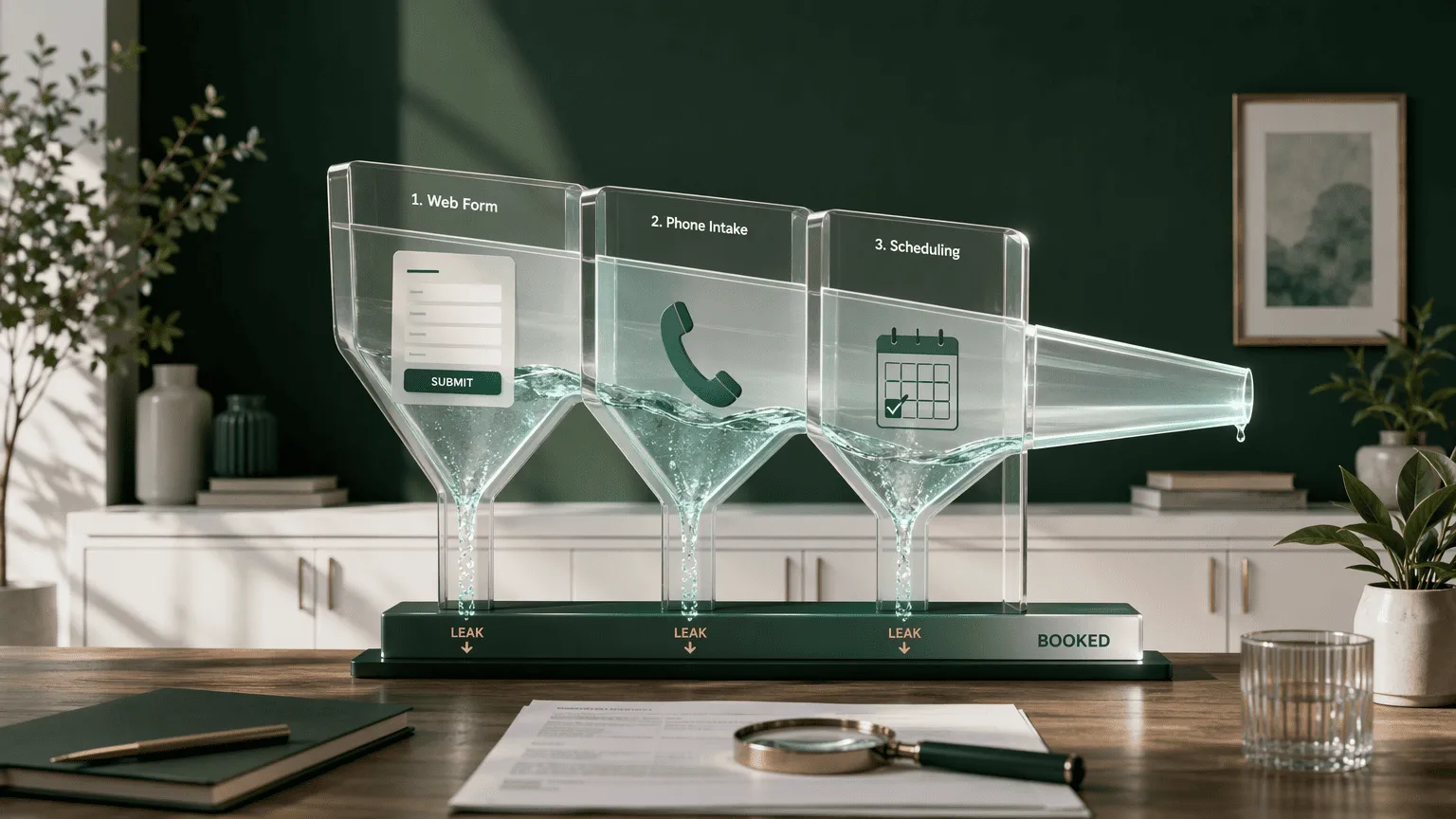
Medspa Market Pro enters the engagement through a different door: they audit your existing GLP-1 booking infrastructure before proposing any retainer. No upfront commitment. The commercial logic is straightforward. If your website leaks consultations at the form, your phone team mishandles GLP-1 intake questions, or your scheduling tool cannot differentiate an injectable consult from a weight-loss medical evaluation, no amount of ad spend fixes it.
Their methodology isolates three conversion bottlenecks. First, on-page friction: form length, mobile load speed, and where disclaimers sit on the page. Second, phone-handling gaps, using dynamic number insertion to track how calls stack up against scripted GLP-1 inquiry protocols. Third, platform-specific abandonment, comparing Meta lead-form drop-off rates against Google click-to-call completion.
The approach diverges hard from traditional agency pitching. Standard agencies lead with creative decks and channel allocation slides. Medspa Market Pro leads with a loss-recovery report that quantifies the revenue already walking out the door. This aligns incentives: the agency earns the retainer only after demonstrating the fixable gap. For GLP-1 programs, where consultation value is higher than aesthetic treatments, a booking leak of even three to five patients per month translates to significant annualized revenue erosion.
Their conversion tracking architecture ties online booking behavior directly to realized appointment revenue. You see which campaigns produce paying patients. The framework draws on online scheduling behavior research that maps how healthcare consumers abandon booking flows at specific friction points.
The single risk is speed. An audit-first model trades launch velocity for diagnostic precision.
If your GLP-1 program is sitting on idle capacity right now, a four-week audit before first campaign activation might feel slow. But for clinics that have already burned budget on underperforming campaigns, the delay is cheaper than another quarter of wasted ad spend.
4. Cardinal Digital Marketing, Healthcare compliance-driven paid media for GLP-1s
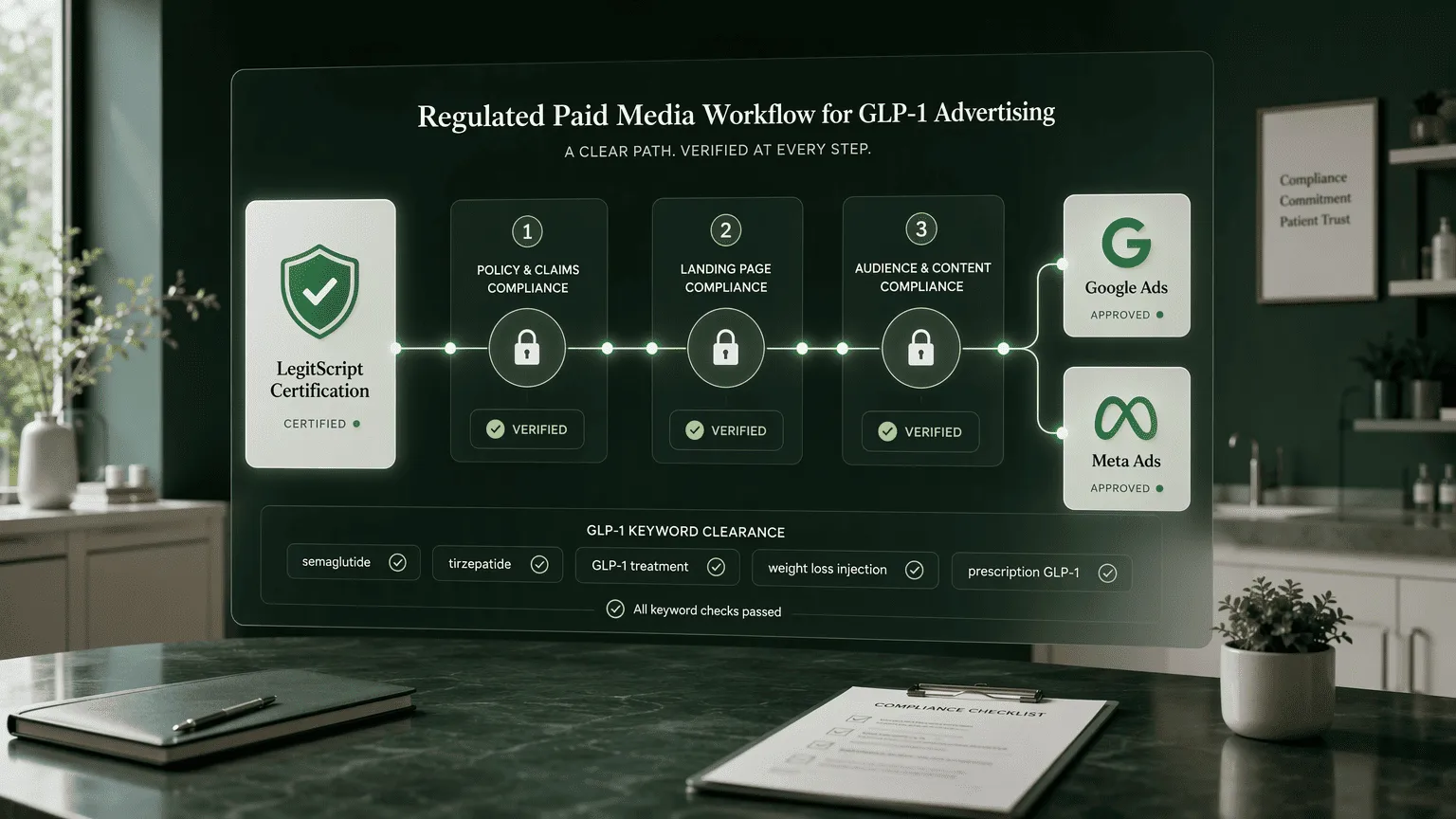
Cardinal Digital Marketing solves the narrowest and most expensive GLP-1 marketing problem: paid search and social within regulated pharmaceutical advertising environments. Google and Meta treat weight-loss advertising with escalating skepticism. LegitScript certification is required to run Google Ads for many aesthetic treatments, and GLP-1-related keywords face additional algorithmic flagging that generic med spa terms never encounter.
Cardinal's framework operates inside these constraints rather than against them. Compliant ad copy is built from condition-aware language (targeting treatment-seeking behavior, not efficacy claims), landing pages layer mandatory disclaimers without killing conversion rate, and audience targeting excludes protected health-condition segments while still reaching GLP-1-intent populations. Their approach matters specifically because the FTC's NextMed settlement demonstrated that fake testimonials and unsubstantiated weight-loss claims now reliably trigger enforcement action, not just platform disapproval. For med spa owners, the cost of a paid-media compliance failure is not a suspended ad account. It is a consent order requiring refunds plus years of compliance monitoring.
5. iMatrix, AI-visible content and GEO strategy for med spa GLP-1 programs

iMatrix addresses a channel most med spa operators have not yet priced into their 2026 marketing plan: generative engine optimization. When a prospective GLP-1 patient asks an AI search tool about side effects, candidacy, or program cost, your clinic's content either surfaces as an authoritative answer or does not exist. Here is how their GLP-1 content architecture builds that visibility.
- Medical entity schema markup: Structured data that signals GLP-1 treatment pages, provider credentials, and condition relationships to AI-generated search results and voice assistants, making your content extractable as answer snippets.
- Educational content depth: Long-form, medically reviewed GLP-1 content structured for question-answering engines, covering mechanism, protocol timelines, eligibility criteria, and cost transparency without making prohibited efficacy promises.
- GEO-to-booking bridge: Content paths that move a patient from an AI-answered
6. RUNNER Agency, Full-funnel lead generation tied to GLP-1 appointment revenue
RUNNER Agency ties marketing spend directly to booked GLP-1 appointments and realized revenue. Their top-of-funnel activity runs through compliant lead-generation channels calibrated to GLP-1 intent signals rather than broad aesthetic audiences.
Middle-funnel architecture is the differentiator. Lead nurturing sequences deliver educational content on GLP-1 protocols, medication management expectations, and program commitment requirements. This pre-qualifies patients before a consultation slot is ever occupied, reducing the no-show rate that plagues weight-loss funnel economics.
Bottom-funnel attribution is where the agency earns its fee. Revenue tracking ties individual patient acquisition cost to program lifetime value, giving owner-operators a defensible P&L line for their GLP-1 spend. For clinics where marketing ROI has historically been a black box, RUNNER's model shifts the conversation from lead volume to revenue cost per acquired patient.
7. Patient Now, CRM-anchored marketing for long-term GLP-1 patient journeys

Patient Now treats the GLP-1 patient relationship as a subscription, not a transaction. Their marketing infrastructure is anchored to the practice's own CRM, which fundamentally changes campaign logic.
Where a standard agency burns budget reactivating patients through paid channels, Patient Now pulls first-party data to automate refill reminders, follow-up visit prompts, and educational drip sequences that keep a GLP-1 patient engaged across a multi-month protocol. This drops re-acquisition cost dramatically.
The approach acknowledges a structural reality that aesthetic marketing rarely has to address: compounded GLP-1s are not FDA-approved, and medication management requires ongoing provider oversight. Marketing automation built on HIPAA-compliant patient data enables clinical re-engagement without the regulatory risk of cold-retargeting a prescription-drug audience on Meta.
The retention architecture extends beyond reminders. Campaigns promote long-term health outcome content aligned with CMS's recognition that GLP-1s have the potential to improve long-term health by preventing chronic diseases. For med spa owners, this patient-relationship layer is the mechanism that converts a short-term weight-loss program into a durable clinic revenue stream.
Conclusion
Your GLP-1 agency selection is a compliance decision before it is a marketing decision. The agencies on this list sort into four operating models, each matched to a different owner risk profile.
Compliance-first operators like Clinads and Cardinal Digital Marketing protect against the FDA's escalating enforcement cadence, which now includes formal action against compounding marketers. Data-and-audit models like Wowbix and Medspa Market Pro favor owners who need transparent KPIs and budget certainty before committing.
iMatrix and Patient Now build long-duration patient relationships through content and retention infrastructure respectively. RUNNER Agency ties the full funnel to revenue attribution.
When you request proposals, demand three deliverables: the agency's GLP-1 claim-review protocol, a consultation-to-revenue tracking framework, and evidence they understand that compounded drugs carry labeling restrictions general aesthetic campaigns never face. Any agency that cannot produce all three is selling creative wraps on a compliance risk you are carrying alone.
Frequently Asked Questions
What should a med spa look for when choosing a marketing agency for its GLP-1 program?
When vetting agencies, prioritize these compliance credentials:
- Pre-approved claim libraries: Ensure the agency maintains libraries mapped to FDA and FTC enforcement patterns.
- FDA/FTC monitoring protocols: Verify they have active processes to track regulatory changes and warning letters.
- Pharmaceutical ad restrictions experience: Confirm they know how to navigate Google and Meta rules for weight-loss keywords.
- GLP-1 claim-review process: Request their exact workflow for auditing copy against agency warning-letter language.
- Consultation-to-revenue attribution framework: Ask how they tie online booking to actual appointment revenue.
- Platform compliance evidence: Look for LegitScript certification or similar proof of adherence to pharmaceutical advertising policies.
General aesthetic experience does not transfer to regulated prescription-drug marketing.
Which US agencies have a proven track record marketing GLP-1 weight loss programs specifically for med spas?
Key differentiators among leading GLP-1 marketing agencies:
- Clinads and Cardinal Digital Marketing operate compliance-first GLP-1 frameworks.
- Wowbix reports a 45% consultation uplift within four months for healthcare clients.
- Medspa Market Pro audits GLP-1 booking funnels before proposing retainers.
- Patient Now focuses on retention.
- RUNNER Agency focuses on full-funnel revenue attribution.
What are the key regulatory and compliance challenges in advertising GLP-1s that a specialized agency must handle?
GLP-1 marketing carries distinct regulatory risks that every med spa owner must understand:
- Warning letters: The FDA sent 30 warning letters to telehealth firms over misleading GLP-1 claims.
- Enforcement actions: The FTC finalized a $150,000 consumer-refund order against NextMed.
- Drug status: Compounded drugs are not FDA-approved.
- Copy restrictions: Agencies must avoid efficacy claims.
- Disclaimers: Compliant disclaimers are required.
- Platform rules: Navigate Google and Meta pharmaceutical ad restrictions.
- Content structure: Educational content must not advertise unapproved drug products.
How much does it typically cost to hire a specialized agency for med spa GLP-1 marketing in 2026?
Pricing models vary significantly across GLP-1 marketing agencies:
- Wowbix publishes a starting price of $1,500/month.
- Medspa Market Pro begins with an audit-first model and no mandatory upfront retainer, charging only after demonstrating fixable booking gaps.
- Agencies that charge a percentage of ad spend rather than a flat fee should be flagged as a potential red flag.
- Compliance infrastructure and GLP-1-specific frameworks typically command a premium over general aesthetic retainers.
What specific ROI metrics or KPIs do these agencies use to demonstrate success with GLP-1 campaigns for med spas?
The single metric that matters for a medspa marketing agency is consultations booked and the revenue they generate. GLP-1 campaigns require extended attribution modeling (60- to 90-day decision cycles), patient-acquisition-cost-to-lifetime-value ratios, and conversion tracking that ties online scheduling behavior directly to realized appointment revenue, not just impressions or leads.
How do med spa GLP-1 marketing strategies differ from marketing other aesthetic services like Botox or lasers?
GLP-1 marketing faces pharmaceutical advertising restrictions that aesthetic treatments do not. Compounded drugs are not FDA-approved, so copy must avoid efficacy claims and emphasize medical oversight, eligibility, and program access. The patient journey is a long-term subscription requiring retention architecture, refill reminders, and re-engagement sequences instead of the one-and-done conversion model that works for injectables and lasers.
Sources
- Med Spa Marketing Agency: AI Ad Creative | ClinAds - getclinads.com
- Best MedSpa Marketing Agencies in 2026 (Honest Reviews) - medspamarketpro.com
- Med Spa SEO Pricing 2026 - Healthcare Marketing Agency - healthcare.wowbix.com
- FDA Warns 30 Telehealth Companies Against Illegal Marketing of Compounded GLP-1s | FDA - www.fda.gov
- Innovation Insight: Affordability of GLP-1s Takes Next Step with BALANCE Model RFAs | CMS - www.cms.gov
- FTC Approves Final Order against Telehealth Provider NextMed Over Charges It Used Deceptive Advertising Claims to Sell GLP-1 Weight-Loss Programs | Federal Trade Commission - www.ftc.gov
Want help executing this for your clinic?
Book a 30-minute call and we will map what a real ad engine would look like for your specific service mix.
Book a call