
Semaglutide Marketing Agencies: Compare Your Options
Summary: Clinics seeking a semaglutide marketing agency can compare Progression Agency, Advernation, Target Patients MD, and Fill The Lobby. Progression and Target Patients MD focus on GLP-1 or medical weight-loss marketing; Advernation combines med-spa marketing with SEO, while Fill The Lobby includes GLP-1 in broader healthcare marketing. Choose based on local visibility, accurate patient education, and tracking calls or consultation requests.
A clinic comparing marketing partners needs more than a polished pitch. Ask how each team would explain your services, make your practice easier to find, and help staff distinguish a general inquiry from an appointment request. Do not assume that a declared specialty demonstrates reliable delivery or that a generalist cannot handle the work.
Hiring a semaglutide marketing agency means dealing with a practical operating problem: can the team demonstrate a plan for local discovery, clear patient-facing information, and useful reporting? Evaluate those tasks against your clinic's approved service information, intake process, and budget rather than relying on predictions about patient volume.
Practices comparing agency options need visible proof where prospective patients do their research before they pick up the phone. Google describes updates to link and source visibility in its AI search experiences. Treat source visibility as something to inspect during an agency demonstration, not as evidence that an agency can guarantee citations, local rankings, or qualified inquiries.
How to read this agency comparison
This is a comparison of public service positioning and questions to use during vendor evaluation, not an independently tested performance ranking. Agency order does not establish relative quality, and a listed specialty does not prove results for your clinic. The agency pages linked below support the descriptions of their advertised focus; the evaluation advice is a framework for checking fit, not a report of campaigns we ran.
ClinAds publishes this article and is also mentioned in the discussion of marketing platforms. Apply the same evidence requirements to that offering as to the other candidates. This comparison does not establish a winner on price, patient acquisition cost, clinical expertise, or return on advertising spend.
Use the same brief when requesting proposals so that differences in scope are visible:
- GLP-1-focused brief: Ask Progression Agency and Target Patients MD to show how their advertised focus would translate into your approved service pages, educational content, and reporting.
- Med-spa brief: Ask Advernation whether the proposed work specifically includes your weight-management service and how it would fit the existing service menu.
- Broader healthcare brief: Ask Fill The Lobby how it would allocate work between weight management and the other services in your practice.
- Comparable evidence: Request a relevant sample, an explanation of who produced it, and the limits of any result shown. Do not compare a selected success story with another candidate's untested forecast.
1. Progression Agency: GLP-1 and medical weight-loss focus
Progression Agency GLP-1 marketing describes a GLP-1 marketing offering. That makes it a candidate to evaluate if your clinic wants semaglutide addressed as a distinct service rather than folded into a general aesthetics campaign.
Before judging fit, give the agency your approved service details, consultation fees, and intake process. Ask it to explain how its proposed pages would address patient questions while keeping medical eligibility decisions with the clinic. A specialty label is a starting point for that discussion, not proof of clinical expertise or campaign performance.
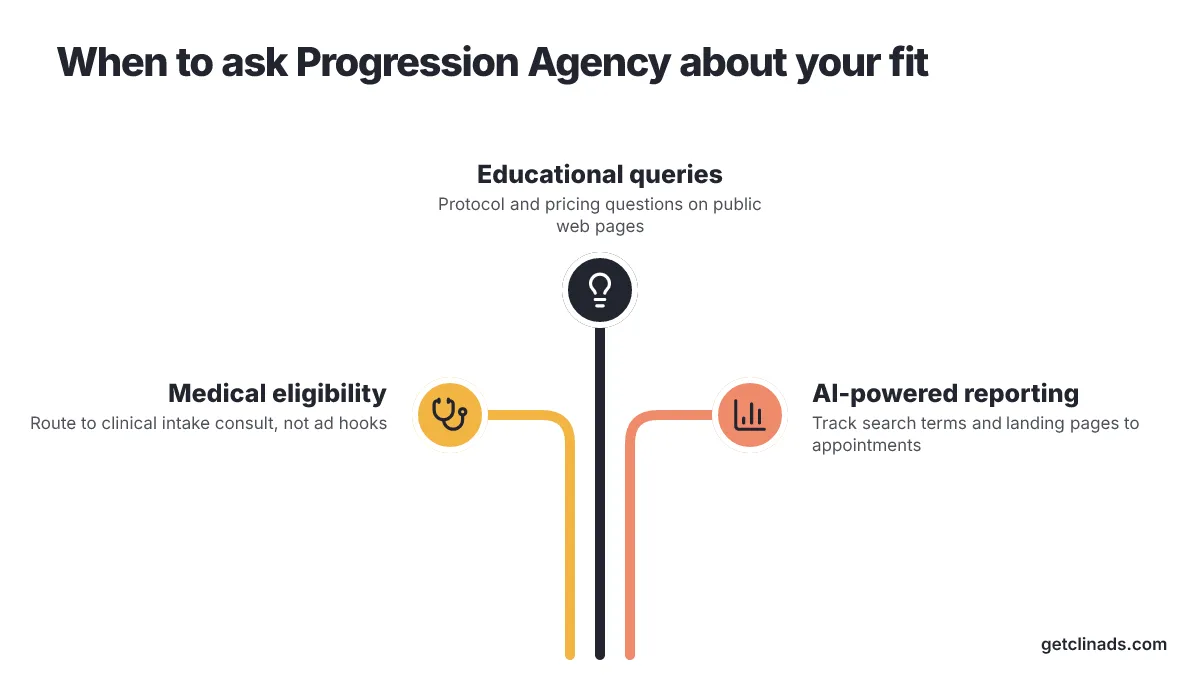
Prospective clients should ask Progression Agency to show how their campaigns handle educational queries instead of relying only on transactional squeeze pages. Google describes unified AI Max reporting across search terms and landing pages, including the queries that triggered ads, the creative shown, and the destination pages. Ask the agency to distinguish that advertising report from your clinic's separate records of booked and attended appointments.
A useful vetting step is to hand the agency the recurring questions your front office hears and ask where each one belongs in the marketing plan. Basic questions about protocols and pricing belong on public web pages, while individual medical eligibility concerns should route to a clinical intake consult rather than an aggressive ad hook. A declared specialty in GLP-1 marketing gives you a solid basis for demanding that distinction during onboarding.
2. Advernation: med-spa marketing with SEO
Advernation med-spa marketing describes marketing and SEO services for medical spas. Consider that positioning if your practice wants to discuss semaglutide alongside an existing aesthetic service menu.
Ask whether the proposed scope covers your weight-management service specifically, rather than assuming that med-spa experience demonstrates experience with prescription-treatment campaigns. Request examples of local service pages, business-profile work, and the approval process for patient-facing copy. Evaluate the examples against your clinic's needs instead of treating an agency's service list as a prediction of search visibility.
Practice managers need to check how the agency handles the line between promotional aesthetics and medical treatment descriptions. Google describes AI-generated ad disclosures and tools for labeling AI-generated advertising content. Ask the agency to identify the current requirements that apply to your planned assets and to explain who checks them before publication. Keep that platform-policy check separate from the clinic's review of medical statements.
Review their plan for organizing semaglutide landing assets alongside standard aesthetic services. That review shows whether the agency provides a structured intake funnel for medical weight loss or simply groups it with non-prescriptive cosmetic treatments. Practice leadership can then decide whether to run an independent semaglutide funnel or an integrated med-spa campaign with a dedicated weight-loss track.
3. Target Patients MD: GLP-1 provider marketing
Target Patients MD GLP providers presents a medical weight-loss marketing offering for GLP-1 providers. Evaluate it if you want to discuss patient acquisition for that service, and ask for evidence of how the proposed work would be measured rather than assuming that its positioning establishes results.
Ask Target Patients MD how it would separate educational queries from requests to arrange a clinical evaluation. Use your own front-office questions to test its proposed landing-page structure, including how it would present costs and route medical questions to qualified staff. Request relevant examples rather than assuming that search interest automatically becomes attended appointments.
Take a close look at their sample reporting packages. For your comparison, distinguish impressions and clicks from answered inquiries, submitted forms, booked consultations, and attended appointments. Ask which of those stages the agency can actually report; an inquiry is not the same as revenue. You risk running blind if an agency cannot point to the exact neighborhood pages, ad angles, and copy changes that produced verified appointment requests.
Set clear baseline numbers before you sign any contract.
Casual traffic on a website is very different from a patient who sits down for an intake review. Your performance dashboard has to split passive website visits from booked appointments, and the agency should be able to walk you through an anonymized reporting example and explain its limits. Ask them to trace each incoming call and web lead back to the search term and landing page that brought it in.
4. Fill The Lobby: healthcare marketing with GLP-1 listed
Fill The Lobby healthcare marketing lists weight loss and GLP-1 among a broader set of healthcare specialties. That positioning makes it a candidate to evaluate when your practice wants to discuss weight management alongside other services.
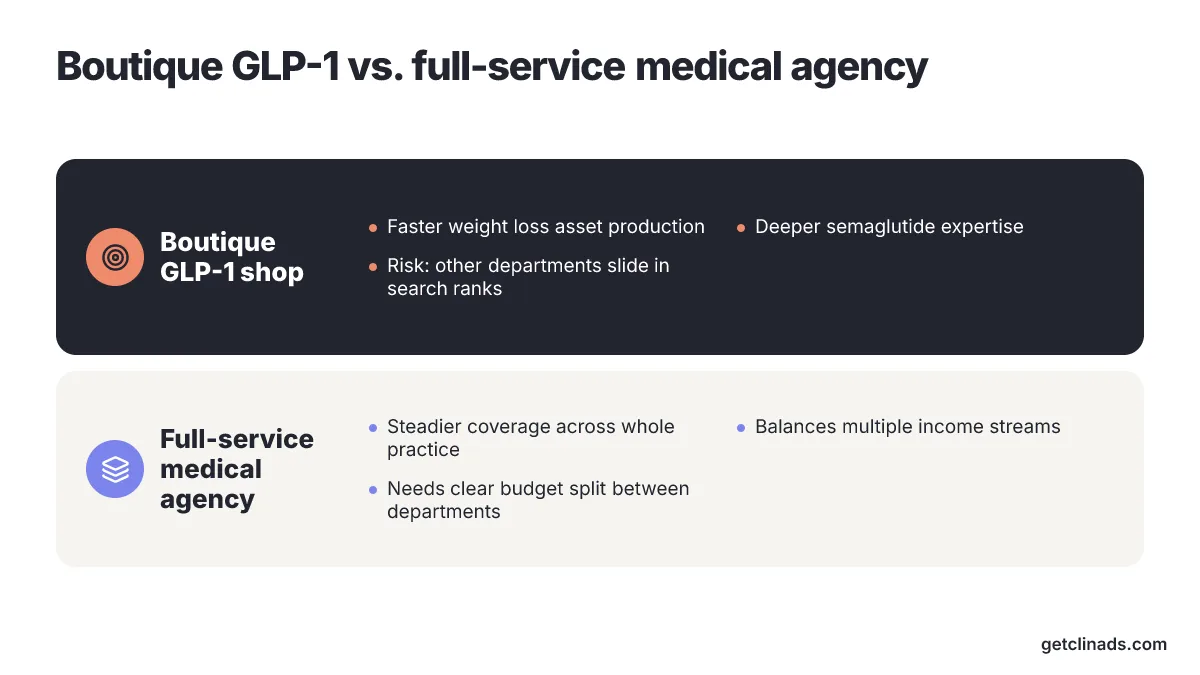
Ask how the agency would divide the proposed scope across departments, who would approve each service page, and how reports would distinguish the work for each service. A broad healthcare offering does not by itself establish that your other departments will receive attention or that semaglutide will have a dedicated campaign.
Check how the agency divides billable hours and ad spend between your different departments. Ask for a service-by-service allocation before approving the creative budget. Do not assume that a specialist produces assets faster or that a full-service agency delivers steadier coverage. Request the proposed responsibilities, approval dependencies, and reporting plan from each candidate so you can compare the actual scope rather than the agency category.
Study the proposed onboarding and delivery schedule, including which tasks depend on access, approvals, or information from your clinic.
If the plan sends the entire advertising and writing budget into GLP-1 campaigns, ask what work remains in scope for your other practice areas; budget allocation alone does not establish what will happen to their search rankings. If their plan barely mentions weight loss, ask them directly how your semaglutide service will win search traffic without dedicated assets built for it.
Graphic evidence note: The illustration above presents possible comparison questions, not demonstrated differences in delivery speed, expertise, or ranking outcomes. Use documented proposals and relevant evidence to evaluate those points; the diagram is not proof that an agency category performs better.
How should a clinic choose a semaglutide marketing partner?
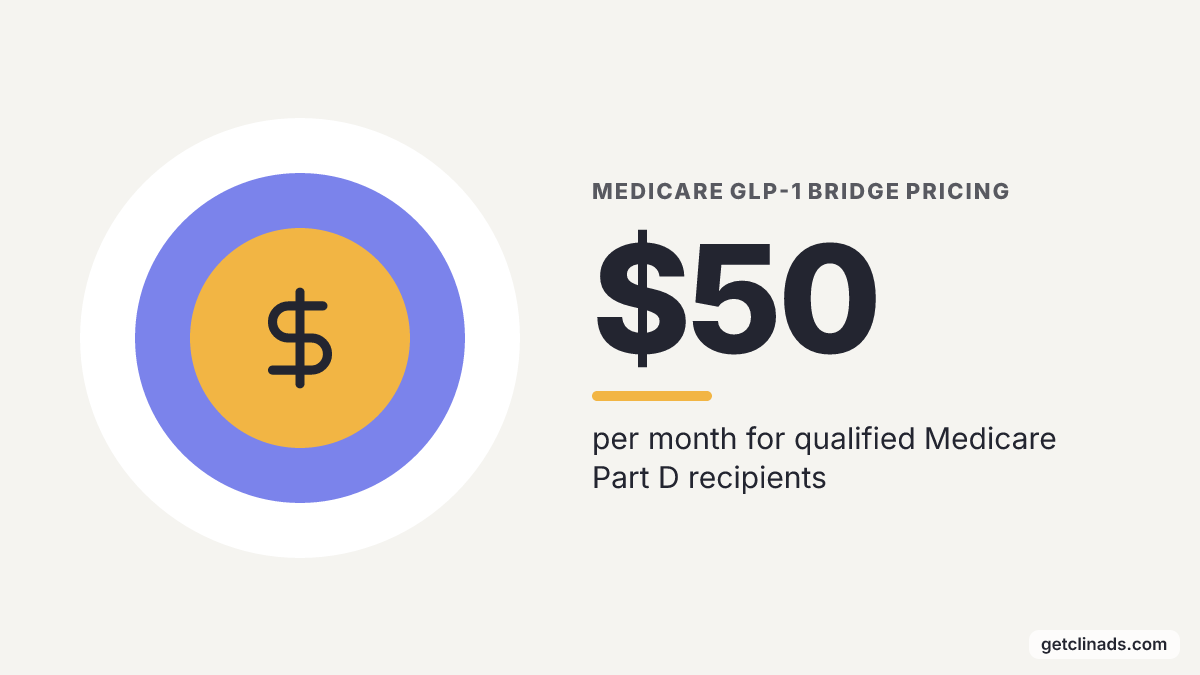
Compare documented scope, clinical approval, and appointment reporting rather than a predicted outcome. For the coverage graphic in this section, refer to the CMS Medicare GLP-1 Bridge announcement and its eligibility limits; do not present that program's price as a general clinic offer.
Pick an agency that can show local search placement, accurate clinical copy, and appointment tracking before you agree to a multi-month retainer. Do not infer suitability from a specialist label alone: ask any candidate to demonstrate its understanding of your approved services, campaign restrictions, and intake process.
Ask each agency candidate for a live audit. They should show where your practice appears when a nearby resident searches for semaglutide on Google Maps, and what an AI assistant suggests for regional medical weight loss. Google's description of AI Mode and AI Overviews provides context for checking the links shown in AI search experiences. Ask the agency to demonstrate what it sees and to separate an observed search result from a prediction about patient acquisition.
Skip slide decks and request an unscripted look at your digital footprint. Have the agency search your practice name, treatment terms, and a relevant regional competitor. Record the query, location context, and observed result so that a later comparison is meaningful; do not treat a selected screenshot as proof of consistent visibility or a lost patient.
Ask for plain detail on the physical marketing assets the agency plans to produce each week. A workable semaglutide strategy needs dedicated treatment pages, clear educational articles, active directory management, review generation, targeted search creative, and qualification funnels. A dependable partner will name the weekly deliverables and the review turnaround before asking for a signature.
ClinAds presents its AI-powered marketing team for clinics as a marketing platform. When comparing it with an agency retainer, verify which website, SEO, content, advertising, and reporting tasks are included in the current scope. Ask for the same evidence of delivery and measurement you would request from the other candidates; do not assume lower costs, unlimited production, or recommendations inside AI answers.
Multi-clinic organizations need a different operating setup than a single boutique location. For a multi-site comparison, ask how the proposed scope handles local pages, provider information, review workflows, and office-level reporting. The site's marketing for DSO groups is a related example for dental organizations, not proof that a vendor has experience promoting semaglutide across medical locations.
Interview every prospective agency using these targeted questions:
- Which clinical pages will you update or publish before any ad spend starts?
- How do you measure visibility across local map packs and conversational AI engines?
- What internal workflow checks medication copy before it goes live?
- Can you show how search intent, ad assets, and landing page URLs appear in unified dashboards?
- What number of educational articles and ad variations will you launch each week?
- What system gets inbound calls and consult submissions to the front desk quickly?
Google's AI Brief and reporting features describe a view of search terms, creative assets, and landing destinations. Ask which features are available in the proposed account and what information is missing from the report. Require the agency to explain how advertising data would be reconciled with your appointment records rather than presenting an ad click as completed business.
When evaluating a proposal, check how the agency would keep coverage and pricing explanations aligned with the program it cites. The Centers for Medicare & Medicaid Services says eligible Medicare beneficiaries may get certain GLP-1 medications for $50 per month through the Medicare GLP-1 Bridge. That statement concerns a specific program and eligible beneficiaries; it is not a general price for a clinic's semaglutide services.
A clinic offering these therapies needs web copy that separates insurance-covered programs from direct cash-pay packages. That level of clarity matters only when your clinic participates in those plans and serves the qualifying demographic. Ask the agency to distinguish federal coverage programs from your in-house self-pay plans, and have a clinical director approve every insurance-related line before it goes out. Marketing materials should never leave self-pay patients thinking federal subsidies apply in every clinical case.
Regulatory compliance stays a strict operational priority. For the agency interview, request the source behind any statement about FDA enforcement, medication sourcing, or permission to advertise a particular treatment. Ask who checks that the cited guidance actually applies to the product, audience, location, and advertising channel in the proposed campaign. Clinics planning promotional content should ask who checks medication claims and sourcing language, especially when a campaign mentions compounds described as not for human consumption.
Require the clinic's review before ad collateral or treatment pages go live. Ask the reviewer to identify unresolved sourcing or advertising questions rather than letting an agency's creative approval stand in for clinical or legal sign-off.
If your clinic has not settled its medical sourcing, consultation costs, clinical evaluation steps, and legal compliance reviews, stop the agency search for now. Before approving spend, check whether staff can answer the questions the campaign invites and whether the landing page matches the approved intake process. Resolve conflicting messages before treating additional inquiries as a useful outcome.
Inbound capacity has to be solved alongside agency selection. Clincy treatment coordination presents itself as an AI treatment coordinator for dental practices. Do not assume that dental treatment-coordination software provides medical intake, eligibility screening, insurance collection, or practice-management integrations; verify the actual scope separately. Dental and medical administrators should keep patient generation separate from patient intake: marketing agencies create interest, while dedicated intake software captures and organizes clinical records after the patient reaches out.
Handling initial demand by hand is often the right move if your practice is still testing whether semaglutide fits the local market. Consider whether your team can maintain an approved service page, business-profile information, a review workflow, and a manageable advertising test before taking on an outside retainer. Decide which tasks genuinely require outside help and what evidence would justify the cost. That exercise gives you a concrete brief for comparing systematic publishing, local visibility work, creative production, and conversion reporting.
What belongs in a comparable agency proposal?
A useful proposal should make scope, ownership, approvals, reporting, and exit terms explicit so your clinic can compare what it is actually buying. Request these details in writing rather than inferring them from a specialty label or a sample dashboard.
- Scope and exclusions: Ask which pages, campaigns, content tasks, and reporting activities are included. Distinguish agency fees from advertising spend, software charges, and optional work without assuming a standard market price.
- Account and asset ownership: Confirm who controls the website, domain, business profiles, advertising accounts, creative files, and reporting access. Ask what your clinic keeps if the engagement ends.
- Approval responsibility: Identify who supplies approved treatment information, who checks medical and insurance statements, and what happens when an asset needs correction. Request an approval record rather than relying on a verbal assurance.
- Measurement definitions: Agree on the meaning of an inquiry, a booked consultation, and an attended appointment. Ask how duplicate inquiries, missed calls, and unavailable attribution would be labeled instead of allowing them to inflate reported results.
- Access and privacy: Ask what information each marketing tool receives and who approves access to clinic systems. Request a demonstration using anonymized examples rather than asking an agency to expose another client's account or identifiable patient records.
- Delivery and exit terms: Review the proposed schedule, clinic dependencies, cancellation process, handover duties, and any commitment period in the actual contract. Compare those terms against your operating needs rather than treating a forecast as a promise.
Keep a short decision record for each candidate: the evidence supplied, unanswered questions, scope exclusions, and the reason the proposal does or does not fit. If a claim cannot be documented, leave it out of your decision rather than filling the gap with an assumed result.
Make the agency shortlist evidence-led
Check your clinic's presence on Google Maps for local semaglutide queries and prompt major AI engines to recommend weight-loss providers in your immediate zip code. Your initial paid discovery should focus on auditing these discovery pathways, evaluating your service content, and auditing your intake forms rather than buying a generic package of social media assets.
Agree on the access a semaglutide marketing partner actually needs to your web management system, business profiles, and review workflows, and identify a qualified clinical staff member to sign off on treatment copy. Use clinic-approved access controls rather than assuming every vendor needs unrestricted access. If an agency cannot explain the exact content they will deliver, how your rankings will be tracked, and how consultation appointments tie directly back to campaign assets, pause the discussion and evaluate other providers.
Frequently Asked Questions
Which semaglutide marketing agency is suited to a clinic focused on GLP-1 treatments?
Progression Agency and Target Patients MD both describe GLP-1 marketing offerings, so they are candidates to evaluate for that brief. Their positioning does not establish which will perform better for your clinic. Compare their proposed handling of educational questions, approved treatment information, intake readiness, reporting, and clinical review rather than assuming that a declared specialty proves results.
Which agency fits a med spa that offers semaglutide alongside aesthetic services?
Advernation describes med-spa marketing and SEO services, making it a candidate to assess for a practice with an aesthetic service menu. Confirm whether the proposed scope includes your semaglutide service and how treatment copy would be approved. Ask whether it would build a dedicated weight-loss track or integrate that work into the broader med-spa campaign, and request relevant examples.
How does Fill The Lobby approach semaglutide marketing differently from a GLP-1-focused agency?
Fill The Lobby lists weight loss and GLP-1 alongside other healthcare specialties. Evaluate that broader positioning if your brief covers several departments, but ask how much work is actually allocated to each service. Do not infer faster delivery from a specialist label or steadier coverage from a generalist label; compare proposed responsibilities, approvals, reporting, and delivery schedules.
What should a clinic ask a semaglutide marketing agency before hiring it?
Ask the agency to show local search visibility, explain how it handles accurate clinical copy, and demonstrate appointment tracking. You can also provide common front-office questions and ask where each belongs in the marketing plan. Public pages can address basic protocol and pricing questions, while individual medical eligibility concerns should lead to a clinical intake consult rather than an aggressive advertising hook.
What results should a semaglutide marketing agency track?
The article recommends tracking answered phone inquiries, submitted intake forms, and verified appointment requests rather than relying on impressions or click counts. A useful dashboard distinguishes passive website visits from booked appointments. Ask the agency to trace calls and web leads back to the search term and landing page that generated them, and to explain which copy changes or ad angles produced requests.
Related reading
Sources
- Progression Agency
- Advernation
- Target Patients MD
- Fill The Lobby
- Google: AI Search adds more inline links and source context
- Google: AI Max adds reporting and expands AI Brief
Want help executing this for your clinic?
Book a 30-minute call and we will map what a real ad engine would look like for your specific service mix.
Book a call